|
 |
 |
 |
 |
| |
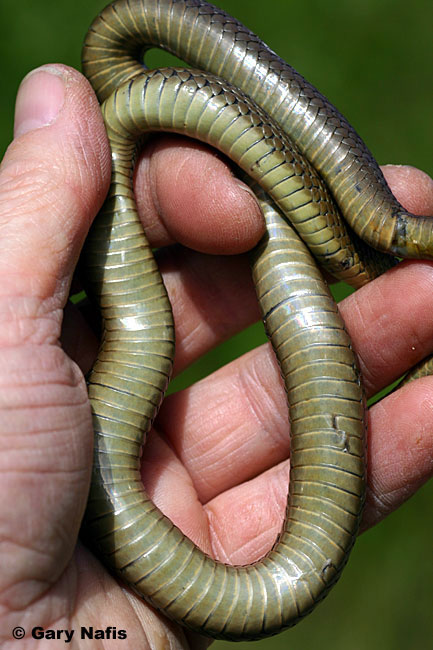
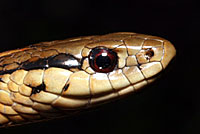
Adult, Del Norte County |
|
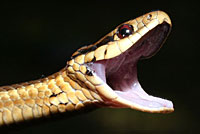
Adult, Del Norte County,
with head flattened defensively |
 |
 |
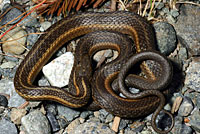 |
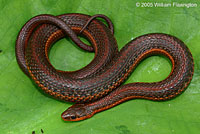 |
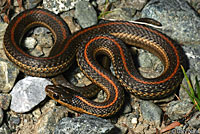
| Red-striped adult, Del Norte County |
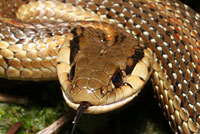
Adult, Del Norte County |
Adult, Del Norte County |
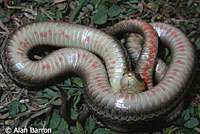
Red adult, Del Norte County
© William Flaxington |
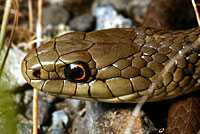 |
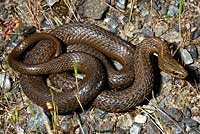 |
 |
 |
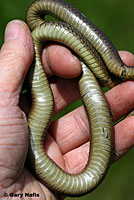
| Brown adult, Del Norte County |
Striped Adult, Humboldt County |
 |
 |
 |
 |
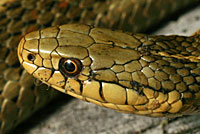
| Striped Adult, Humboldt County |
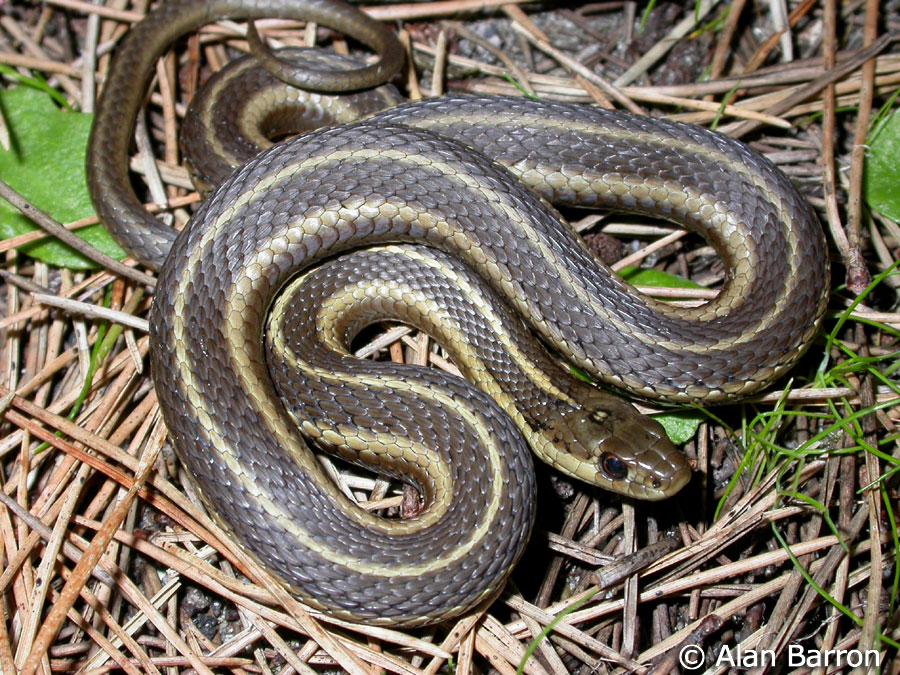
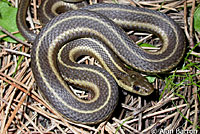
Striped Adult, Del Norte County
© Alan Barron |
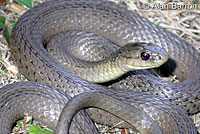
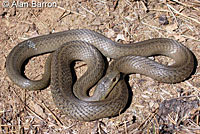
Nearly patternless adult,
Del Norte County © Alan Barron |
 |
 |
 |
 |
Nearly patternless adult,
Del Norte County © Alan Barron |
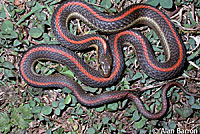
Red-striped adult, Del Norte County © Alan Barron |
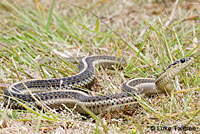
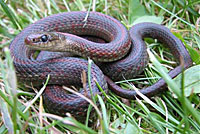
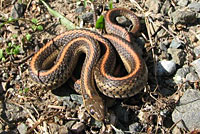
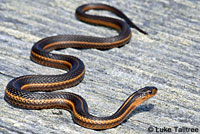
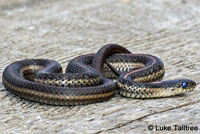
Adult, Del Norte County © Luke Talltree |
 |
 |
 |
 |
Adult, Del Norte County
© Steven Krause
|
Adult, Del Norte County
© Steven Krause |
Adult, Del Norte County
© Luke Talltree |
Adult, Del Norte County
© Luke Talltree |
| |
|
|
|
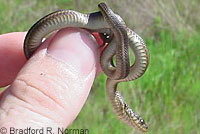
| Juveniles |
 |
|
|
|
| Juvenile from Korbel, Humboldt County © Bradrord R. Norman |
|
|
|
| |
|
|
|
| Northwestern Gartersnakes From Outside of California |
 |
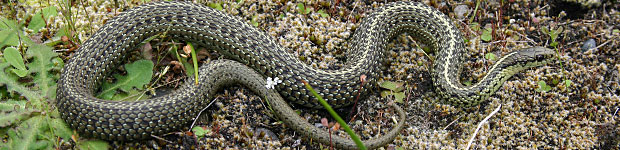
| Adult, Thurston County, Washington |
 |
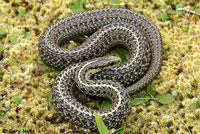 |
| Adult, Thurston County, Washington |
 |
 |
 |
 |
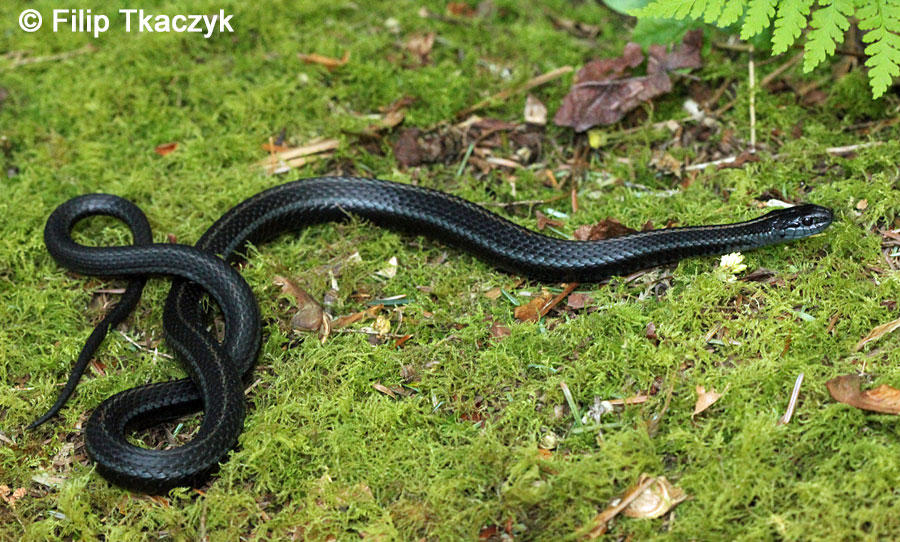
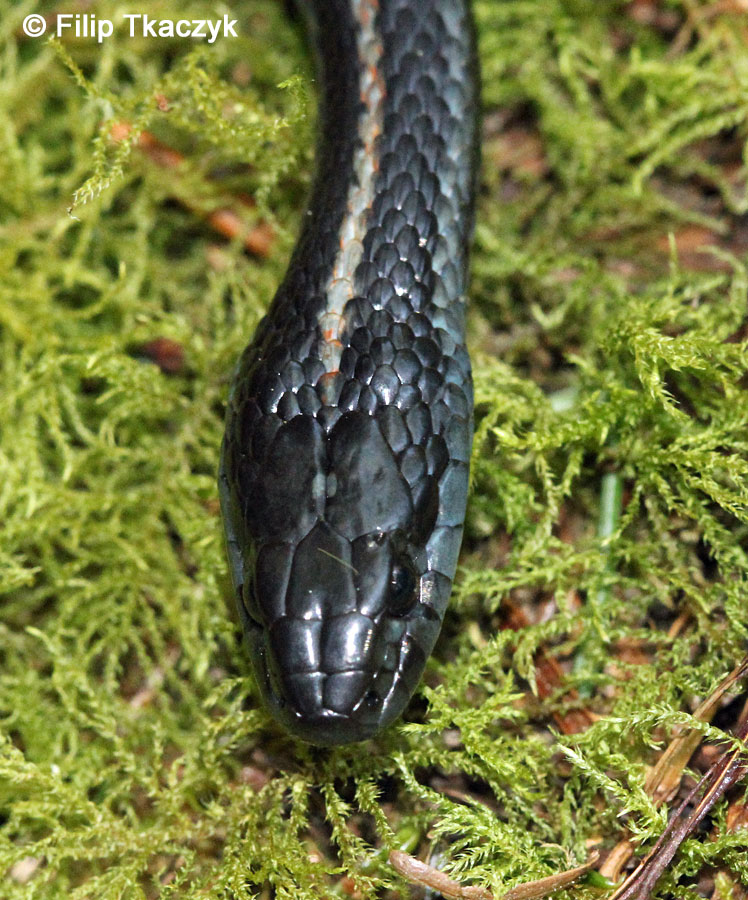
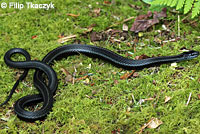
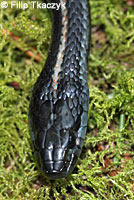
| Melanistic blue-striped adult from King County, Washington © Filip Tkaczyk |
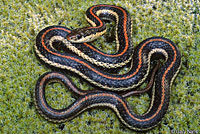
Red-striped adult,
Hood River County, Oregon |
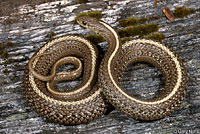
Single-striped adult,
Multnomah County, Oregon |
 |
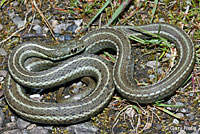 |
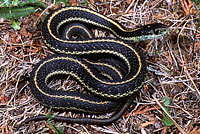 |
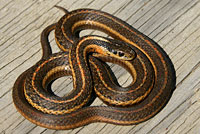 |
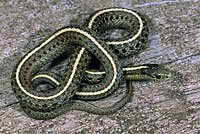
Single-striped sub-adult,
Multnomah County, Oregon |
Sub-adult, Thurston County, Washington |
Adult with gold stripe,
King County, Washington |
Adult, Kittitas County, Washington. |
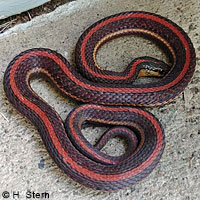 |
 |
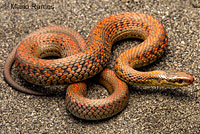 |
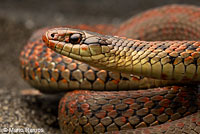 |
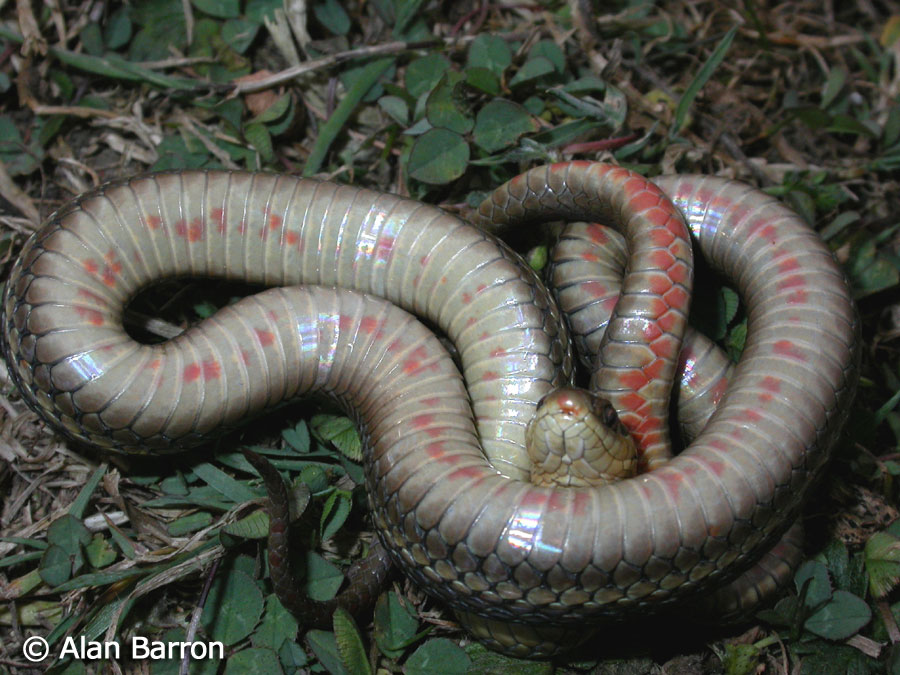
| This adult from Pierce County, Washington, is colored with red all over, including the underside. © H. Stern |
Stripe-less adult, northeast Clallam County, Washington © Mario Ramos |
More pictures of this snake and its natural habitat outside of California
are available on the Northwest Herps page.
|
| |
|
|
|
| Identification Tip |
| |
 |
|
|
| |
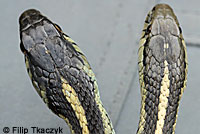
Looking at the top of the heads can help to identify these sympatric species on the north coast:
T. sirtalis - Common Gartersnake (Left) has a larger longer head with bigger eyes than T. ordinoides - Northwestern Gartersnake (Right.)
© Filip Tkaczyk
California Gartersnakes Identification Key |
|
|
| |
|
|
|
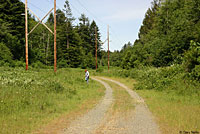
| Habitat |
 |
 |
 |
 |
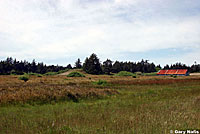
| Habitat, Del Norte County |
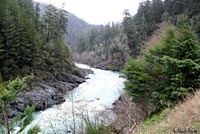
Habitat, Humboldt County |
Habitat, Del Norte County |
Habitat, Del Norte County |
| |
|
|
|
| Short Videos |
 |
 |
|
|
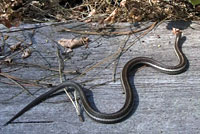
A Northwestern Gartersnake
on the move. |
Common Sharp-tailed Snakes are found under objects in Washington State, and two of the flips also turn up Northwestern Gartersnakes with the sharp-tails. |
|
|
|
|
|
|
|
Description |
Not Dangerous - This snake may produce a mild venom that does not typically cause death or serious illness or injury in most humans, but its bite should be avoided.
Commonly described as "harmless" or "not poisonous" to indicate that its bite is not dangerous, but "not venomous" is more accurate since the venom is not dangerous. (A poisonous snake can hurt you if you eat it. A venomous snake can hurt you if it bites you.)
Long-considered non-venomous, discoveries in the early 2000s revealed that gartersnakes produce a mild venom that can be harmful to small prey but is not considered dangerous to most humans, although a bite may cause slight irritation and swelling around the puncture wound. Enlarged teeth at the rear of the mouth are thought to help spread the venom.
|
| Size |
A fairly small gartersnake - 13 - 38 inches long ( 33 - 96 cm), averaging 12 - 24 inches (30 - 61 cm).
Neonates are about 6 inches (15 cm).
|
| Appearance |
A medium-sized snake with a head barely wider than the neck and keeled dorsal scales.
The head is relatively small compared to other California gartersnakes.
|
| Color and Pattern |
Highly variable in color in pattern.
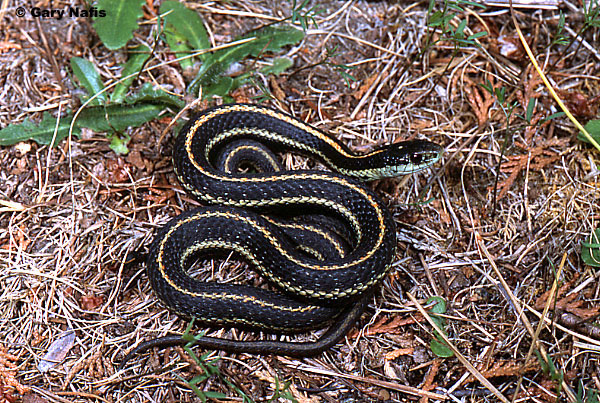
Typically there is a wide and distinct dorsal stripe, but sometimes the stripe is narrow, very dull in color, or absent.
The color of this stripe can be red, orange, gold, yellow, greenish, blue, white, or tan.
There are usually stripes along the lower sides, but these, too, may be absent on some individuals.
These stripes also vary in color from yellow, to tan, to whitish.
The ground color is blackish, olive, brownish, bluish, or gray, sometimes with a reddish tint, or reddish specks, and there are typically two rows of alternating dark spots, which may be partly obscured by a very dark ground color.
The underside is yellowish, brown, gray, or black, often with dark spots or red specks.
Completely red, unstriped snakes occur in the Siskiyou Mountains of extreme northwestern California [the county is not mentioned, but this is most likely Del Norte County]. (St. John, 2002.)
Melanistic individuals are sometimes found. |
Key to Identifying California Gartersnake Species
|
| Life History and Behavior |
Activity |
Active in the daytime.
Mostly terrestrial, escaping into vegetation not water when threatened. Capable of swimming, but not often found in water.
When first handled, often releases cloacal contents and musk, but rarely bites. In most areas, activity begins in March and ends in October, but this snake can sometimes be seen basking on sunny days in winter.
|
| Defense |
| Studies have shown that the escape behavior of this snake is determined by pattern: striped snakes will escape by crawling away, since the stripes make it difficult to determine the snake's speed, while spotted or plain snakes will crawl, suddenly change direction, then hold still, as their pattern tends to blend in with the background. (E. D. Brodie III) |
| Diet and Feeding |
Mostly slugs and earthworms, occasionally snails, and amphibians, possibly fish.
Three Northwestern Gartersnakes in Oregon and Washington were documented preying on non-native African nightcrawlers, introduced for fish bait, which were almost as long as two of the snakes that ate them. (Herpetological Review 38(4), 2007)
An unusual water-feeding population near PeaVine Lake in Del Norte Co. has been verified as eating Pacific Treefrog tadpoles and in the water of a nearby seep there is a record of one eating a torrent salamander (Bradford Norman, Herp Review 33(4) 2002.) |
| Reproduction |
Mating apparently occurs both in early spring, and early fall.
Females are ovoviviparous. After mating with a male they carry the eggs internally until the young are born live from July to September.
|
| Habitat |
Occurs in California mostly in the northern coastal fog belt in damp areas with lots of vegetation and open sunny areas, such as lowland thickets, meadows and forest clearings. Can be common hear human dwellings. Often found beneath boards and other surface cover.
|
| Geographical Range |
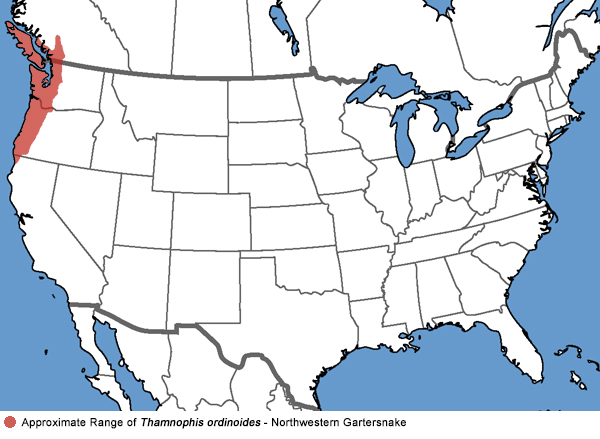
Ranges from Vancouver Island and southwest British Columbia south along the coast, chiefly west of the Cascade Mountains, through Washington and Oregon, south to northern Humboldt County, California.
Range in California
Found only along the extreme northwest coast of California in Del Norte and Humboldt counties.
Museum records from McKinleyville and Prairie Creek Redwoods State Park in Humboldt County along with other sight records suggest that the species should be present all along the coast north of there. Stebbins (1972) also states that the species occurs north of Mad River, Humboldt County.
I have also been told that this species has been seen on the Humboldt State University Campus in Arcata and a few miles east of there, at Bluff Creek in the Six Rivers National Forest and nearby in the extreme northerneast part of Humboldt County, above Weithipec, Humboldt County, and near Somes Bar and Ti Bar Creek in Siskiyou County.
|
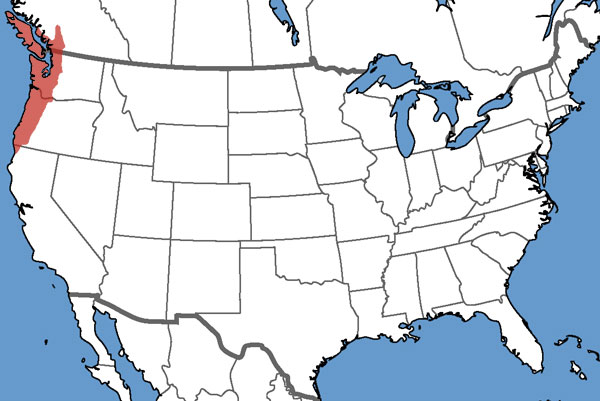 |
Range is shown in red
|
| Taxonomic Notes |
No subspecies are recognized, though there are geographic populations where one color morph is dominant.
Alternate and Previous Names (Synonyms)
Thamnophis ordinoides - Northwestern Gartersnake (Stebbins 1961, 1985, 2003, Stebbins & McGinnis 2012)
Thamnophis ordinoides ordinoides - Pacific Coast Garter Snake (Tropidonotus ordinoides; Eutaenia leptocephala; Eutaenia infernalis vidua; Eutainia atrata; Eutaenia elegans, part; Eutaenia infernalis, part; Eutaenia elegans ordinoides; Tropidonotus leptocephalus; Eutaenia sirtalis leptocephala; Eutaenia ordinoides; Thamnophis infernalis, part; Eutainia sirtalis elegans; Thamnophis leptocephala. Puget Garter Snake; Narrow-headed Garter Snake; Black Garter Snake; Boyd's Garter Snake, part) (Grinnell and Camp 1917)
Red-striped garter snake
Cooper's garter snake
Small-headed striped snake
Western garter snake
|
| Conservation Issues (Conservation Status) |
| There are no known serious threats to this species. |
|
| Taxonomy |
| Family |
Colubridae |
Colubrids |
Oppel, 1811 |
| Genus |
Thamnophis |
North American Gartersnakes |
Fitzinger, 1843 |
Species
|
ordinoides |
Northwestern Gartersnake |
(Baird and Girard, 1852) |
|
Original Description |
Thamnophis ordinoides - (Baird and Girard, 1852) - Proc. Acad. Nat. Sci. Philadelphia, Vol. 6, p. 176
from Original Description Citations for the Reptiles and Amphibians of North America © Ellin Beltz
|
|
Meaning of the Scientific Name |
Thamnophis - Greek - thamnos = shrub or bush + ophis = snake, serpent
ordinoides - similar to T. ordinatus - Baird and Girard compared this to a species now called T. sirtalis
from Scientific and Common Names of the Reptiles and Amphibians of North America - Explained © Ellin Beltz
|
|
Other California Gartersnakes |
T. a. atratus - Santa Cruz Gartersnake
T. a. hydrophilus - Oregon Gartersnake
T. a. zaxanthus - Diablo Range Gartersnake
T. couchii - Sierra Gartersnake
T. gigas - Giant Gartersnake
T. e. elegans - Mountain Gartersnake
T. e. terrestris - Coast Gartersnake
T. e. vagrans - Wandering Gartersnake
T. hammondii - Two-striped Gartersnake
T. m. marcianus - Marcy's Checkered Gartersnake
T. s. fitchi - Valley Gartersnake
T. s. infernalis - California Red-sided Gartersnake
T. s. tetrataenia - San Francisco Gartersnake
|
|
More Information and References |
California Department of Fish and Wildlife
Hansen, Robert W. and Shedd, Jackson D. California Amphibians and Reptiles. (Princeton Field Guides.) Princeton University Press, 2025.
Stebbins, Robert C., and McGinnis, Samuel M. Field Guide to Amphibians and Reptiles of California: Revised Edition (California Natural History Guides) University of California Press, 2012.
Stebbins, Robert C. California Amphibians and Reptiles. The University of California Press, 1972.
Flaxington, William C. Amphibians and Reptiles of California: Field Observations, Distribution, and Natural History. Fieldnotes Press, Anaheim, California, 2021.
Nicholson, K. E. (ed.). 2025. Scientific and Standard English Names of Amphibians and Reptiles of North America North of Mexico, with Comments Regarding Confidence in Our Understanding. Ninth Edition. Society for the Study of Amphibians and Reptiles. [SSAR] 87pp.
Samuel M. McGinnis and Robert C. Stebbins. Peterson Field Guide to Western Reptiles & Amphibians. 4th Edition. Houghton Mifflin Harcourt Publishing Company, 2018.
Stebbins, Robert C. A Field Guide to Western Reptiles and Amphibians. 3rd Edition. Houghton Mifflin Company, 2003.
Behler, John L., and F. Wayne King. The Audubon Society Field Guide to North American Reptiles and Amphibians. Alfred A. Knopf, 1992.
Robert Powell, Roger Conant, and Joseph T. Collins. Peterson Field Guide to Reptiles and Amphibians of Eastern and Central North America. Fourth Edition. Houghton Mifflin Harcourt, 2016.
Powell, Robert., Joseph T. Collins, and Errol D. Hooper Jr. A Key to Amphibians and Reptiles of the Continental United States and Canada. The University Press of Kansas, 1998.
Bartlett, R. D. & Patricia P. Bartlett. Guide and Reference to the Snakes of Western North America (North of Mexico) and Hawaii. University Press of Florida, 2009.
Bartlett, R. D. & Alan Tennant. Snakes of North America - Western Region. Gulf Publishing Co., 2000.
Brown, Philip R. A Field Guide to Snakes of California. Gulf Publishing Co., 1997.
Ernst, Carl H., Evelyn M. Ernst, & Robert M. Corker. Snakes of the United States and Canada. Smithsonian Institution Press, 2003.
Taylor, Emily. California Snakes and How to Find Them. Heyday, Berkeley, California. 2024.
Wright, Albert Hazen & Anna Allen Wright. Handbook of Snakes of the United States and Canada. Cornell University Press, 1957.
Rossman, Douglas A., Neil B, Ford, & Richard A. Siegel. The Garter Snakes - Evolution and Ecology. University of Oklahoma press, 1996.
Brown et. al. Reptiles of Washington and Oregon. Seattle Audubon Society,1995.
Nussbaum, R. A., E. D. Brodie Jr., and R. M. Storm. Amphibians and Reptiles of the Pacific Northwest. Moscow,
Idaho: University Press of Idaho, 1983.
St. John, Alan D. Reptiles of the Northwest: Alaska to California; Rockies to the Coast. 2nd Edition - Revised & Updated. Lone Pine Publishing, 2021.
Joseph Grinnell and Charles Lewis Camp. A Distributional List of the Amphibians and Reptiles of California. University of California Publications in Zoology Vol. 17, No. 10, pp. 127-208. July 11, 1917.
|
|
|
The following conservation status listings for this animal are taken from the July 2025 State of California Special Animals List and the July 2025 Federally Listed Endangered and Threatened Animals of California list (unless indicated otherwise below.) Both lists are produced by multiple agencies every year, and sometimes more than once per year, so the conservation status listing information found below might not be from the most recent lists, but they don't change a great deal from year to year.. To make sure you are seeing the most recent listings, go to this California Department of Fish and Wildlife web page where you can search for and download both lists:
https://www.wildlife.ca.gov/Data/CNDDB/Plants-and-Animals.
A detailed explanation of the meaning of the status listing symbols can be found at the beginning of the two lists. For quick reference, I have included them on my Special Status Information page.
If no status is listed here, the animal is not included on either list. This most likely indicates that there are no serious conservation concerns for the animal. To find out more about an animal's status you can also go to the NatureServe and IUCN websites to check their rankings.
Check the current California Department of Fish and Wildlife sport fishing regulations to find out if this animal can be legally pursued and handled or collected with possession of a current fishing license. You can also look at the summary of the sport fishing regulations as they apply only to reptiles and amphibians that has been made for this website.
This snake is not included on the Special Animals List, which indicates that there are no significant conservation concerns for it in California.
|
| Organization |
Status Listing |
Notes |
| NatureServe Global Ranking |
|
|
| NatureServe State Ranking |
|
|
| U.S. Endangered Species Act (ESA) |
None |
|
| California Endangered Species Act (CESA) |
None |
|
| California Department of Fish and Wildlife |
None |
|
| Bureau of Land Management |
None |
|
| USDA Forest Service |
None |
|
| IUCN |
|
|
|
|