|
 |
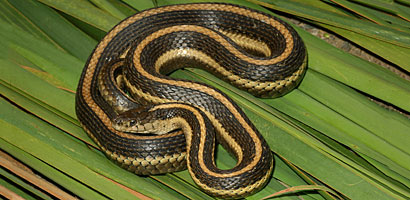 |
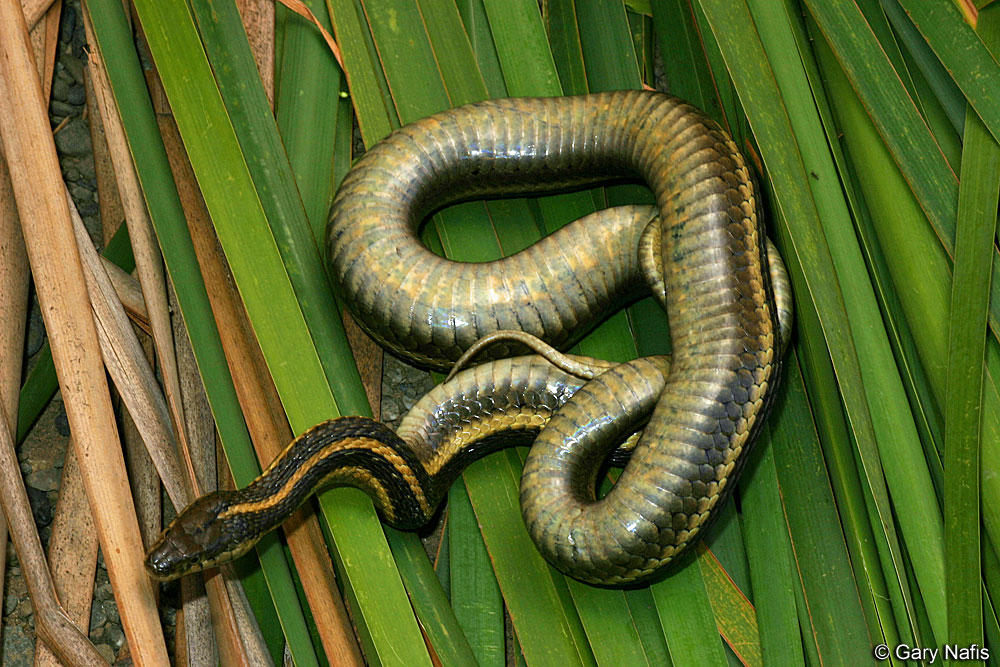
| Adult, Yolo County © Gary Nafis. Specimen courtesy of Glenn D. Wylie, USGS |
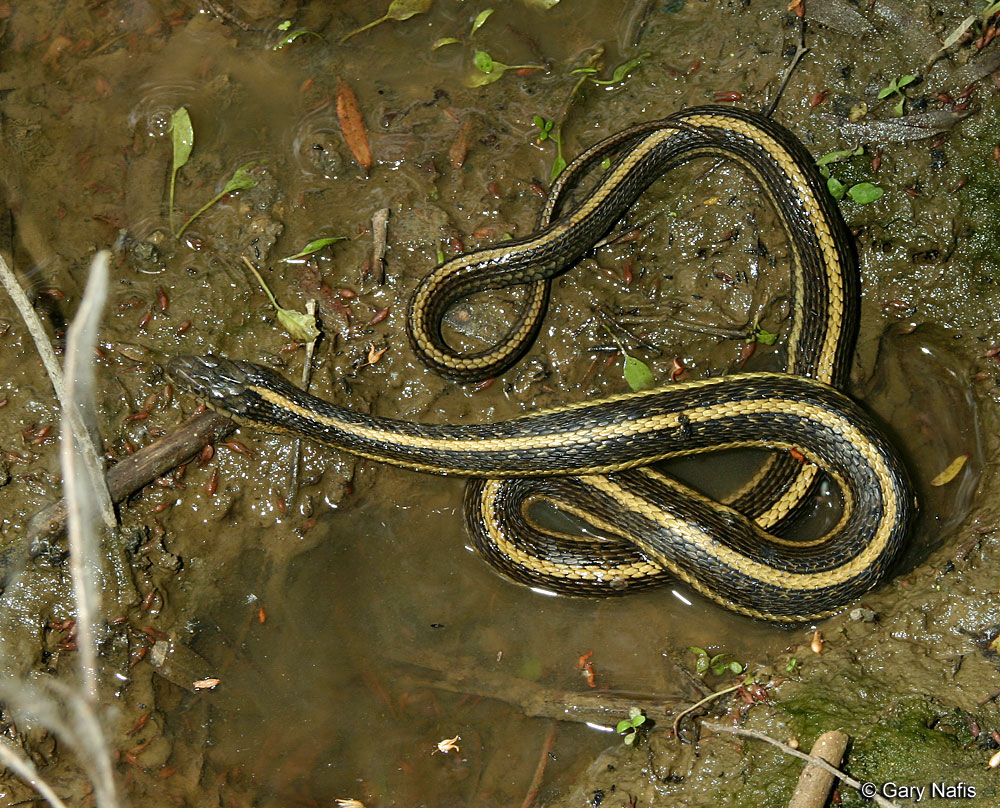
Adult, Yolo County © Gary Nafis. Specimen courtesy of Glenn D. Wylie, USGS |
 |
 |
 |
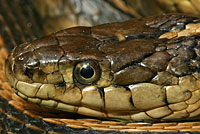 |
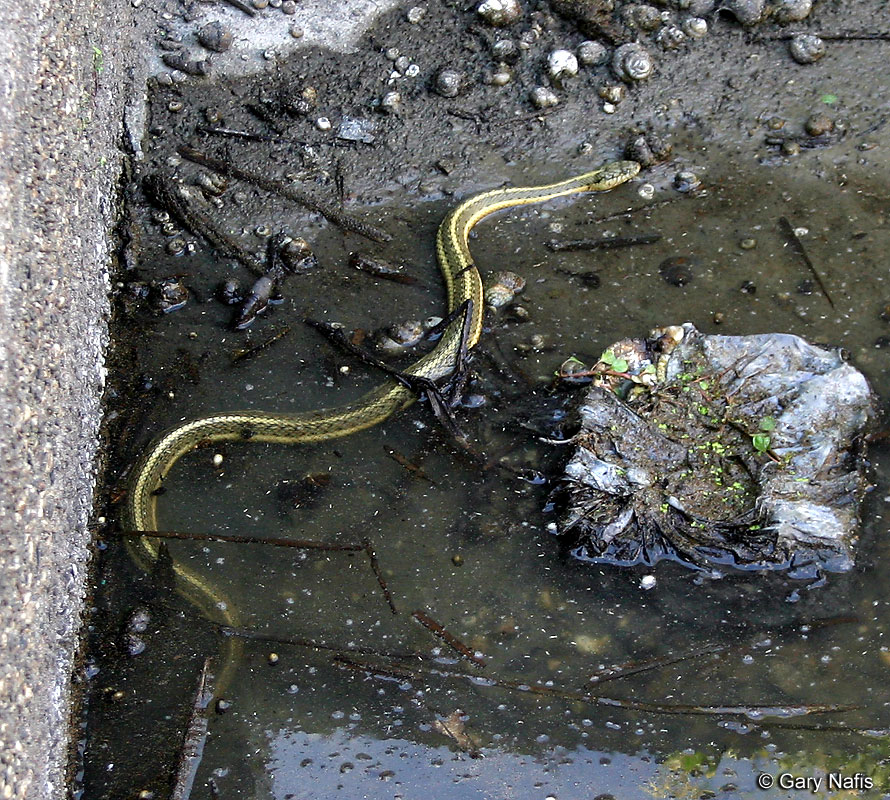
| Adult, Yolo County © Gary Nafis. Specimen courtesy of Glenn D. Wylie, USGS |
 |
 |
 |
 |
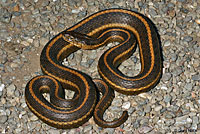
| Adult, Yolo County © Gary Nafis. Specimen courtesy of Glenn D. Wylie, USGS |
 |
 |
 |
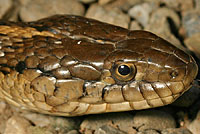 |
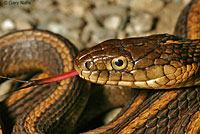
| Adult, Yolo County © Gary Nafis. Specimen courtesy of Glenn D. Wylie, USGS |
Adult, Sutter County © Richard Porter |
Adult, Sutter County © Richard Porter |
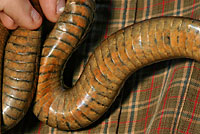
Adult, Yolo County © Gary Nafis. Specimen courtesy of Glenn D. Wylie, USGS |
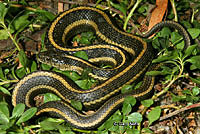 |
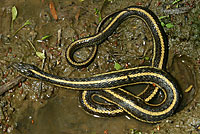 |
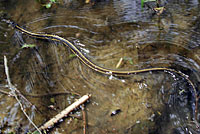 |
 |
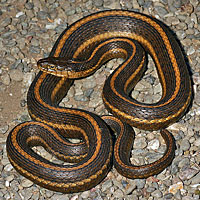
| Adult, Yolo County © Gary Nafis. Specimen courtesy of Patrick Viehoever & Becky, USGS |
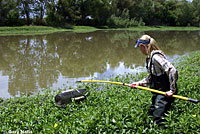
USGS researcher checking a trap
for a Giant Gartersnake study. |
 |
 |
 |
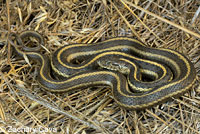 |
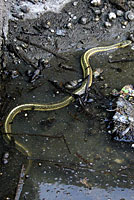
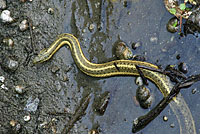
Adult, Yolo County © Gary Nafis.
specimen
courtesy of Glenn D. Wylie, USGS |
Adult, observed foraging in an agricultural conduit, Sacramento County |
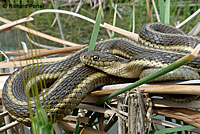
Adult, Sutter County
© Zachary Cava |
 |
 |
 |
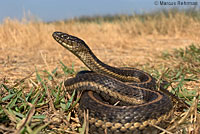 |
| Adult, Sutter County © Richard Porter |
Adult, Sacramento County
© Marcus Rehrman |
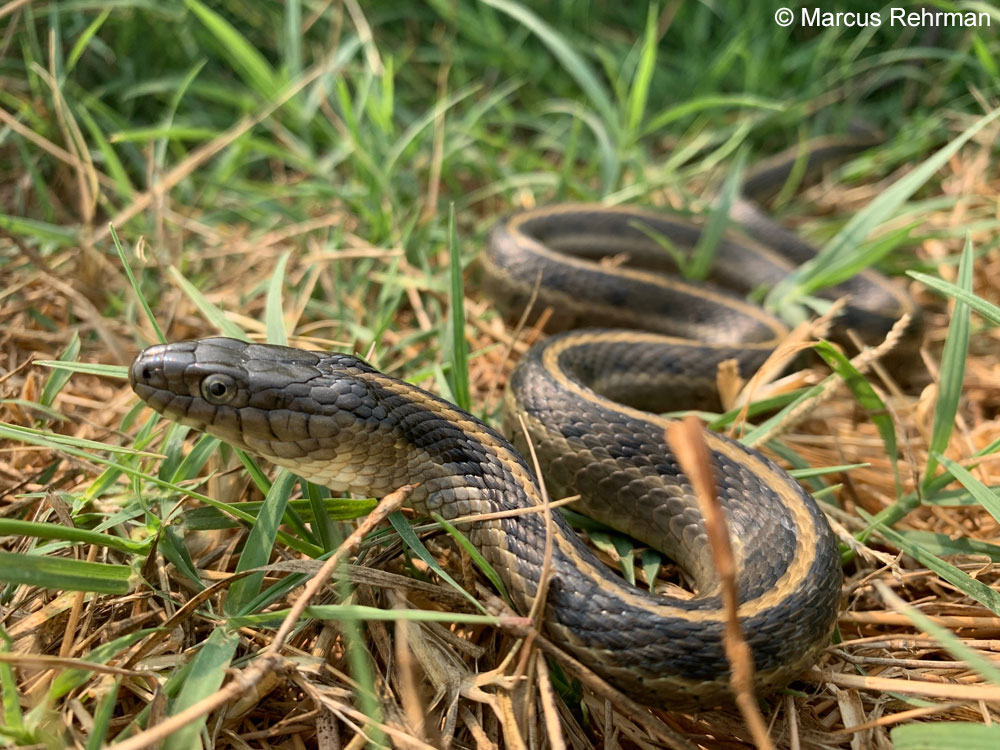
Adult, Sacramento County
© Marcus Rehrman |
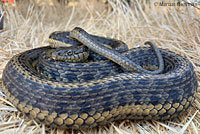 |
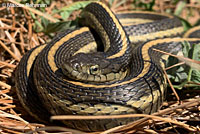 |
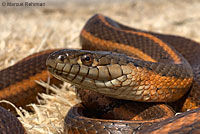 |
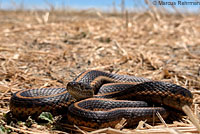 |
Adult, Sacramento County
© Marcus Rehrman |
Adult, Sacramento County
© Marcus Rehrman |
Adult, Sacramento County
© Marcus Rehrman |
Adult, Sacramento County
© Marcus Rehrman |
 |
 |
 |
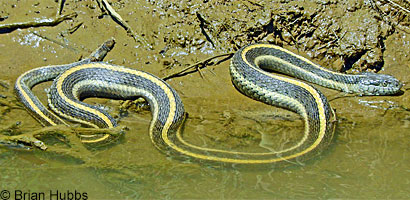
| Adult with damaged tail tip, Colusa County © Brian Hubbs |
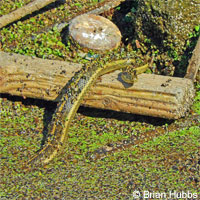
Adult, Sutter County © Brian Hubbs |
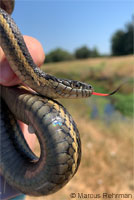
Adult, Sacramento County
© Marcus Rehrman |
| |
|
|
|
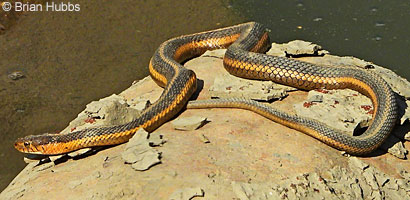
| Juveniles |
 |
 |
 |
| Reddish juvenile Sutter County © Brian Hubbs |
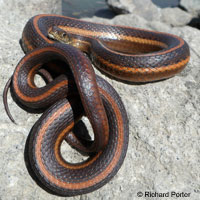
Sub-adult with red coloring, Sutter County. © Richard Porter |
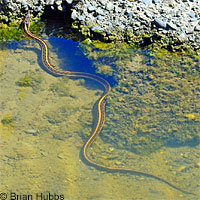
Juvenile in water Glenn County
© Brian Hubbs |
 |
|
|
|
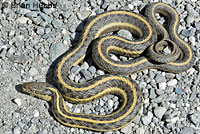
Juvenile, Colusa County
© Brian Hubbs |
|
|
|
| |
|
|
|
| Giant Gartersnakes Feeding |
 |
 |
 |
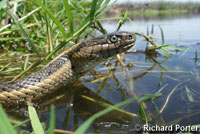 |
| These pictures show an adult Giant Gartersnake eating a sunfish, Sutter County © Richard Porter |
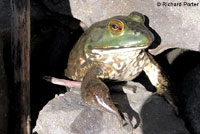 |
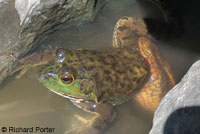 |
 |
|
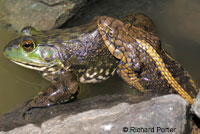 |
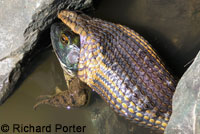 |
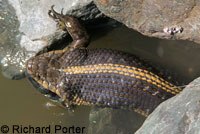 |
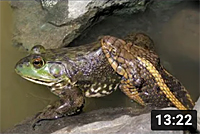 |
| These pictures show an adult Giant Gartersnake eating an adult female American Bullfrog in Sutter County. © Richard Porter |
Watch a YouTube video of this snake eating the bullfrog, that also shows another Giant Gartersnake and a Gophersnake. © Richard Porter |
 |
 |
|
|
Adult Giant Gartersnake eating an American Bullfrog in Sutter County
© Brian Hubbs |
|
|
| |
|
|
|
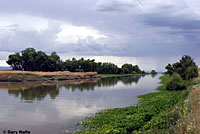
| Giant Gartersnake Habitat |
 |
 |
 |
 |
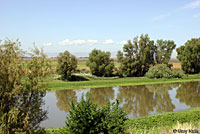
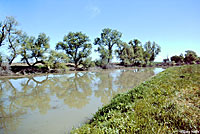
| Agricultural canal habitat, Yolo county |
Agricultural canal habitat, Yolo county |
Habitat, agricultural canal,
Sacramento County |
Habitat, agricultural canal in rice fields,
Sacramento County |
 |
 |
 |
 |
Riparian habitat, rice field,
Sacramento County |
Agricultural canal habitat, Yolo County |
Agricultural canal habitat, Sutter County
© Richard Porter |
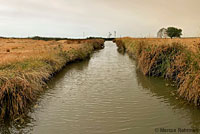
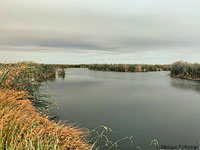
Habitat, Sacramento County
© Marcus Rehrman |
 |
 |
 |
|
Habitat, Sacramento County
© Marcus Rehrman |
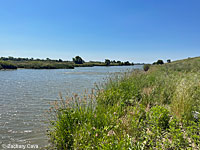
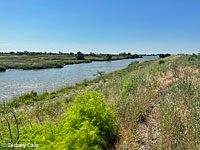
Habitat, a tidally influenced slough in the Solano County delta with fresh, not brackish water. © Zachary Cava |
|
|
|
|
|
|
Description |
Not Dangerous - This snake may produce a mild venom that does not typically cause death or serious illness or injury in most humans, but its bite should be avoided.
Commonly described as "harmless" or "not poisonous" to indicate that its bite is not dangerous, but "not venomous" is more accurate since the venom is not dangerous. (A poisonous snake can hurt you if you eat it. A venomous snake can hurt you if it bites you.)
Long-considered non-venomous, discoveries in the early 2000s revealed that gartersnakes produce a mild venom that can be harmful to small prey but is not considered dangerous to most humans, although a bite may cause slight irritation and swelling around the puncture wound. Enlarged teeth at the rear of the mouth are thought to help spread the venom.
|
| Size |
The largest species of gartersnake, adults from 36 - 65 inches long (91 - 165 cm). Snakes encountered are typically 36 - 48 inches in length (91 - 122 cm).
Neonates are 8.5 - 11.5 inches long (22 - 29cm).
|
| Appearance |
| A large snake with with keeled dorsal scales and a head slightly wider than the neck. |
| Color and Pattern |
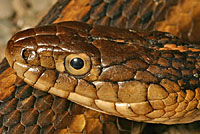
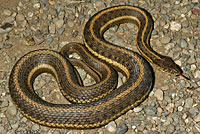
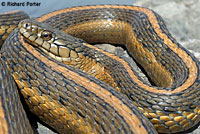
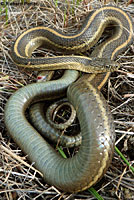
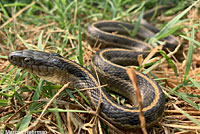
Ground color is brown or olive to black.
The underside is light brown or light grayish.
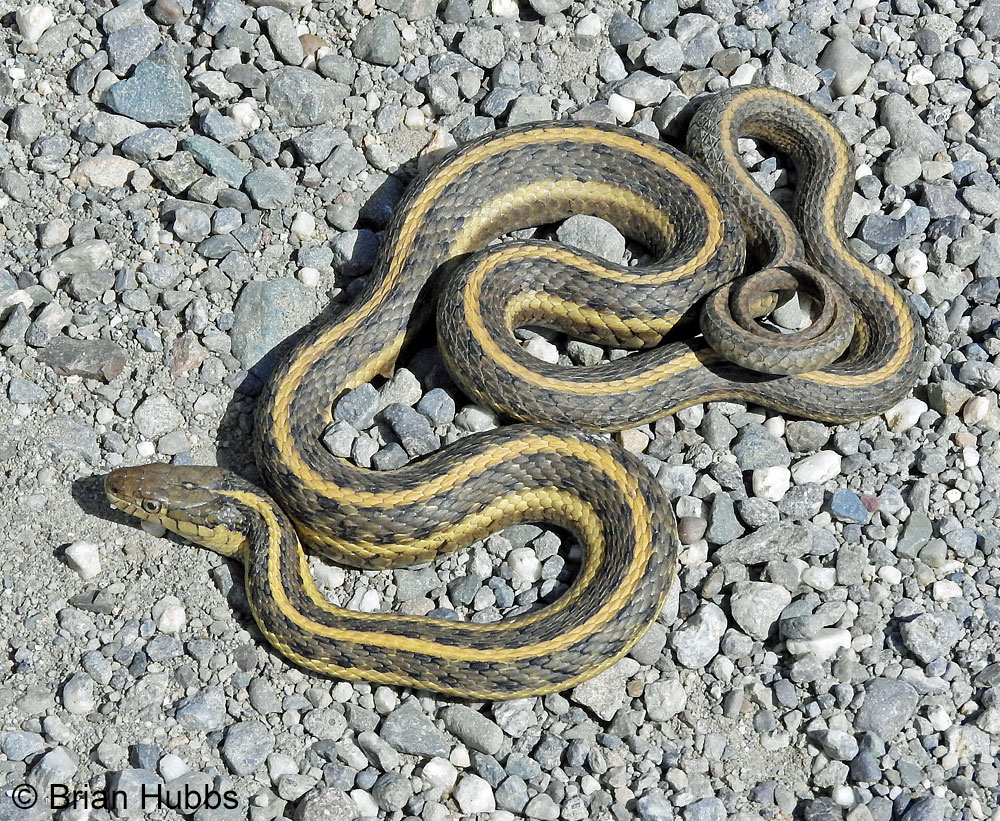
There is typically a yellowish dorsal stripe, a light yellowish stripe on each side, and two rows of dark blotches on the sides.
Snakes at the northern end of the range in the upper Sacramento Valley tend to have distinct stripes and a dark ground color.
Snakes in the San Joaquin Valley may also have indistinct stripes or no stripes, creating a checkered appearance.
|
Key to Identifying California Gartersnake Species
|
| Life History and Behavior |
Activity |
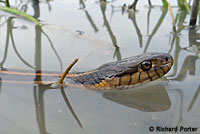
Highly aquatic.
Active during daylight, and at night in hot weather.
Secretive and difficult to approach, this snake will quickly drop into the water from its basking site and dive to the bottom before the observer can get close.
This behavior probably derives from the habitat of this snake which is often open and treeless and the presence of many airborne predators such as egrets, herons, and hawks.
Emerges from overwintering sites in March.
Basks on vegetation near water in spring, and utilizes animal burrows and vegetation piles during hotter weather.
Some snakes are active until October.
Overwinters in animal burrows.
|
| Defense |
| When threatened or picked up, this snake will release its cloacal contents and excrete a foul-smelling musk. |
| Diet and Feeding |
Feeds primarily on aquatic fish, frogs and tadpoles.
Historical prey has been extirpated in much of this snake's range, leaving it to consume introduced bullfrogs and introduced species of fish. Non-native species are probably now the predominant food items. |
| Reproduction |
Mating takes place soon after emergence in the Spring.
Females are ovoviviparous. After mating with a male they carry the eggs internally until the young are born live from July through early September.
Large litter sizes average about 23.
|
| Habitat |
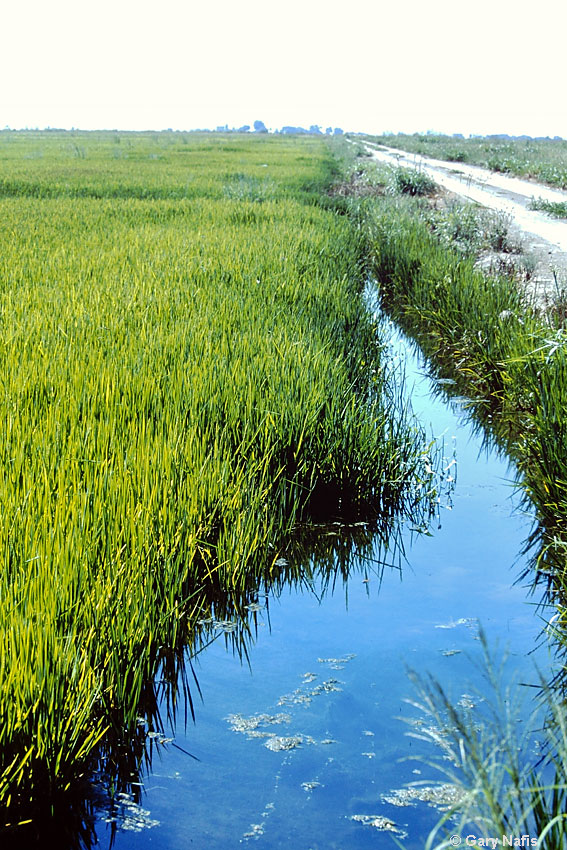
Found primarily in marshes, sloughs, drainage canals, and irrigation ditches, especially around rice fields, and occasionally in slow-moving creeks.
Prefers locations with vegetation close to the water for basking.
|
| Geographical Range |
Endemic to California.
Historically, this snake ranged from Kern County north along the Central Valley to Butte County, with a gap in the central part of the valley. Currently, ranges from Glenn County to the southern edge of the San Francisco Bay Delta, and from Merced County to northern Fresno County, apparently no longer occurring from south of northern Fresno County. |
 |
Approximate historic range shown in red. Current range is greatly reduced.
|
| Elevational Range |
From sea level to 400 ft. (122 m).
|
| Notes on Taxonomy |
Formerly classified as a subspecies of Thamnophis ordinoides, and later of Thamnophis couchii.
Recognized as a full species by Rossman and Stewart in 1987.
---------------------------------------------------------------------------------------------------------------------------------------------------------------------------------------------------------------------------"Wood et al. (2015, Conservation Genetics 16: 1025–1039) using microsatellite data identified lineages within this species."
(Nicholson, K. E. (ed.). 2025 SSAR Scientific and Standard English Names List)
-----------------------------------------------------------------------------------------------------------------------------------------------------------------------------------------------------------------------------
Alternate and Previous Names (Synonyms)
Thamnophis gigas - Giant Garter Snake (Stebbins, 2003, 2012)
Thamnophis couchii gigas - Giant Garter Snake (Stebbins, 1966, 1985)
Thamnophis elegans gigas (Stebbins 1954)
Thamnophis elegans gigas - Giant Garter Snake (Fitch, 1940)
Couch's garter snake
|
| Conservation Issues (Conservation Status) |
Apparently absent from an estimated 98 percent of former habitat in the San Joaquin Valley. Listed as a threatened species due to loss of habitat and introduced predatory fish. This snake's habitat has been destroyed and seriously fragmented largely due to the loss of or degradation of wetlands in the Central Valley due to an extensive system of dams in the Sierra Nevada Mountains, and dikes and draining for agriculture.
Protected waterfowl habitats in wildlife refuges are an important source of habitat for this snake, but they do not necessarily provide good habitat for this snake when they are flooded in winter and drained in summer, the opposite of this snake's needs, which resulted from the summer flooding of valley wetlands due to snow melt from the Sierra Nevada Mountains, and their drying up in winter. Rice fields and irrigation ditches, which are both flooded in summer, are now providing good habitat for this snake.
Pesticide and fertilizer runoff from agriculture are also responsible for killing some of this snake's prey, including native Red-legged frogs.
Grazing of vegetation along water sources also threatens this snake.
Introduced watersnakes (Nerodia) in the Folsom area could possibly threaten this snake if they were to spread downriver into the valley.
Increased water salinity due to declining groundwater levels in the central valleys are also a threat. It is not clear if the Giant Gartersnake is able to tolerate brackish water, but the fish and amphibians that are its major food source most likely cannot.
|
|
| Taxonomy |
| Family |
Colubridae |
Colubrids |
Oppel, 1811 |
| Genus |
Thamnophis |
North American Gartersnakes |
Fitzinger, 1843 |
Species
|
gigas |
Giant Gartersnake |
Fitch, 1940 |
|
Original Description |
Thamnophis gigas - Fitch, 1940 - Univ. California Publ. Zool., Vol. 44, p. 69
from Original Description Citations for the Reptiles and Amphibians of North America © Ellin Beltz
|
|
Meaning of the Scientific Name |
Thamnophis - Greek - thamnos = shrub or bush + ophis = snake, serpent
gigas - Latin = giant, immense - refers to the relatively large size of the species compared to other gartersnake species.
from Scientific and Common Names of the Reptiles and Amphibians of North America - Explained © Ellin Beltz
|
| Other California Gartersnakes |
T. a. atratus - Santa Cruz Gartersnake
T. a. hydrophilus - Oregon Gartersnake
T. a. zaxanthus - Diablo Range Gartersnake
T. couchii - Sierra Gartersnake
T. e. elegans - Mountain Gartersnake
T. e. terrestris - Coast Gartersnake
T. e. vagrans - Wandering Gartersnake
T. hammondii - Two-striped Gartersnake
T. m. marcianus - Marcy's Checkered Gartersnake
T. ordinoides - Northwestern Gartersnake
T. s. fitchi - Valley Gartersnake
T. s. infernalis - California Red-sided Gartersnake
T. s. tetrataenia - San Francisco Gartersnake
|
|
More Information and References |
California Department of Fish and Wildlife
Rossman, Douglas A., Neil B, Ford, & Richard A. Siegel. The Garter Snakes - Evolution and Ecology. University of Oklahoma press, 1996.
Thelander, C. G., ed. Life on the Edge: A Guide to California's Endangered Natural Resources Volume I: Wildlife.
Santa Cruz, California. Biosystems Books, 1994.
Hansen, Robert W. and Shedd, Jackson D. California Amphibians and Reptiles. (Princeton Field Guides.) Princeton University Press, 2025.
Stebbins, Robert C., and McGinnis, Samuel M. Field Guide to Amphibians and Reptiles of California: Revised Edition (California Natural History Guides) University of California Press, 2012.
Stebbins, Robert C. California Amphibians and Reptiles. The University of California Press, 1972.
Flaxington, William C. Amphibians and Reptiles of California: Field Observations, Distribution, and Natural History. Fieldnotes Press, Anaheim, California, 2021.
Nicholson, K. E. (ed.). 2025. Scientific and Standard English Names of Amphibians and Reptiles of North America North of Mexico, with Comments Regarding Confidence in Our Understanding. Ninth Edition. Society for the Study of Amphibians and Reptiles. [SSAR] 87pp.
Samuel M. McGinnis and Robert C. Stebbins. Peterson Field Guide to Western Reptiles & Amphibians. 4th Edition. Houghton Mifflin Harcourt Publishing Company, 2018.
Stebbins, Robert C. A Field Guide to Western Reptiles and Amphibians. 3rd Edition. Houghton Mifflin Company, 2003.
Behler, John L., and F. Wayne King. The Audubon Society Field Guide to North American Reptiles and Amphibians. Alfred A. Knopf, 1992.
Robert Powell, Roger Conant, and Joseph T. Collins. Peterson Field Guide to Reptiles and Amphibians of Eastern and Central North America. Fourth Edition. Houghton Mifflin Harcourt, 2016.
Powell, Robert., Joseph T. Collins, and Errol D. Hooper Jr. A Key to Amphibians and Reptiles of the Continental United States and Canada. The University Press of Kansas, 1998.
Bartlett, R. D. & Patricia P. Bartlett. Guide and Reference to the Snakes of Western North America (North of Mexico) and Hawaii. University Press of Florida, 2009.
Bartlett, R. D. & Alan Tennant. Snakes of North America - Western Region. Gulf Publishing Co., 2000.
Brown, Philip R. A Field Guide to Snakes of California. Gulf Publishing Co., 1997.
Ernst, Carl H., Evelyn M. Ernst, & Robert M. Corker. Snakes of the United States and Canada. Smithsonian Institution Press, 2003.
Taylor, Emily. California Snakes and How to Find Them. Heyday, Berkeley, California. 2024.
Wright, Albert Hazen & Anna Allen Wright. Handbook of Snakes of the United States and Canada. Cornell University Press, 1957.
Karen J. Miller, Kelly Hornaday, U.S. Fish and Wildlife Service Sacramento Fish and Wildlife Office and
The Giant Garter Snake Recovery Team. DRAFT RECOVERY PLAN FOR THE GIANT GARTER SNAKE (Thamnopsis gigas). U.S. Fish and Wildlife Service (1999)
Glenn D. Wylie and Michael L. Casazza. Investigations of Giant Garter Snakes in the Natomas Basin: 2001 Field Season.
USGS-BRD, Western Ecological Research Center Dixon Field Station
|
|
|
The following conservation status listings for this animal are taken from the July 2025 State of California Special Animals List and the July 2025 Federally Listed Endangered and Threatened Animals of California list (unless indicated otherwise below.) Both lists are produced by multiple agencies every year, and sometimes more than once per year, so the conservation status listing information found below might not be from the most recent lists, but they don't change a great deal from year to year.. To make sure you are seeing the most recent listings, go to this California Department of Fish and Wildlife web page where you can search for and download both lists:
https://www.wildlife.ca.gov/Data/CNDDB/Plants-and-Animals.
A detailed explanation of the meaning of the status listing symbols can be found at the beginning of the two lists. For quick reference, I have included them on my Special Status Information page.
If no status is listed here, the animal is not included on either list. This most likely indicates that there are no serious conservation concerns for the animal. To find out more about an animal's status you can also go to the NatureServe and IUCN websites to check their rankings.
Check the current California Department of Fish and Wildlife sport fishing regulations to find out if this animal can be legally pursued and handled or collected with possession of a current fishing license. You can also look at the summary of the sport fishing regulations as they apply only to reptiles and amphibians that has been made for this website.
The 2023 State and Federally Endangered list shows this comment: "Listed by State of California as Thamnophis couchi gigas."
However, the California Special Animals List lists the species as Thamnophis gigas.
|
| Organization |
Status Listing |
Notes |
| NatureServe Global Ranking |
G2 |
Imperiled |
| NatureServe State Ranking |
S2 |
Imperiled
|
| U.S. Endangered Species Act (ESA) |
FT |
Listed as Threatened 11/19/1993 |
| California Endangered Species Act (CESA) |
ST |
Listed as Threatened 6/27/1971 |
| California Department of Fish and Wildlife |
None |
|
| Bureau of Land Management |
None |
|
| USDA Forest Service |
None |
|
| IUCN |
VU |
Vulnerable |
|
|