
A Guide to the Amphibians
and Reptiles of California
Click on a picture for a larger view

Salamanders Most Commonly Encountered in California
| Salamanders Info. |

| These are what I believe to be the most commonly encountered salamanders in California, based on personal experience and email I have received asking me to identify salamanders. Most of these can either be found near heavily-populated areas, or are species that conspicuously crawl in the open either at night or in daylight. You will also find it helpful to look at these pages: California Salamanders Overview - a general description of the natural history of California's salamanders. Salamander Photo Index - a picture of every kind of salamander found in the state. Salamander Range Maps page - range maps for every salamander found in the state. Identifying California Salamanders - pictures and range maps for every salamander found in the state. |
||
| Arboreal Salamander - Aneides lugubris | ||
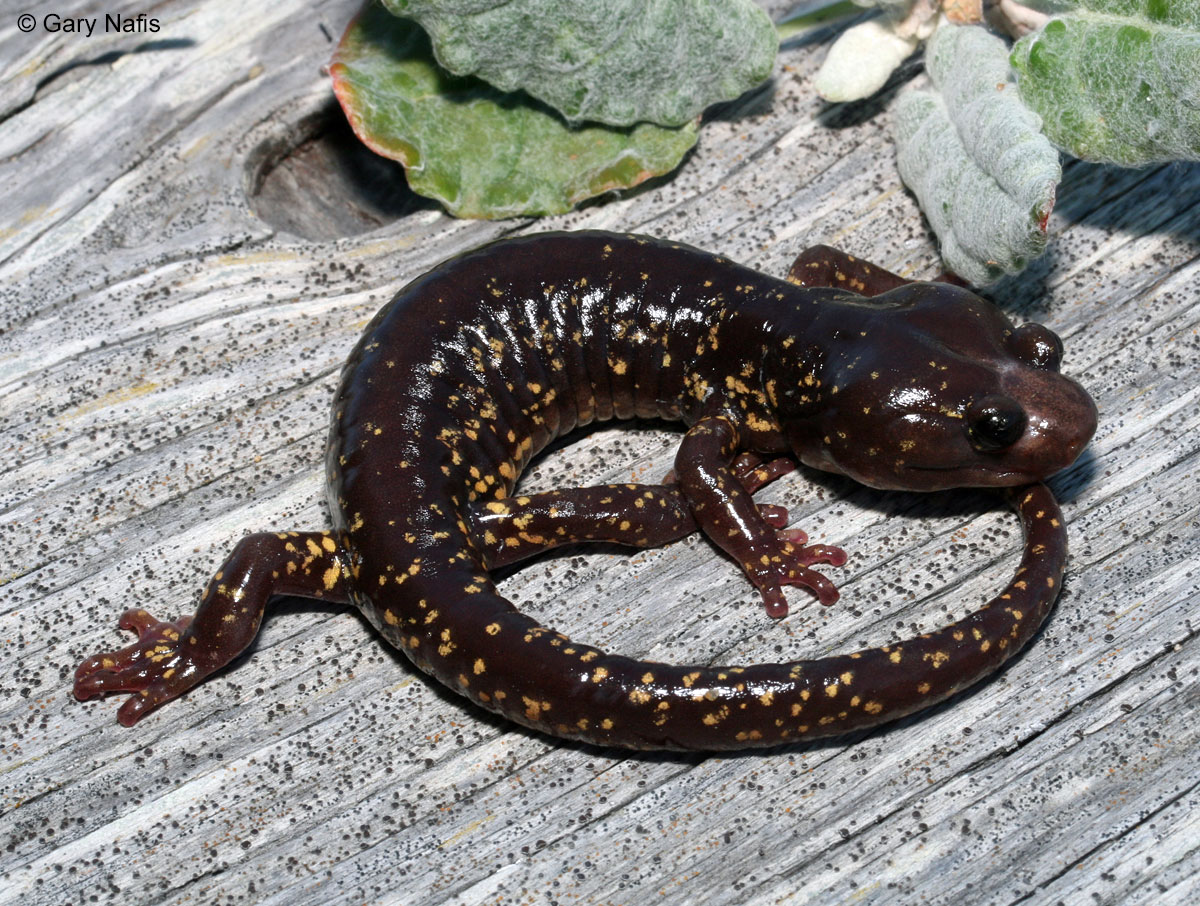
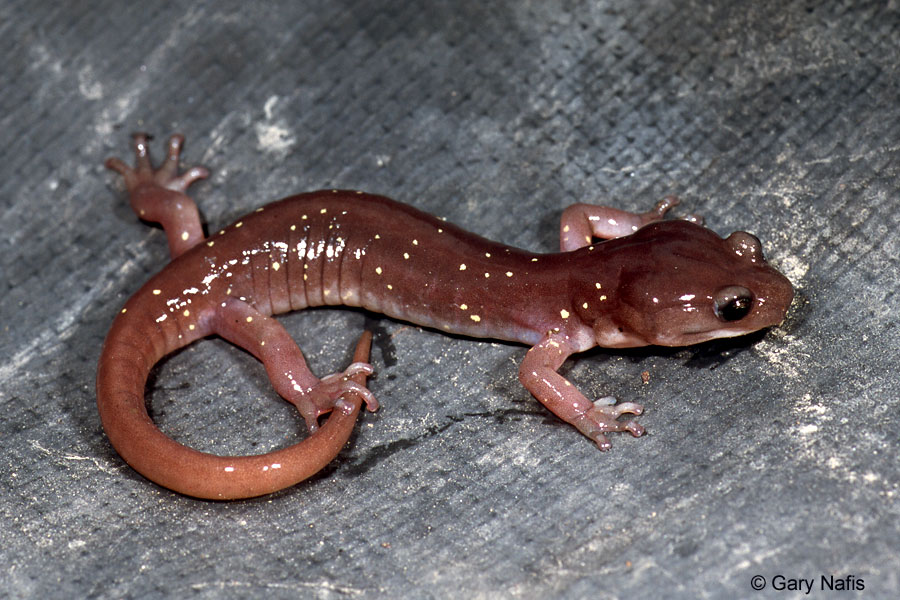
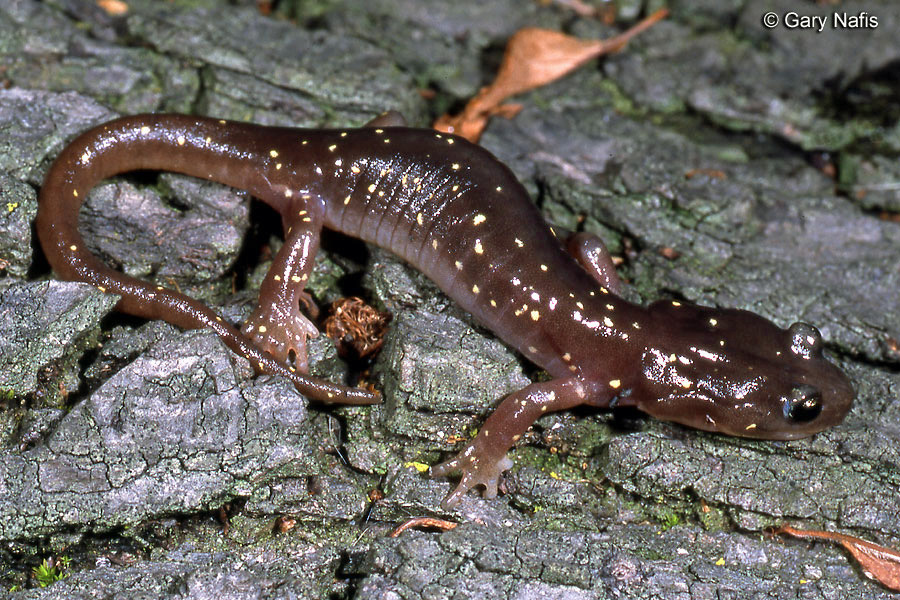
Size: 2 1/4 - 4 in. (5.7 - 10.1 cm) from snout to vent and up to 7 inches (18 cm) in total length (including tail.) This salamander is commonly seen in moist shaded yards and gardens in Northern California, especially around the Bay Area. It also occurs along the coast through southern California, and north to Humboldt county along the coast and northern coast ranges, as well as in the central Sierra Nevada foothills. These salamanders can be seen walking around on the ground at night, or climbing on walls and trees, especially during or after rains, usually from about November until the end of the spring rains in April or May. They may also be found under wood, branches, flower pots, slabs of cement, paving stones, or any other objects in your yard, and they are also occasionally found inside basements and garages. I had one or more living in my Oakland garage which was below the ground level and prone to flooding during heavy rain. When the garage flooded, the salamanders would float to the surface. This salamander is typically brown with cream-colored spots. The size of spots varies, and some have few or none. The ground color can vary from light grey or brown to dark brownish purple. Young salamanders are very dark with light speckles or patches. The limbs have no yellow or orange coloring (as do the young of another neighboring species.) The head is large and triangular on males and the eyes are dark with a patch of gold speckles. |
||
 |
 |
 |
 |
 |
 |
| Juveniles are very dark in color | ||
 |
||
| Red: California distribution of Arboreal Salamander |
||
| Pacific Newts - Genus Taricha | ||
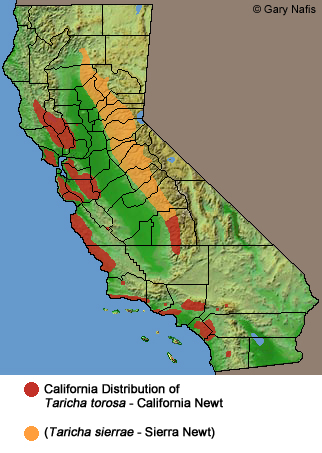
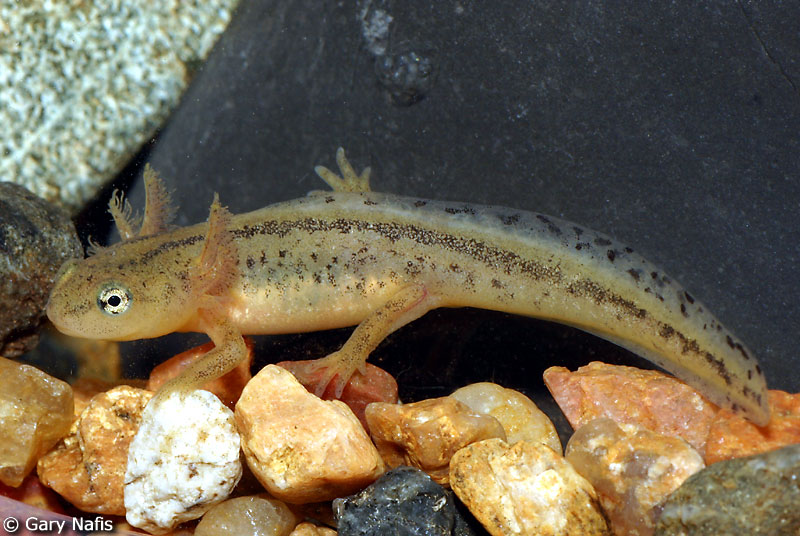
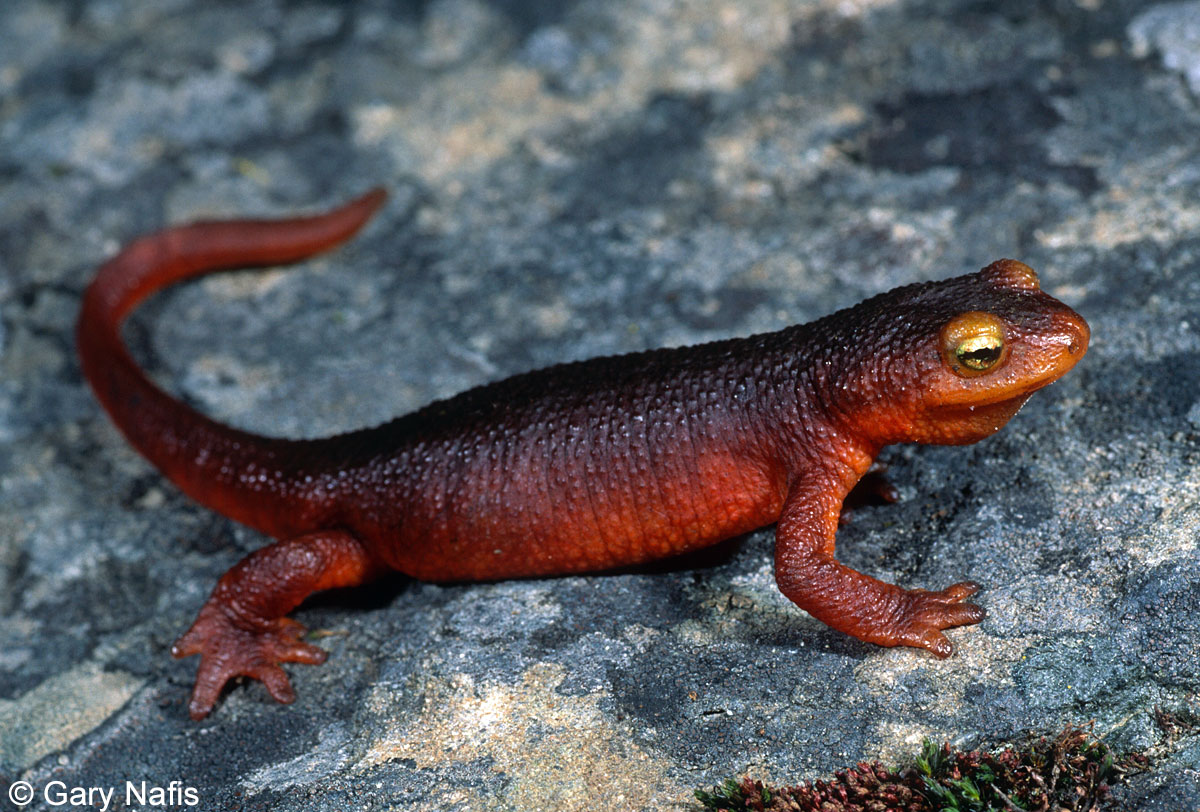
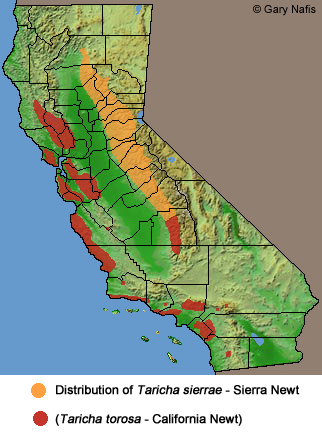
Size: 2 1/2 - 3 1/2 inches (6.4 - 8.9 cm) snout to vent, 3 1/2 - 7 7/8 inches (8.9 - 20 cm) total length (including tail.) Pacific Newts are stocky salamanders usually with rough, bumpy skin. However, they move in and out of water during the breeding season and at this time the skin will be smooth. These salamanders are frequently seen during daylight walking on roads or forest floors during the rainy season when they move to ponds or streams to breed. They are all brown or orange with yellow, orange, or red below. There are four types of newts which occur in California. Once you determine that your salamander is a newt, it's best to use the range maps below to determine which kind you have. Where they overlap - especially along the Mendocino coast, it can be difficult to tell them apart. Here are some tips on how to tell them apart: Identifying Species of Pacific Newts - Taricha. |
||
| Rough-skinned Newt - Taricha granulosa granulosa | ||
 |
||
 Adult |
||
 |
||
| Juveniles are aquatic |
Red: California distribution of Rough-skinned Newt | |
| Red-bellied Newt - Taricha rivularis | ||
 |
||
 Adult |
||
 |
||
| Juveniles are aquatic | Red: Distribution of Red-bellied Newt | |
| California Newt - Taricha torosa | ||
 |
||
 Adult |
||
 |
||
| Juveniles are aquatic |
Red: California distribution of California Newt | |
| Sierra Newt - Taricha sierrae | ||
 Adult Adult |
 |
|
 |
||
| Juveniles are aquatic | Orange: Distribution of Sierra Newt | |
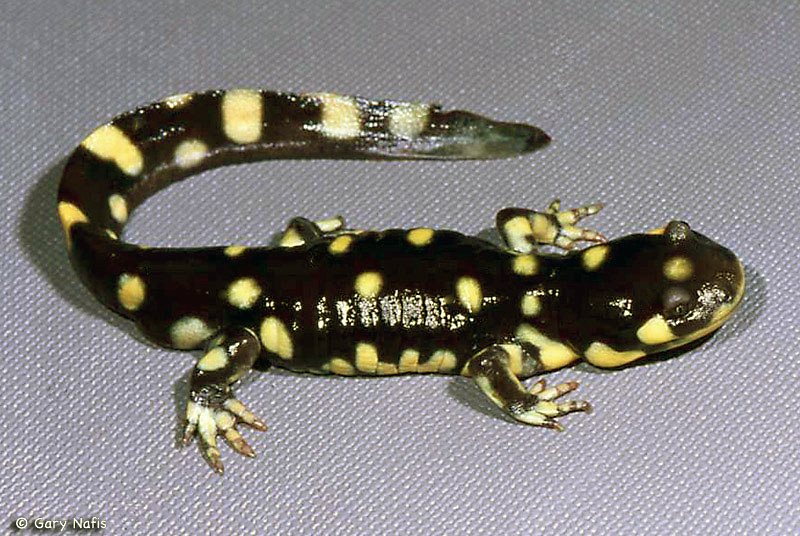
| California Tiger Salamander - Ambystoma californiense | ||
| Size: 3-5 inches (7.6 - 12.7 cm) snout-to-vent, 5.9 - 8.5 inches (15-22 cm) total length. This large stocky salamander is not common in California, and is not usually seen because it lives underground most of the year, but it can be very conspicuous in selected areas during the rainy winter months when it can be seen crossing roads on wet or rainy nights moving to and from its breeding ponds. It is also occasionally found under surface objects in yards and gardens, especially in rural areas. California Tiger Salamanders are black or dark brown with yellow or cream-colored spots or bars on the body. The head is large and rounded with large protuberant eyes. The young hatch and live in water before growing legs and transforming and moving onto the ground. |
||
 |
 |
 |
| Adults | Juveniles are aquatic | |
 |
||
| Red: Distribution of California Tiger Salamander | ||
| Giant Salamanders - Genus Dicamptodon | ||
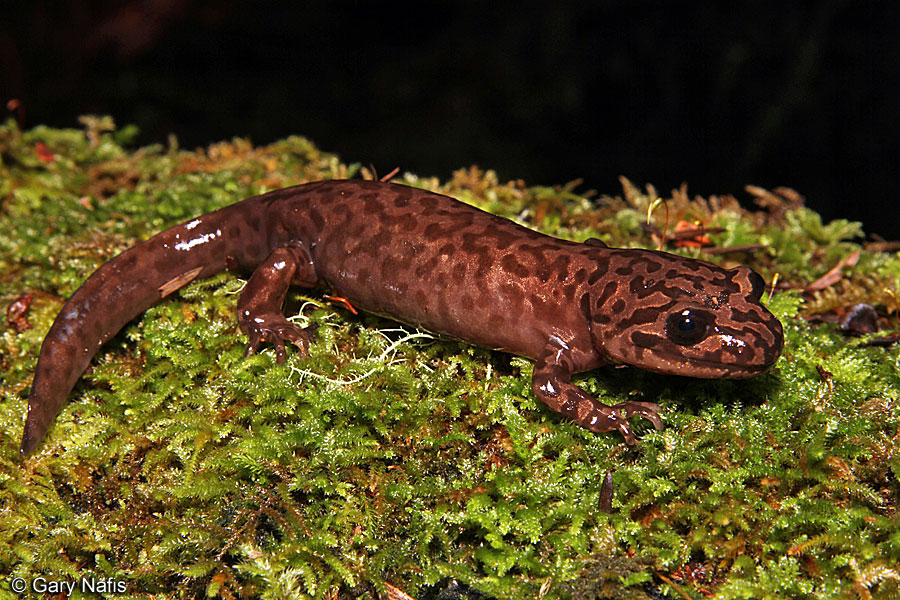
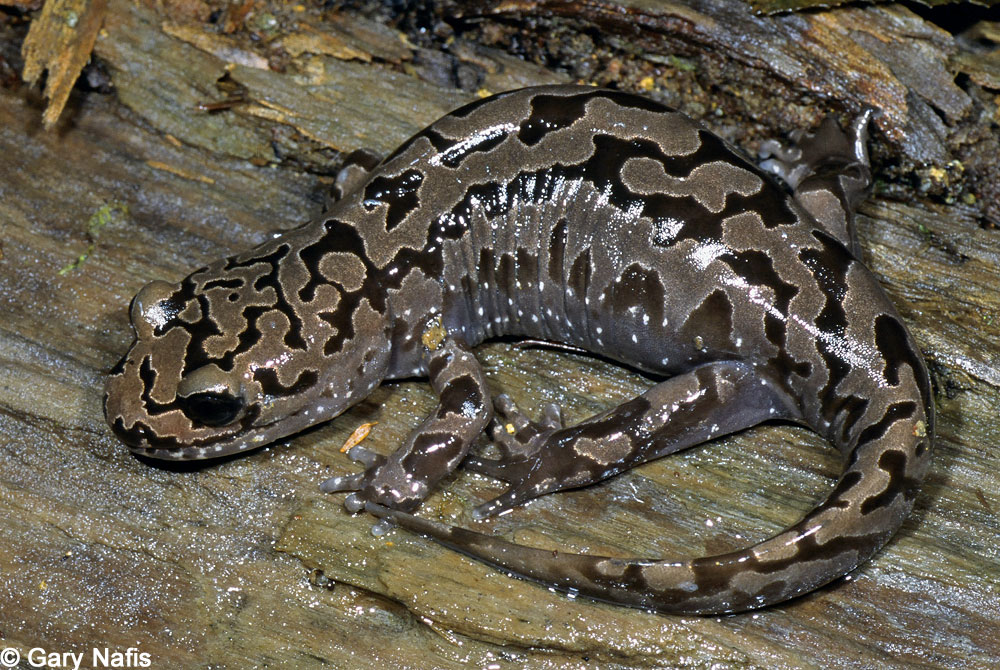
| Size: 2 1/2 to 6 4/5 inches (6.25 - 17 cm) snout to vent, and up to 13 inches (34 cm) total length (including tail.) Giant Salamanders live up to their name, growing up to a foot long, although it takes years for them to reach that size and many that you might encounter are much smaller. The body, head and limbs are very large and the tail is fairly short and flattened. They are brownish or copper-colored with dark marbled markings. These salamanders are sometimes seen crossing roads on rainy nights along the coast north of the Monterey Bay, and may be seen crawling around streams at night or even in yards in rural forested areas near streams. The two species are very similar in appearance. They were previously thought to be the same species. You should use the range map to determine which species is in your area. |
||
| California Giant Salamander - Dicamptodon ensatus | ||
 |
 |
 |
| Adults | Juveniles are aquatic | |
 |
||
| Red: Distribution of California Giant Salamander |
||
| Coastal Giant Salamander - Dicamptodon tenebrosus | ||
 |
 |
 |
| Adults | Juveniles are aquatic | |
 |
||
| Red: California distribution of Coastal Giant Salamander |
||
| Slender Salamanders - Genus Batrachoseps | ||
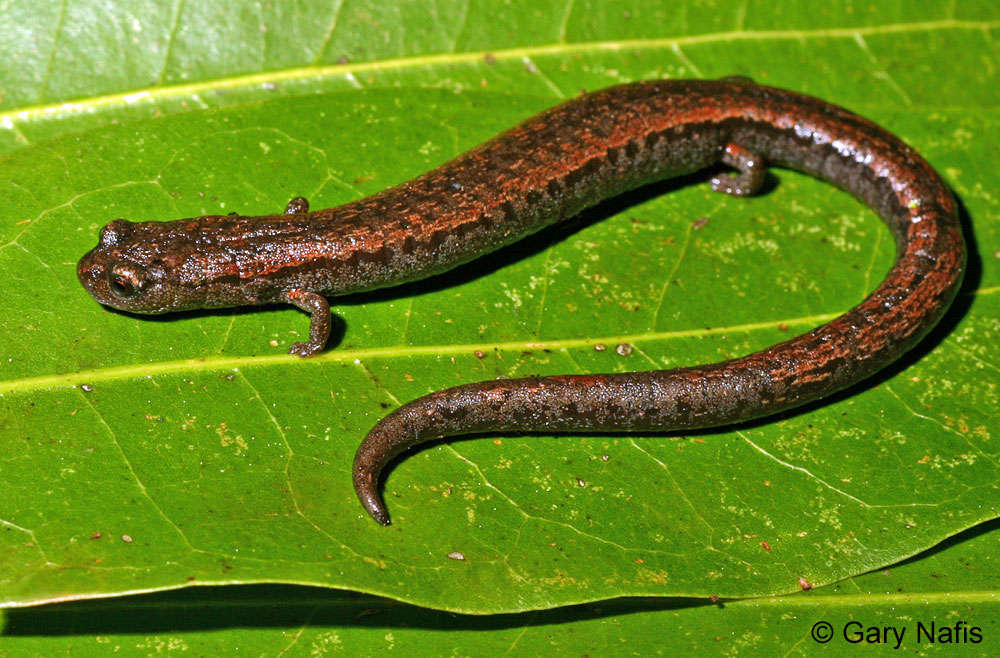
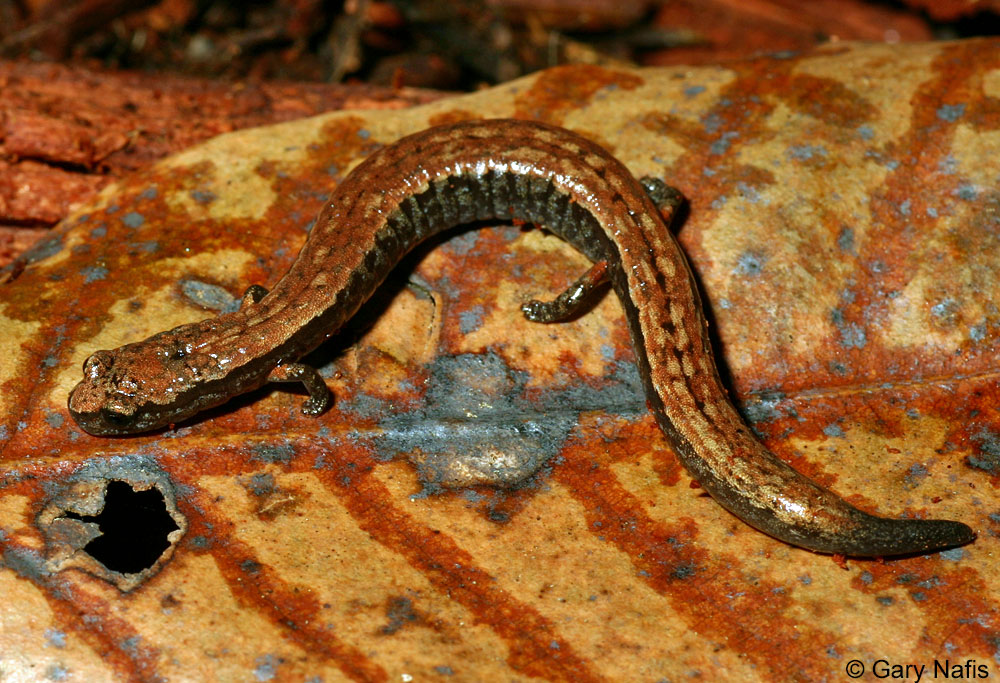
| These long thin salamanders are often mistaken for worms. The grooves on their sides even give them a somewhat ringed appearance like a worm. Like worms, they are usually discovered hiding underneath objects such as boards and pots and rocks in wet places. Occasionally they will be seen crawling on wet pavement at night during a rainy period. There are 19 kinds of slender salamanders in California, plus a few more that may also be unique. They are very difficult to tell apart but in most areas there is only one kind that you will find (although some of them occur in only a small area.) Looking at a map of their distribution is probably the best way to identify them. If you look at the map of all slender salamanders in California, that should help you narrow down which species you want to identify. You can also check the individual Salamander Range Maps page to see the distribution of other slender salamanders (Batrachoseps) in the state. In many areas where more than one species of slender salamander occurs, I have included pictures comparing the two species. You can't really tell them apart by color, pattern, or size, so the best way is to pay attention to the relative size of the body, the feet and the toes when compared to the other species. Often this will help to separate them. |
||
 |
||
| Click on the image above to see the ranges of all Slender Salamanders in California | ||
| California Slender Salamander - Batrachoseps attenuatus | ||
Size: 1 1/4 - 1 7/8 inches (3.2 - 4.7 cm) snout to vent, 3 - 5 1/2 inches ( 7.5 - 14 cm) total length (including tail.) This salamander can be abundant in the right habitat, which includes shaded, moist yards and gardens, woodlands, forests, and chaparral. As with most California salamanders, they can be seen walking around on the ground at night, especially during or after rains, usually from about November until the end of the spring rains in April or May. I have even seen them crawling on wet sidewalks in daylight. They may also be found under wood, branches, flower pots, slabs of cement, paving stones, mats of grass or vines, or any other objects in your yard. I found many at the edge of the house under grass or vegetation where it contacted the house. This is a small, thin salamander, which might look like a worm on first sight, before the tiny limbs are noticed. Often they will be found coiled up under a surface object. When disturbed, they may spring up and writhe on the ground, wagging their tail, which sometimes is let loose as a distraction. It is also easily detached when a salamander is handled. Many of these salamanders will be found with an short tail that has not completely grown back. |
||
 |
 |
 |
| Typical adults | ||
 |
 |
 |
| They are often found coiled up | Adult re-growing its tail. | |
 |
||
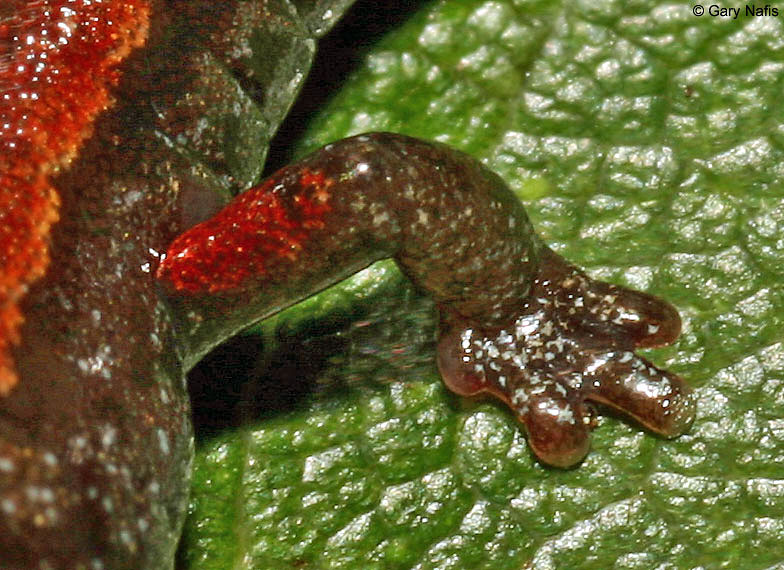
| Slender Salamanders (genus Batrachoseps) have only 4 toes on their hind feet. All other California salamanders have 5 toes on their hind feet. | ||
 |
||
| Red: California distribution of California Slender Salamander | ||
| Southern California (Garden) Slender Salamander - Batrachoseps major | ||
Size: 1 1/4 - 2 1/3 inches (3.2 - 5.9 cm) snout to vent, and about twice that length with a full tail. This is the small worm-like salamander commonly found in gardens and yards in coastal southern California. It is often seen under surface objects, especially in moist and shaded areas, but it may also be found under cover in open areas including coastal chaparral. This is a small, thin salamander, which might look like a worm on first sight, before the tiny limbs are noticed. Often they will be found coiled up under a surface object. When disturbed, they may spring up and writhe on the ground, wagging their tail, which sometimes is let loose as a distraction. It is also easily detached when a salamander is handled. Many of these salamanders will be found with an incompletely re-grown tail. This is one of two small, slender salamander occurring in Southern California in the areas shown on the map below, but the second species is less commonly encountered and is found in the mountains. There are many other species of slender salamanders occurring throughout the state which all look so much alike that they are nearly impossible to identify without using a range map. Check the Salamander Range Maps page to see the distribution of other slender salamanders or Batrachoseps in the state. |
||
 |
 |
 |
| Typical adults | Adult and juvenile | |
 |
||
| Red: California distribution of Southern California (Garden) Slander Salamander |
||
| Ensatina - Ensatina eschscholtzii | ||
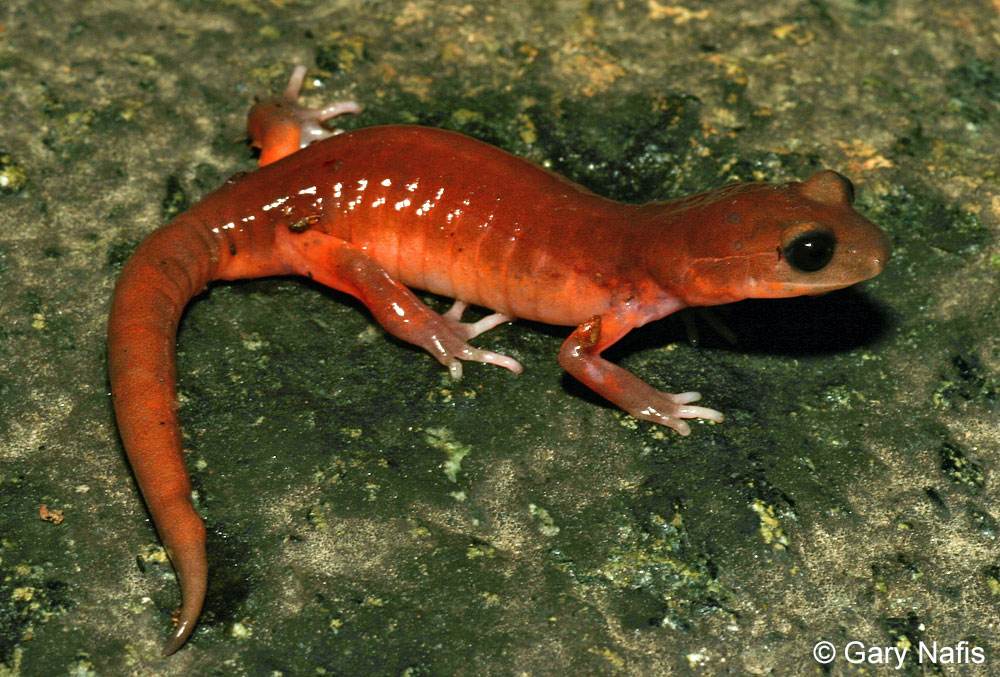
| Adult Ensatina measure from 1.5 - 3.2 inches long (3.8 - 8.1 cm) from snout to vent, and 3 - 6 inches (7.5 - 15.5 cm) in total length. A medium-sized salamander. The legs are long, and the body is relatively short, with 12 - 13 costal grooves. Nasolabial grooves are present. The tail is rounded and constricted at the base, which will differentiate this salamander from its neighbors. Males have longer, more slender tails than females, and a shorter snout with an enlarged upper lip, while the bodies of females are usually shorter and fatter than the bodies of males. Each subspecies, shown below, has a different color and pattern. Check the map for the range of each subspecies to avoid confusion. Sometimes the color of the blotches of the blotched forms can appear orange or yellow. Ensatina are not common in urban and suburban yards, but they are sometimes found under rocks, logs, brushpiles, and other surface objects on property adjacent to forests and other open space, and occasionally they are seen active on the surface on rainy nights. |
||
 |
 |
 |
| Sierra Nevada Ensatina | Large-blotched Ensatina | Yellow-blotched Ensatina |
 |
 |
 |
| Monterey Ensatina | Oregon Ensatina | Painted Ensatina |
 |
||
| Yellow-eyed Ensatina | ||
 |
||
| Distribution of Ensatina in California, showing the ranges of individual subspecies. Click on the map to see a key to the subspecies. |
||


Return to the Top
© 2000 -