|
 |
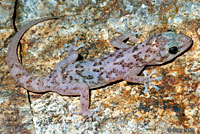
| Adult, active at night, San Diego County |
 |
 |
 |
 |
| Adult, active at night, San Diego County |
Adult, active at night, San Diego County |
Adult, active at night, San Diego County |
 |
 |
 |
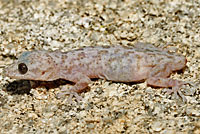 |
| Adult, San Diego County |
Adult, active at night, San Diego County |
Adult, with re-generating tail,
Imperial County |
Adult female, missing her tail,
Imperial County |
 |
 |
 |
| Adult, Imperial County © Stuart Young |
Adult, Imperial County © Stuart Young |
Adult, San Diego County © Grigory Heaton |
 |
 |
 |
 |
| Adult, Imperial County © Stuart Young |
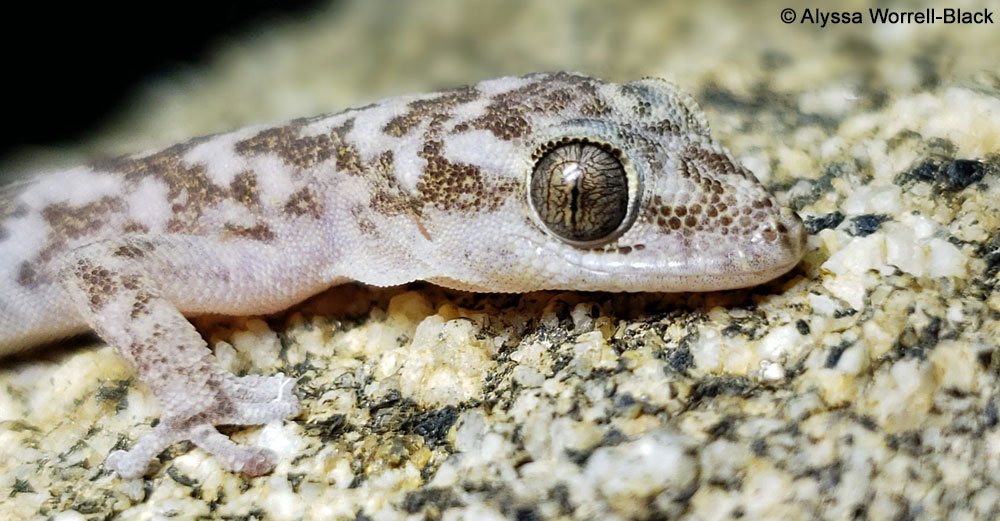
Adult from the Little San Bernardino Mountains population in Riverside County © Alyssa Worrell-Black |
Adult from the Little San Bernardino Mountains population in Riverside County © Robert Black |
Adult from the Little San Bernardino Mountains population in Riverside County © Robert Black |
 |
 |
|
Adult, San Diego County
© Jason Jones |
Adult, Imperial County, © Kahleo Thompson
You can see here how the gecko's markings can help it to disguise itself on the granite rocks it inhabits to avoid being seen. |
|
 |
 |
 |
 |
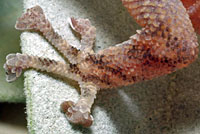
| Peninsular Leaf-toed Geckos have expanded toe pads to help them climb that resemble leaves, giving them their name. |
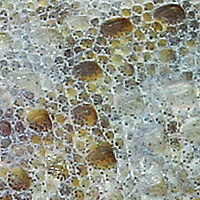
Peninsular Leaf-toed Geckos have small granular dorsal scales that are interspersed with enlarged keeled tubercles. |
| |
|
|
|
| Juveniles |
 |
 |
|
|
Juvenile, active at night,
San Diego County |
Juvenile, Imperial County |
|
|
| |
|
|
|
| Peninsular Leaf-toed Geckos From Baja California |
 |
 |
 |
 |
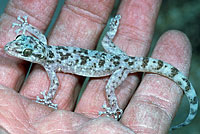
| Adult, Baja California Norte (found hiding under rock during daytime) |
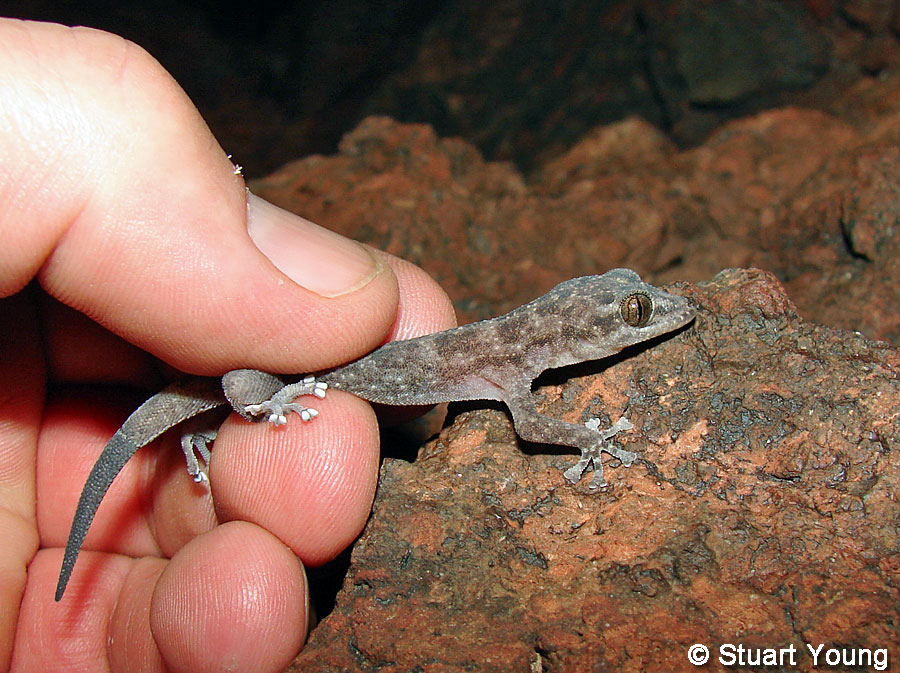
Dark adult from dark lava rock habitat, Baja California Norte © Stuart Young |
 |
|
|
|
| Dark adult from dark lava rock habitat, Baja California Norte © Stuart Young |
|
|
|
| |
| Habitat |
|
 |
 |
|
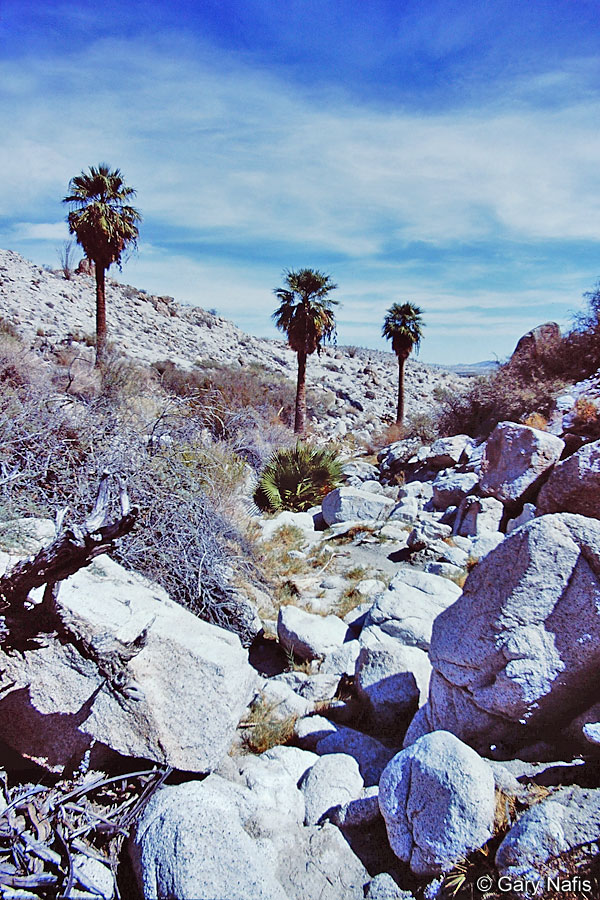
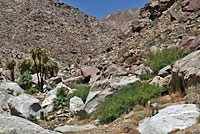
| Habitat, San Diego County |
Habitat, San Diego County |
Habitat, Imperial County |
Habitat, San Diego County |
 |
 |
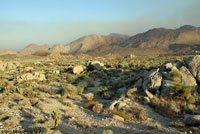 |
 |
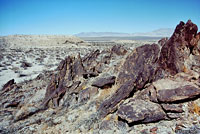
| Habitat, San Diego County |
Habitat, Imperial County |
Habitat, Imperial County |
Habitat, Imperial County |
 |
 |
 |
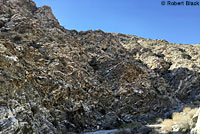 |
Habitat, at night, Imperial County
© Stuart Young |
Habitat, San Diego County |
Habitat in the Little San Bernardino Mountains, Riverside County
© Robert Black |
Habitat in the Little San Bernardino Mountains, Riverside County
© Robert Black |
| |
|
|
|
| Short Videos |
 |
 |
|
|
| A Peninsular leaf-toed gecko crawls around on a large rock outcrop at night. |
A huge gravid female Peninsular leaf-toed gecko with no tail runs around on a big boulder at night. |
|
|
|
|
|
|
| Description |
| |
| Size |
1 3/5 - 2 1/2 inches long from snout to vent (4.1 - 6.3 cm). (Stebbins 2003)
|
| Appearance |
A medium-sized gecko with large eyes without movable eyelids and vertical pupils.
Expanded toe pads that resemble leaves give this gecko its common name.
The toes have two large flat scales at their tips with a claw in-between them.
Scales are small and granular with scattered enlarged keeled tubercles.
The t
ail is easily detached.
Males have enlarged pre-anal pores. |
| Color and Pattern |
Color is a translucent gray, brown, or pink usually with dark brown blotches on the back.
The underside is pale and unmarked.
|
| Life History and Behavior |
Activity |
Nocturnal, emerging shortly after dark.
Most active from March to October.
Probably remains inactive during cold of winter.
An excellent climber, rarely found away from rocks.
|
| Defense |
Squeaks when alarmed or captured.
May leap into the air to avoid capture. |
| Diet and Feeding |
Stalks its prey of small invertebrates, which include termites, spiders, moths, flies, and ants.
Sometimes leaves rocks to forage on the ground, on trees, and buildings. |
| Reproduction |
Breeds in April and May.
Females
lay several clutches of 1 - 2 eggs from May to July.
Eggs are laid in crevices or under exfoliating bark. (Grismer 2002)
Eggs
hatch from June to August.
|
| Habitat |
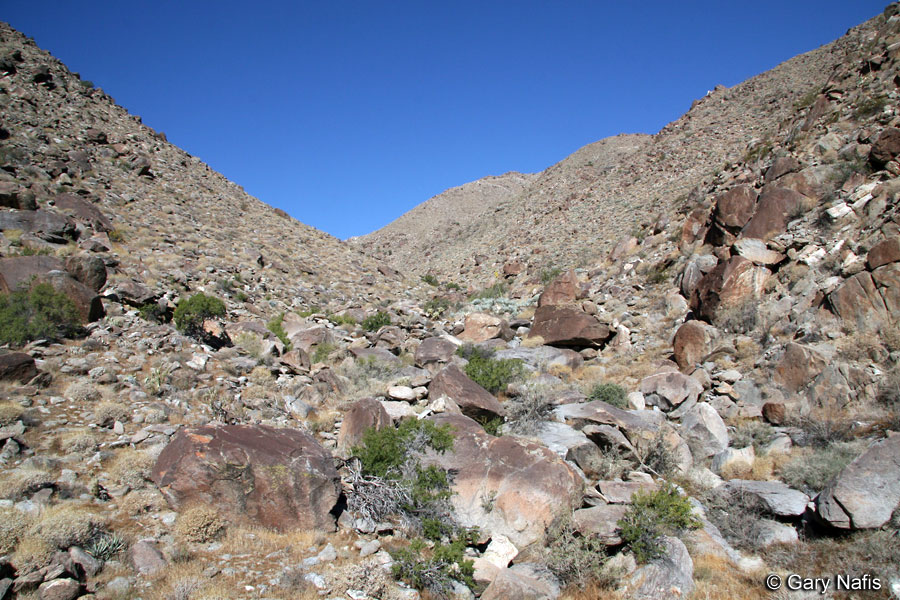
Lives among rocks in desert scrub and broken chaparral, hiding in cracks and crevices and under exfoliating slabs. Often found in canyons with massive boulders especially near springs and streams, but also found in rocky, non-riparian areas. Occasionally found under plant material.
|
| Geographical Range |
Occurs along the lower desert slopes of the peninsular ranges from near Palm Springs in Riverside County south throughout much of Baja California and Baja California Sur, including several islands in the Gulf of California.
Previously known only from the Peninsular Ranges on the southern side of the Coachella Valley, an isolated population was discovered in May 2018 on the northern side of the Coachella Valley in the Little San Bernardino Mountains, part of the Transverse Ranges. This location is 20 km (12.4 miles) farther north than the previous northern-most known location for the species, and north of a 5 - 15 km (3-9 mile) wide sandy area that was thought to have acted as a barrier to the northern dispersal of the species, which relies on rocky habitat. Genetic data have determined that the population is of natural origin and that it is distinct from lizards found in the Peninsular Ranges.
In his 2003 field guide, Stebbins reports that a single individual of P. nocticolus was found in 1997 on a bathroom wall at Cottonwood Springs, approximately 40 miles (64.4 km) to the east of this new population in the same mountain range. Stebbins suggests that it could have been a misidentified Mediterranean Gecko, but this new discovery along with the 1997 record suggests that the species might be found more extensively through the southern part of these mountains.
(Dustin A. Wood, Alyssa Worrel-Black, Robert Black, Anna Mitelberg, Mark Fisher, Robert N. Fisher, Amy G. Vandergast, and Cameron W. Barrows. Newly Documented Population Extends Geographic Range and Genetic Diversity for the Peninsula Leaf-toed Gecko (Phyllodactylus nocticolus) into the Transverse Ranges of Southern California. Herpetological Review 51(3), 2020).
|
 |
Red: Phyllodactylus nocticolus - Peninsular Leaf-toed Gecko
|
| Elevational Range |
Sea level to about 3,200 feet (1,000 meters) (Lizards of the American Southwest, 2009, and personal communication, 2019.)
|
| Notes on Taxonomy |
Only one species occurs in the U.S. - P. nocticolus.
Phyllodactylus taxonomy has been controversial. Many species and subspecies have been recognized from Mexico, including island endemics. No subspecies are recognized in the taxonomy followed here, but there are other interpretations, including one that recognizes several subspecies from islands in the Sea of Cortez.
-----------------------------------------------------------------------------------------------------------------------------------------------------------------------------------------------------------------------------
In 1993 P. nocticolus was described as a species distinct from P. xanti (Flores-Villela 1993 Carnegie Museum of Natural History Special Publication 17) This taxonomy has not been recognized by everyone, and this gecko is still sometimes called P. xanti. (2007)
-----------------------------------------------------------------------------------------------------------------------------------------------------------------------------------------------------------------------------
"The standard English name of this species is returned to that used in the 5th and 6th editions of this list (which used 'Peninsular' rather than “'Peninsula')."
(Nicholson, K. E. (ed.). 2025 SSAR Scientific and Standard English Names List)
-----------------------------------------------------------------------------------------------------------------------------------------------------------------------------------------------------------------------------
Alternate and Previous Names (Synonyms)
Phyllodactylus nocticolus - Peninsula Leaf-toed Gecko (2017 SSAR list)
Phyllodactylus xanti nocticolus - Peninsular Leaf-toed Gecko (Stebbins 1985, 2003)
Phyllodactylus xanti nocticolus - Leaf-toed Gecko (Stebbins 1966)
Phyllodactylus tuberculosus - Tuberculate Gecko (Stebbins 1954)
Phyllodactylus tuberculosus - Tubercular Gecko (Smith 1946)
|
| Conservation Issues (Conservation Status) |
This species is not yet (2021) listed as a threatened or endangered species by the U.S. Endangered Species Act or by the State of California, nor is it a California State Species of Special Concern, and its NatureServe Global Rank is G5 Secure, but it is still protected by being excluded from the list of lizards that can be legally collected. It is also prohibited to destroy the rock outcrops it inhabits. |
|
|
Taxonomy |
| Family |
Gekkonidae |
Geckos |
Gamble, Bauer, Greenbaum, & Jackman 2008 |
| Genus |
Phyllodactylus |
Leaf-toed Geckos |
Gray, 1828 |
Species
|
nocticolus |
Peninsular Leaf-toed Gecko |
Dixon, 1964 |
|
Original Description |
Phyllodactylus nocticolus - Dixon, 1964 - New Mexico State Univ. Sci. Bull, Vol. 64, No. 1, p. 55
from Original Description Citations for the Reptiles and Amphibians of North America © Ellin Beltz
|
|
Meaning of the Scientific Name |
Phyllodactylus - Greek - phyllon = leaf + daktylos = finger or digit - refers to the leaf like terminal subdigital lamellae
nocticolus - Latin = resident of the night - refers to this lizard's nocturnal habits
from Scientific and Common Names of the Reptiles and Amphibians of North America - Explained © Ellin Beltz
|
|
Related or Similar California Lizards |
Coleonyx variegatus variegatus - Desert Banded Gecko
Coleonyx switaki switaki - Peninsular Banded Gecko
Non-native geckos in California
Rough-tailed Gecko - Cyrtopodion scabrum
Common House Gecko - Hemidactylus frenatus
Indo-Pacific Gecko - Hemidactylus garnotii
Tropical House Gecko - Hemidactylus mabouia
Flat-tailed House Gecko - Hemidactylus platyurus
Mediterranean Gecko - Hemidactylus turcicus
Yellow Fan-Fingered Gecko - Ptyodactylus hasselquistii
Ringed Wall Gecko - Tarentola annularis
Moorish Gecko - Tarentola mauritanica
|
|
More Information and References |
California Department of Fish and Wildlife
Hansen, Robert W. and Shedd, Jackson D. California Amphibians and Reptiles. (Princeton Field Guides.) Princeton University Press, 2025.
Stebbins, Robert C., and McGinnis, Samuel M. Field Guide to Amphibians and Reptiles of California: Revised Edition (California Natural History Guides) University of California Press, 2012.
Stebbins, Robert C. California Amphibians and Reptiles. The University of California Press, 1972.
Flaxington, William C. Amphibians and Reptiles of California: Field Observations, Distribution, and Natural History. Fieldnotes Press, Anaheim, California, 2021.
Nicholson, K. E. (ed.). 2025. Scientific and Standard English Names of Amphibians and Reptiles of North America North of Mexico, with Comments Regarding Confidence in Our Understanding. Ninth Edition. Society for the Study of Amphibians and Reptiles. [SSAR] 87pp.
Samuel M. McGinnis and Robert C. Stebbins. Peterson Field Guide to Western Reptiles & Amphibians. 4th Edition. Houghton Mifflin Harcourt Publishing Company, 2018.
Stebbins, Robert C. A Field Guide to Western Reptiles and Amphibians. 3rd Edition. Houghton Mifflin Company, 2003.
Behler, John L., and F. Wayne King. The Audubon Society Field Guide to North American Reptiles and Amphibians. Alfred A. Knopf, 1992.
Robert Powell, Roger Conant, and Joseph T. Collins. Peterson Field Guide to Reptiles and Amphibians of Eastern and Central North America. Fourth Edition. Houghton Mifflin Harcourt, 2016.
Powell, Robert., Joseph T. Collins, and Errol D. Hooper Jr. A Key to Amphibians and Reptiles of the Continental United States and Canada. The University Press of Kansas, 1998.
Grismer, L. Lee. Amphibians and Reptiles of Baja California, Including Its Pacific Islands and the Islands in the Sea of Cortés. The University of California Press, 2002.
McPeak, Ron H. Amphibians and Reptiles of Baja California. Sea Challengers, 2000.
Samuel M. McGinnis and Robert C. Stebbins. Peterson Field Guide to Western Reptiles & Amphibians. 4th Edition. Houghton Mifflin Harcourt Publishing Company, 2018.
Stebbins, Robert C. A Field Guide to Western Reptiles and Amphibians. 3rd Edition. Houghton Mifflin Company, 2003.
The Reptile Database
Lemm, Jeffrey. Field Guide to Amphibians and Reptiles of the San Diego Region (California Natural History Guides). University of California Press, 2006.
Bartlett, R. D. & Patricia P. Bartlett. Guide and Reference to the Turtles and Lizards of Western North America (North of Mexico) and Hawaii. University Press of Florida, 2009.
Jones, Lawrence, Rob Lovich, editors. Lizards of the American Southwest: A Photographic Field Guide. Rio Nuevo Publishers, 2009.
Smith, Hobart M. Handbook of Lizards, Lizards of the United States and of Canada. Cornell University Press, 1946.
Taylor, Emily. California Lizards and How to Find Them. Heyday, Berkeley, California. 2025.
|
|
|
The following conservation status listings for this animal are taken from the July 2025 State of California Special Animals List and the July 2025 Federally Listed Endangered and Threatened Animals of California list (unless indicated otherwise below.) Both lists are produced by multiple agencies every year, and sometimes more than once per year, so the conservation status listing information found below might not be from the most recent lists, but they don't change a great deal from year to year.. To make sure you are seeing the most recent listings, go to this California Department of Fish and Wildlife web page where you can search for and download both lists:
https://www.wildlife.ca.gov/Data/CNDDB/Plants-and-Animals.
A detailed explanation of the meaning of the status listing symbols can be found at the beginning of the two lists. For quick reference, I have included them on my Special Status Information page.
If no status is listed here, the animal is not included on either list. This most likely indicates that there are no serious conservation concerns for the animal. To find out more about an animal's status you can also go to the NatureServe and IUCN websites to check their rankings.
Check the current California Department of Fish and Wildlife sport fishing regulations to find out if this animal can be legally pursued and handled or collected with possession of a current fishing license. You can also look at the summary of the sport fishing regulations as they apply only to reptiles and amphibians that has been made for this website.
This lizard is on the California Department of Fish and Game list of reptiles that cannot be taken with a valid license, but it is not included on the Special Animals List, indicating that there are no significant conservation concerns for it in California. The state is clearly protecting it for some reason, possibly to protect its rocky habitat from being damaged. This is the same situation found with Xantusia henshawi (see Conservation Issues comments) which shares most of its range and habitat. NatureServe lists this species as "Secure" but this includes its entire range, which is much more extensive in Baja California.
|
| Organization |
Status Listing |
Notes |
| NatureServe Global Ranking |
G 5 |
Secure (As of 2/21) |
| NatureServe State Ranking |
|
|
| U.S. Endangered Species Act (ESA) |
None |
|
| California Endangered Species Act (CESA) |
None |
|
| California Department of Fish and Wildlife |
None |
|
| Bureau of Land Management |
None |
|
| USDA Forest Service |
None |
|
| IUCN |
|
|
|
|