|
 |
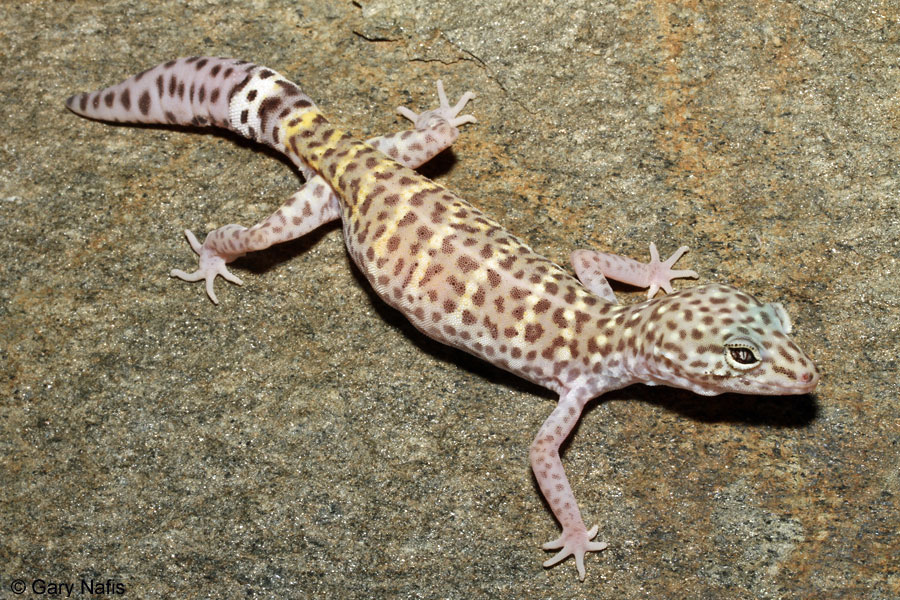
| Adult female, San Diego County |
 |
 |
 |
 |
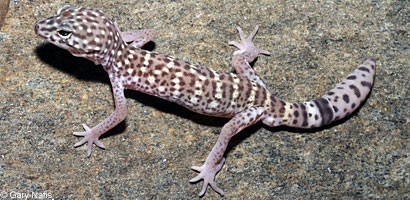
| Adult female, San Diego County |
 |
 |
 |
| Adult male, San Diego County |
 |
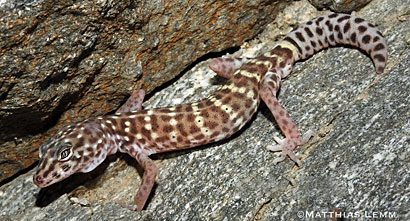 |
| Adult, San Diego County © Matthias Lemm |
Adult, San Diego County © Matthias Lemm |
 |
 |
 |
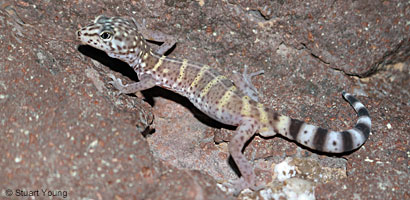
| Adult, Imperial County, with solid bands and dorsal stripe. © Stuart Young |
 |
 |
 |
 |
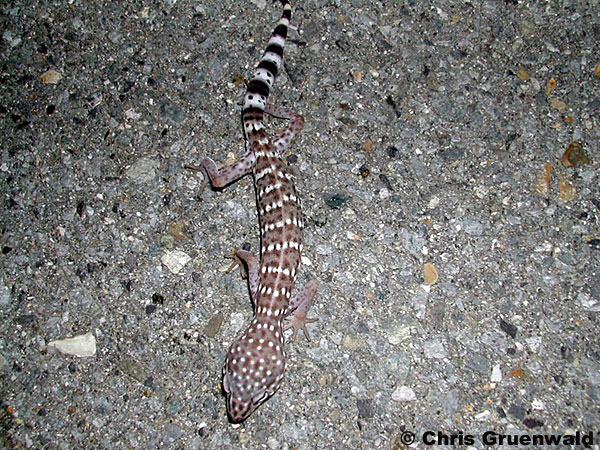
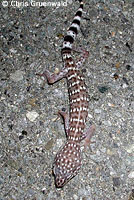
| Adult, San Diego County, © Chris Gruenwald |
Adult, San Diego County. © Bruce Edley |
 |
 |
 |
|
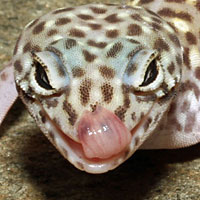
Adult, San Diego County
© Dick Bartlett |
Adult, San Diego County,
showing the tongue |
|
| |
|
|
|
Juveniles |
 |
 |
 |
 |
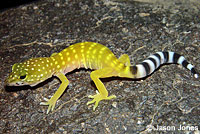
Hatchling, San Diego County
© Jason Jones |
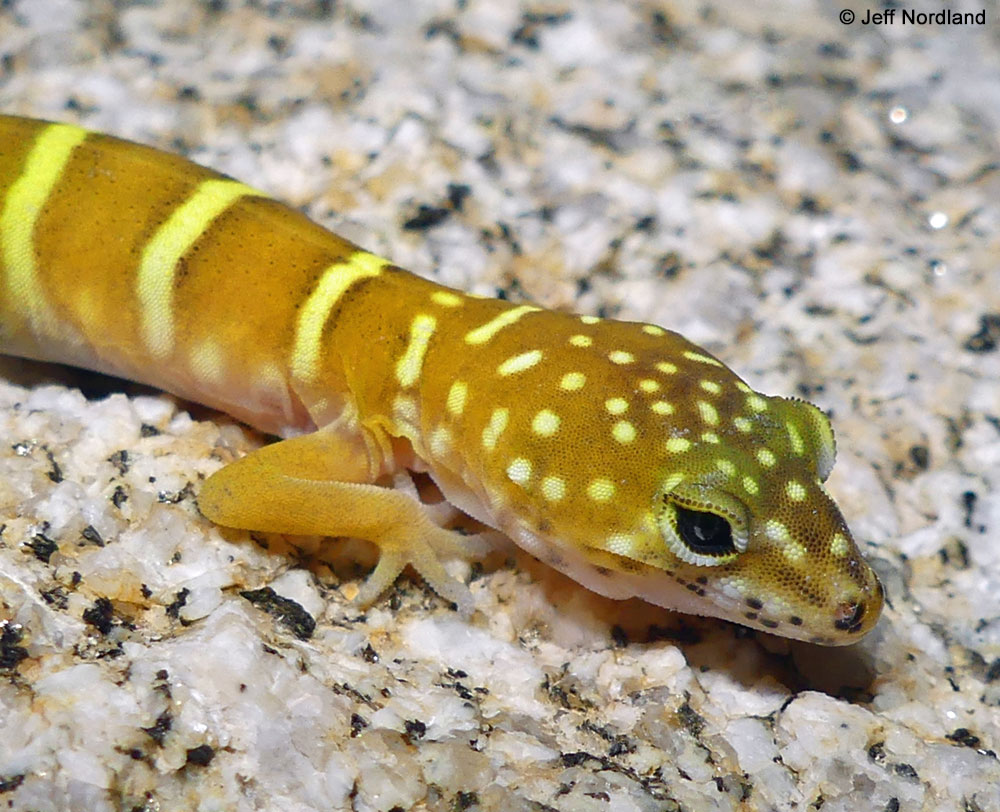
Hatchling, Imperial County © Jeff Nordland |
 |
 |
 |
 |
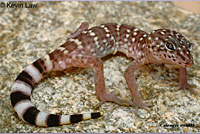
Juvenile, San Diego County
© Kevin Law |
Juvenile, San Diego County
© Kevin Law |
Juvenile, San Diego County, © Anish Yelekar |
 |
|
|
|
Sub-adult, San Diego County
© William Flaxington |
|
|
|
| |
|
|
|
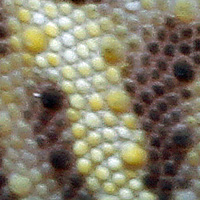
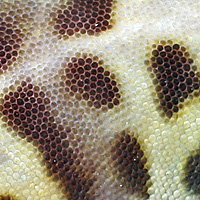
| Comparison with Desert Banded Gecko |
 |
 |
|
|
Peninsula Banded Gecko - C. s. switaki
Skin is smooth with small granular scales interspersed with larger tubercles. |
Desert Banded Gecko - C.variegatus
Skin is smooth with small granular scales that are not interspersed with larger tubercles. |
|
|
| |
|
|
| Habitat |
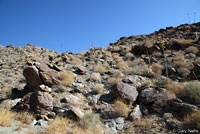 |
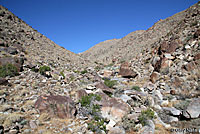 |
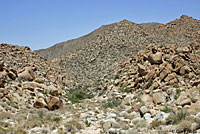 |
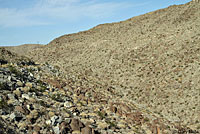 |
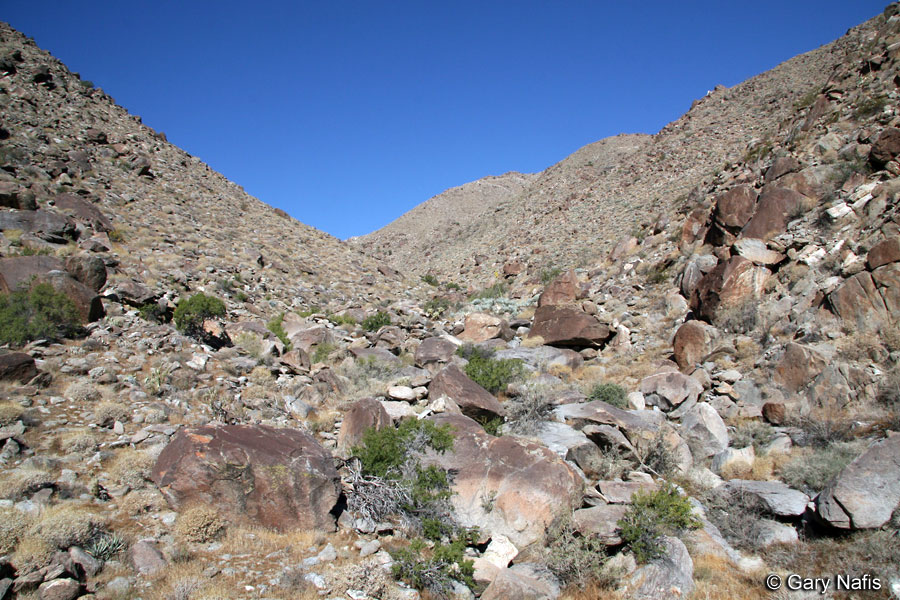
| Habitat, San Diego County |
Habitat, San Diego County |
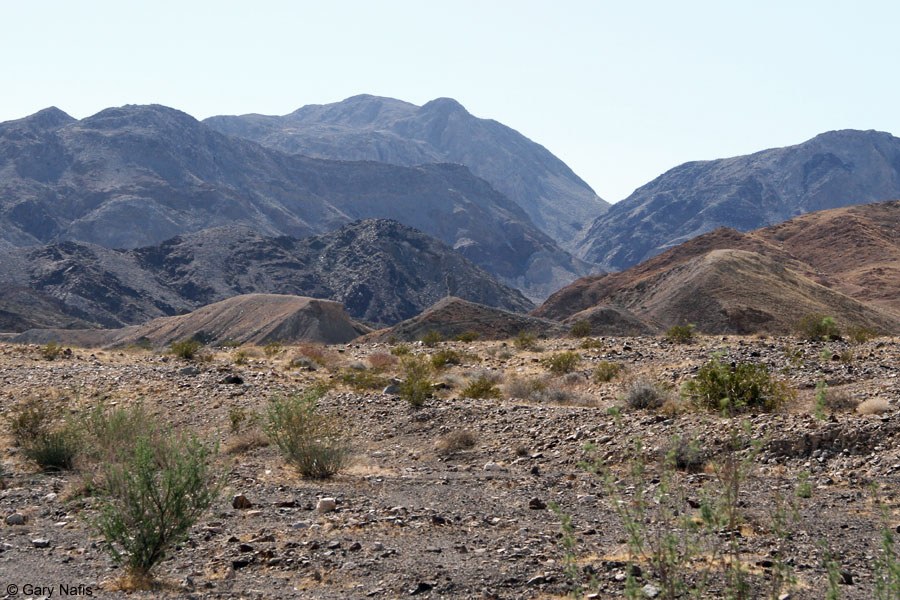
Habitat, Imperial County |
Habitat, San Diego County |
 |
 |
|
|
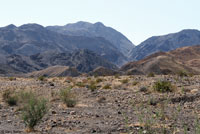
An isolated population of C. switaki occurs in the
Coyote Mountains of Imperial County, seen above. |
|
|
|
|
|
| Description |
| |
| Size |
2 - 3.5 Inches long (5.1 - 8.6 cm) from snout to vent.
The largest native Gecko species in California.
|
| Appearance |
A small lizard with a triangular head, distinctly wider than the neck.
Movable eyelids, vertical pupils.
Skin is soft with fine granular scales and tubercles on the upper sides, back, neck, and the upper base of the tail.
Toes are slender.
Tail is constricted at the base.
Males can be identified by prominent spurs on both sides of the base of the tail.
|
| Color and Pattern |
Color pattern is variable, depending on habitat - from light gray, beige, yellowish, reddish brown to dark brown.
With numerous round brown spots, and sometimes pale cross-bands made up of round pale spots.
During breeding season, males develop yellow coloring on body.
Tail has light and dark rings. |
| Young |
Hatchlings are born with bright yellow or orange coloring and a distinctly black and white banded tail.
The bright coloring and banding on the tail begin to fade as they reach one year of age.
|
| Life History and Behavior |
Activity |
The natural history of this gecko is not well-known. Secretive, noctural, hides by day in deep crevices.
Active in fairly cool ambient temperatures during periods of increased humidity, typically spring through fall. Hibernates through the winter.
Curls the tail up and waves it back and forth off the ground when stalking prey.
When grasped, this gecko may emit a short squeak. |
| Defense |
The tail can break off and distract a predator by writhing around for several minutes.
The tail will grow back, typically without the banding pattern matching the rest of the lizard's body.
More information about tail loss and regeneration. |
| Diet and Feeding |
Not well known. Small invertebrates probably make up the bulk of the diet.
Captive adults have also eaten neonate geckos.º |
| Reproduction |
(All summarized from Grismer, 2002)
Most likely, the breeding season lasts from Spring to Summer, mid-May through late July.
Males develop a bright yellow coloring during the reproductive season.
Females lay a clutch of one or two eggs, and may lay up to three clutches from a single mating within 20 days of the first oviposition.
Eggs hatch after around two months, in late summer to early fall.
|
| Habitat |
Found in arid rocky areas on flatlands, canyons, thornscrub, especially where there are large boulders and rock outcrops, and where vegetation is sparse.
According to Grismer, 2002, describing the habitat in Baja California, the species "is most common on the talus slopes of volcanic hillsides and terraces where the mean rock size is slightly less than 1 m [3.3 feet] and the vegetation is not too dense."... "...occasionally found under cap rocks and in deep cracks. It is less common in areas with large granitic outcroppings."
|
| Geographical Range |
Not discovered in California until the early 1980s.
In California, inhabits the arid desert slopes of the eastern side of the Peninsular Ranges from near Borrego Springs south to the Baja California border.
An isolated population occurs in the Coyote Mountains of Imperial County.
Another isolated population was discovered about 15 miles (24 km) to the north of the Coyote Mountains in the Fish Creek Mountains in May, 2019.
[Herp Review (51(1) 2020]
The majority of the range of this species is on the Baja California peninsula along the eastern edge of the Peninsular Mountain range as far south as near Santa Rosalia. Also found on Isla San Marcos.
|
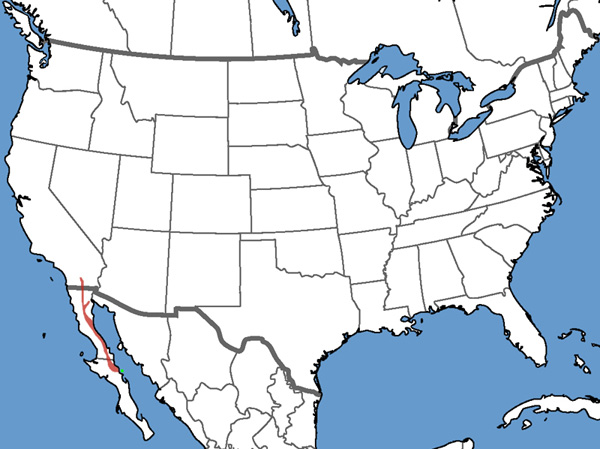 |
Approximate distribution of Coleonyx switaki - Switak's Banded Gecko
Red: Coleonyx switaki switaki - Peninsula Banded Gecko
- Not found in California
Bright Green: Coleonyx switaki gypsicolus - Isla San Marcos Barefoot Gecko
|
| Elevational Range |
From near sea level to over 2,000 ft. (700 m).
|
| Notes on Taxonomy |
Described in 1973.
------------------------------------------------------------------------------------------------------------------------------------------------------------------------------------------------------------------------------
C. s. gypsicolus was treated as a distinct species, C. gypsicolus, by Grismer (2002).
------------------------------------------------------------------------------------------------------------------------------------------------------------------------------------------------------------------------------
"The first word of the standard English name was changed from “Peninsula” to “Peninsular” to make it adjectival."
(Nicholson, K. E. (ed.). 2025 SSAR Scientific and Standard English Names List)
------------------------------------------------------------------------------------------------------------------------------------------------------------------------------------------------------------------------------
Alternate and Previous Names (Synonyms)
Coleonyx switaki - Switak's Banded Gecko (Hansen and Shedd, 2025)
Coleonyx switaki switaki - Peninsula Banded Gecko (2017 SSAR list)
Coleonyx switaki - Barefoot Gecko (Switak's Banded Gecko) (Stebbins 2003)
Coleonyx switaki - Barefoot Gecko (Stebbins 1985)
Anarbolys switaki 1974
Barefoot Gecko
Magic Gecko
|
| Conservation Issues (Conservation Status) |
Listed as Threatened under the California Endangered Species Act due to its limited range.
Protected from collection and possession without a permit. |
|
|
Taxonomy |
| Family |
Gekkonidae (Eublepharidae) |
Eyelid Geckos |
Boulenger, 1883 |
| Genus |
Coleonyx |
Banded Geckos |
Gray, 1845 |
| Species |
switaki |
Switak's Banded Gecko |
(Murphy, 1974) |
Subspecies
|
switaki |
Peninsular Banded Gecko |
(Murphy, 1974) |
|
Original Description |
(Murphy, 1974) - Proc. California Acad. Sci., Ser. 4, Vol. 40, No. 4, p. 87
from Original Description Citations for the Reptiles and Amphibians of North America © Ellin Beltz
Eponyms
First described by Murphy in 1974, the specific name "Coleonyx switaki" and the common name "Switak's Banded Gecko" honor Karl H. Switak, a German/American herpetologist, born in 1938.
See: Biographies of Persons Honored in the Herpetological Nomenclature © Ellin Beltz
|
|
Meaning of the Scientific Name |
Coleonyx - Greek - koleos = sheath + onyx = nail, talon or claw - refers to sheathed claws
switaki - honors Switak, Karl H.
from Scientific and Common Names of the Reptiles and Amphibians of North America - Explained © Ellin Beltz
|
|
Related or Similar California Lizards |
Desert Banded Gecko - C. v. variegatus
|
|
More Information and References |
California Department of Fish and Wildlife
Lemm, Jeffrey. Field Guide to Amphibians and Reptiles of the San Diego Region (California Natural History Guides). University of California Press, 2006.
Hansen, Robert W. and Shedd, Jackson D. California Amphibians and Reptiles. (Princeton Field Guides.) Princeton University Press, 2025.
Stebbins, Robert C., and McGinnis, Samuel M. Field Guide to Amphibians and Reptiles of California: Revised Edition (California Natural History Guides) University of California Press, 2012.
Stebbins, Robert C. California Amphibians and Reptiles. The University of California Press, 1972.
Flaxington, William C. Amphibians and Reptiles of California: Field Observations, Distribution, and Natural History. Fieldnotes Press, Anaheim, California, 2021.
Nicholson, K. E. (ed.). 2025. Scientific and Standard English Names of Amphibians and Reptiles of North America North of Mexico, with Comments Regarding Confidence in Our Understanding. Ninth Edition. Society for the Study of Amphibians and Reptiles. [SSAR] 87pp.
Samuel M. McGinnis and Robert C. Stebbins. Peterson Field Guide to Western Reptiles & Amphibians. 4th Edition. Houghton Mifflin Harcourt Publishing Company, 2018.
Stebbins, Robert C. A Field Guide to Western Reptiles and Amphibians. 3rd Edition. Houghton Mifflin Company, 2003.
Behler, John L., and F. Wayne King. The Audubon Society Field Guide to North American Reptiles and Amphibians. Alfred A. Knopf, 1992.
Robert Powell, Roger Conant, and Joseph T. Collins. Peterson Field Guide to Reptiles and Amphibians of Eastern and Central North America. Fourth Edition. Houghton Mifflin Harcourt, 2016.
Powell, Robert., Joseph T. Collins, and Errol D. Hooper Jr. A Key to Amphibians and Reptiles of the Continental United States and Canada. The University Press of Kansas, 1998. Bartlett, R. D. & Patricia P. Bartlett. Guide and Reference to the Turtles and Lizards of Western North America (North of Mexico) and Hawaii. University Press of Florida, 2009.
Jones, Lawrence, Rob Lovich, editors. Lizards of the American Southwest: A Photographic Field Guide. Rio Nuevo Publishers, 2009.
Smith, Hobart M. Handbook of Lizards, Lizards of the United States and of Canada. Cornell University Press, 1946.
Taylor, Emily. California Lizards and How to Find Them. Heyday, Berkeley, California. 2025.
Grismer, L. Lee. Amphibians and Reptiles of Baja California, Including Its Pacific Islands and the Islands in the Sea of Cortés. The University of California Press, 2002.
McPeak, Ron H. Amphibians and Reptiles of Baja California. Sea Challengers, 2000.
Samuel M. McGinnis and Robert C. Stebbins. Peterson Field Guide to Western Reptiles & Amphibians. 4th Edition. Houghton Mifflin Harcourt Publishing Company, 2018.
Stebbins, Robert C. A Field Guide to Western Reptiles and Amphibians. 3rd Edition. Houghton Mifflin Company, 2003.
The Reptile Database
Thelander, Carl G., editor in chief. Life on the Edge - A Guide to California's Endangered Natural Resources - Wildlife. Berkeley: Bio Systems Books, 1994.
|
|
|
The following conservation status listings for this animal are taken from the July 2025 State of California Special Animals List and the July 2025 Federally Listed Endangered and Threatened Animals of California list (unless indicated otherwise below.) Both lists are produced by multiple agencies every year, and sometimes more than once per year, so the conservation status listing information found below might not be from the most recent lists, but they don't change a great deal from year to year.. To make sure you are seeing the most recent listings, go to this California Department of Fish and Wildlife web page where you can search for and download both lists:
https://www.wildlife.ca.gov/Data/CNDDB/Plants-and-Animals.
A detailed explanation of the meaning of the status listing symbols can be found at the beginning of the two lists. For quick reference, I have included them on my Special Status Information page.
If no status is listed here, the animal is not included on either list. This most likely indicates that there are no serious conservation concerns for the animal. To find out more about an animal's status you can also go to the NatureServe and IUCN websites to check their rankings.
Check the current California Department of Fish and Wildlife sport fishing regulations to find out if this animal can be legally pursued and handled or collected with possession of a current fishing license. You can also look at the summary of the sport fishing regulations as they apply only to reptiles and amphibians that has been made for this website.
Both of the July 2023 lists described above use the common name Barefoot Banded Gecko for this species. The Federal list gives two other alternate names but not Peninsular Banded Gecko, which is used on this list:
"
Alternate common names: Switak's banded gecko, barefoot banded gecko."
|
| Organization |
Status Listing |
Notes |
| NatureServe Global Ranking |
G4 |
Apparently Secure |
| NatureServe State Ranking |
S3 |
Vulnerable |
| U.S. Endangered Species Act (ESA) |
None |
|
| California Endangered Species Act (CESA) |
ST |
Listed as Threatened 10/2/1980 |
| California Department of Fish and Wildlife |
None |
|
| Bureau of Land Management |
S |
Sensitive |
| USDA Forest Service |
None |
|
| IUCN |
LC |
Least Concern |
|
|