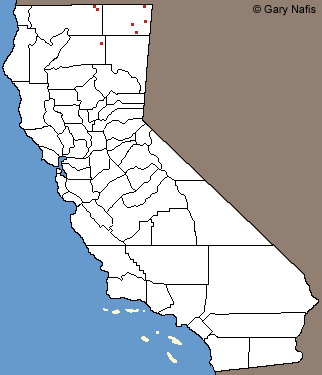
 Red:
Red: Historic range in California
(May not be present in these areas any more)
Click on the map for a topographical view
Map with California County Names
Listen to this frog:

A short example
|
I have no pictures yet of this frog from California. All of the pictures here are of frogs found outside California.
|
 |
 |
 |
 |
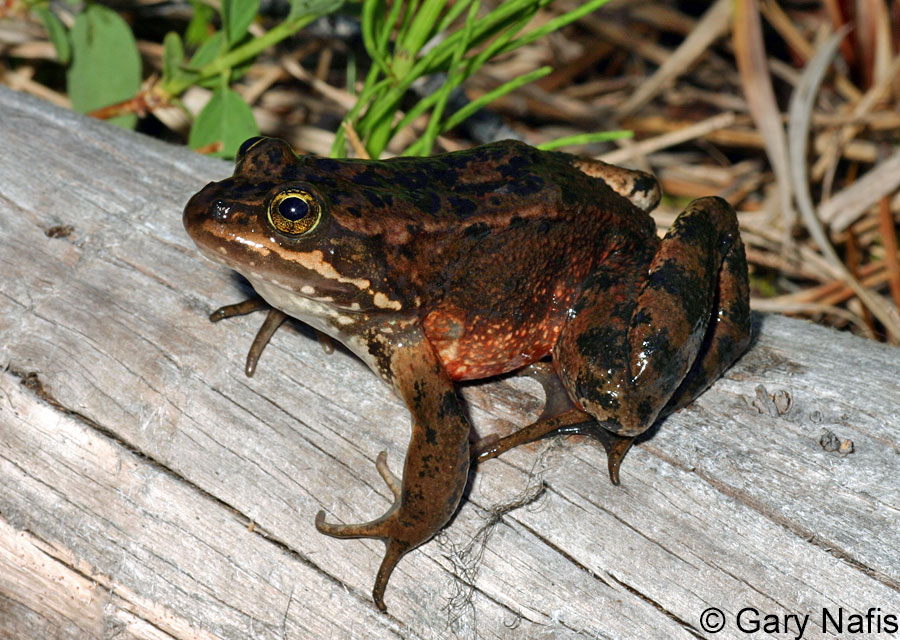
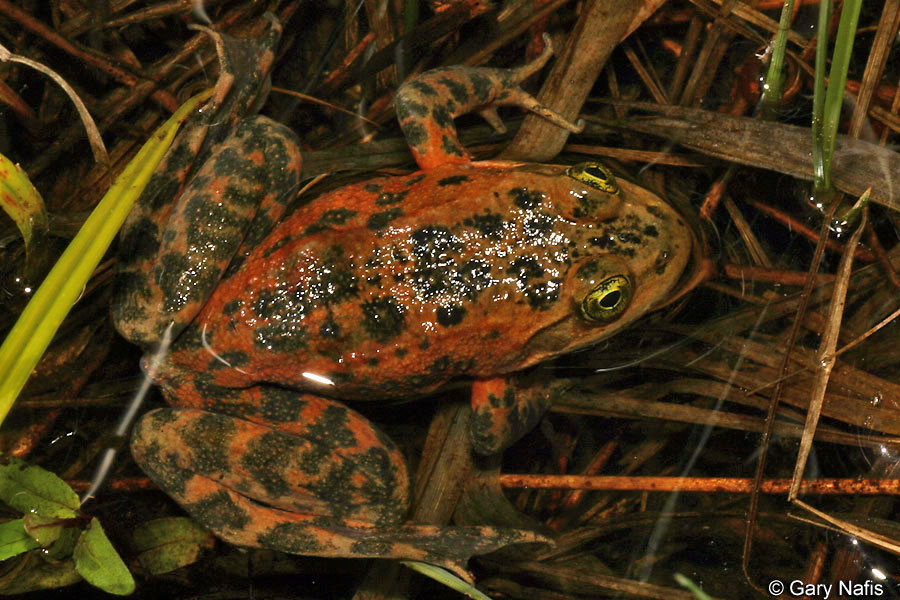
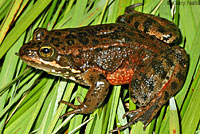
| Adult, Lane County, Oregon |
Adult, Lane County, Oregon |
 |
 |
 |
 |
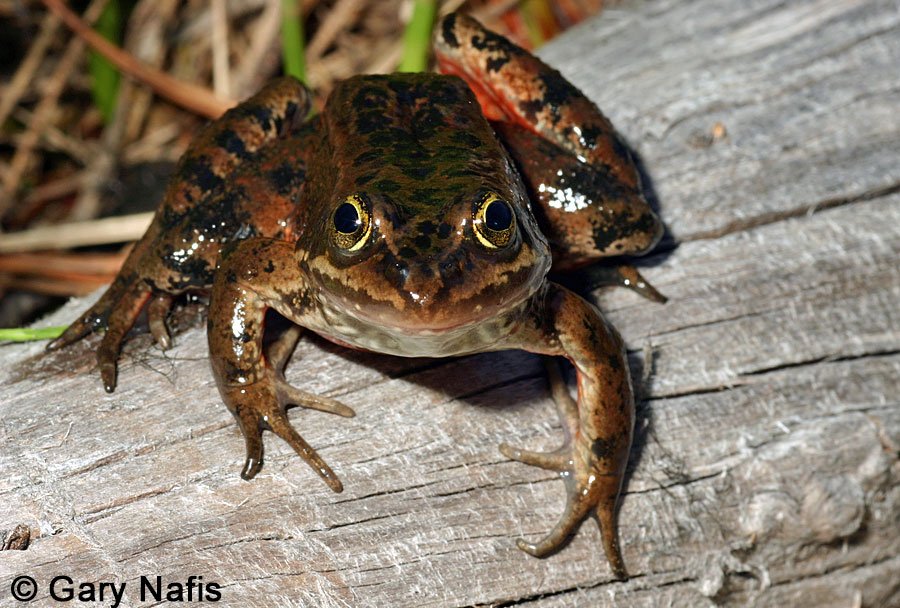
Adult, Lane County, Oregon
|
|
|
 |
 |
 |
 |
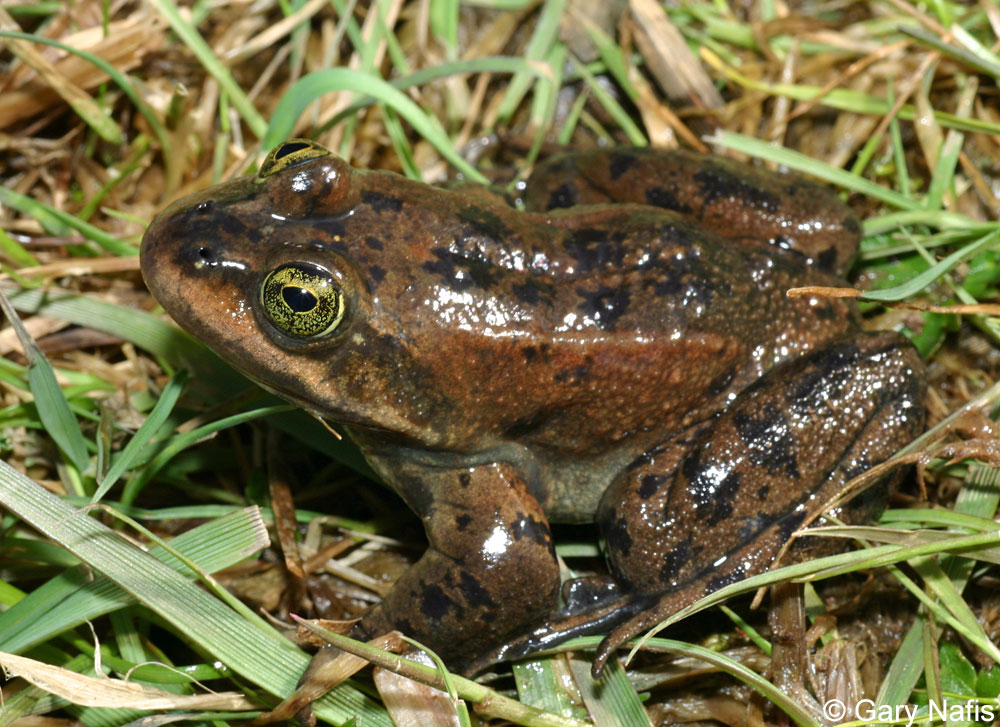
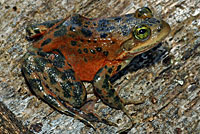
| Adult, Klickitat County, Washington |
 |
 |
 |
 |
| Adult, Klickitat County, Washington |
Adult, Klickitat County, Washington |
Adult, Klickitat County, Washington |
 |
 |
 |
 |
| Adult, Lane County, Oregon |
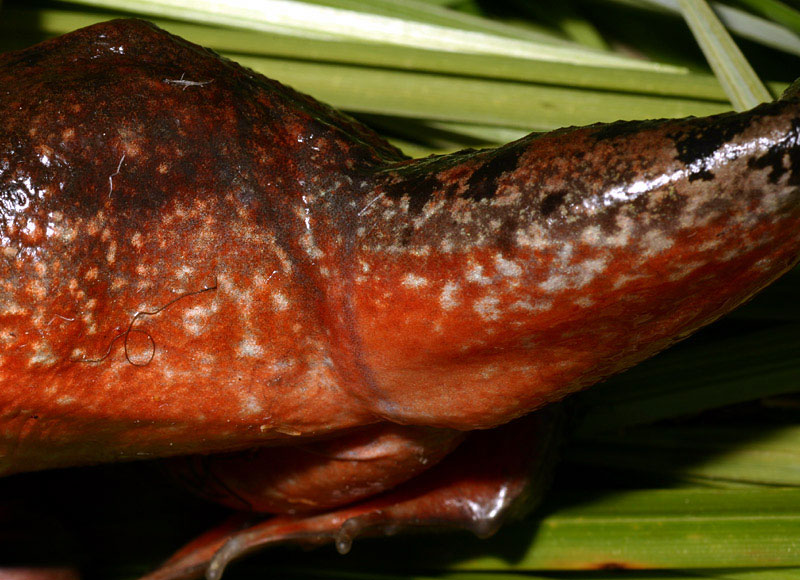
View of the groin are of an adult,
Lane County, Oregon |
Adult, Deschutes County, Oregon © Marcus Rehrman |
| |
|
|
|
| Juveniles |
 |
 |
 |
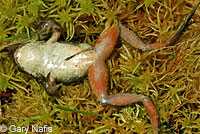 |
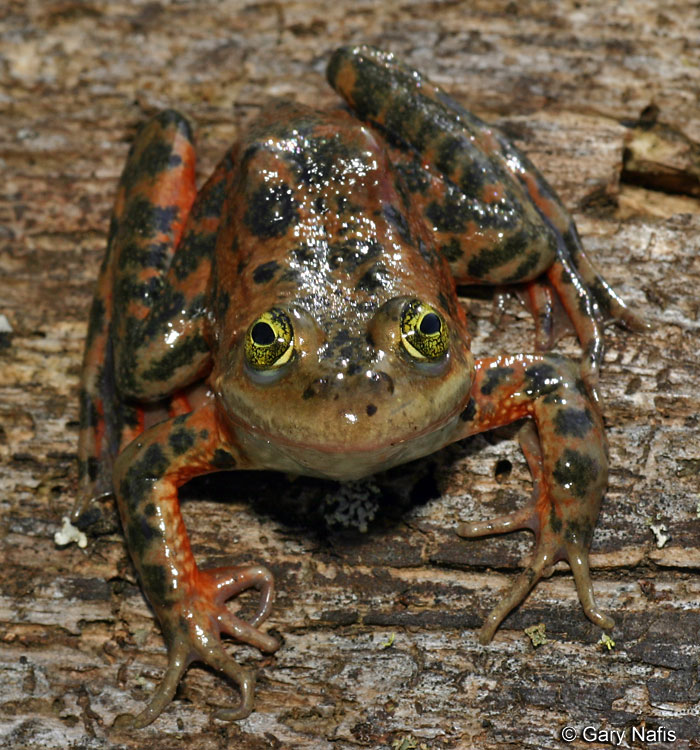
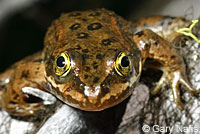
| Juvenile, Lane County, Oregon |
Juvenile, Lane County, Oregon |
Juvenile, Lane County, Oregon |
Juvenile, Lane County, Oregon |
| |
|
|
|
| Reproduction, Eggs, and Tadpoles |
 |
 |
 |
 |
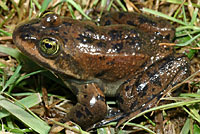
Adult male in the breeding season, Thurston County, Washington,
courtesy of Kelly McAllister,Washington Department of Fish and Wildlife. © Gary Nafis |
Breeding adult male, calling from shallow water, Thurston County, Washington |
 |
 |
 |
 |
Calling adult male,
Thurston County, Washington |
Newly-laid eggs,
Klickitat County, Washington. |
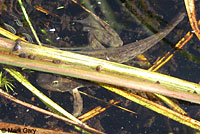
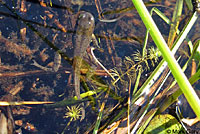
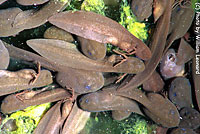
Mature tadpoles, Lane County, Oregon © Mark Gary |
 |
|
|
|
Tadpoles, Thurston Co., WA
© 1997 William Leonard |
|
|
|
| |
|
| Predation |
 |
 |
 |
 |
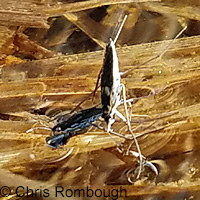
| Chris Rombough observed water striders (family Gerridae, aka water skippers, pond skaters, and jesus bugs) walking on the surface of the shallow edge of a pond in Deschutes County Oregon. The pond contained clusters of newly-hatched Oregon Spotted Frog, Rana pretiosa, tadpoles, which remained still in clusters on top of the degrading egg masses as frog egg embryos do before they disperse individually into the pond as developing tadpoles. In these pictures we see a water strider above the embryos capturing one of them, then two views of the strider as it begins to feed on it. © Chris Rombough |
This short video shows the water strider beginning to eat the embryo then moving away from a rival water strider.
© Chris Rombough |
| |
|
| Habitat |
 |
 |
|
|
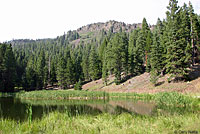
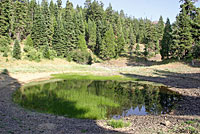
| Possible former habitat, west side of Warner Mountains near an old museum record locality for this species. |
Possible former habitat, 6500 ft.,
Warner Mountains, Modoc County |
|
|
| |
|
|
|
| Habitat Outside of California |
 |
 |
 |
 |
Habitat in breeding season,
Thurston County, Washington
|
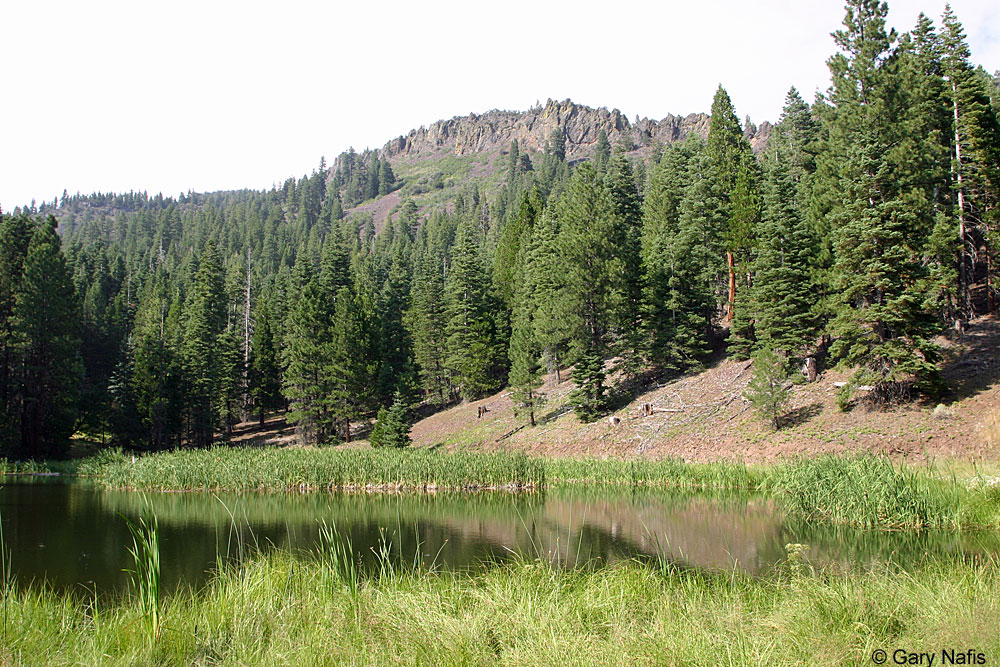
Habitat, summer, 5,000 ft.,
Lane County, Oregon |
Habitat during breeding season in March, 1,800 ft., Klickitat County, Washington. |
Habitat, late summer,
Klickitat County, Washington |
 |
|
|
|
More pictures of this frog's natural habitat in Washington and Oregon can be seen on the Northwest page.
|
| Short Video |
 |
|
|
|
| An Oregon Spotted frog sitting in a canal in southern Washington in late August. |
|
|
|
|
|
|
|
| Description |
| |
| Size |
Adults are 1 3/4 - 4 inches long from snout to vent (4.4 - 10.1 cm). Females are larger, males grow up to 3 in. long (7.5 cm).
|
| Appearance |
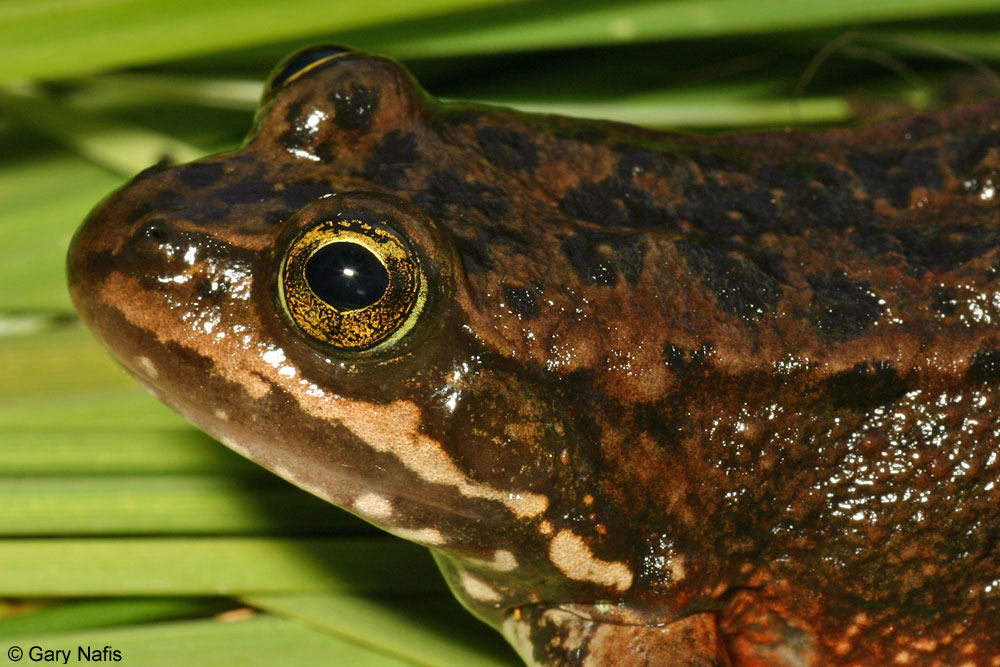
Brown, tan, olive green, or reddish above with small to large irregular black spots on the back, sides, and legs, usually with indistinct edges and light centers. The face mask is dull or absent. There is a light jaw stripe. Reddish below, on the sides, and underneath the legs. The reddish color appears to be superficially painted on the surface (compared to Rana aurora.) The groin is faintly mottled, or un-mottled and grayish. The hind legs are short. Eyes are turned slightly upward. Distinct dorsolateral folds.
Tadpoles are brown, with a light belly and grow to 1 3/4 in. long. (4.3 cm.)
|
| Life History and Behavior |
Our most aquatic native frog, rarely found more than 2 meters from surface water. At one site, adults are thought to move as much as 50 - 400 meters between their aquatic active season habitat and the overwintering habitat. Overwintering sites are channels or springs that do not freeze over completely. One recorded overwintering site is the mud bottom of a marshy lake fringe. Frogs often bury themselves in mud during winter, but may emerge on sunny days.
This species is fairly sluggish. To avoid danger, it typically swims a short distance and hides, or swims to the bottom to hide. |
| Voice (Listen) |
| A quiet series of rapid low-pitched clicks. Males call during the day while floating on the surface and underwater. Sunny, windless days are preferred. |
| Diet |
| Adults probably consume a wide variety of invertebrates, along with small vertebrates including small frogs. Frogs ambush their prey from water. Tadpoles consume algae and organic detritus. |
| Reproduction and Young |
Reproduction is aquatic.
Fertilization is external, with the male amplexing the female and releasing sperm as the female lays her eggs.
(Very little is known about the specific habits of the California populations of R. pretiosa.) At sites in Oregon and Washington, Mating and egg-laying begins as soon as snow melts or the temperature warms up sufficiently, from February at lowland locations to late June at higher elevation locations. Males gather in shallow water and make an advertisement call to attract females. Breeding is concentrated within a 1-2 week period, though it may extend to 4 weeks. Adults apparently move to breeding sites 1-2 weeks before eggs are laid. Males are thought to be reproductively mature at at 2 years and females in their 2nd or third year. Females apparently breed each year.
Breeding takes place in warm vegetated shallow water beside ponds or streams, or in flooded meadows. If temporary pools of water are used, permanent water must be very near for post-metamorphs.
Egg masses averaging 598 - 643 eggs are laid in large communal groups, which are only partly submerged, floating to the surface as they mature. Eggs hatch into tadpoles in 18 - 30 days.
Tadpoles transform during their first summer. At one site in Canada, they metamorphosed in 110 to 130 days. Eggs at a location in Oregon hatched in 95 days. Tadpoles prefer warm shallows with thick aquatic vegetation. Newly-metamorphosed froglets are around 3/4 in. long (1.6 - 2/3 cm).
|
| Habitat |
R. pretiosa inhabits aquatic environments mostly in mixed coniferous forests, preferring large marshy areas that are filled by warm water from springs. Found near cool, quiet, permanent water sources; slow streams that meander through meadows, sluggish streams and rivers, marshes, springs, pools, edges of small lakes, and ponds.
|
| Geographical Range |
Historically, this species ranged from extreme southwest British Columbia south through Washington and Oregon, to extreme northeast California, where it was known from only a few scattered localities including Pine Creek, S. Fork Pitt River near Alturas, Warner Mtns., and the southwest side of Lower Klamath Lake.
|
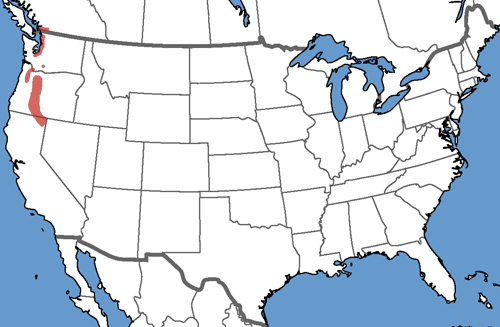 |
Red: Approximate historic range of Rana pretiosa - Oregon Spotted Frog
|
| Elevational Range |
Found at elevations from near sea level to 5,000 ft. (1,524 m.)
"Its known elevational range in California extends from ca. 1000 m [3280 ft.] (Fall River Mills, Shasta County...) to ca. 1450 m [4757 ft.] (Pine Creek near New Pine Creek (town), Modoc County; J. Brode, pers. comm.)." (Jennings and Hayes 1994)
|
| Notes on Taxonomy |
Rana pretiosa luteiventris and Rana pretiosa pretiosa were both recognized as subspecies of Rana pretiosa until 1996 when they were split into two species, based on genetic differences, but not morphological differences.
Marc Hayes told me in a personal communication that the spotted frogs from the eastern side of the Warner Mountains, including a recent record from Cedarville, are Rana luteiventris, while those on the western side are Rana pretiosa, the Oregon Spotted Frog. (The Jennings and Hayes 2004 California survey was made before the species was split.) However, I still show the Cedarville location on this range map because its species has not been confirmed yet as far as I know.
Alternate and Previous Names (Synonyms)
Rana pretiosa - Oregon Spotted Frog (Stebbins 2003, Stebbins & McGinnis 2012)
Rana pretiosa - Spotted Frog (Stebbins 1954, 1966, 1985)
Rana pretiosa pretiosa - Western Spotted Frog (Western Frog, Pacific Frog, Spotted Frog) (Wright & Wright 1949)
Rana pretiosa pretiosa - Western Spotted Frog (Storer 1925)
Rana pretiosa pretiosa - Western Spotted Frog (Grinnell and Camp 1917)
Rana pretiosa (Baird & Girard 1853)
|
| Conservation Issues (Conservation Status) |
Considered extirpated in California, but undiscovered isolated populations may still remain in the Warner Mountains,
Modoc County. Only one frog has been recorded in the last 15 years; a juvenile found in Cedarville, Modoc County, and this frog could actually be the species Rana luteiventris. (Marc Hayes, personal communication).
------------------------------------------------------------------------------------------------------------------------------------------------------------------------------------------------------------------------------
Rana pretiosa has undergone a significant decline in the last 50 years throughout its range. Estimates suggest that they have been extirpated in 70 - 90 percent of their native range. Invasive species such as bullfrogs and non-native fishes, and habitat alteration such as the degradation of wetlands by agriculture, flood control, and urbanization, have been mentioned as possible reasons for the decline. Loss of springs may have destroyed available overwintering sites. Degradation of wetlands from agricultural and urban land use also stresses frog populations.
------------------------------------------------------------------------------------------------------------------------------------------------------------------------------------------------------------------------------
There is a description and conservation status summary of this taxon with a dot-locality distribution map in an online .pdf from the California Department of Fish and Wildlife book California Amphibian and Reptile Species of Special Concern (Thomson, Wright, and Shaffer 2016). Below is some of the description of the conservation status of this species:
"The limited California range of Rana pretiosa and its apparent extirpation from the few known historic localities are the main drivers for its high score. The paucity of historical records in California suggests that this taxon may have historically been rare in the state, and its specialized ecological requirements (large permanent wetlands, specialized sub-habitats for breeding, hibernation, and growth) make it inherently sensitive to declines. Together, these factors justify a Priority 1 designation for this species." |
|
| Taxonomy |
| Family |
Ranidae |
True Frogs |
Rafinesque, 1814 |
| Genus |
Rana |
True Frogs |
Linnaeus, 1758 |
| Species |
pretiosa |
Oregon Spotted Frog
|
Baird and Girard, 1853 |
|
Original Description |
Baird and Girard, 1853 - Proc. Acad. Nat. Sci. Philadelphia, Vol. 6, p. 378
from Original Description Citations for the Reptiles and Amphibians of North America © Ellin Beltz
|
|
Meaning of the Scientific Name |
Rana - Latin = frog - probably mimics how the Romans heard their call
pretiosa - Latin = to be prized or worth the effort - may refer to vivid adult coloration.
from Scientific and Common Names of the Reptiles and Amphibians of North America - Explained © Ellin Beltz
|
|
Related or Similar California Frogs |
Rana draytonii
Rana aurora
Rana boylii
Rana cascadae
Lithobates pipiens
Lithobates catesbeiana
Lithobates yavapaiensis
Rana muscosa
Rana luteiventris
|
|
More Information and References |
California Department of Fish and Wildlife
There is a description and conservation status summary of this taxon with a dot-locality distribution map in an online .pdf from the California Department of Fish and Wildlife book California Amphibian and Reptile Species of Special Concern (Thomson, Wright, and Shaffer 2016).
AmphibiaWeb
Center for Bilogical Diversity
Hansen, Robert W. and Shedd, Jackson D. California Amphibians and Reptiles. (Princeton Field Guides.) Princeton University Press, 2025.
Stebbins, Robert C., and McGinnis, Samuel M. Field Guide to Amphibians and Reptiles of California: Revised Edition (California Natural History Guides) University of California Press, 2012.
Stebbins, Robert C. California Amphibians and Reptiles. The University of California Press, 1972.
Flaxington, William C. Amphibians and Reptiles of California: Field Observations, Distribution, and Natural History. Fieldnotes Press, Anaheim, California, 2021.
Nicholson, K. E. (ed.). 2025. Scientific and Standard English Names of Amphibians and Reptiles of North America North of Mexico, with Comments Regarding Confidence in Our Understanding. Ninth Edition. Society for the Study of Amphibians and Reptiles. [SSAR] 87pp.
Samuel M. McGinnis and Robert C. Stebbins. Peterson Field Guide to Western Reptiles & Amphibians. 4th Edition. Houghton Mifflin Harcourt Publishing Company, 2018.
Stebbins, Robert C. A Field Guide to Western Reptiles and Amphibians. 3rd Edition. Houghton Mifflin Company, 2003.
Behler, John L., and F. Wayne King. The Audubon Society Field Guide to North American Reptiles and Amphibians. Alfred A. Knopf, 1992.
Robert Powell, Roger Conant, and Joseph T. Collins. Peterson Field Guide to Reptiles and Amphibians of Eastern and Central North America. Fourth Edition. Houghton Mifflin Harcourt, 2016.
Powell, Robert., Joseph T. Collins, and Errol D. Hooper Jr. A Key to Amphibians and Reptiles of the Continental United States and Canada. The University Press of Kansas, 1998.
Corkran, Charlotte & Chris Thoms. Amphibians of Oregon, Washington, and British Columbia. Lone Pine Publishing, 1996.
Jones, Lawrence L. C. , William P. Leonard, Deanna H. Olson, editors. Amphibians of the Pacific Northwest. Seattle Audubon Society, 2005.
Leonard et. al. Amphibians of Washington and Oregon. Seattle Audubon Society, 1993.
Nussbaum, R. A., E. D. Brodie Jr., and R. M. Storm. Amphibians and Reptiles of the Pacific Northwest. Moscow, Idaho: University Press of Idaho, 1983.
American Museum of Natural History - Amphibian Species of the World 6.2
Bartlett, R. D. & Patricia P. Bartlett. Guide and Reference to the Amphibians of Western North America (North of Mexico) and Hawaii. University Press of Florida, 2009.
Elliott, Lang, Carl Gerhardt, and Carlos Davidson. Frogs and Toads of North America, a Comprehensive Guide to their Identification, Behavior, and Calls. Houghton Mifflin Harcourt, 2009.
Lannoo, Michael (Editor). Amphibian Declines: The Conservation Status of United States Species. University of California Press, June 2005.
Storer, Tracy I. A Synopsis of the Amphibia of California. University of California Press Berkeley, California 1925.
Wright, Albert Hazen and Anna Wright. Handbook of Frogs and Toads of the United States and Canada. Cornell University Press, 1949.
(Jennings, M.R. and M.P. Hayes. 1994. Amphibian and reptile species of special concern in California. California Department of Fish and Game, Inland Fisheries Division, Final report, Rancho Cordova, California).
Davidson, Carlos. Booklet to the CD Frog and Toad Calls of the Pacific Coast - Vanishing Voices. Cornell Laboratory of Ornithology, 1995.
Joseph Grinnell and Charles Lewis Camp. A Distributional List of the Amphibians and Reptiles of California. University of California Publications in Zoology Vol. 17, No. 10, pp. 127-208. July 11, 1917.
|
|
|
The following conservation status listings for this animal are taken from the July 2025 State of California Special Animals List and the July 2025 Federally Listed Endangered and Threatened Animals of California list (unless indicated otherwise below.) Both lists are produced by multiple agencies every year, and sometimes more than once per year, so the conservation status listing information found below might not be from the most recent lists, but they don't change a great deal from year to year.. To make sure you are seeing the most recent listings, go to this California Department of Fish and Wildlife web page where you can search for and download both lists:
https://www.wildlife.ca.gov/Data/CNDDB/Plants-and-Animals.
A detailed explanation of the meaning of the status listing symbols can be found at the beginning of the two lists. For quick reference, I have included them on my Special Status Information page.
If no status is listed here, the animal is not included on either list. This most likely indicates that there are no serious conservation concerns for the animal. To find out more about an animal's status you can also go to the NatureServe and IUCN websites to check their rankings.
Check the current California Department of Fish and Wildlife sport fishing regulations to find out if this animal can be legally pursued and handled or collected with possession of a current fishing license. You can also look at the summary of the sport fishing regulations as they apply only to reptiles and amphibians that has been made for this website.
|
| Organization |
Status Listing |
Notes |
| NatureServe Global Ranking |
G2 |
Imperiled |
| NatureServe State Ranking |
SH |
All California sites are historical; the element has not been seen in the state for at least 20 years, but suitable habitat still exists. |
| U.S. Endangered Species Act (ESA) |
FT |
Listed as Threatened 9/29/14 |
| California Endangered Species Act (CESA) |
None |
|
| California Department of Fish and Wildlife |
SSC |
Species of Special Concern |
| Bureau of Land Management |
S |
Sensitive |
| USDA Forest Service |
None |
|
| IUCN |
VU |
Vulnerable |
|
|
|