|
 |
 |
 |
| |
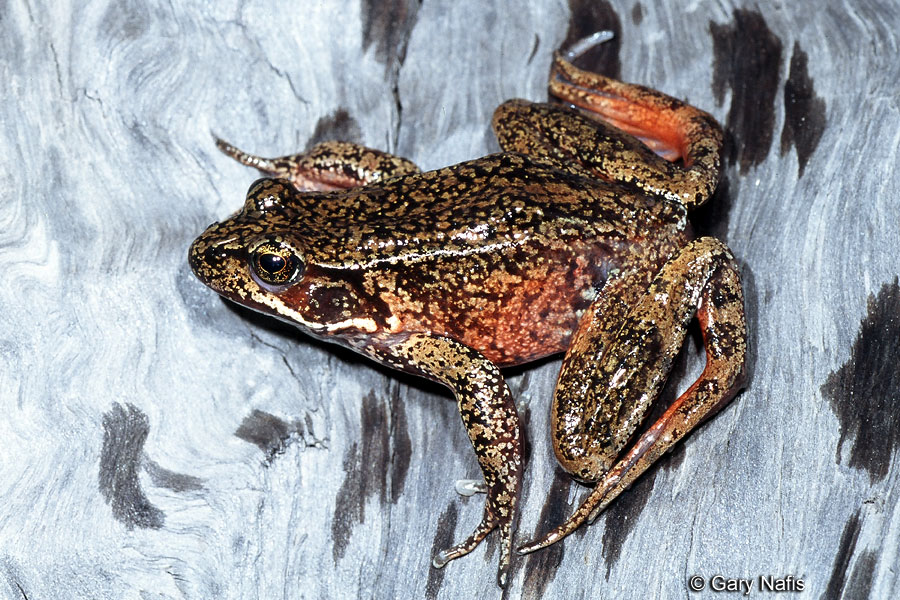
Adult Male, Humboldt County |
|
 |
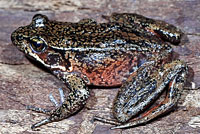 |
 |
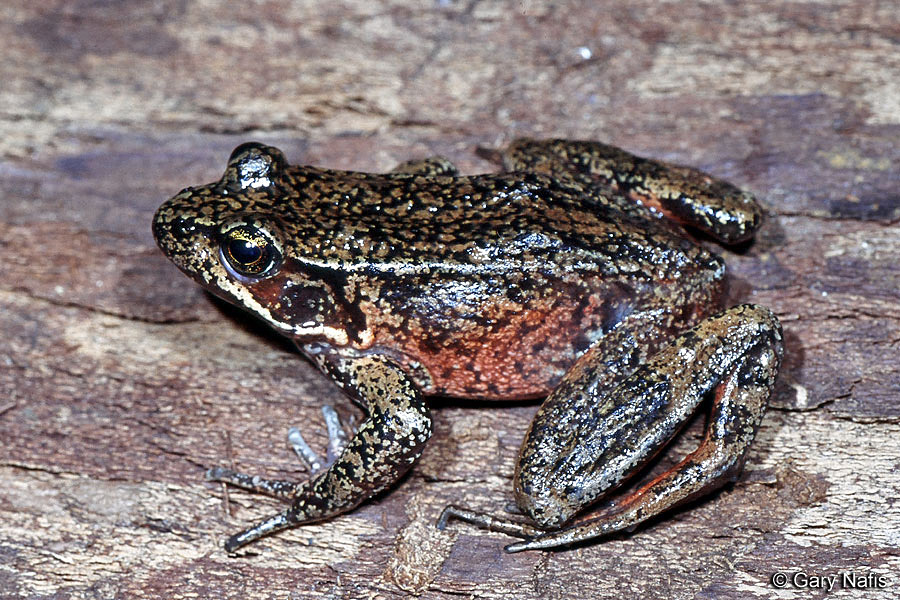
| Adult, Humboldt County |
 |
 |
 |
| Adult, Del Norte County © Alan Barron |
Adult, Humboldt County
© Andrew Harmer |
Adult, Del Norte County © Alan Barron |
 |
 |
 |
| Adult, Humboldt County © Ryan Sikola |
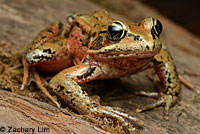
Adult, Humboldt County © Zachary Lim |
| |
 |
|
| |
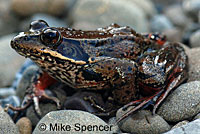
Adult, Mendocino County
© Mike Spencer
|
|
| |
|
|
| Juveniles |
 |
 |
 |
| Sub-adult, Del Norte County |
Sub-adult, Del Norte County |
| |
|
|
| Northern Red-legged Frogs From Outside California |
 |
 |
 |
| |
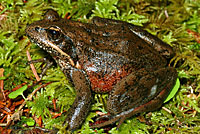
Adult, Pacific County, Washington |
|
| |
 |
|
| |
Adult, Multnomah County, Oregon |
|
| |
|
|
| Juveniles From Outside California |
 |
 |
 |
| Juvenile, 900 ft., Lewis County, Washington |
 |
 |
 |
| Sub-adult, Multnomah County, Oregon |
Sub-adult, Multnomah County, Oregon |
 |
 |
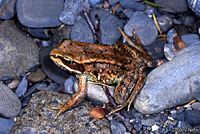 |
| Sub-adult, Multnomah County, Oregon |
Sub-adult, Multnomah County, Oregon |
Juvenile, Olympic Peninsula, Jefferson County, Washington |
| |
|
|
| Reproduction, Eggs, and Young |
 |
 |
 |
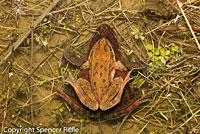
| Adults in amplexus, Humboldt County © Spencer Riffle |
Adult male and female in amplexus, Humboldt County © Maureen Krinsky |
 |
 |
 |
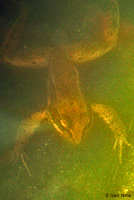
Breeding adult male, Humboldt County.
Left: throat with very reduced vocal sacs.
Right: the same frog calling underwater on the bottom of an artificial pond about 12 inches below the surface. |
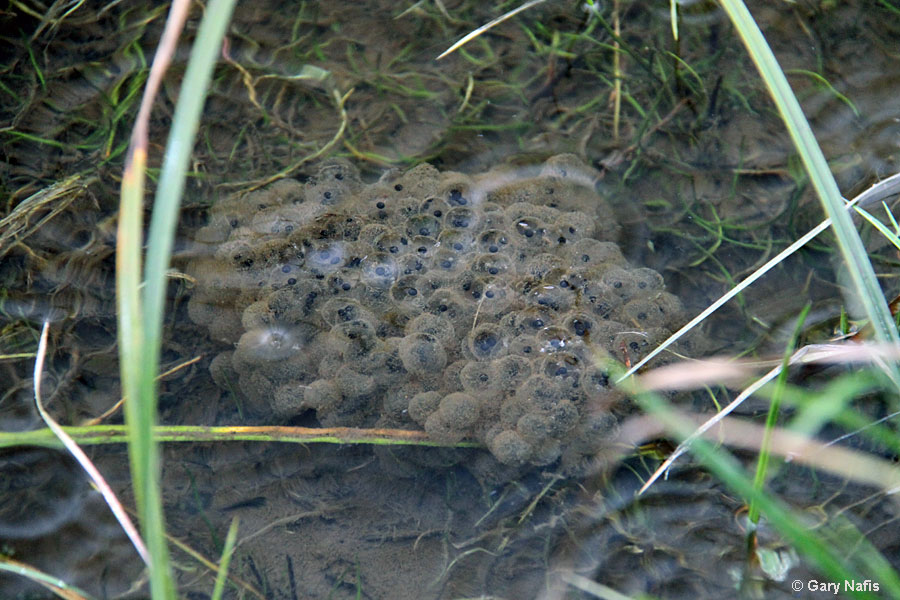
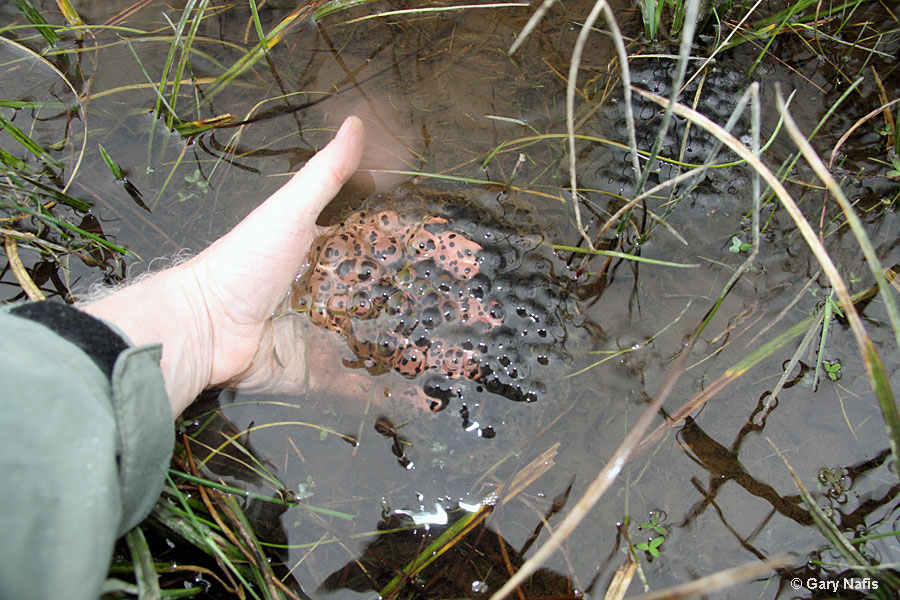
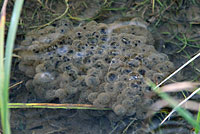
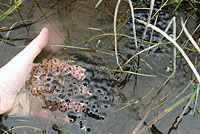
Eggs in early March, coastal
Humboldt County |
 |
 |
|
Eggs in early March, coastal
Humboldt County |
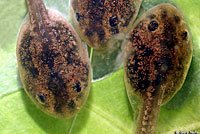
Tadpole eyes are set in from the margin of the head. Compare with P. regilla |
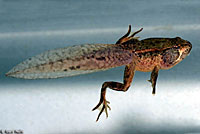
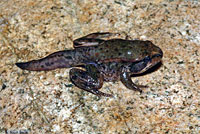
Mature Tadpole |
 |
 |
 |
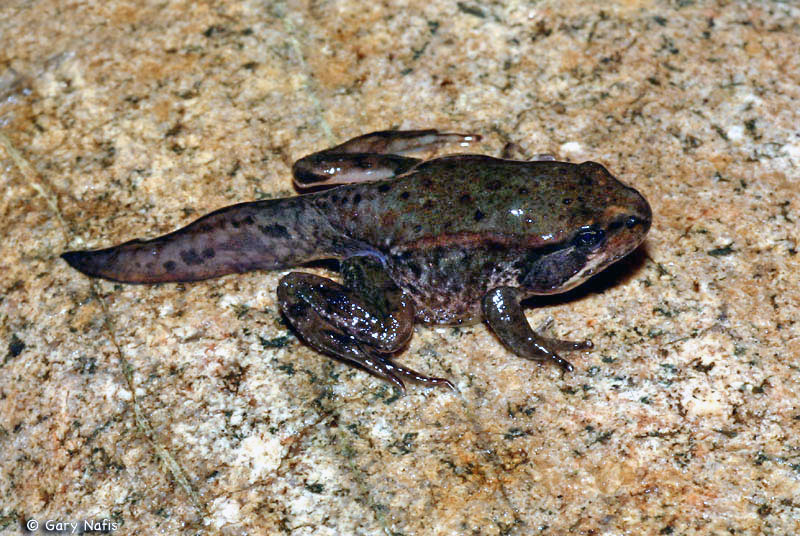
| Transforming tadpole |
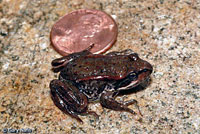
Tiny metamorph, first day on land, with tail not yet absorbed. |
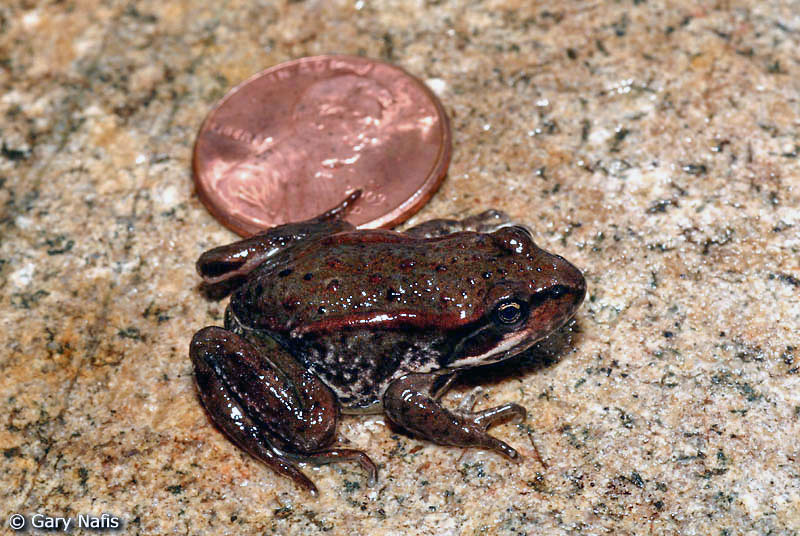
Tiny metamorph, fewer than
two weeks out of the water.
|
| |
|
|
You can see more pictures of Northern Red-legged Frog eggs, tadpoles and juveniles Here.
|
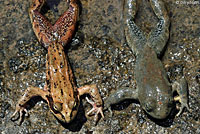
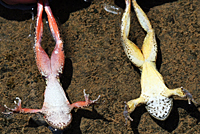
Comparison of Rana aurora - Northern Red-legged Frog with similar sympatric
Rana boylii - Foothill Yellow-legged Frog
|
 |
 |
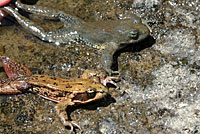 |
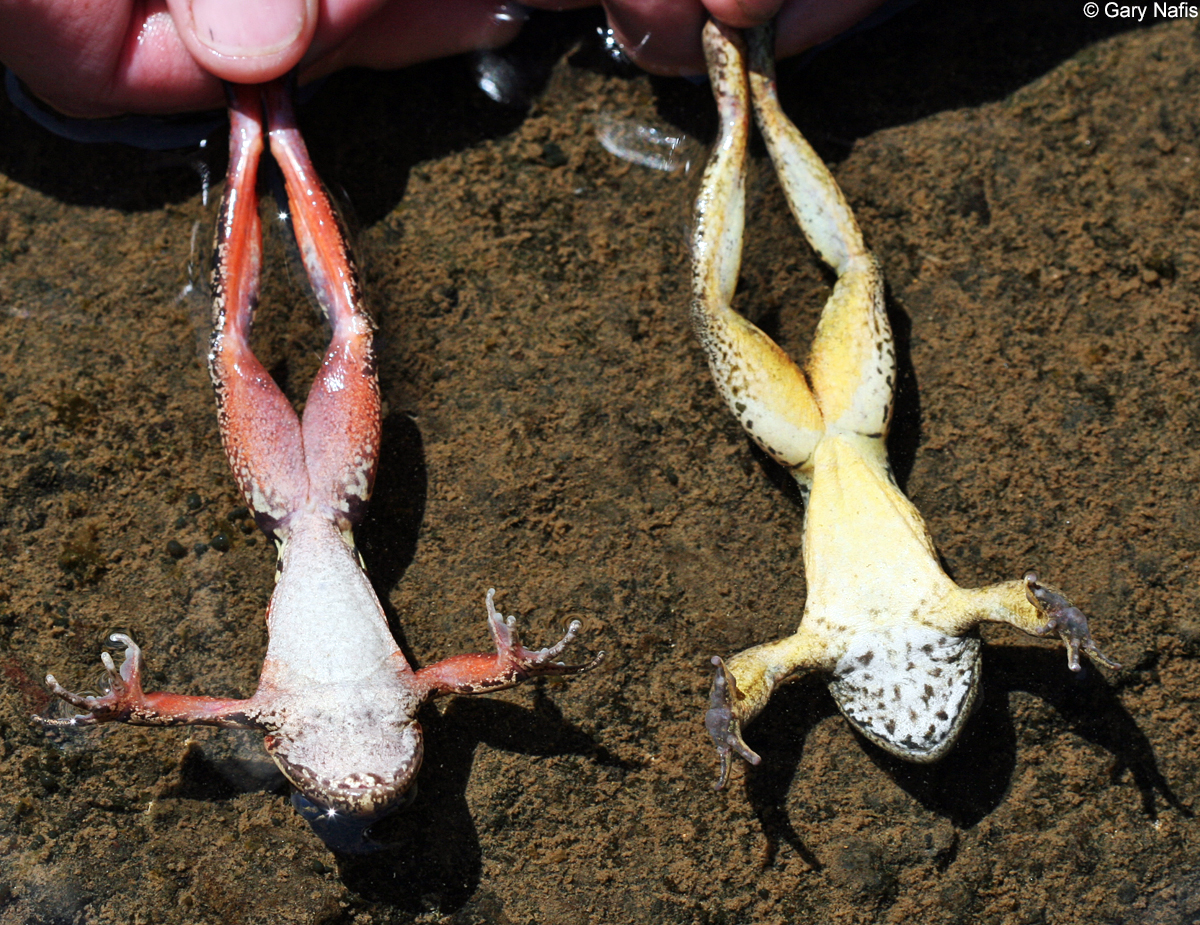
Left: Adult Rana aurora - Northern Red-legged Frog
Right: Adult Rana boylii - Foothill Yellow-legged Frog
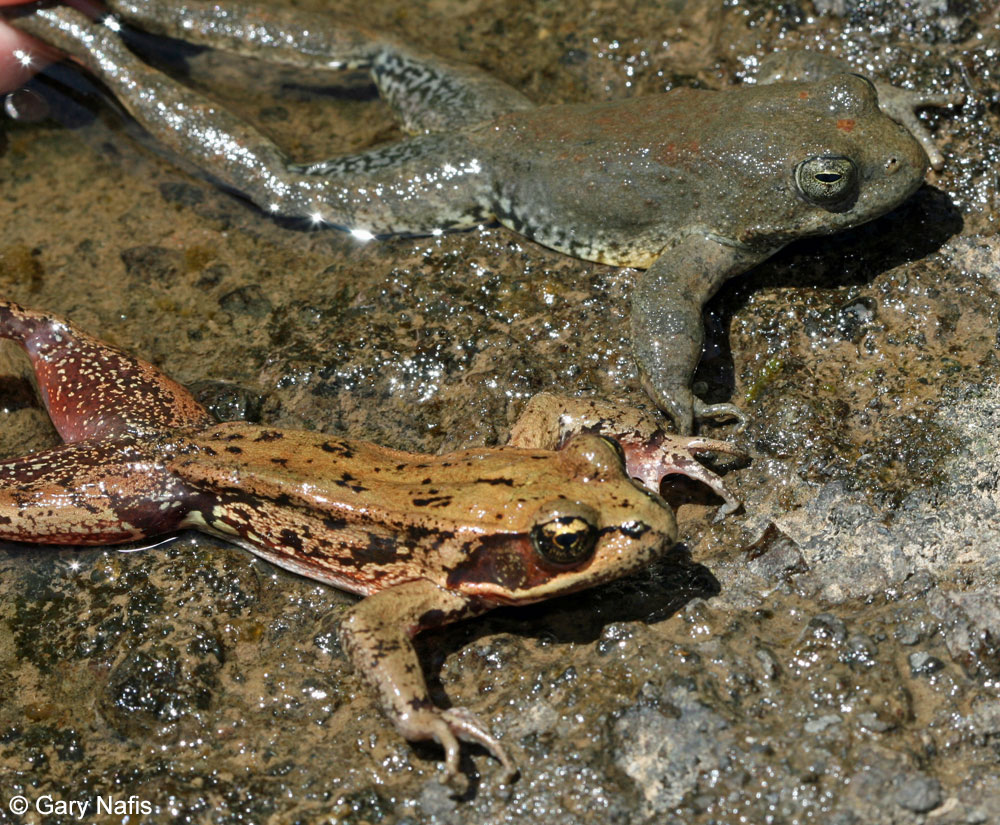
Both frogs were found near each other in the same river in Linn County, Oregon.
|
Top: Rana boylii
Bottom: Rana aurora |
| |
|
|
| Habitat |
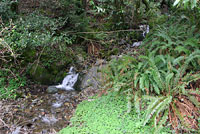 |
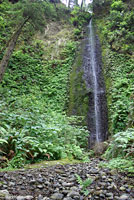 |
 |
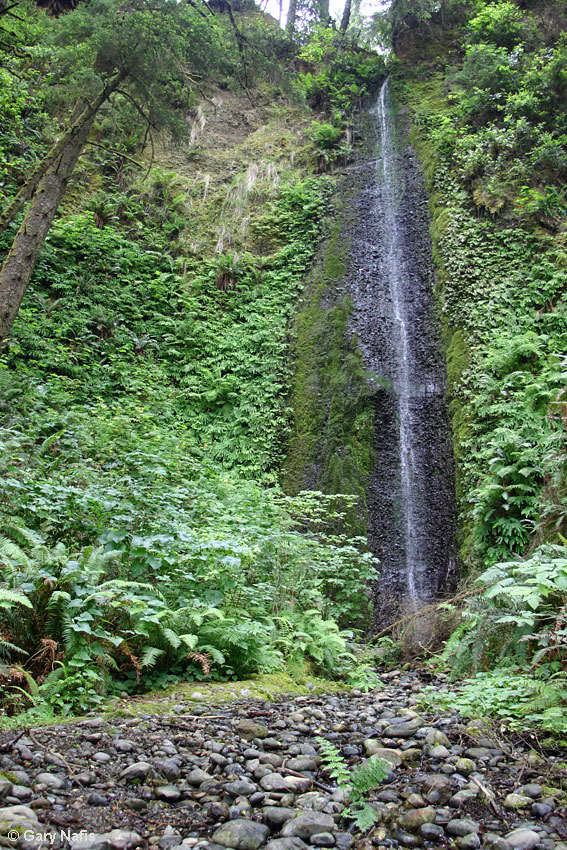
| Habitat, Del Norte County |
Habitat, Humboldt County |
Habitat, Humboldt County |
 |
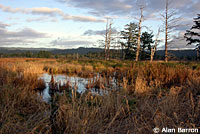 |
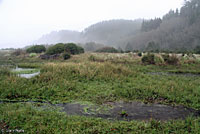 |
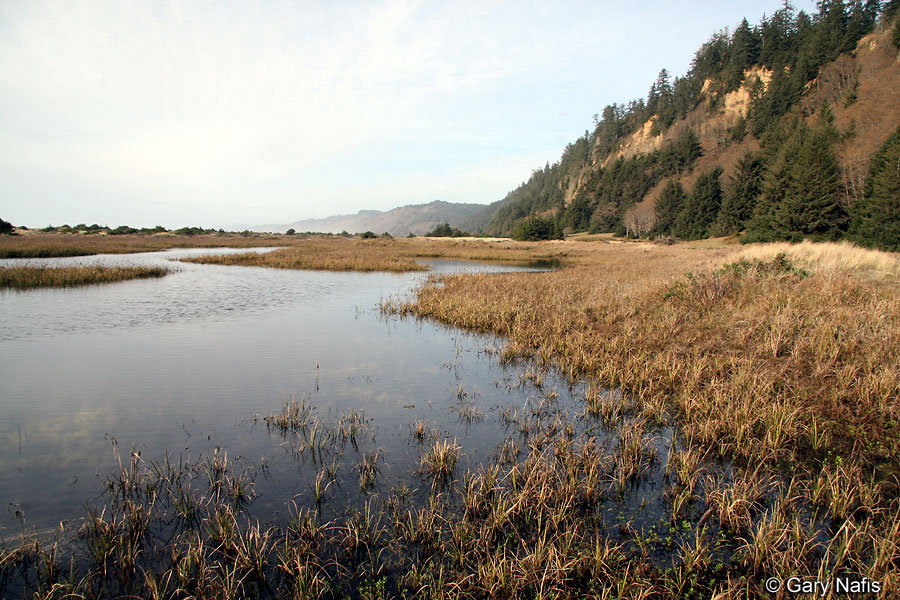
Habitat, temporary pools on coastal plain, Humboldt County
|
Breeding habitat, Del Norte County
© Alan Barron |
Breeding waters with eggs in early March, Humboldt County |
| |
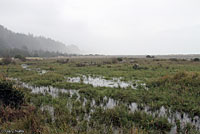 |
|
| |
Breeding waters with eggs in early March, Humboldt County |
|
| |
|
|
You can see more pictures of this frog and its habitat on our Northwest Herps page.
|
| Short Videos |
 |
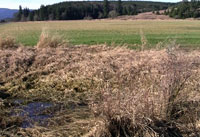 |
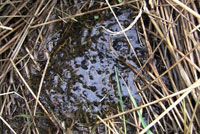 |
| A Northern Red-legged Frog on a late summer day. |
Northern Red-legged Frog breeding habitat with eggs in Washington. |
More Northern Red-legged Frog breeding habitat with eggs in Washington. |
|
|
|
| Description |
| |
| Size |
Adults are 1.75 to 3 inches long from snout to vent ( 4.4 - 7.6 cm).
|
| Appearance |
A medium-sized frog with a slim waist, long legs, smooth skin and webbing on the hind feet.
Ridges on the sides (dorsolateral folds) are prominent.
Legs are relatively long.
The eyes are outward oriented. |
| Color and Pattern |
Coloring is reddish -brown or brown, gray, or olive, with small black flecks and spots on the back and sides and dark banding on the legs.
Dark blotches marking the back typically have no light coloring in the center.
There is a dark mask on the head and a stripe extending from the shoulder to the front of the upper jaw.
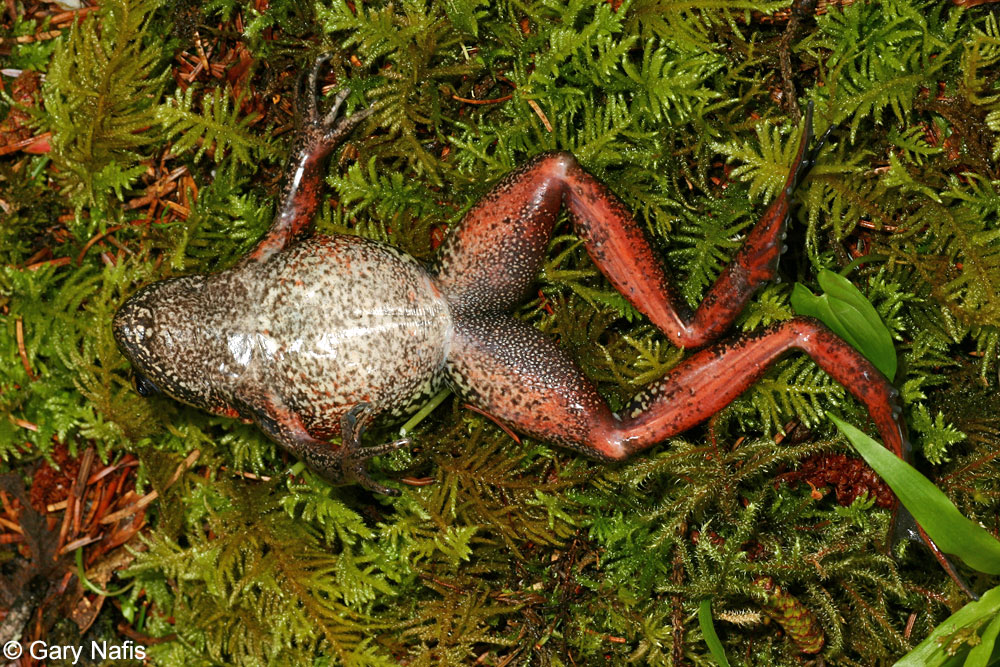
The hind legs and lower belly are red underneath, giving this frog its name.
On older frogs the red coloring extends onto the belly and sides.
The chest and throat are creamy and marbled with dark gray.
Yellowish-green and black coloring mottles the groin.
|
| Male/Female Differences |
| Males develop enlarged forearms and a dark nuptial pad on each thumb during the breeding season. |
| Young |
| Often the coloring under the legs and lower belly is yellowish. |
| Larvae (Tadpoles) |
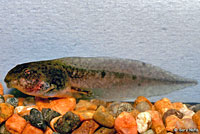
Tadpoles are brown marked with small dark spots with eyes set in from the margin of the head. (Compare with P. regilla.)
Creamy white coloring flecked with small spots covers the lower body.
Rows of dorsolateral light spots may be evident running back from behind the eyes.
|
| Comparing Red-legged Frogs and Yellow-legged Frogs and Bullfrogs |
| |
| Life History and Behavior |
| Activity |
Primarily diurnal.
Typically a pond frog, found in or near water, but Northern Red-legged Frogs can be wide-ranging and highly terrestrial, sometimes inhabiting damp places far from water. (A study of Rana aurora in Oregon re-captured an adult female frog that had moved almost 3 miles (4.8 km) from her known breeding pond. Herpetological Review 38-2-07)
In the northern part of the range and at higher elevations, adults probably hibernate during winter freezes.
|
| Movement |
| Long rear legs give this frog excellent leaping ability, which it relies on to avoid predators by quickly leaping into vegetation or water. |
| Defense |
Frogs remain immobile to avoid detection, but when a threat gets too close, they will quickly leap off into the brush or water.
|
Territoriality
|
Not considered territorial, but breeding males act aggressively with each other at breeding sites.
Egg masses are laid separately, unlike other northwestern ranid frogs such as R. cascadae and R. luteiventris where females lay their eggs on other egg masses. |
| Longevity |
| In captivity, this species is known to live to more than ten years. |
| Voice (Listen) |
| The call is a very quiet weak series of 5 - 7 notes, sounding like uh-uh-uh-uh-uh, lasting 1 - 3 seconds. Calls during the day or night, typically for only one or two weeks at a location (sometimes longer). Calls are typically made underwater and are easily missed because they are either not audible or very low in volume when heard in the air. Frogs may also call in the air where they are sometimes audible from a small distance. Listen here. According to Stebbins (2003) Rana aurora north of the Smith River in Del Norte County do not have vocal sacs, while frogs from Del Norte County south have rudimentary vocal sacs. |
| Diet and Feeding |
| Eats a wide variety of invertebrates. Typical of most frogs, the prey is located by vision, then a large sticky tongue is used to catch the prey and bring it into the mouth to eat. |
| Reproduction |
Reproduction is aquatic.
Fertilization is external, with the male grasping the back of the female and releasing sperm as the female lays her eggs.
The reproductive cycle is similar to that of most North American Frogs and Toads. Mature adults come into breeding condition and the males call to advertise their fitness to competing males and to females. Males and females pair up in amplexus in the water where the female lays her eggs as the male fertilizes them externally. The eggs hatch into tadpoles which feed in the water and eventually grow four legs, lose their tails and emerge onto land where they disperse into the surrounding territory.
Males typically become reproductively mature at 2 years, females at 3 years of age.
Males develop enlarged forearms and a dark nuptial pad on each thumb during the breeding season.
Breeding and egg-laying occurs in vegetated shallows with little water flow in permanent wetlands and temporary pools which last long enough for tadpoles to transform.
Some sources state that breeding takes place in January and February, others as early as October with large numbers of frogs arriving in November and December in Oregon and Northern California. (I have witnessed breeding in Humboldt County as late as early March.)
Breeding lasts for only a week or two at a location. Afterwards, adults move back into nearby moist forests and riparian areas, sometimes traveling more than a thousand feet.
|
| Eggs |
Females lay an average of 530 - 830 eggs (ranging from 100 - 1,100) in a large gelatinous oval cluster which is attached to vegetation beneath the water. Egg clusters are dispersed, not laid together in a communal mass.
The egg mass will eventually float to the surface.
Eggs hatch after about four weeks. |
| Tadpoles and Young |
Tadpoles metamorphose in three to five months.
Recently-transformed juveniles often stay at the edge of their birth pond for a few days or weeks before dispersing into nearby moist dense vegetation.
|
| Habitat |
Found in humid forests, woodlands, grasslands, and stream edges with plant cover.
Most common in lowlands or foothills.
Frequently found in woods adjacent to streams.
Breeding habitat is in permanent water sources; lakes, ponds, reservoirs, slow streams, marshes, bogs, and swamps.
|
| Geographical Range |
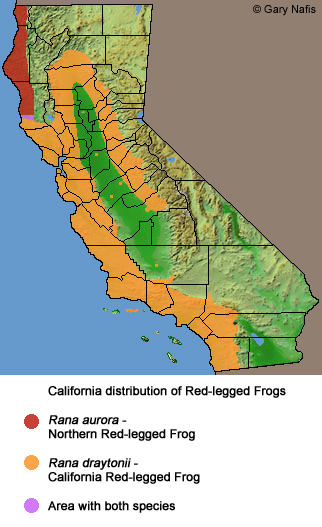
Ranges from Mendocino County in Northern California north along the west coast through Oregon and Washington, west of the Cascades Mountains, on Vancouver Island, and along the southwestern coast of British Columbia.
Rana aurora was introduced from Washington State to Chichagof Island in Alaska in 1982. The population has successfully reproduced and spread into nearby wetlands.
See: Alaska Deptment of Fish and Game Page & 2007 Population Status Report
A narrow range overlap with Rana draytonii (about 5 km) occurs in Mendocino County: Shaffer et. al. in research for their 2004 paper found only Rana aurora north of Big River, Mendocino County, both Rana aurora and Rana draytonii between Big River and Mills Creek, Mendocino County, and only Rana draytonii south of Mills Creek.
|
 |
| Elevational Range |
Found at elevations from sea level to 4,680 ft. (1427 m.)
|
| Notes on Taxonomy |
Before being separated into two species, two subspecies of Rana aurora were recognized: R. a. aurora, and R. a. draytonii. Frogs in the very large area between Del Norte County and the Walker Creek drainage in Marin County were considered to be intergrades.
Schaeffer et al. in a 2004 genetics study determined that R. aurora actually consists of two species, R. aurora, and R. draytonii, whose ranges overlap only in a narrow zone in Mendocino County. R. aurora is found to be closely related to R. cascadae. Other studies, including an analysis of vocal sacs, have supported separate species status, concluding that R. aurora and R. draytonii are biologically quite different.
Alternate and Previous Names (Synonyms)
Rana aurora aurora - Northern Red-legged Frog (Stebbins 1966 1985, 2003)
Rana aurora aurora - Oregon Red-legged Frog (Western Wood Frog) (Wright & Wright 1949)
Rana aurora aurora - Oregon Red-legged Frog (Storer 1925)
Rana aurora aurora - Oregon Red-legged Frog (Grinnell and Camp 1917)
Rana aurora (Baird & Girard 1852)
|
| Conservation Issues (Conservation Status) |
| No serious threats to this species have been documented, but the state regards it as a species worth monitoring. Introduced predators including American Bullfrogs, and water quality degradation could be negatively affecting the species. |
|
| Taxonomy |
| Family |
Ranidae |
True Frogs |
Rafinesque, 1814 |
| Genus |
Rana |
True Frogs |
Linnaeus, 1758 |
| Species |
aurora |
Northern Red-legged Frog
|
Baird and Girard, 1852 |
|
Original Description |
Baird and Girard, 1852 - Proc. Acad. Nat. Sci. Philadelphia, Vol. 6, p. 174
from Original Description Citations for the Reptiles and Amphibians of North America © Ellin Beltz
|
|
Meaning of the Scientific Name |
Rana - Latin = frog - probably mimics how the Romans heard their call
aurora - Latin -=dawn, red - referring to the red color of the underside of the hind legs.
from Scientific and Common Names of the Reptiles and Amphibians of North America - Explained © Ellin Beltz
|
|
Related or Similar California Frogs |
Rana boylii
Lithobates catesbeiana
Lithobates yavapaiensis
Rana draytonii
Rana pretiosa
Lithobates pipiens
|
|
More Information and References |
California Department of Fish and Wildlife
AmphibiaWeb
Hansen, Robert W. and Shedd, Jackson D. California Amphibians and Reptiles. (Princeton Field Guides.) Princeton University Press, 2025.
Stebbins, Robert C., and McGinnis, Samuel M. Field Guide to Amphibians and Reptiles of California: Revised Edition (California Natural History Guides) University of California Press, 2012.
Stebbins, Robert C. California Amphibians and Reptiles. The University of California Press, 1972.
Flaxington, William C. Amphibians and Reptiles of California: Field Observations, Distribution, and Natural History. Fieldnotes Press, Anaheim, California, 2021.
Nicholson, K. E. (ed.). 2025. Scientific and Standard English Names of Amphibians and Reptiles of North America North of Mexico, with Comments Regarding Confidence in Our Understanding. Ninth Edition. Society for the Study of Amphibians and Reptiles. [SSAR] 87pp.
Shaffer, H. Bradley, G. M. Fellers, S. Randal Voss, J. C. Olive and Gregory B. Pauly (2004 Species boundaries, phylogeography and conservation genetics of the red-legged frog (Rana aurora/draytonii) complex. Molecular Ecology 13(9): 2667-2677)
Samuel M. McGinnis and Robert C. Stebbins. Peterson Field Guide to Western Reptiles & Amphibians. 4th Edition. Houghton Mifflin Harcourt Publishing Company, 2018.
Stebbins, Robert C. A Field Guide to Western Reptiles and Amphibians. 3rd Edition. Houghton Mifflin Company, 2003.
Behler, John L., and F. Wayne King. The Audubon Society Field Guide to North American Reptiles and Amphibians. Alfred A. Knopf, 1992.
Robert Powell, Roger Conant, and Joseph T. Collins. Peterson Field Guide to Reptiles and Amphibians of Eastern and Central North America. Fourth Edition. Houghton Mifflin Harcourt, 2016.
Powell, Robert., Joseph T. Collins, and Errol D. Hooper Jr. A Key to Amphibians and Reptiles of the Continental United States and Canada. The University Press of Kansas, 1998.
Corkran, Charlotte & Chris Thoms. Amphibians of Oregon, Washington, and British Columbia. Lone Pine Publishing, 1996.
Jones, Lawrence L. C. , William P. Leonard, Deanna H. Olson, editors. Amphibians of the Pacific Northwest. Seattle Audubon Society, 2005.
Leonard et. al. Amphibians of Washington and Oregon. Seattle Audubon Society, 1993.
Nussbaum, R. A., E. D. Brodie Jr., and R. M. Storm. Amphibians and Reptiles of the Pacific Northwest. Moscow, Idaho: University Press of Idaho, 1983.
American Museum of Natural History - Amphibian Species of the World 6.2
Bartlett, R. D. & Patricia P. Bartlett. Guide and Reference to the Amphibians of Western North America (North of Mexico) and Hawaii. University Press of Florida, 2009.
Elliott, Lang, Carl Gerhardt, and Carlos Davidson. Frogs and Toads of North America, a Comprehensive Guide to their Identification, Behavior, and Calls. Houghton Mifflin Harcourt, 2009.
Lannoo, Michael (Editor). Amphibian Declines: The Conservation Status of United States Species. University of California Press, June 2005.
Storer, Tracy I. A Synopsis of the Amphibia of California. University of California Press Berkeley, California 1925.
Wright, Albert Hazen and Anna Wright. Handbook of Frogs and Toads of the United States and Canada. Cornell University Press, 1949.
Davidson, Carlos. Booklet to the CD Frog and Toad Calls of the Pacific Coast - Vanishing Voices. Cornell Laboratory of Ornithology, 1995.
Joseph Grinnell and Charles Lewis Camp. A Distributional List of the Amphibians and Reptiles of California. University of California Publications in Zoology Vol. 17, No. 10, pp. 127-208. July 11, 1917.
|
|
|
The following conservation status listings for this animal are taken from the July 2025 State of California Special Animals List and the July 2025 Federally Listed Endangered and Threatened Animals of California list (unless indicated otherwise below.) Both lists are produced by multiple agencies every year, and sometimes more than once per year, so the conservation status listing information found below might not be from the most recent lists, but they don't change a great deal from year to year.. To make sure you are seeing the most recent listings, go to this California Department of Fish and Wildlife web page where you can search for and download both lists:
https://www.wildlife.ca.gov/Data/CNDDB/Plants-and-Animals.
A detailed explanation of the meaning of the status listing symbols can be found at the beginning of the two lists. For quick reference, I have included them on my Special Status Information page.
If no status is listed here, the animal is not included on either list. This most likely indicates that there are no serious conservation concerns for the animal. To find out more about an animal's status you can also go to the NatureServe and IUCN websites to check their rankings.
Check the current California Department of Fish and Wildlife sport fishing regulations to find out if this animal can be legally pursued and handled or collected with possession of a current fishing license. You can also look at the summary of the sport fishing regulations as they apply only to reptiles and amphibians that has been made for this website.
2023 Special Animals List Notes:
An mtDNA study (Shaffer et al. 2004) concluded that Rana aurora aurora and Rana aurora draytonii should be recognized as separate species with a narrow zone of overlap
|
| Organization |
Status Listing |
Notes |
| NatureServe Global Ranking |
G4 |
Apparently Secure
|
| NatureServe State Ranking |
S3 |
Vulnerable
|
| U.S. Endangered Species Act (ESA) |
None |
|
| California Endangered Species Act (CESA) |
None |
|
| California Department of Fish and Wildlife |
SSC |
Species of Special Concern |
| Bureau of Land Management |
None |
|
| USDA Forest Service |
S |
Sensitive |
| IUCN |
LC |
Least Concern |
|
|
|