|
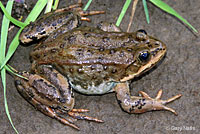
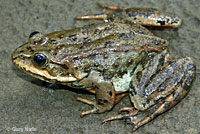
I have no pictures yet of this frog from California. All pictures are of frogs found outside California.
|
 |
 |
 |
| |
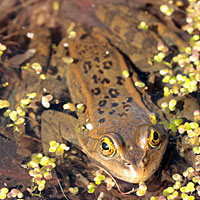
Adult, Yakima County, Washington |
|
 |
 |
 |
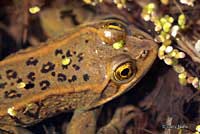
| Adult, Kittitas County, Washington |
Adult, Kittitas County, Washington |
 |
 |
 |
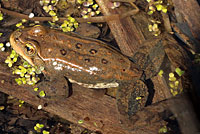
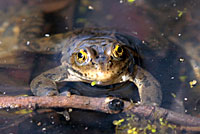
| Adult, Kittitas County, Washington |
Adult, Kittitas County, Washington |
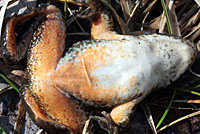
Underside of adult,
Kittitas County, Washington |
 |
 |
 |
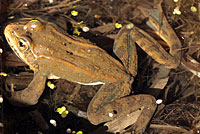
| Adult, Kittitas County, Washington |
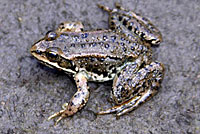
Juvenile, Yakima County, Washington |
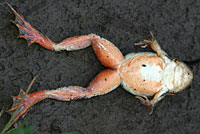
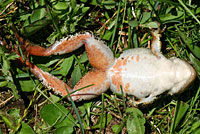
Underside of adult,
Yakima County, Washington |
 |
 |
 |
| Adult, Park County, Wyoming |
Underside of adult,
Park County, Wyoming |
| |
|
| Reproduction Adults, Eggs and Tadpoles |
 |
 |
 |
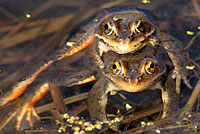
Male and female in amplexus,
Kittitas County, Washington |
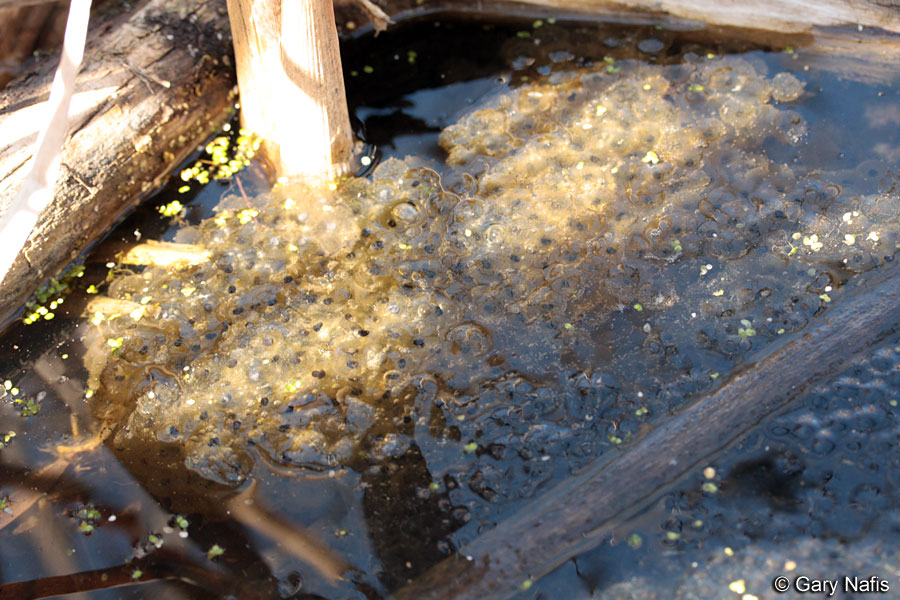
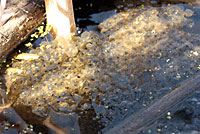
Egg mass, Kittitas County, Washington |
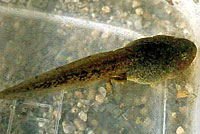
Tadpole, Spokane County, Washington |
More pictures of breeding and eggs can be seen here.
|
| Habitat |
| |
 |
|
| |
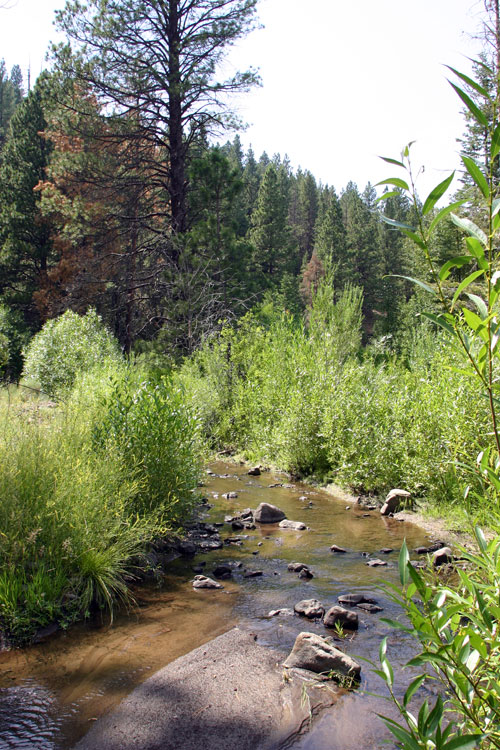
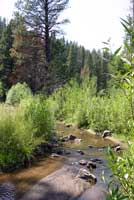
This creek on the east side of the Warner Mountains in Modoc County is an old recorded locality for Spotted Frogs.
|
|
| |
|
|
| Short Videos |
 |
 |
 |
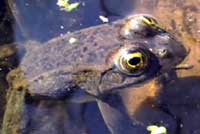
| Views of Columbia Spotted Frogs during the breeding season, including lots of breeding males sitting in the pond, huge egg masses, and a quick look at the breeding habitat. No sound. |
Male Columbia Spotted Frogs in a breeding pond in call underwater and chase each other around an amplexing pair. |
Several male Columbia Spotted Frogs in a breeding pond call in the air while floating on the water, followed by a male diving, calling underwater, then surfacing. |
 |
 |
 |
| A male Columbia Spotted Frog in a breeding pond calls in the air. When he is joined by three other frogs, he calls underwater, chases one and grabs on. We hear release calls made underwater, then he lets go and surfaces. |
A male Columbia Spotted Frog in a breeding pond calls in the air while floating on the water, then dives and calls underwater. |
A male Columbia Spotted Frog in a breeding pond calls above and below the water as he chases another frog. |
|
|
|
| Description |
| |
| Size |
1 3/4 to 4 inches (10.1 cm) in length from snout to vent.
|
| Appearance |
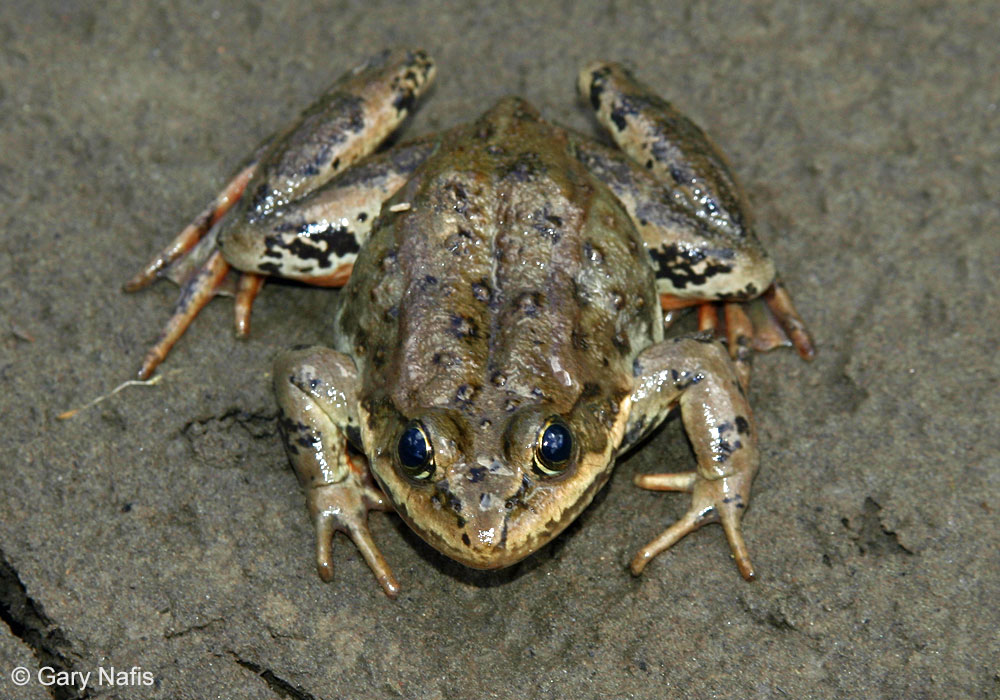
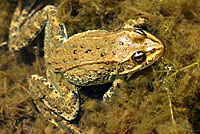
A medium-sized frog with a slim waist, long legs, smooth skin and webbing on the hind feet.
Ridges on the sides (dorsolateral folds) are prominent.
There is extensive webbing between the toes of the hind feet, suiting this frog's highly-aquatic lifestyle.
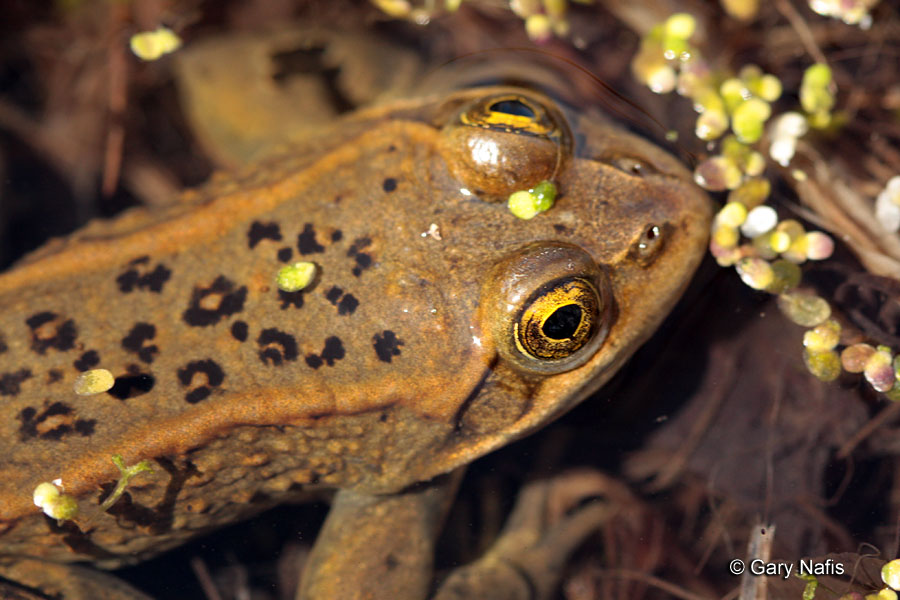
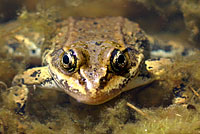
The eyes are upturned (compared with some other ranid frogs whose eyes are oriented more to the sides.
This species is very similar in appearance to the Oregon Spotted Frog, so geographic location must be taken into account when identifying either species. |
| Color and Pattern |
Dorsal ground color varies from brown, tan, olive green, gray, rusty to red, often to match the environment.
The dark blackish spots which give this species its name and which mark the back and legs are irregular in shape with lighter color in their centers.
The groin is not prominently mottled.
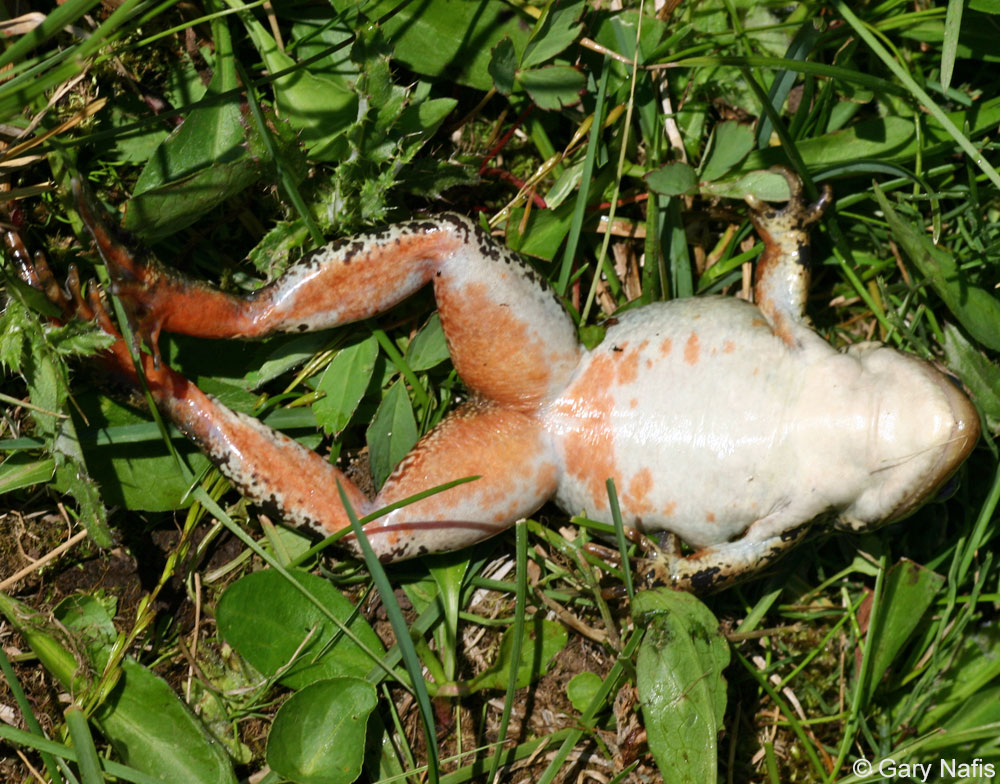
The underside is cream colored with a thin salmon, orange or yellow wash along the legs and abdomen which can gradually intensify and broaden to cover the entire underside up to the throat as the frog ages. |
| Young |
| Ventral pigmentation is weak or absent on juveniles. |
| Larvae (Tadpoles) |
Tadpoles are dark brown to black and silver or white underneath with a pond type tail fin that extends onto the posterior third of the body. The eyes are inset from the margins of the head.
|
| Life History and Behavior |
| Activity |
This frog is highly aquatic, usually found close to a source of water.
Adults overwinter in ponds, seeps, rivers and streams, preferring areas where the water does not freeze, but they also overwinter under ice. Overwintering frogs are not necessarily torpid; they may be active all winter, even under the ice. Adults emerge from winter hibernation somewhere from late February to early July, depending on location.
After breeding, adults often disperse into habitats adjacent to the breeding waters, probably to avoid predation by animals such as gartersnakes that come to prey on tadpoles and metamorphs.
|
| Defense |
| Columbia Spotted frogs are sluggish relative to other ranids, so their best defense against visual detection by predators may be to dive below debris on the bottom of the water or to remain still and blend in with the background. |
Territoriality
|
| Not known to be territorial. |
| Longevity |
| Longevity has been estimated at 10 years for males, and 10 - 13 years for females. |
| Voice (Listen) |
| The advertisement call is a low-volume series of slow or rapid low clicks or knocking sounds. Males call during the day while floating on the surface and underwater. An alarm call, a shriek lasting around 6 seconds, is made when a frog is attacked. A release call is also produced when a frog is grasped across the back. |
| Diet and Feeding |
Columbia Spotted Frogs feed during the day and at night.
Diet most likely consists of a wide variety of aquatic and terrestrial invertebrates. Other small frogs are also eaten.
Typical of most frogs, the prey is located by vision, then a large sticky tongue is used to catch the prey and bring it into the mouth to eat. |
| Reproduction |
Reproduction is aquatic.
Fertilization is external, with the male grasping the back of the female and releasing sperm as the female lays her eggs.
The reproductive cycle is similar to that of most North American Frogs and Toads. Mature adults come into breeding condition and the males call to advertise their fitness to competing males and to females. Males and females pair up in amplexus in the water where the female lays her eggs as the male fertilizes them externally. The eggs hatch into tadpoles which feed in the water and eventually grow four legs, lose their tails and emerge onto land where they disperse into the surrounding territory.
At a location studied in Wyoming, males reached reproductive maturity at 4 years of age, females at 5-6 years. Analysis has shown that males in central Nevada mature after 1 - 2 winters and females 1 - 2 years later.
Males typically arrive first, followed by females, but not always.
Amplexus can last from hours to weeks.
The timing of breeding varies with climate and elevation. Due to the wide range and diverse elevational habitats of this frog, breeding takes place for a short period at a location sometime between February and early July, shortly after the winter thaw leaves ice-free water. In California, this would probably be early or mid spring.
Adults sometimes migrate overland or across wetlands to the breeding site if the wintering site does not support breeding. Breeding takes place in shallow areas next to lakes, springs, ponds, and marshes, that have been flooded from thawing snow or the runoff from snowmelt. Frogs typically breed and lay eggs in the same site year after year.
|
| Eggs |
Eggs are laid in relatively exposed shallow waters with herbaceous vegetation. These locations typically are the warmest areas of the water which helps to prevent destruction of the eggs by freezing temperatures.
Egg masses are globular and are usually deposited communally, often with 25 or more egg masses piled together, on matted grass or floating free among herbaceous plants. Egg, tadpole, and metamorph mortality can be extremely high, even up to 95 percent. |
| Tadpoles and Young |
Tadpoles metamorphose into tiny frogs during their first summer or fall.
|
| Habitat |
Over their wide range, Columbia Spotted Frogs are found diverse habitats, usually in places with strong sun exposure near water with floating vegetation, including beaver ponds, mountaintop wetlands, small lakes, boreal ponds, wet springs, and slow-moving stream edges. Exposed basking sites are preferred. The habitat surrounding thse riparian areas vary from mixed coniferous and subalpine montane forests, to arid desert and arid grass and brushlands.
|
| Geographical Range |
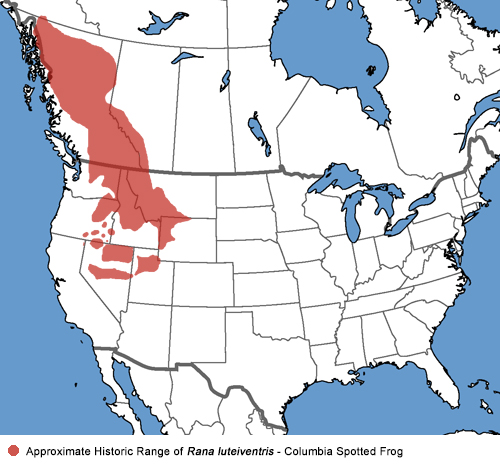
In California, historically found on the east side of the Warner Mountains in the extreme northeast corner of the state.
Overall, Rana luteiventris occurs from southeast Alaska south through most of British Columbia and a bit of the Northwest Territories and Alberta, most of eastern Washington and Oregon, the northern half of Nevada, and east into northwest Utah, most of Idaho, the western part of Wyoming, and the western half of Montana.
Rana luteiventris is not typically considered a resident of California on state species lists or by the California Dept. of Fish and Wildlife, but Jennings and Hayes consider the Spotted Frogs found on the eastern side of the Warner Mountains to be Rana luteiventris so I put it on my list of herps that were historically found in the state, or at least within the last few centuries, even though it's likely they are no longer found in the area. Undiscovered isolated populations may still exist in the eastern Warner Mountains which is mostly private property that may not have been surveyed, but most of the wetlands the frogs need have disappeared.
Biologist Marc Hayes told me in a personal communication that the spotted frogs on the eastern side of the Warner Mountains, including a recent record from Cedarville, are Rana luteiventris, while those on the western side are Rana pretiosa, the Oregon Spotted Frog. His survey with Mark Jennings was made before R. luteiventris was split off as a separate species from R. pretiosa. There are also populations of R. luteiventris not far north of the Warner Valley in Lake County, Oregon.
Storer (1925) also mentions that Cope (1889) says that he found Rana temporaria pretiosa [=luteiventris] "the entire length of the valley of the Warner Lakes, but not at Fort Bidwell."
Grinnell and Camp 1917 include this species on their list of California Frogs, showing the range as "Eastern Modoc County. Only Station, Pine Creek, near Alturas, Modoc County. (Mus. Vert. Zool., nos. 2098, 2099) Specimens captured on banks of a slow-flowing stream."
Hansen and Shedd (2025) list this species as potentially occurring in California, but with this relevant comment: "
Given the transformation of regional wetlands on which this species depends, there is almost no chance it occurs in CA."
|
 |
Red: Approximate historic range of Rana luteiventris - Columbia Spotted Frog
|
| Elevational Range |
From near sea level to 10,000 ft. (3,000 m.)
|
| Notes on Taxonomy |
According to Stebbins (2003) the range of the Columbia Spotted Frog is not known to overlap the range of the Oregon Spotted Frog, but where their ranges contact, they will occasionally hybridize.
Rana pretiosa luteiventris and Rana pretiosa pretiosa were both recognized as subspecies of Rana pretiosa until 1996 when they were split into two species, based on genetic differences, but not morphological differences.
According to Stebbins (2003) some isolated populations on mountain tops and at desert springs may be approaching species levels of differentiation. A 2001 molecular study by Bos and Sites showed four clades; Northern Rocky Mountain, Lahonton, Bonneville, and Deep Creek. According to Lanoo, 2005,
Other studies are in progress which are expected to reveal divisions within Rana luteiventris which may prove to be distinguishable on both a molecular and morphological basis.
A 2008 study using mtDNA showed that Rana luteiventris may consist of three distinct species, but did not name them pending further analysis using nucleic DNA. (W. Chris Funk, Christopher A. Pearl, Hope M. Draheim, Michael J. Adams, Thomas D. Mullins & Susan M. Haig 2008. Range-wide phylogeographic analysis of the Spotted Frog complex [Rana luteiventris and Rana pretiosa] in northwestern North America. Molecular Phylogenetics and Evolution 49: 198-210)
Alternate and Previous Names (Synonyms)
Rana luteiventris - Columbia Spotted Frog (Stebbins 2003, Stebbins & McGinnis 2012)
Rana pretiosa - Spotted Frog (Stebbins 1954, 1966, 1985)
Rana pretiosa luteiventris - Nevada Spotted Frog (Wright & Wright 1949)
Rana pretiosa luteiventris - Nevada Spotted Frog (Storer 1925)
Rana pretiosa luteiventris - Nevada Spotted Frog (Grinnell and Camp 1917)
Rana temporaria pretiosa (Cope 1883)
|
| Conservation Issues |
Like most amphibians in the western United States, Columbia Spotted Frogs are experiencing declines in some areas. Destruction of wetland habitat for agriculture and land development, alteration of natural springs, removal of beaver dams, the introduction of non-native fish, and livestock grazing are all possible threats to this species.
In California, only one frog has been recorded recently; "A single subadult frog was found beneath a woodpile at the Modoc National Forest Fire Station in Cedarville, Modoc County, on 24 September 1989 (G. Martinsen, pers. comm.). " (Jennings and Hayes, 1994). Rana luteiventris is not typically considered a resident of California on state species lists or by the California Dept. of Fish and Wildlife, but Jennings and Hayes consider the Spotted Frogs found on the eastern side of the Warner Mountains to be Rana luteiventris. (See comments above under "Range".)
|
|
|
Taxonomy |
| Family |
Ranidae |
True Frogs |
Rafinesque, 1814 |
| Genus |
Rana |
True Frogs |
Linnaeus, 1758 |
Species
|
luteiventris |
Columbia Spotted Frog |
Thompson, 1913 |
|
Original Description |
Rana luteiventris Thompson, 1913 - Proc. Biol. So. Wash., Vol. 26, p. 53, pl. 3, figs. 2-3
from Original Description Citations for the Reptiles and Amphibians of North America © Ellin Beltz
|
|
Meaning of the Scientific Name |
Rana - Latin = frog - probably mimics how the Romans heard their call
Luteiventris - Latin - luteus = golden-yellow + ventris = of the belly - refers to the yellow ventral coloring.
from Scientific and Common Names of the Reptiles and Amphibians of North America - Explained © Ellin Beltz |
|
Alternate Names |
| Initially recognized as Rana pretiosa. |
|
Related or Similar California Frogs |
Rana pretiosa
Rana draytonii
Rana aurora
Rana boylii
Rana cascadae
Lithobates pipiens
Lithobates catesbeiana
Lithobates yavapaiensis
Rana muscosa
|
|
More Information and References |
* (Jennings, M.R. and M.P. Hayes. 1994. Amphibian and reptile species of special concern in California. California Department of Fish and Game, Inland Fisheries Division, Final report, Rancho Cordova, California).
Hansen, Robert W. and Shedd, Jackson D. California Amphibians and Reptiles. (Princeton Field Guides.) Princeton University Press, 2025.
Stebbins, Robert C., and McGinnis, Samuel M. Field Guide to Amphibians and Reptiles of California: Revised Edition (California Natural History Guides) University of California Press, 2012.
Stebbins, Robert C. California Amphibians and Reptiles. The University of California Press, 1972.
Flaxington, William C. Amphibians and Reptiles of California: Field Observations, Distribution, and Natural History. Fieldnotes Press, Anaheim, California, 2021.
Nicholson, K. E. (ed.). 2025. Scientific and Standard English Names of Amphibians and Reptiles of North America North of Mexico, with Comments Regarding Confidence in Our Understanding. Ninth Edition. Society for the Study of Amphibians and Reptiles. [SSAR] 87pp.
Samuel M. McGinnis and Robert C. Stebbins. Peterson Field Guide to Western Reptiles & Amphibians. 4th Edition. Houghton Mifflin Harcourt Publishing Company, 2018.
Stebbins, Robert C. A Field Guide to Western Reptiles and Amphibians. 3rd Edition. Houghton Mifflin Company, 2003.
Behler, John L., and F. Wayne King. The Audubon Society Field Guide to North American Reptiles and Amphibians. Alfred A. Knopf, 1992.
Robert Powell, Roger Conant, and Joseph T. Collins. Peterson Field Guide to Reptiles and Amphibians of Eastern and Central North America. Fourth Edition. Houghton Mifflin Harcourt, 2016.
Powell, Robert., Joseph T. Collins, and Errol D. Hooper Jr. A Key to Amphibians and Reptiles of the Continental United States and Canada. The University Press of Kansas, 1998.
Corkran, Charlotte & Chris Thoms. Amphibians of Oregon, Washington, and British Columbia. Lone Pine Publishing, 1996.
Jones, Lawrence L. C. , William P. Leonard, Deanna H. Olson, editors. Amphibians of the Pacific Northwest. Seattle Audubon Society, 2005.
Leonard et. al. Amphibians of Washington and Oregon. Seattle Audubon Society, 1993.
Nussbaum, R. A., E. D. Brodie Jr., and R. M. Storm. Amphibians and Reptiles of the Pacific Northwest. Moscow, Idaho: University Press of Idaho, 1983.
American Museum of Natural History - Amphibian Species of the World 6.2
Bartlett, R. D. & Patricia P. Bartlett. Guide and Reference to the Amphibians of Western North America (North of Mexico) and Hawaii. University Press of Florida, 2009.
Elliott, Lang, Carl Gerhardt, and Carlos Davidson. Frogs and Toads of North America, a Comprehensive Guide to their Identification, Behavior, and Calls. Houghton Mifflin Harcourt, 2009.
Lannoo, Michael (Editor). Amphibian Declines: The Conservation Status of United States Species. University of California Press, June 2005.
Storer, Tracy I. A Synopsis of the Amphibia of California. University of California Press Berkeley, California 1925.
Wright, Albert Hazen and Anna Wright. Handbook of Frogs and Toads of the United States and Canada. Cornell University Press, 1949.
Storer, Tracy I. A Synopsis of the Amphibia of California. University of Califonia Publications in Zoology Volume 27, The University of California Press, 1925.
Davidson, Carlos. Booklet to the CD Frog and Toad Calls of the Pacific Coast - Vanishing Voices. Cornell Laboratory of Ornithology, 1995.
Joseph Grinnell and Charles Lewis Camp. A Distributional List of the Amphibians and Reptiles of California. University of California Publications in Zoology Vol. 17, No. 10, pp. 127-208. July 11, 1917.
California Department of Fish and Wildlife
AmphibiaWeb
|
|
|
The following conservation status listings for this animal are taken from the July 2025 State of California Special Animals List and the July 2025 Federally Listed Endangered and Threatened Animals of California list (unless indicated otherwise below.) Both lists are produced by multiple agencies every year, and sometimes more than once per year, so the conservation status listing information found below might not be from the most recent lists, but they don't change a great deal from year to year.. To make sure you are seeing the most recent listings, go to this California Department of Fish and Wildlife web page where you can search for and download both lists:
https://www.wildlife.ca.gov/Data/CNDDB/Plants-and-Animals.
A detailed explanation of the meaning of the status listing symbols can be found at the beginning of the two lists. For quick reference, I have included them on my Special Status Information page.
If no status is listed here, the animal is not included on either list. This most likely indicates that there are no serious conservation concerns for the animal. To find out more about an animal's status you can also go to the NatureServe and IUCN websites to check their rankings.
Check the current California Department of Fish and Wildlife sport fishing regulations to find out if this animal can be legally pursued and handled or collected with possession of a current fishing license. You can also look at the summary of the sport fishing regulations as they apply only to reptiles and amphibians that has been made for this website.
This species is not on the California Dept. of Fish and Game state list, so there are no status listings for it in California.
The IUCN Red List* shows the status of this species as: Least Concern ver 3.1. Pop. trend: decreasing.
* IUCN 2013. IUCN Red List of Threatened Species. Version 2013.2. Downloaded on 26 January 2014.
|
| Organization |
Status Listing |
Notes |
| NatureServe Global Ranking |
|
|
| NatureServe State Ranking |
|
|
| U.S. Endangered Species Act (ESA) |
|
|
| California Endangered Species Act (CESA) |
None |
|
| California Department of Fish and Wildlife |
None |
|
| Bureau of Land Management |
|
|
| USDA Forest Service |
|
|
| IUCN |
|
|
|
|