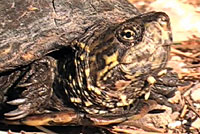
|
This species formerly occurred in California but is most likely now extinct in the state.
|
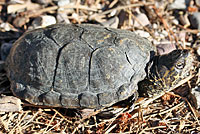 |
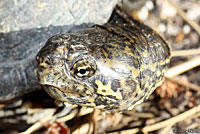 |
 |
| |
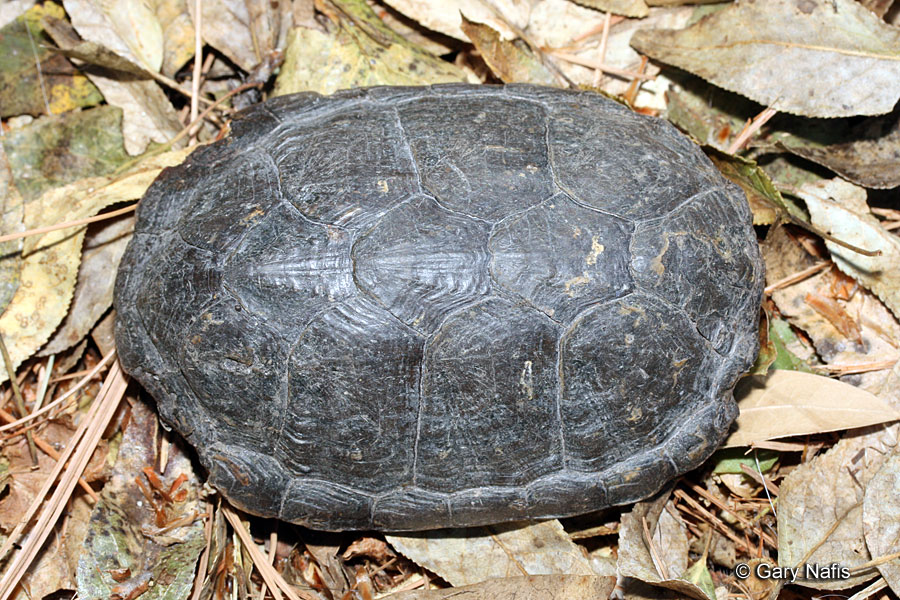
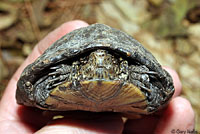
Adult, Pima County, Arizona |
|
 |
 |
 |
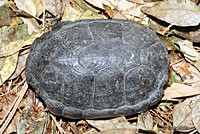
| Adult, Pima County, Arizona |
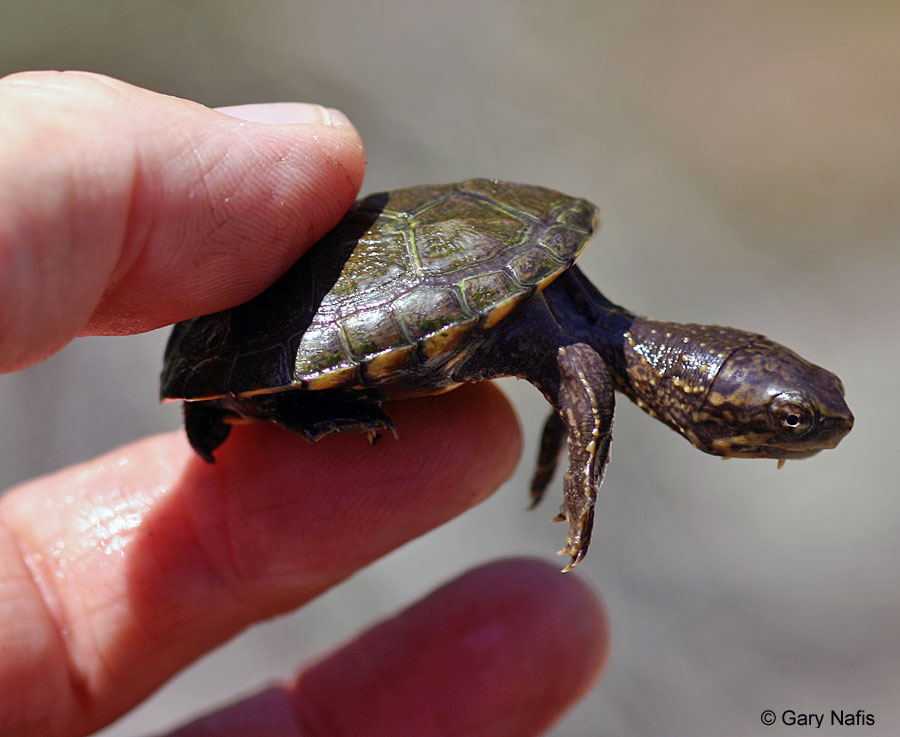
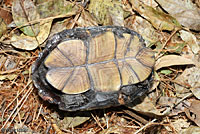
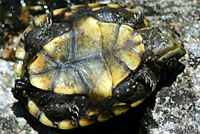
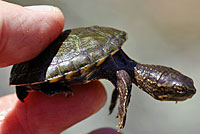
Juvenile, Santa Cruz County, Arizona |
 |
 |
 |
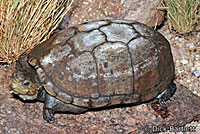
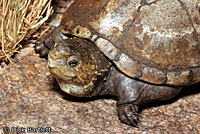
| Adult, Santa Cruz County, Arizona, © Dick Bartlett |
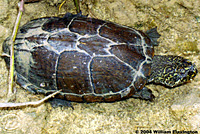
Adult, Santa Cruz County, Arizona
© 2004 William Flaxington
|
 |
 |
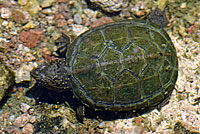 |
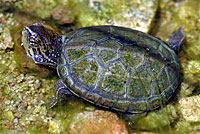
| Juvenile, Santa Cruz County, Arizona |
| |
 |
|
| |
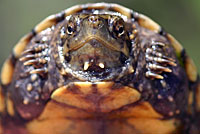
Juvenile, Santa Cruz County, Arizona |
|
| |
|
| Habitat |
 |
 |
|
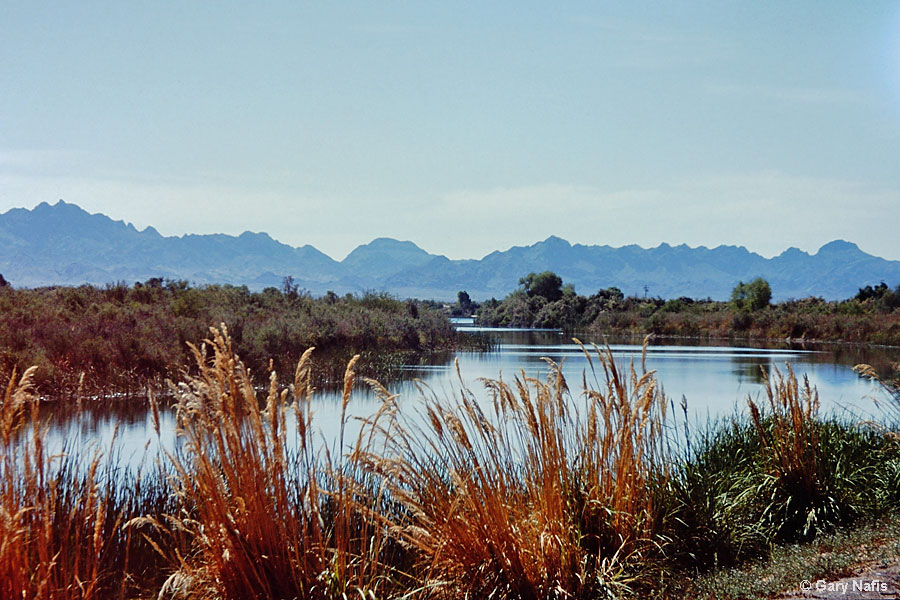
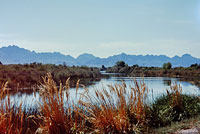
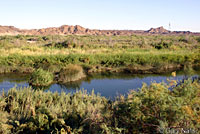
Former habitat, next to Colorado River near Palo Verde, Imperial County
|
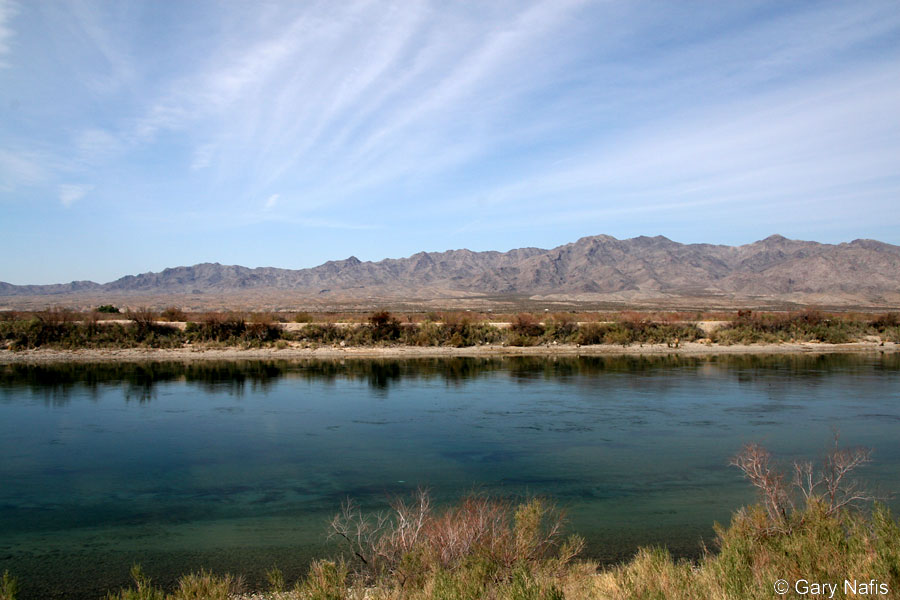
Former habitat, next to Colorado River near Laguna Dam, Imperial County |
Former habitat, next to Colorado
River near Ft. Mojave |
More pictures of habitat in Arizona
|
| Short Video |
| |
|
|
A Sonora Mud Turtle, found wandering overland next to a dry creek in the mountains outside of Tucson Arizona, slowly pokes its head out of its shell and looks around for several minutes before quickly returning back into the shell. It never did come out, and was left to crawl back to wherever it was going.
|
|
| Description |
| |
| Size |
3 1/8 - 6 1/2 inches in shell length (7.9 - 16.5 cm) (Stebbins 2003)
|
| Appearance |
A dark, medium-sized turtle with a smooth and elongated carapace.
1 or 3 lengthwise keels may be present on the carapace.
|
| Color and Pattern |
Mottled markings on the head, neck and limbs.
Light markings on the head tend to form a pair of stripes on each side of the head.
The feet are webbed, the tail is short, and there are barbels on the throat.
Carapace color is olive to dark brown, with darkly-marked seams.
The plastron is hinged and yellow to brown in color with darkly-marked seams. |
| Male / Female Differences |
Males are smaller with a concave plastron and a longer thicker tail.
|
| Life History and Behavior |
Activity |
Most information for this species comes from individuals studied in Arizona. Little is known about the life history of California animals.
Active during the day and at night, becoming more nocturnal in hot summer weather. Active all year, though feeding may not occur during the cold of winter. Higher-elevation populations may be forced to hibernate in winter.
Mostly sedentary, rarely moving out of or away from water, but occasionally migrates considerable distances from one waterway to another. |
| Diet and Feeding |
| Omnivorous, eating mostly animals including snails, fish, frogs, tadpoles, crustaceans, and other small invertebrates, along with some plant material. |
| Reproduction |
Females lay a clutch of 1 - 11 eggs from May to September, which take almost a year to hatch.
Sometimes as many as four clutches a year are laid.
Females reach sexual maturity 6 years, males in 2- 6 years.
|
| Habitat |
In California, formerly found in the desert in overflow channels of the lower Colorado River.
Normally occurs in ponds and slow-moving tree-lined watercourses, including quiet pools in streams, oxbows, ponds, creeks, and cattle tanks.
Found in woodlands and occasionally in grasslands. Needs a permanent or nearly permanent water source.
|
| Geographical Range |
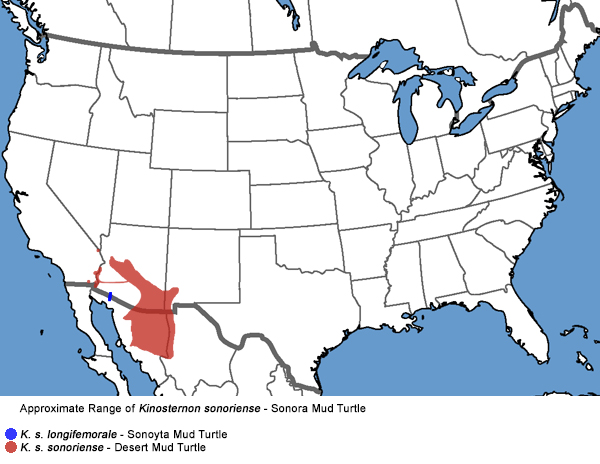
Historic range was southwestern New Mexico, southern Arizona, southeast California along the Colorado River, and Chihuahua and Sonora, Mexico. Now apparently extinct along the Colorado River.
In California, the historic range was adjacent to the Colorado River from the Nevada Border south to the Mexican border. Sonora Mud Turtles also began dispersing into agricultural canals in the Imperial Valley before they disappeared from California. Some of the old California records include Palo Verde, Yuma Indian Reservation, Ft. Mojave, and near Laguna Dam. Has not been recorded from California since 1962.
"It has not been recorded from its historic range along the California-Arizona border since 1962."
(California Amphibian and Reptile Species of Special Concern (Thomson et al. 2016).)
|
 |
Red: Kinosternon sonoriense sonoriense - Sonora Mud Turtle (Extinct in California)
- Not found in California
Dark Blue: Kinosternon sonoriense longifemorale - Sonoyta Mud Turtle
|
| Notes on Taxonomy |
Two subspecies have been described:
Kinosternon sonoriense longifemorale - Sonoyta Mud Turtle (Inverson, 1981)
Kinosternon sonoriense sonoriense - Sonora Mud Turtle (Le Conte, 1854)
Alternate and Previous Names (Synonyms)
Kinosternon sonoriense - Sonora Mud Turtle (Stebbins & McGinnis 2018)
Kinosternon sonoriense sonoriense - Desert Mud Turtle (SSAR Herpetological Circular No. 43, 2017)
Kinosternon sonoriense - Sonora Mud Turtle (Stebbins 2003)
Kinosternon sonoriense - Sonora Mud Turtle (Stebbins 1966)
Kinosternon sonoriense - Sonoran Mud Turtle (Stebbins 1985)
Kinosternon sonoriense - Sonoran Mud Turtle (Stebbins 1954)
Kinosternon sonoriense - Arizona Mud Turtle (Cinosternum flavescens; Platythrya favescens. Yellow Mud Turtle) (Grinnell and Camp 1917)
|
| Conservation Issues (Conservation Status) |
Endangered.
This species appears to be declining over much of its range. The last known verifiable record along the Colorado River was from near Laguna Dam in 1962.
The reasons for this turtles apparent extinction in California are uncertain, but most likely a combination of introduced aquatic predators such as bullfrogs and Louisiana red swamp crayfish, introduced vegetation, especially salt cedar, and widespread water and land alterations along the Colorado River including reservoirs, dams, and agriculture, is responsible.
"It has not been recorded from its historic range along the California-Arizona border since 1962."
(California Amphibian and Reptile Species of Special Concern (Thomson et al. 2016).)
There is a description and conservation status summary of this taxon with a dot-locality distribution map in an online .pdf from the California Department of Fish and Wildlife book California Amphibian and Reptile Species of Special Concern (Thomson, Wright, and Shaffer 2016). Below are some of the threats to this species and management recommendations discussed in the book:
"The causes of decline of Kinosternon sonoriense in California are poorly understood, but may be associated with habitat modification and water diversion along the Colorado River and the Imperial Valley (Ohmart et al. 1988). Increased use of pesticides may have modified the available prey base, forcing the species to shift to a suboptimal herbivorous diet, which has been suggested as a factor in other K. sonoriense declines (King et al. 1996). The impact of introduced exotic crayfish, bullfrogs, warm water fishes, and softshelled turtles, all of which were well established around the time of K. sonoriense declines (Dill 1944, Lovich and Beaman 2008), is unknown, but they could plausibly have had a negative impact on K. sonoriense. At one site in Arizona, reduced K. sonoriense densities appear to be associated with the presence of introduced crayfish (Lazaroff et al. 2006).
Between 1941 and 1943, the Imperial Irrigation District burned and sprayed oil on 13,000 km of ditches and canals in the Imperial Valley in an effort to control the damage being done by spreading muskrat populations (Twining and Hensley 1943). These efforts certainly destroyed a great deal of aquatic habitat in the region, and the effect of the oil residues may have also had strong impacts on K. sonoriense and other taxa that disappeared from this area during the same time period (e.g., Rana yavapaiensis, Bufo alvarius)."
"A Priority 1 Species of Special Concern designation is justified by the complete absence of records for this species since the 1960s. This is the primary cause for concern. Little understanding of Kinosternon sonoriense’s habitat requirements or factors leading to decline in California currently exists. However, given the survey efforts that have been conducted to date, we assume that any remaining California populations are small, fragmentary, and vulnerable to extirpation. The species may also be vulnerable to increasing temperatures and changing hydrology due to climate change."
"If future surveys detect any remaining populations, initial management efforts should focus on protecting those populations while research is performed that focuses on expanding suitable habitat and rebuilding local populations. If initial estimates of population structure indicate that reproduction and/or recruitment is not occurring, a headstarting program could be effective as a stopgap measure to prevent local extirpation. Many aquatic turtles have very different habitat requirements for hatchlings and adults, and ecological studies of both age classes will almost certainly be necessary to ensure the survival of remnant native populations."
|
|
|
Taxonomy |
| Family |
Kinosternidae |
Mud and Musk Turtles |
Agassiz, 1857 |
| Genus |
Kinosternon |
American Mud Turtles |
Spix, 1824 |
| Species |
sonoriense |
Sonora Mud Turtle |
LeConte, 1854 |
Subspecies
|
sonoriense |
Sonora Mud Turtle |
LeConte, 1854 |
|
Original Description |
Kinosternon sonoriense - Le Conte, 1854 - Proc. Acad. Nat. Sci. Philadelphia, Vol. 7, p. 184
from Original Description Citations for the Reptiles and Amphibians of North America © Ellin Beltz
|
|
Meaning of the Scientific Name |
Kinsoternon - Greek - kineo = move + sternon = chest, breast - refers to their ability to move the lower shell
sonoriense - belonging to Sonora Province, Mexico -- type locality, "Tucson in Sonora"
from Scientific and Common Names of the Reptiles and Amphibians of North America - Explained © Ellin Beltz
|
|
Related or Similar California Turtles |
A. marmorata - Northwestern Pond Turtle
A. pallida - Southwestern Pond Turtle
C. p. bellii - Western Painted Turtle
P. concinna - River Cooter
S. odoratus - Eastern Musk Turtle
T. s. elegans - Red-eared Slider
T. s. scripta - Yellow-bellied Slider
|
|
More Information and References |
California Department of Fish and Wildlife
There is a description and conservation status summary of this taxon with a dot-locality distribution map in an online .pdf from the California Department of Fish and Wildlife book California Amphibian and Reptile Species of Special Concern (Thomson, Wright, and Shaffer 2016).
California Turtle and Tortoise Club
Reptiles of Arizona
AMPHIBIAN AND REPTILE SPECIES OF SPECIAL CONCERN IN CALIFORNIA
A report to the California Department of Fish and Game
Mark R. Jennings and Marc P. Hayes, November 1, 1994
Hansen, Robert W. and Shedd, Jackson D. California Amphibians and Reptiles. (Princeton Field Guides.) Princeton University Press, 2025.
Stebbins, Robert C., and McGinnis, Samuel M. Field Guide to Amphibians and Reptiles of California: Revised Edition (California Natural History Guides) University of California Press, 2012.
Stebbins, Robert C. California Amphibians and Reptiles. The University of California Press, 1972.
Flaxington, William C. Amphibians and Reptiles of California: Field Observations, Distribution, and Natural History. Fieldnotes Press, Anaheim, California, 2021.
Nicholson, K. E. (ed.). 2025. Scientific and Standard English Names of Amphibians and Reptiles of North America North of Mexico, with Comments Regarding Confidence in Our Understanding. Ninth Edition. Society for the Study of Amphibians and Reptiles. [SSAR] 87pp.
Samuel M. McGinnis and Robert C. Stebbins. Peterson Field Guide to Western Reptiles & Amphibians. 4th Edition. Houghton Mifflin Harcourt Publishing Company, 2018.
Stebbins, Robert C. A Field Guide to Western Reptiles and Amphibians. 3rd Edition. Houghton Mifflin Company, 2003.
Behler, John L., and F. Wayne King. The Audubon Society Field Guide to North American Reptiles and Amphibians. Alfred A. Knopf, 1992.
Robert Powell, Roger Conant, and Joseph T. Collins. Peterson Field Guide to Reptiles and Amphibians of Eastern and Central North America. Fourth Edition. Houghton Mifflin Harcourt, 2016.
Powell, Robert., Joseph T. Collins, and Errol D. Hooper Jr. A Key to Amphibians and Reptiles of the Continental United States and Canada. The University Press of Kansas, 1998.
Bartlett, R. D. & Patricia P. Bartlett. Guide and Reference to the Turtles and Lizards of Western North America (North of Mexico) and Hawaii. University Press of Florida, 2009.
Carr, Archie. Handbook of Turtles: The Turtles of the United States, Canada, and Baja California. Cornell University Press, 1969.
Ernst, Carl H., Roger W. Barbour, & Jeffrey E. Lovich. Turtles of the United States and Canada. Smithsonian Institution 1994.
(2nd Edition published 2009)
|
|
|
The following conservation status listings for this animal are taken from the July 2025 State of California Special Animals List and the July 2025 Federally Listed Endangered and Threatened Animals of California list (unless indicated otherwise below.) Both lists are produced by multiple agencies every year, and sometimes more than once per year, so the conservation status listing information found below might not be from the most recent lists, but they don't change a great deal from year to year.. To make sure you are seeing the most recent listings, go to this California Department of Fish and Wildlife web page where you can search for and download both lists:
https://www.wildlife.ca.gov/Data/CNDDB/Plants-and-Animals.
A detailed explanation of the meaning of the status listing symbols can be found at the beginning of the two lists. For quick reference, I have included them on my Special Status Information page.
If no status is listed here, the animal is not included on either list. This most likely indicates that there are no serious conservation concerns for the animal. To find out more about an animal's status you can also go to the NatureServe and IUCN websites to check their rankings.
Check the current California Department of Fish and Wildlife sport fishing regulations to find out if this animal can be legally pursued and handled or collected with possession of a current fishing license. You can also look at the summary of the sport fishing regulations as they apply only to reptiles and amphibians that has been made for this website.
|
| Organization |
Status Listing |
Notes |
| NatureServe Global Ranking |
G4 |
Apparently Secure |
| NatureServe State Ranking |
SH |
All California sites are historical; the element has not been seen in the state for at least 20 years, but suitable habitat still exists.
|
| U.S. Endangered Species Act (ESA) |
None |
|
| California Endangered Species Act (CESA) |
None |
|
| California Department of Fish and Wildlife |
SSC |
Species of Special Concern |
| Bureau of Land Management |
None |
|
| USDA Forest Service |
None |
|
| IUCN |
NT |
Near Threatened |
|
|
|