|
This species has been introduced into California. It is not a native species.
|
| |
 |
 |
 |
 |
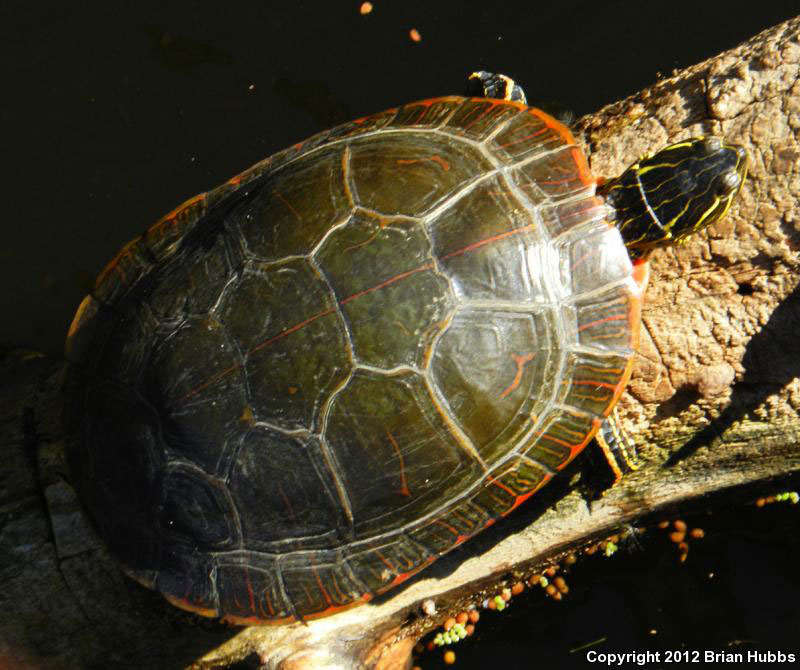
Adult, San Luis Obispo County
© Brian Hubbs |
Adult, Solano County © Brian Hubbs |
Adult, Solano County, with Western Pond Turtle on right © Brian Hubbs |
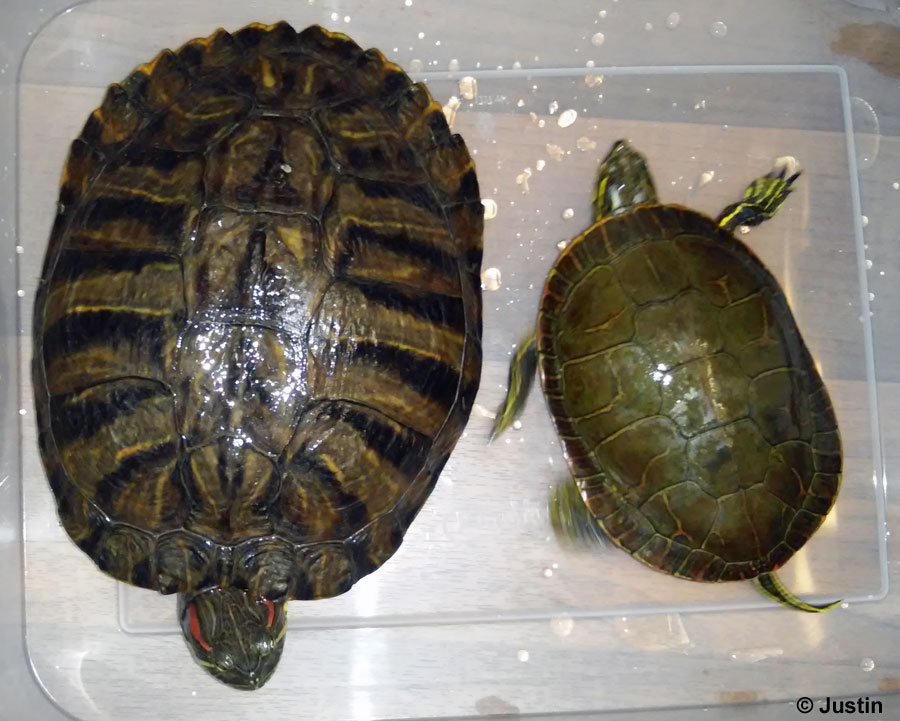
Left: Large adult melanistic
Red-eared Slider
Right: Sub-adult Western Painted Turtle
Sacramento County © Justin |
 |
 |
 |
 |
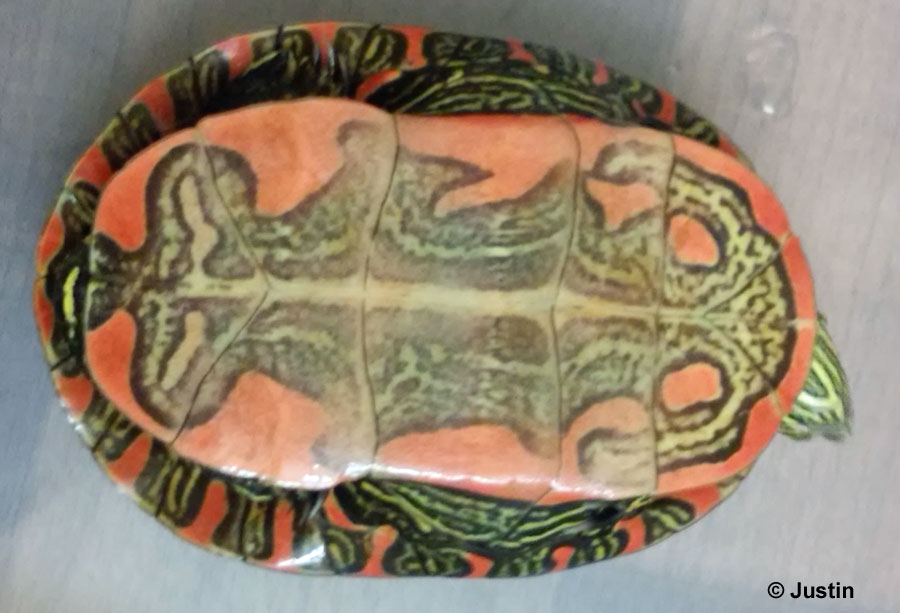
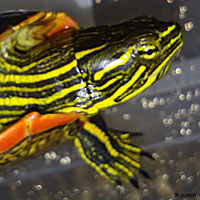
| Adult, Sacramento County © Justin |
Sub-adult, Sacramento County © Justin |
 |
 |
 |
|
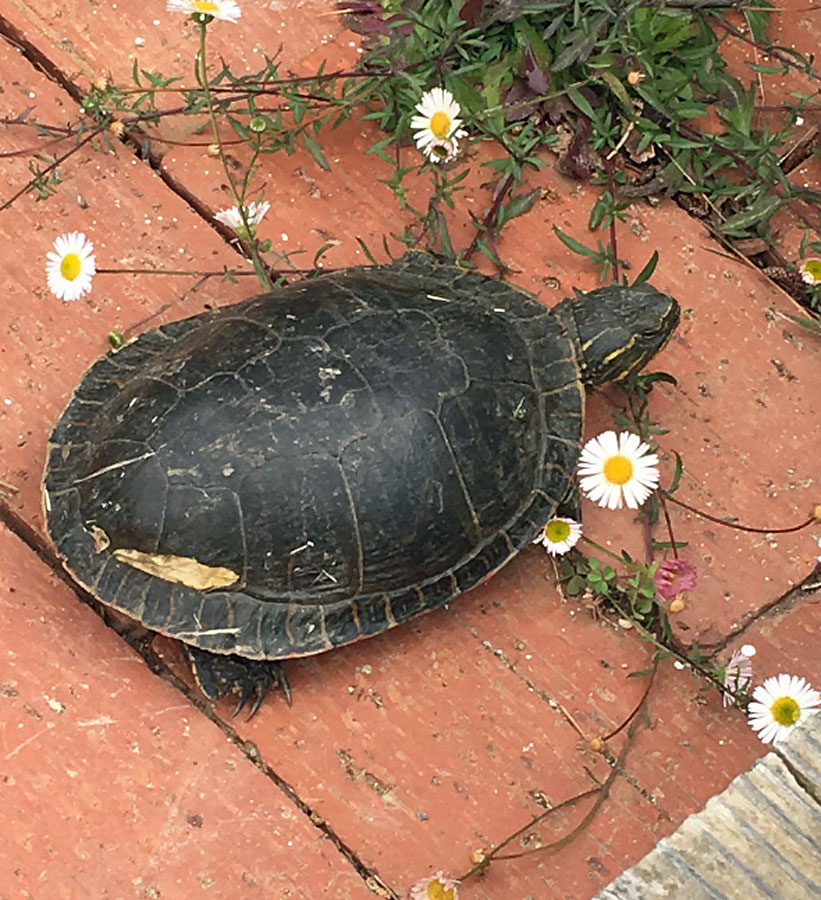
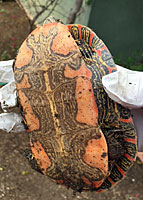
| This painted turtle was found wandering on land in a suburban area next to wilderness in Malibu, Los Angeles County. |
|
| |
|
|
|
| Identifying Red-eared Sliders and Western Painted Turtles (More Here) |
| |
|
|
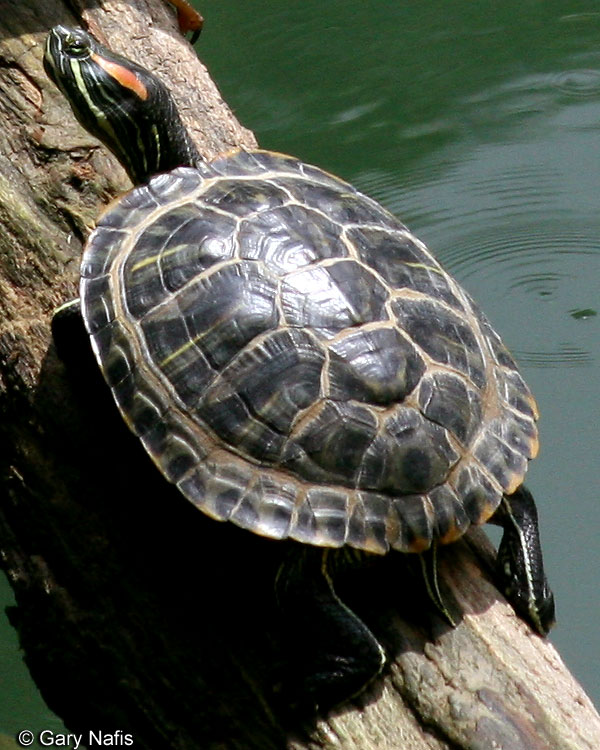
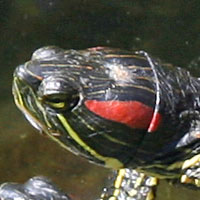
| Red-eared Slider |
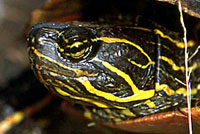
Western Painted Turtle |
 |
 |
 |
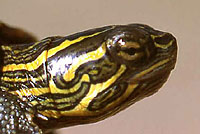 |
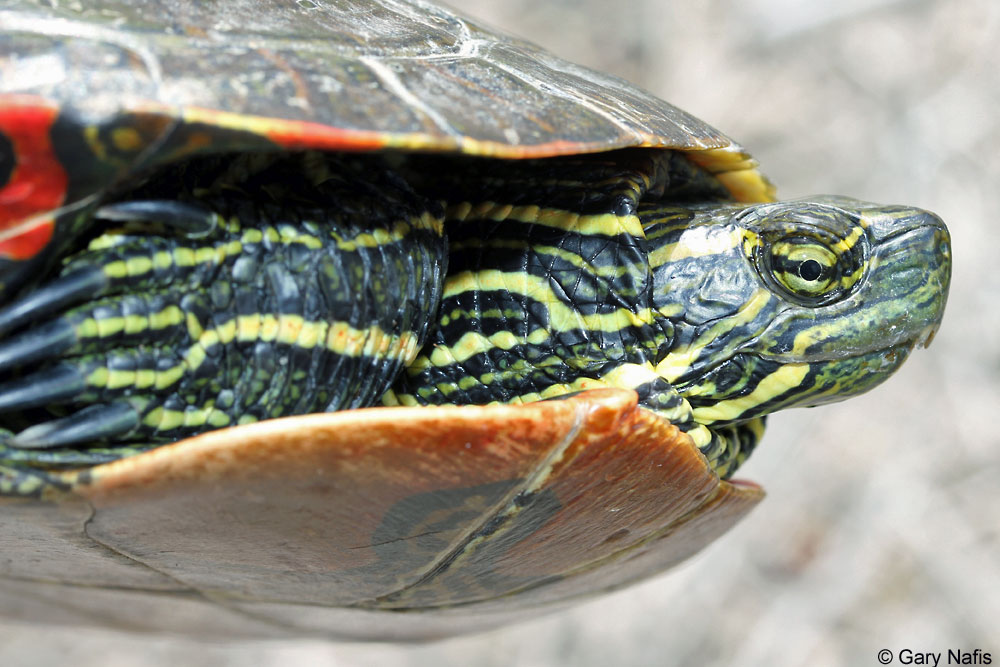
Red stripes behind the eyes
(sometimes missing on older individuals) |
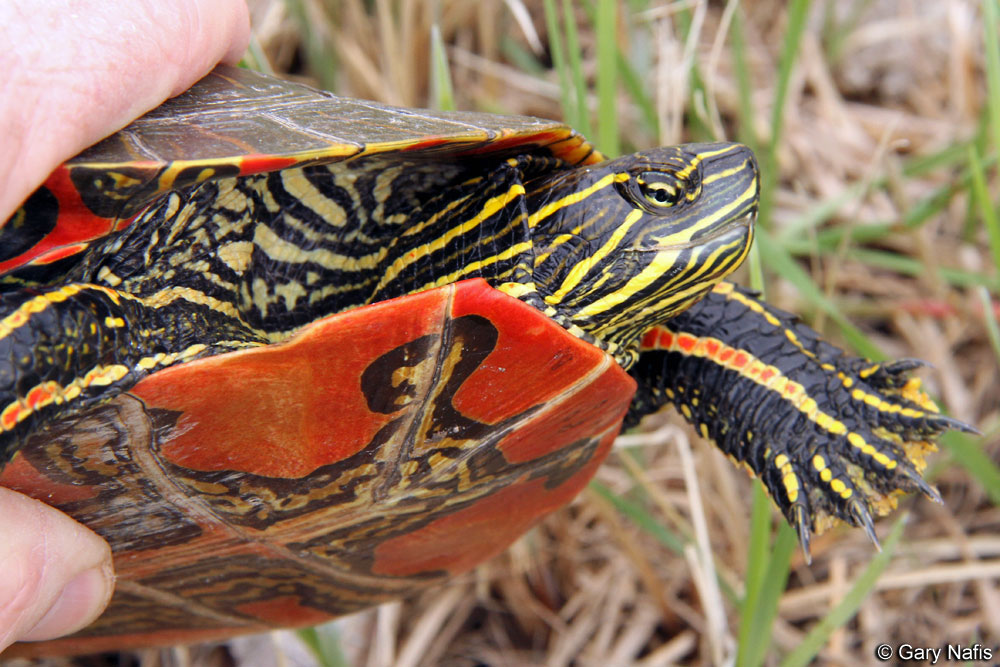
Yellow stripes on the head with no red markings. |
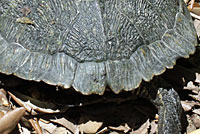 |
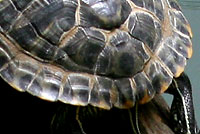 |
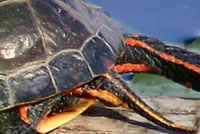 |
 |
The large scales on the rear edge of the shell are serrated.
The shell is
not marked with red. |
The large scales on the rear edge of the shell are smooth, not serrated.
The shell is usually marked with red. |
| |
|
|
|
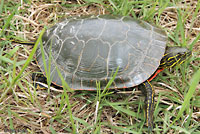
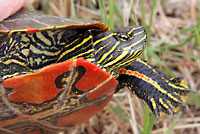
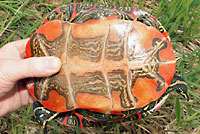
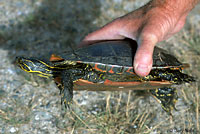
| Western Painted Turtles from Outside California |
 |
 |
 |
|
| |
Adult, Manitoba, Canada |
|
|
 |
 |
 |
|
| |
Adult, Manitoba, Canada |
|
|
 |
 |
 |
|
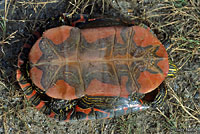
Adult, Spokane County, Washington
|
|
 |
 |
 |
|
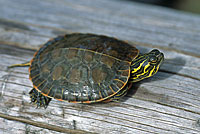
| Juvenile, Spokane County, Washington |
|
 |
 |
|
|
Adult, molting scutes on its shell, Larimer County, Colorado, © Janet Hardin
As a turtle grows, the shell grows with it and the individual scutes are shed annually. This helps the shell from getting too thick and heavy and helps to remove algae and other growths that occur from living in the water. |
|
|
| |
|
|
|
| Habitat |
 |
 |
 |
 |
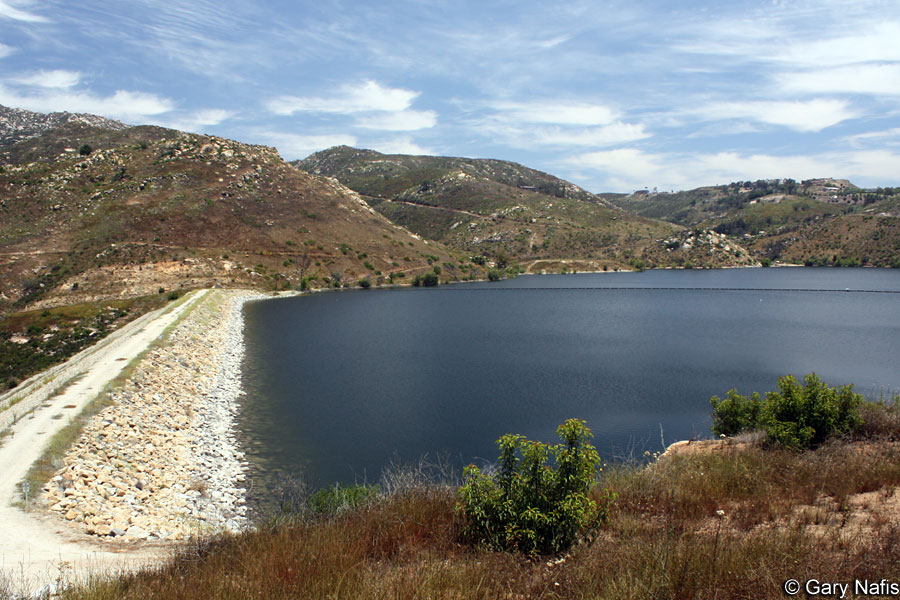
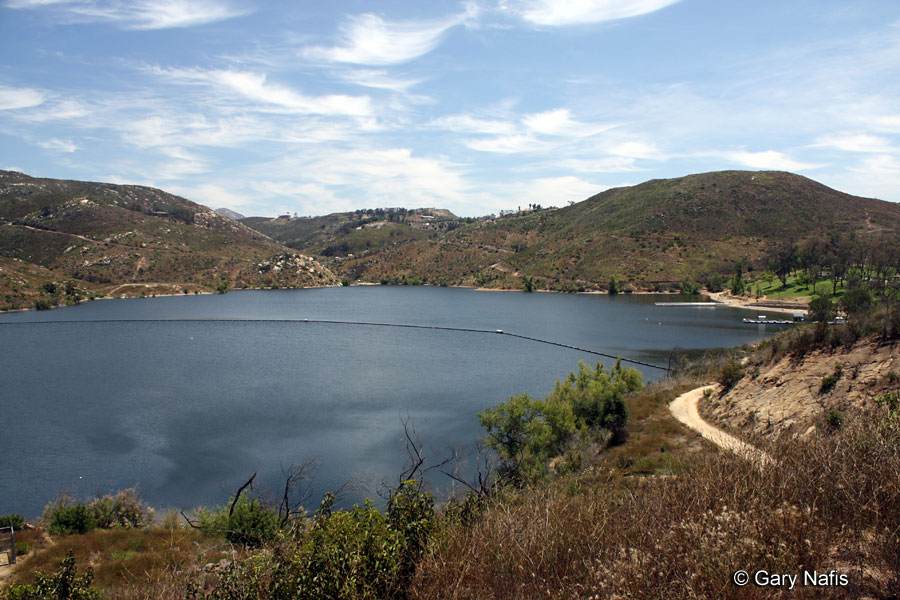
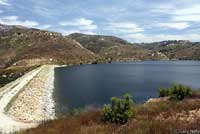
| Habitat, Santa Barbara County |
Habitat, San Diego County |
Habitat, San Luis Obispo County
© Brian Hubbs |
More pictures of this turtle and its habitats in the Northwest can be seen here.
|
| Short Videos |
| |
 |
 |
|
| |
Painted turtles at a wetlands in Canada. |
Painted turtles at a pond in Okanagan County, Washington. |
|
|
| Description |
| |
| Size |
2.5 - 10 inches in shell length (6.3 - 25.4 cm). (Stebbins 2003)
|
| Appearance Color and Pattern |
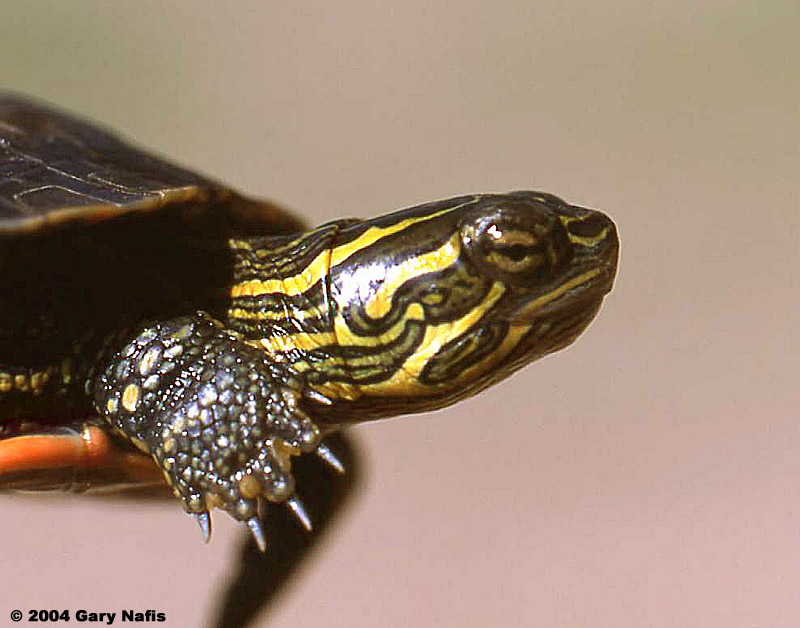
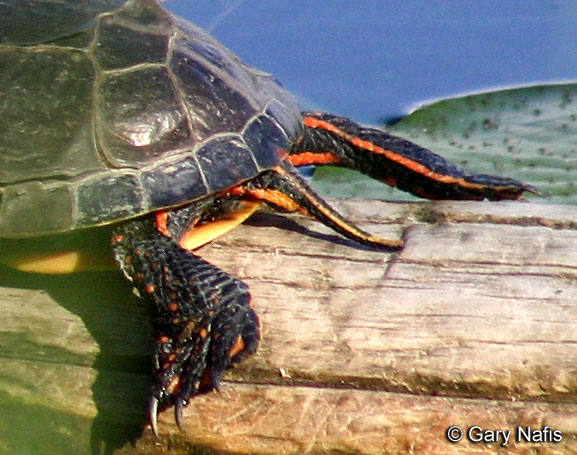
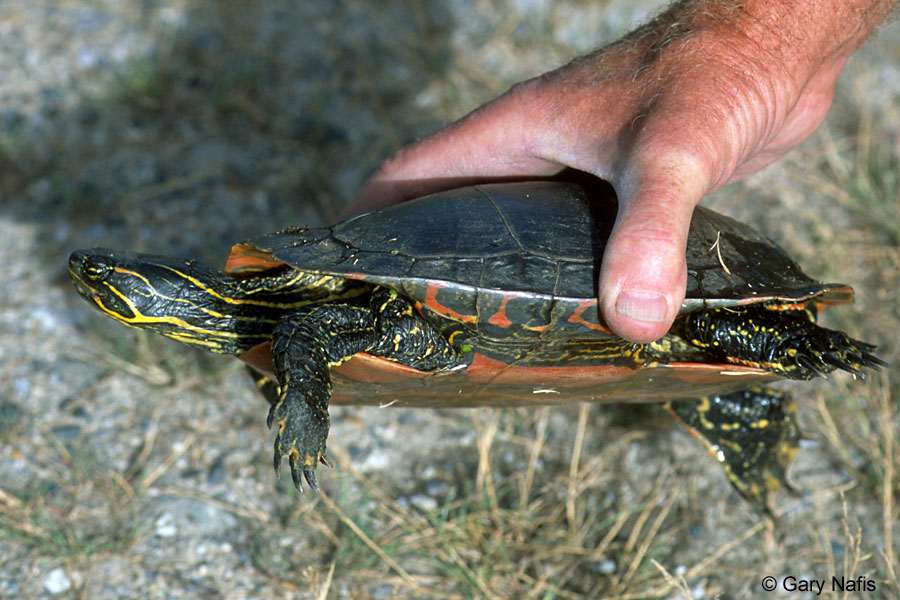
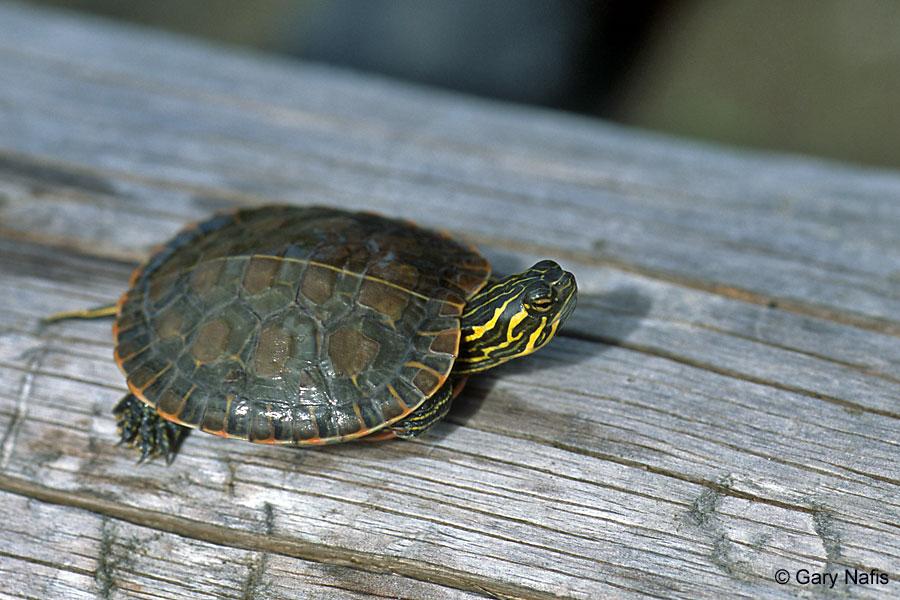
A small turtle with red markings on the marginals and a smooth, oval, somewhat flattened keelless carapace which is black, brown, or olive in color with a network of faint light lines and olive, yellowish, or red borders along front edge of the shields. The posterior rim of the carapace has a smooth (not serrated) border.
The limbs and head are black to olive and marked with yellow lines.
Yellow stripes extend rearward from underneath the eyes and often from below the jaw.
The upper jaw is notched in front.
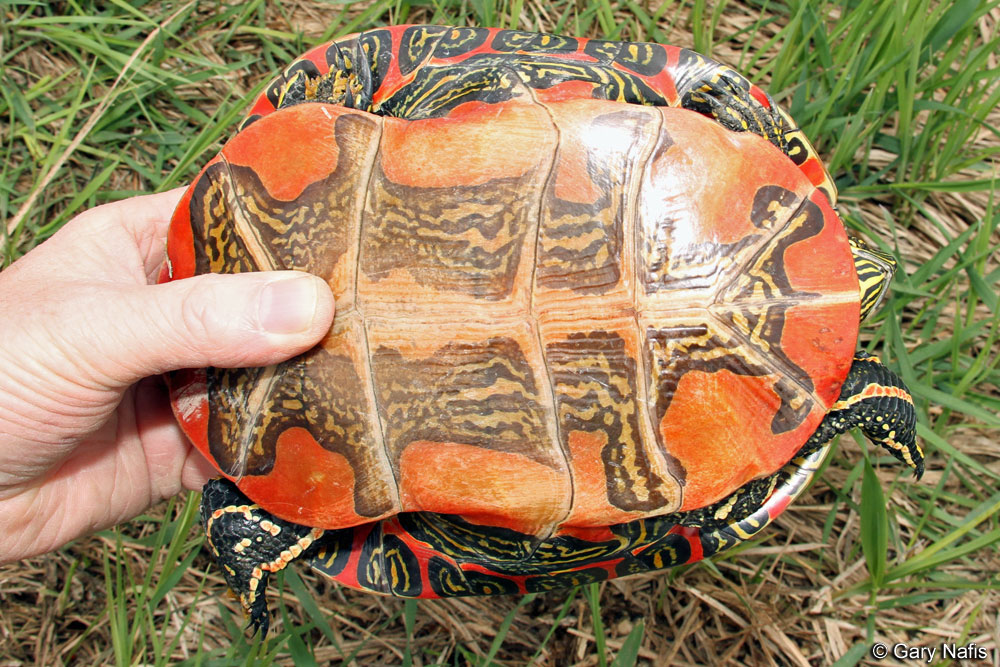
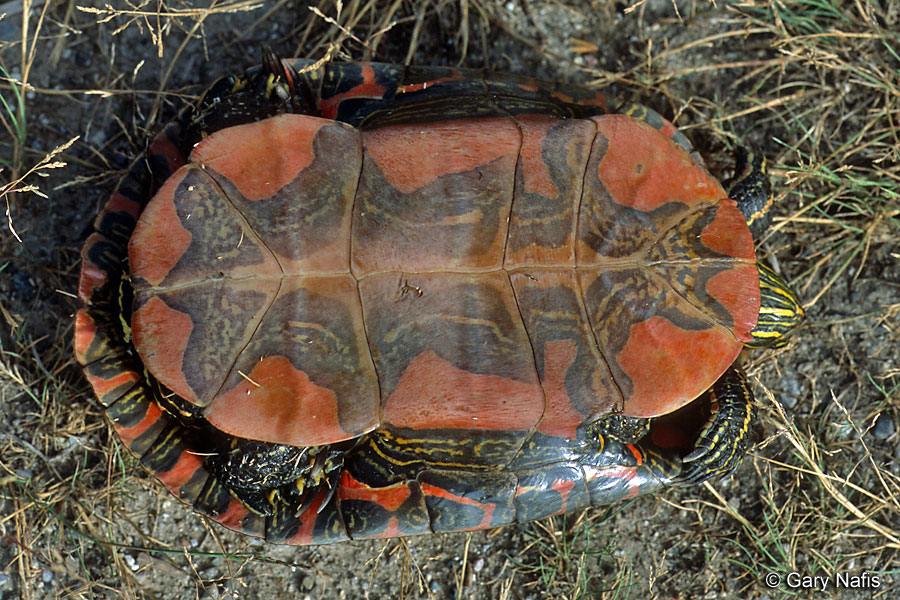
The unhinged plastron is reddish with a large dark mark in the center which branches out between the scutes.
|
| Male / Female Differences |
Males are smaller than females and have very long nails on the front feet.
A male's plastron is more concave toward the rear than it is on a female. |
| Young |
The plastron coloring on juveniles is more strongly contrasted than on adults.
|
| Similar Species |
Turtles of another alien species - Red-eared Slider, Tracemys scripta elegans, are more common in California waters than painted turtles. You can use a couple of details to tell them apart in the field if you can get close enough, the color behind the eye and the rear of the shell. See above.
If you get the turtle in hand, you can also look at the plastron, which will be marked with a lot of red on the painted turtle but not marked with red on the slider.
|
| Life History and Behavior |
Activity |
Aquatic and diurnal. Sleeps at night on the bottom or on a partially submerged object. Probably active all year long in the south but inactive during cold periods. In the north, probably hibernates beginning in late fall, emerging in March or April.
Often seen basking on rocks, logs, or dirt banks, sometimes in large groups.
Relatively cold-tolerant. In some areas, they can be observed swimming under ice just before it melts in March. |
| Turtles Walking on Land Do Not Always Need to be Picked Up and Rescued |
| Turtles sometimes leave the water to search for food, a better place to live, a mate, or to lay their eggs in the spring - typically from March to June. If you see a turtle walking on the land, it is probably not sick or lost, so the best thing you can do for the turtle is to leave it alone. Some people want to help a turtle they think is in danger by picking it up and bringing it home or to a wildlife rehabilitation center, but most of the time this harms the turtle by removing it from the wild without reason. Sometimes turtles do get lost or stranded in yards or on busy roads or somewhere where they may be in danger. If you find one in such a situation, it's ok to move it out of danger, but it's best to leave it in a safe place as close to where you found it as possible. |
| Diet and Feeding |
| An omnivorous generalist - eating almost anything found in its habitat, including insects, worms, snails, crayfish, fish, amphibians and tadpoles, carrion, and aquatic vegetation. Young are carnivorous, but become more herbivorous as they grow older. |
| Reproduction |
Becomes sexually mature when it reaches the appropriate size, typically in 3 - 6 years.
Breeds from March to June.
When the environmental conditions are just right, the female digs a nest at a sunny site near water in loose soil, anytime between May and August. Hot weather and drought can cause her to delay her nesting for a few weeks.
She lays from one to 23 eggs.
Egg incubated naturally in a Painted Turtle nest observed in Pennsylvania took 72 - 80 days to hatch.
(Ernst 1994)
|
| Habitat |
Ponds, marshes, lakes, ditches, quiet streams with sandy or muddy bottoms and aquatic vegetation.
|
| Geographical Range |
Chrysemys picta - Painted Turtle - is the most widespread species of freshwater turtle inhabiting North America, ranging across the entire continent from southeastern Canada to Louisiana to Washington, with isolated populations in Utah, Arizona, Colorado, New Mexico and Texas.
Distribution in California
The species is reported to be introduced and established in waters throughout populated areas of coastal southern California, however I can find very few sight records or museum specimens for this species from anywhere in California. It is possible that most of the sightings of this species did not result in specimens being collected and deposited in a museum or they were only written up as a sight record in a herpetological journal that I have not seen. It's also possible that some turtles identified at a distance as painted turtles might be Red-eared Sliders since they are similar in appearance at a distance.
My range map shows the species inhabiting the same general range in the heavily-populated region of coastal southern California that is shown in most field guides, (including Stebbins and McGinnis, 2012, and the 2018 Peterson Guide) even though I cannot find very many records from this area. I suspect that the species has been found in that area and in other locations throughout the state where pet owners have dumped them, but they have not been successfully established in most of those locations, so they are not observed consistently in the area.
Observations of painted turtles in California reported on iNaturalist (viewed 6/7/21) include a few locations where this species has been identified in Sonoma County, one location outside of Sacramento, a few locations in the San Francisco Bay Area, mostly in the East Bay, a location in Carmel Valley, and a few locations in Orange and San Diego Counties.
I've also seen pictures of an Eastern Painted Turtle - C. p. picta, that was found on the Stanislaus River below Knights Ferry, obviously another pet release.
I would appreciate getting email from anyone who has seen a painted turtle in the wild in California, including pictures that I can use here, if possible.
Kaiser Meadow Population
In the late 1970s, some painted turtles were released at Kaiser Meadow in Siskiyou County. A local science teacher notified Robert Stebbins resulting in the inclusion of the location in his subsequent field guides (including his final 2013 guide). Searches there since the 1980s have uncovered no painted turtles, only native pond turtles. It appears that there is no established population at Kaiser Meadow, so I have left that location off my range map. (James Buskirk, personal communication.)
|
 |
| Notes on Taxonomy |
Three subspecies of Chrysemys picta are recognized, but some researchers want to return the full species Chrysemys dorsalis - Southern Painted Turtle, to subspecies status.
------------------------------------------------------------------------------------------------------------------------------------------------------------------------------------------------------------------------------
In 2003, Starkey, David E., H. Bradley Shaffer, Russell L. Burke, Michael R. J. Forstner, John B. Iverson, Fredric J. Janzen, Anders G. J. Rhodin, and Gordon R. Ultsch [Molecular systematics, phylogeography, and the effects of Pleistocene glaciation in the Painted Turtle (Chrysemys picta) complex. Evolution 57(1): 119-128] determined that Chrysemys picta consists of two species. If this is accepted, C. p. bellii will become Chrysemys picta with no subspecies recognized.
------------------------------------------------------------------------------------------------------------------------------------------------------------------------------------------------------------------------------
Chrysemys picta subspecies may not be valid
"Jensen et al. (2014, Conservation Genetics 15: 261–274) examined genetic variation among populations of C. picta. They found local population clusters that supported the continued recognition of C. dorsalis and C. picta but made no taxonomic recommendations. Jensen et al. (2015, Journal of Herpetology 49: 314–324) further examined the range-wide genetic variation of C. picta and found no support for the currently recognized subspecies. Reid et al. (2018, Heredity 122: 441–457) found genetic and morphological variability throughout its range. However, they did not reject subspecies outright. Turtle Taxonomy Working Group (2021, Chelonian Research Monographs (8): 1–472) continue to recognize three subspecies of C. picta."
(Nicholson, K. E. (ed.). 2025 SSAR Scientific and Standard English Names List)
------------------------------------------------------------------------------------------------------------------------------------------------------------------------------------------------------------------------------
"The prior editions of this list (e.g., Iverson et al. (2017. Pp. 82–91 in Crother (ed.) Herpetological Circulars (43):1-102) gave the authority as (Gray, 1831). Cowan (1969, Journal of the Society for the Bibliography of Natural History 5: 137–140) provided evidence that the actual date of publication was 1830. The conclusions of Cowan (op. cit.) are discussed in and followed by Turtle Taxonomy Working Group (2021, Chelonian Research Monographs (8): 1–472) page 385."
(Nicholson, K. E. (ed.). 2025 SSAR Scientific and Standard English Names List)
------------------------------------------------------------------------------------------------------------------------------------------------------------------------------------------------------------------------------
Alternate and Previous Names (Synonyms)
Chrysemys picta - Western Painted Turtle (Stebbins & McGinnis 2012)
Chrysemys picta bellii - Western Painted Turtle (Stebbins 2003)
Chrysemys picta - Painted Turtle (Stebbins 1954, 1966, 1985)
|
| Conservation Issues (Conservation Status) |
| As an introduced species, it is possible that this turtle competes with and therefore poses a threat to native Pacific Pond Turtles. |
|
|
Taxonomy |
| Family |
Emydidae |
Box and Water or Pond Turtles |
Gray, 1825 |
| Genus |
Chrysemys |
Painted Turtles |
Gray, 1844 |
| Species |
picta |
Painted Turtle |
(Schneider, 1783) |
Subspecies
|
bellii |
Western Painted Turtle |
(Gray, 1831) |
|
Original Description |
Chrysemys picta - (Schneider, 1783) - Naturg. Schildkr., p. 348
Chrysemys picta bellii - (Gray, 1831) - Syn. Rept., p. 31
from Original Description Citations for the Reptiles and Amphibians of North America © Ellin Beltz
|
|
Meaning of the Scientific Name |
Chrysemys - Greek - khrysos = golden, yellow or light green + emys = turtle - probably refers to the yellow stripes on the head of all members of this genus
picta - Latin -= ainted, embroidered - probably refers to the delicate shell pattern
bellii - honors Bell, Thomas
from Scientific and Common Names of the Reptiles and Amphibians of North America - Explained © Ellin Beltz
|
|
Related or Similar California Turtles |
T. s. elegans - Red-eared Slider
T. s. scripta - Yellow-bellied Slider
A. m. marmorata - Northern Pacific Pond Turtle
A. m. pallida - Southern Pacific Pond Turtle
|
|
More Information and References |
California Department of Fish and Wildlife
Hansen, Robert W. and Shedd, Jackson D. California Amphibians and Reptiles. (Princeton Field Guides.) Princeton University Press, 2025.
Stebbins, Robert C., and McGinnis, Samuel M. Field Guide to Amphibians and Reptiles of California: Revised Edition (California Natural History Guides) University of California Press, 2012.
Stebbins, Robert C. California Amphibians and Reptiles. The University of California Press, 1972.
Flaxington, William C. Amphibians and Reptiles of California: Field Observations, Distribution, and Natural History. Fieldnotes Press, Anaheim, California, 2021.
Nicholson, K. E. (ed.). 2025. Scientific and Standard English Names of Amphibians and Reptiles of North America North of Mexico, with Comments Regarding Confidence in Our Understanding. Ninth Edition. Society for the Study of Amphibians and Reptiles. [SSAR] 87pp.
Samuel M. McGinnis and Robert C. Stebbins. Peterson Field Guide to Western Reptiles & Amphibians. 4th Edition. Houghton Mifflin Harcourt Publishing Company, 2018.
Stebbins, Robert C. A Field Guide to Western Reptiles and Amphibians. 3rd Edition. Houghton Mifflin Company, 2003.
Behler, John L., and F. Wayne King. The Audubon Society Field Guide to North American Reptiles and Amphibians. Alfred A. Knopf, 1992.
Robert Powell, Roger Conant, and Joseph T. Collins. Peterson Field Guide to Reptiles and Amphibians of Eastern and Central North America. Fourth Edition. Houghton Mifflin Harcourt, 2016.
Powell, Robert., Joseph T. Collins, and Errol D. Hooper Jr. A Key to Amphibians and Reptiles of the Continental United States and Canada. The University Press of Kansas, 1998.
Bartlett, R. D. & Patricia P. Bartlett. Guide and Reference to the Turtles and Lizards of Western North America (North of Mexico) and Hawaii. University Press of Florida, 2009.
Carr, Archie. Handbook of Turtles: The Turtles of the United States, Canada, and Baja California. Cornell University Press, 1969.
Ernst, Carl H., Roger W. Barbour, & Jeffrey E. Lovich. Turtles of the United States and Canada. Smithsonian Institution 1994.
(2nd Edition published 2009)
Lemm, Jeffrey. Field Guide to Amphibians and Reptiles of the San Diego Region (California Natural History Guides). University of California Press, 2006.
|
|
|
The following conservation status listings for this animal are taken from the July 2025 State of California Special Animals List and the July 2025 Federally Listed Endangered and Threatened Animals of California list (unless indicated otherwise below.) Both lists are produced by multiple agencies every year, and sometimes more than once per year, so the conservation status listing information found below might not be from the most recent lists, but they don't change a great deal from year to year.. To make sure you are seeing the most recent listings, go to this California Department of Fish and Wildlife web page where you can search for and download both lists:
https://www.wildlife.ca.gov/Data/CNDDB/Plants-and-Animals.
A detailed explanation of the meaning of the status listing symbols can be found at the beginning of the two lists. For quick reference, I have included them on my Special Status Information page.
If no status is listed here, the animal is not included on either list. This most likely indicates that there are no serious conservation concerns for the animal. To find out more about an animal's status you can also go to the NatureServe and IUCN websites to check their rankings.
Check the current California Department of Fish and Wildlife sport fishing regulations to find out if this animal can be legally pursued and handled or collected with possession of a current fishing license. You can also look at the summary of the sport fishing regulations as they apply only to reptiles and amphibians that has been made for this website.
There are no significant conservation concerns for this animal in California.
|
| Organization |
Status Listing |
Notes |
| NatureServe Global Ranking |
|
|
| NatureServe State Ranking |
|
|
| U.S. Endangered Species Act (ESA) |
None |
|
| California Endangered Species Act (CESA) |
None |
|
| California Department of Fish and Wildlife |
None |
|
| Bureau of Land Management |
None |
|
| USDA Forest Service |
None |
|
| IUCN |
|
|
|
|