|
 |
 |
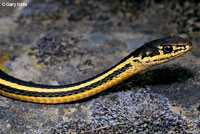
Adult, Contra Costa County
|
 |
 |
 |
 |
| |
Adult, Contra Costa County |
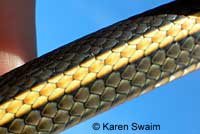
Adult, Contra Costa County, showing the side stripe consisting of one full plus two half scales. © Karen Swaim. |
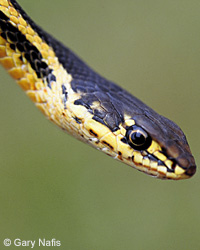
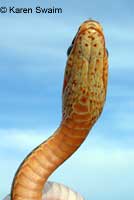
Adult, Alameda County, showing the orange color suffusion under the chin.
© Karen Swaim. |
 |
 |
 |
 |
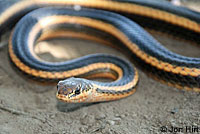
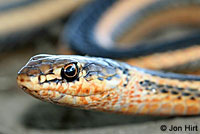
| Adult, Contra Costa County © Jon Hirt |
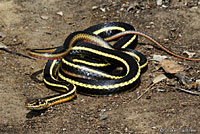
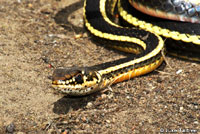
Adult, Contra Costa County © Luke Talltree |
 |
 |
 |
 |
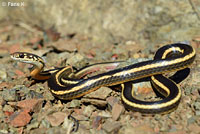
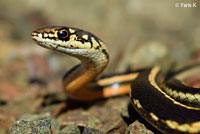
| Adult, Contra Costa County © Faris K |
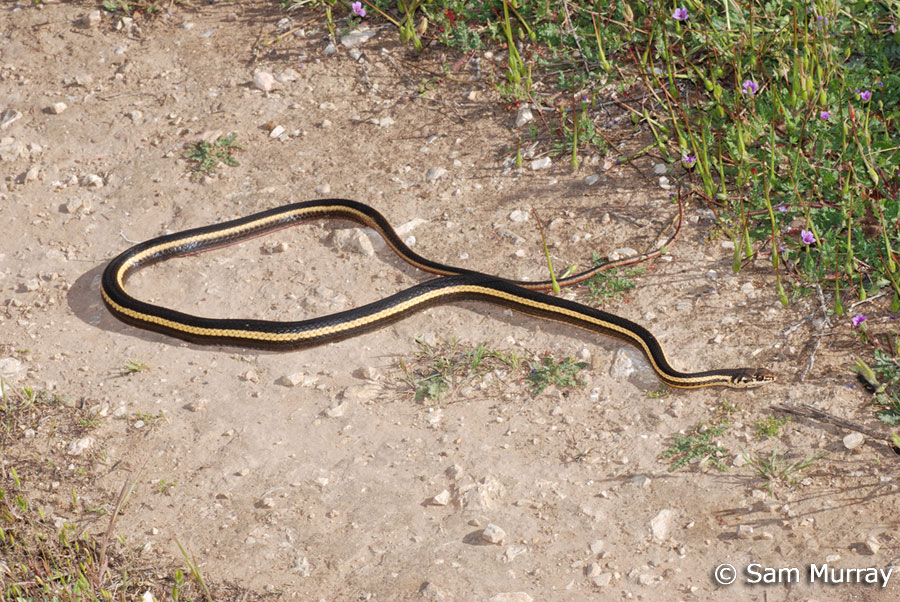
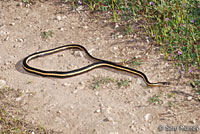
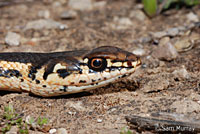
Adult, Contra Costa County © Sam Murray
|
 |
 |
 |
 |
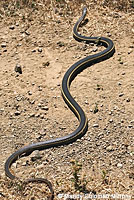
| Adult, Contra Costa County |
Adult, 3,600 ft. elevation, Ohlone Regional Wilderness, Alameda County
© Mandy Colombo Murphy |
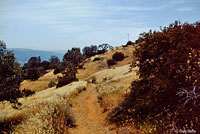
Fig. 1
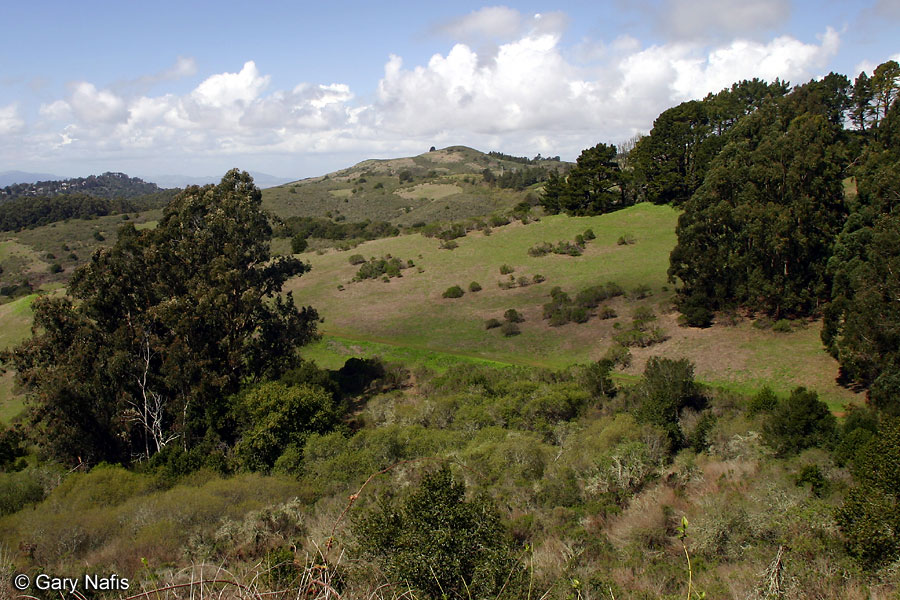
Habitat, Contra Costa County |
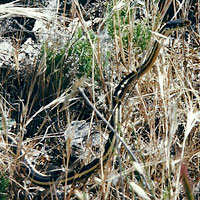
Fig. 2
Adult, Contra Costa County, with head elevated high in typical hunting posture. |
| |
|
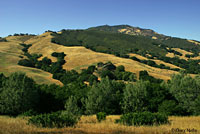
I was hiking up a mountain trail (Fig.1 above) one summer morning, watching a California Whiptail scurry up the trail a few yards ahead of me, when I saw the lizard move off the trail into some dry grass. In an instant the lizard quickly turned around and raced back across the trail into a shrub, kicking up a small cloud of dust. I turned to see an Alameda Striped Racer with its head held high in hunting mode (Fig. 2 above). The snake eyed me standing between itself and the lizard and abandoned its chase, freezing for a few seconds giving me just enough time to pull out a little point and shoot film camera and snap a few shots before the snake turned and crawled into a hole underneath a nearby fallen log. That was my first Alameda Striped Racer sighting and it was at least a year before I got another opportunity to photograph this very fast and wary snake. |
| |
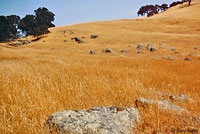
| Habitat |
 |
 |
 |
 |
Habitat, East Bay Hills,
Contra Costa County |
Habitat, Contra Costa County |
Habitat, Contra Costa County
|
Habitat, Contra Costa County |
 |
|
|
|
| Habitat, Contra Costa County |
|
|
|
| |
|
|
|
| Signs |
 |
 |
 |
|
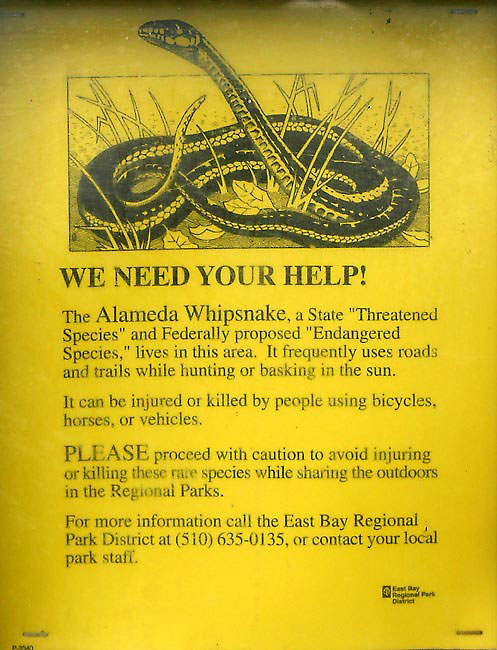
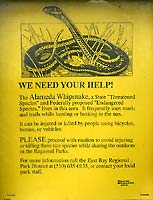
| Alameda Striped Racer (Whipsnake) signs, Contra Costa County |
|
|
| Description |
Not Dangerous - This snake does not have venom that can cause death or serious illness or injury in most humans.
Commonly described as "harmless" or "not poisonous" to indicate that its bite is not dangerous, but "not venomous" is more accurate. (A poisonous snake can hurt you if you eat it. A venomous snake can hurt you if it bites you.)
|
| Size |
Adults are generally 3 - 4 feet long (91 - 122 cm) and occasionally reach 5 ft. (152cm.)
Hatchlings are about 13 inches long (33 cm.)
|
| Appearance |
A long fast-moving snake with a thin body and a long thin tail, large eyes, a broad elongated head, a slender neck, and smooth scales.
|
| Color and Pattern |
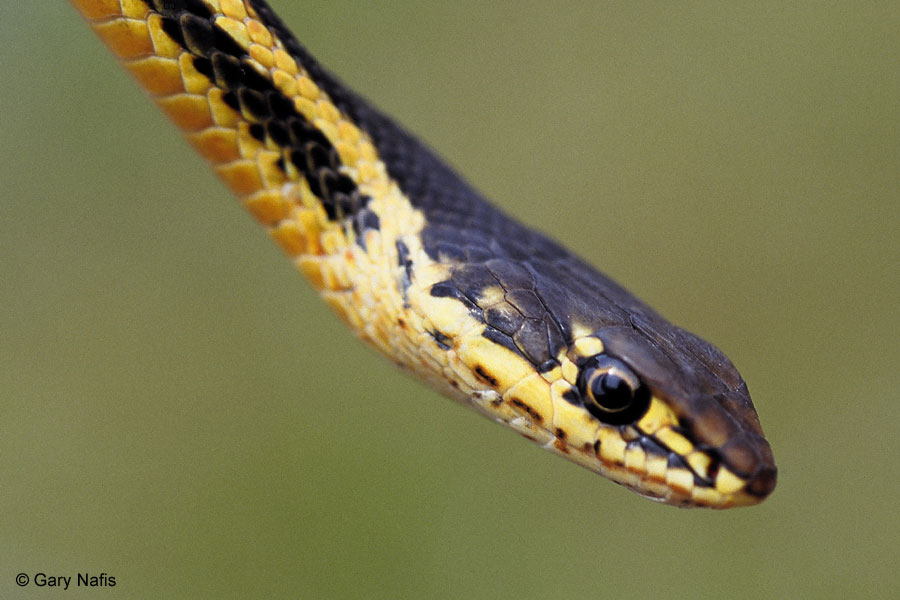
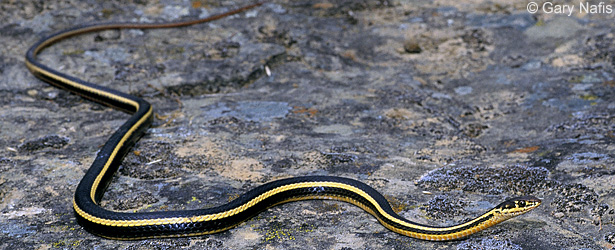
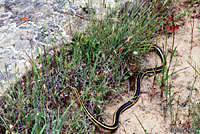
Dark brown to black with a wide solid yellow- orange stripe on each side extending from the back of the eye to or beyond the vent.
The stripes are "broad, 1 and 2 half-scale rows wide." (Stebbins)
The underside is cream tapering to orange or pink toward the tail.
|
| Young |
| Similar to adults. |
| Similar Snakes |
The Alameda Striped Racer subspecies differs from the more widespread California Striped Racer subspecies in having wider side stripes with more orange coloring, a darker black back, no distinct spotting under the head and neck, no dark line across the scale at the end of the nose, and an uninterrupted light stripe from the nose to the eye.
Comparison chart of
Coluber lateralis lateralis - California Striped Racer, with the similar subspecies
Coluber lateralis euryxanthus - Alameda Striped Racer, and the similar species
Coluber taeniatus taeniatus - Desert Striped Whipsnake.
(The lack of a stripe down the middle of the back can help distinguish this species from several sympatric gartersnake species.)
|
| Life History and Behavior |
Activity |
Diurnal, often seen actively foraging in the daytime with head and forward part of the body held up off the ground searching for prey with its acute vision.
Climbs vegetation and seeks shelter in burrows, rocks, or woody debris.
Very fast-moving and alert, quickly fleeing when threatened, this snake is difficult to get close to.
|
| Defense |
| Like most racers and whipsnakes, this snake will strike repeatedly and bite viciously when threatened or handled. |
| Diet and Feeding |
Eats lizards, small rodents, small birds, frogs, salamanders, small snakes.
Juveniles will consume large insects. |
| Reproduction |
Females are oviparous, laying eggs in late spring or early summer which hatch in two to three months.
|
| Habitat |
Open areas in canyons, rocky hillsides, chaparral scrublands, open woodlands, pond edges, stream courses.
|
| Geographical Range |
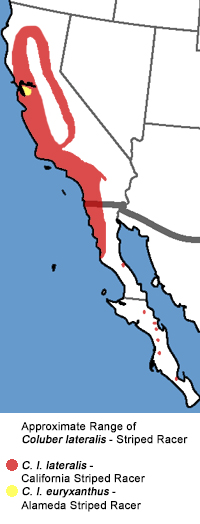
This subspecies, Masticophis lateralis euryxanthus - Alameda Striped Racer, is endemic to California. It occurs only in a small area on the east side of the San Francisco Bay in western Contra Costa and Alameda counties and possibly the edge of Santa Clara County.
According to the U. S. Environmental Protection Agency Endangered Species Protection Program fact sheet for the subspecies (http://www.epa.gov/espp/factsheets/alameda-whipsnake.pdf), it is likely that the range of this subspecies has always been very restricted and limited by the extent of the East Bay coastal scrub and oak woodland communities, and that the current range is similar, but is now fragmented into separate populations with little or no contact due to habitat loss. These fragmented populations are: Tilden-Briones, Oakland-Las Trampas, and Mount Diablo-Black Hills populations in Contra Costa County; Hayward-Pleasanton Ridge population in Alameda County; and the Sunol-Cedar Mountain population in Alameda County and into San Joaquin and Santa Clara Counties.
The species Masticophis lateralis - Striped Racer, is found only in California and Baja California, Mexico.
|
 |
| |
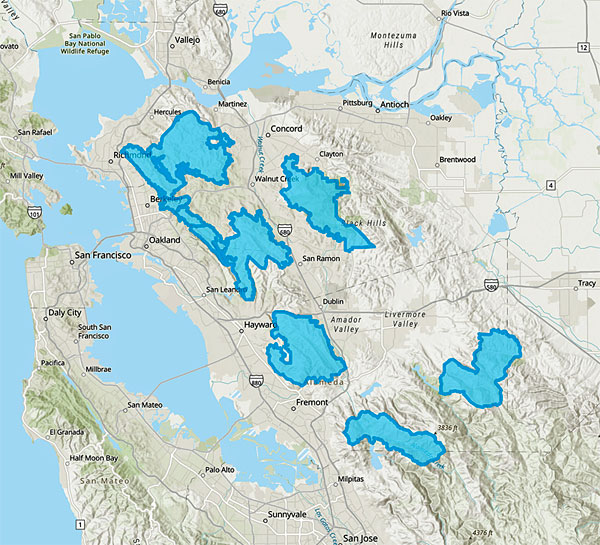 |
California Department of Fish and Wildlife Biographic Information Observation System (BIOS) map: Alameda Whipsnake - Final Critical Habitat [ds274]
(Accessed 10/23/25.)
Click to enlarge.
Go to this page to see the original interactive map.
|
| Notes on Taxonomy |
North American snakes placed in the genus Masticophis were changed to the genus Coluber based on a 2004 paper * by Nagy et al. Utiger et al. (2005, Russian Journal of Herpetology 12:39-60) supported Nagy et al. and synonymized Masticophis with Coluber. This was not universally accepted, but Coluber was used previously on this website.
In a study published in 2017, Myers et al found that the genus Masticophis is monophyletic with respect to Coluber. Following this taxonomy Coluber constrictor mormon will remain but the species previously placed in the genus Masticophis on this website have been returned to Masticophis:
Coluber flagellum - is now Masticophis flagellum
Coluber fuloginosus - is now Masticophis fuliginosus
Coluber lateralis - is now Masticophis lateralis
Coluber taeniatus - is now Masticophis taeniatus
(Edward A. Myers, Jamie L. Burgoon, Julie M. Ray, Juan E. Martinez-Gomez, Noemi Matias-Ferrer, Daniel G. Mulcahy, and Frank T. Burbrink.
Coalescent Species Tree Inference of Coluber and Masticophis. Copeia 105, No. 4, 2017, 642–650)
Alternate and Previous Names (Synonyms)
Masticophis lateralis euryxanthus - Alameda Whipsnake (Hansen and Shedd 2025)
Coluber lateralis euryxanthus - Alameda Striped Racer (Nagy et al 2005)
Masticophis lateralis euryxanthus - Alameda Striped Racer (Stebbins & McGinnis 2012)
Masticophis lateralis euryxanthus - Alameda Whipsnake (Stebbins 1985, 2003)
Masticophis lateralis euryxanthus - Alameda Striped Racer (Stebbins 1966)
Masticophis lateralis - California Striped Whipsnake (Stebbins 1954)
Banded Racer; Few-striped Whip Snake; Hallowell's Coachwhip Snake; Striped Racer; Striped-side Whip Snake (Wright & Wright 1957)
Coluber lateralis - California Striped Racer (Leptophis lateralis; Zamenis lateralis; Gascanion laterale; Bascanium taeniatum laterale; Bascanion taeniatus, part; Drymobius lateralis. Striped Racer; Hallowell's Coach-ship Snake; Banded Racer; Few-striped Whip Snake; Striped-side Whip Snake) (Grinnell and Camp 1917)
California Racer (Van Denburgh 1897)
|
| Conservation Issues (Conservation Status) |
Protected as a threatened species by the state of California and the Federal government due to its limited range and available habitat. Listed December 5, 1997. Critical Habitat Designated October 2, 2006.
Human development has fragmented this snake's originally continuous range into five populations. Approximately 60 percent of this snake's habitat is owned by the public. In 1999 the status of this snake was listed as Declining. |
|
| Taxonomy |
| Family |
Colubridae |
Colubrids |
Oppel, 1811 |
| Genus |
Masticophis |
Coachwhips and Whipsnakes |
Baird & Girard, 1853 |
| Species |
lateralis |
Striped Racer |
(Hallowell, 1853) |
Subspecies
|
euryxanthus |
Alameda Striped Racer |
Riemer, 1954 |
|
Original Description |
Masticophis lateralis - (Hallowell, 1853) - Proc. Acad. Nat. Sci. Philadelphia, Vol. 6, p. 237
Masticophis lateralis euryxanthus - (Riemer, 1954) - Copeia, p. 45
from Original Description Citations for the Reptiles and Amphibians of North America © Ellin Beltz
|
|
Meaning of the Scientific Name |
Masticophis - Greek - mastix = whip + ophis = referring to the body shape and braided appearance of the tail
lateralis - Latin = of the side - referring to the lateral stripes
euryxanthus - Greek - eurys = broad or wide + xanthos = yellow - referring to yellowish lateral striping
from Scientific and Common Names of the Reptiles and Amphibians of North America - Explained © Ellin Beltz
|
|
Alternate Names |
Alameda Whipsnake
Coluber lateralis euryxanthus - Alameda Striped Racer
|
|
Related or Similar California Snakes |
M. l. lateralis - California Striped Racer
C. constrictor mormon - Western Yellow-bellied Racer
T. a. zaxanthus - Diablo Range Gartersnake
|
|
More Information and References |
California Department of Fish and Wildlife
Center for Biological Diversity
U. S. Environmental Protection Agency
Hansen, Robert W. and Shedd, Jackson D. California Amphibians and Reptiles. (Princeton Field Guides.) Princeton University Press, 2025.
Stebbins, Robert C., and McGinnis, Samuel M. Field Guide to Amphibians and Reptiles of California: Revised Edition (California Natural History Guides) University of California Press, 2012.
Stebbins, Robert C. California Amphibians and Reptiles. The University of California Press, 1972.
Flaxington, William C. Amphibians and Reptiles of California: Field Observations, Distribution, and Natural History. Fieldnotes Press, Anaheim, California, 2021.
Nicholson, K. E. (ed.). 2025. Scientific and Standard English Names of Amphibians and Reptiles of North America North of Mexico, with Comments Regarding Confidence in Our Understanding. Ninth Edition. Society for the Study of Amphibians and Reptiles. [SSAR] 87pp.
Samuel M. McGinnis and Robert C. Stebbins. Peterson Field Guide to Western Reptiles & Amphibians. 4th Edition. Houghton Mifflin Harcourt Publishing Company, 2018.
Stebbins, Robert C. A Field Guide to Western Reptiles and Amphibians. 3rd Edition. Houghton Mifflin Company, 2003.
Behler, John L., and F. Wayne King. The Audubon Society Field Guide to North American Reptiles and Amphibians. Alfred A. Knopf, 1992.
Robert Powell, Roger Conant, and Joseph T. Collins. Peterson Field Guide to Reptiles and Amphibians of Eastern and Central North America. Fourth Edition. Houghton Mifflin Harcourt, 2016.
Powell, Robert., Joseph T. Collins, and Errol D. Hooper Jr. A Key to Amphibians and Reptiles of the Continental United States and Canada. The University Press of Kansas, 1998.
Bartlett, R. D. & Patricia P. Bartlett. Guide and Reference to the Snakes of Western North America (North of Mexico) and Hawaii. University Press of Florida, 2009.
Bartlett, R. D. & Alan Tennant. Snakes of North America - Western Region. Gulf Publishing Co., 2000.
Brown, Philip R. A Field Guide to Snakes of California. Gulf Publishing Co., 1997.
Ernst, Carl H., Evelyn M. Ernst, & Robert M. Corker. Snakes of the United States and Canada. Smithsonian Institution Press, 2003.
Taylor, Emily. California Snakes and How to Find Them. Heyday, Berkeley, California. 2024.
Wright, Albert Hazen & Anna Allen Wright. Handbook of Snakes of the United States and Canada. Cornell University Press, 1957.
Thelander, Carl G., editor in chief. Life on the Edge - A Guide to California's Endangered Natural Resources - Wildlife. Berkeley: Bio Systems Books, 1994.
* Z. T. Nagy, Robin Lawson, U. Joger and M. Wink. Molecular systematics of Racers, Whipsnakes and relatives (Reptilia: Colubridae) using Mitochondrial and Nuclear Markers. Journal of Zoological Systematics and Evolutionary Research (Volume 42 pages 223–233). 2004
Joseph Grinnell and Charles Lewis Camp. A Distributional List of the Amphibians and Reptiles of California. University of California Publications in Zoology Vol. 17, No. 10, pp. 127-208. July 11, 1917.
|
|
|
The following conservation status listings for this animal are taken from the July 2025 State of California Special Animals List and the July 2025 Federally Listed Endangered and Threatened Animals of California list (unless indicated otherwise below.) Both lists are produced by multiple agencies every year, and sometimes more than once per year, so the conservation status listing information found below might not be from the most recent lists, but they don't change a great deal from year to year.. To make sure you are seeing the most recent listings, go to this California Department of Fish and Wildlife web page where you can search for and download both lists:
https://www.wildlife.ca.gov/Data/CNDDB/Plants-and-Animals.
A detailed explanation of the meaning of the status listing symbols can be found at the beginning of the two lists. For quick reference, I have included them on my Special Status Information page.
If no status is listed here, the animal is not included on either list. This most likely indicates that there are no serious conservation concerns for the animal. To find out more about an animal's status you can also go to the NatureServe and IUCN websites to check their rankings.
Check the current California Department of Fish and Wildlife sport fishing regulations to find out if this animal can be legally pursued and handled or collected with possession of a current fishing license. You can also look at the summary of the sport fishing regulations as they apply only to reptiles and amphibians that has been made for this website.
Both lists show this snake as Masticophis lateralis euryxanthus - Alameda whipsnake.
The Federally Endangered and Threatened Animals List shows that this taxa is "Synonymous with Coluber lateralis euryxanthus."
|
| Organization |
Status Listing |
Notes |
| NatureServe Global Ranking |
G4T2 |
The species is: Apparently Secure
This subspecies is: Imperiled |
| NatureServe State Ranking |
S2 |
Imperiled |
| U.S. Endangered Species Act (ESA) |
FT |
Listed as Threatened 12/05/1997 |
| California Endangered Species Act (CESA) |
ST |
Listed as Threatened 6/27/1971 |
| California Department of Fish and Wildlife |
None |
|
| Bureau of Land Management |
None |
|
| USDA Forest Service |
None |
|
| IUCN |
None |
|
|
|