|
 |
 |
 |
 |
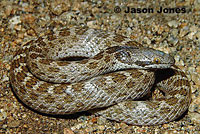
| Adults, San Diego County © Jason Jones |
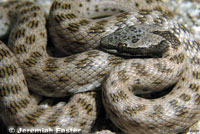
Adult, San Diego County
© 2005 Jeremiah Easter |
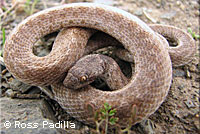
Adult, Riverside County © Ross Padilla |
 |
 |
 |
 |
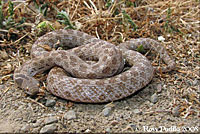
| Adult, Riverside County © Ross Padilla |
Adult, Riverside County © Ross Padilla |
Juvenile, San Diego County.
© Bob Stephens-Doll |
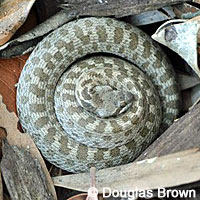
Adult, San Diego County
© Douglas Brown |
 |
 |
 |
 |
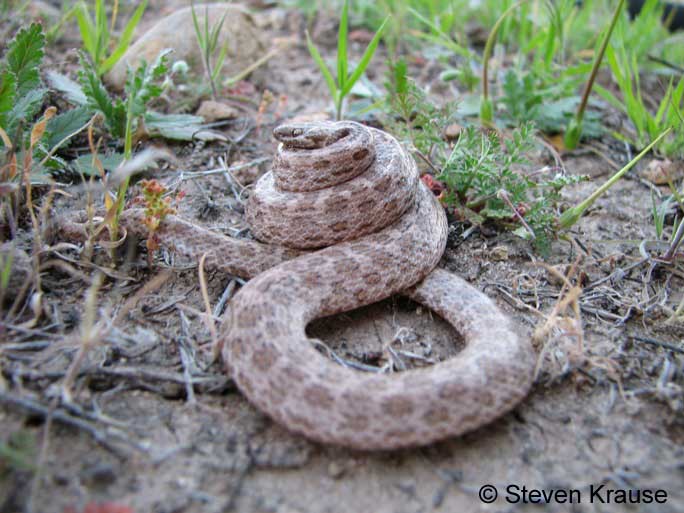
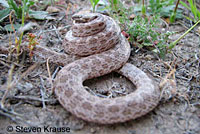
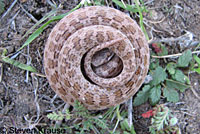
| Adult, coiling defensively, San Diego County. © Steven Krause |
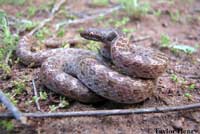
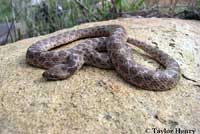
Adult, San Diego County © Taylor Henry |
Adult, San Diego County © Taylor Henry |
 |
 |
 |
 |
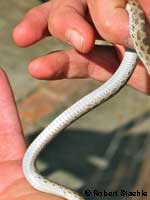
Underside of adult, Los Angeles County
© Robert Staehle
|
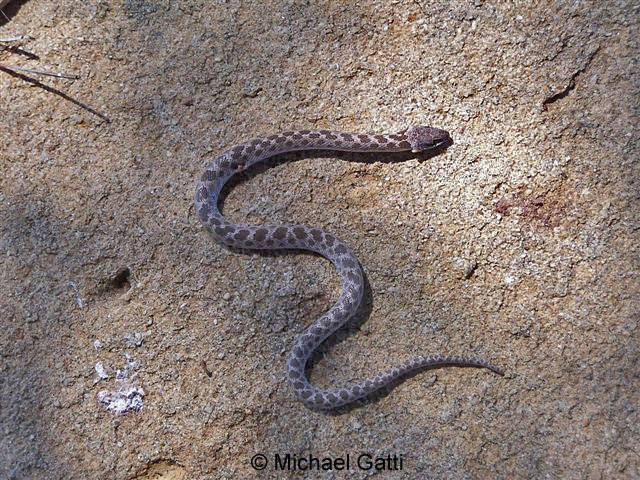
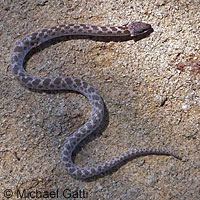
Adult, Santa Barbara County
© Michael Gatti |
Adult, Riverside County |
 |
 |
 |
 |
| Adult in coastal habitat, Los Angeles County © Grigory Heaton |
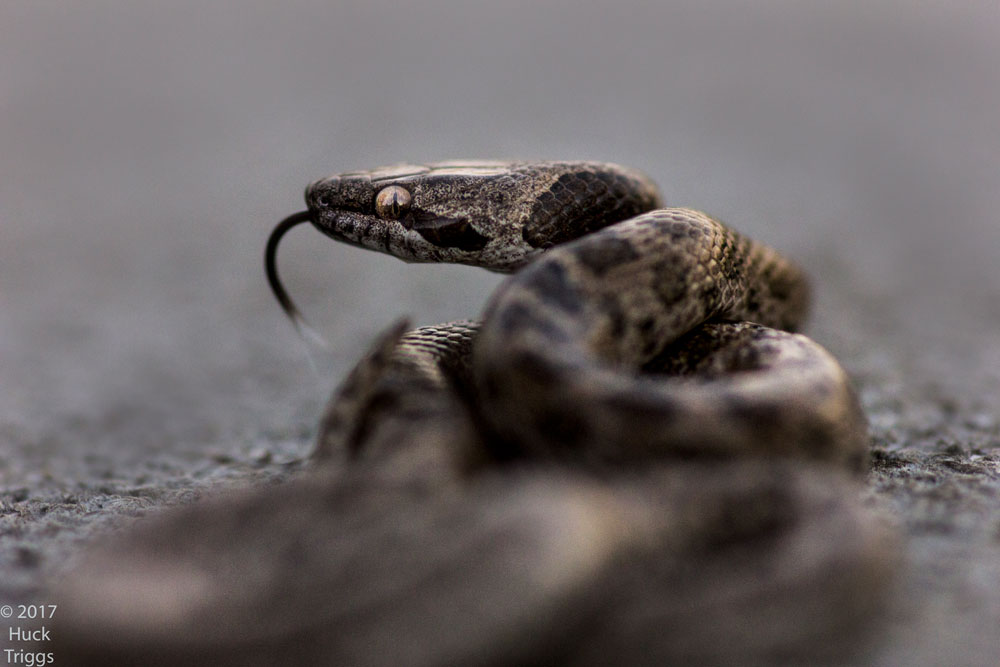
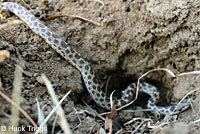
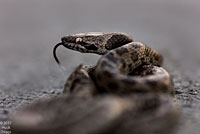
Adult, Los Angeles County
© Huck Triggs |
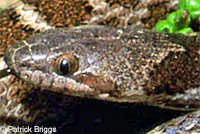
Adult, Ventura County © Patrick Briggs
|
 |
 |
 |
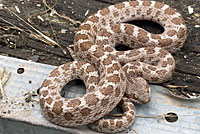 |
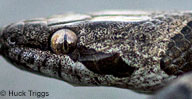
| Adult, Santa Monica Mountains, Los Angeles County © Huck Triggs |
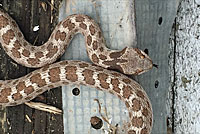
Adult, Santa Barbara County |
 |
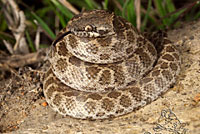 |
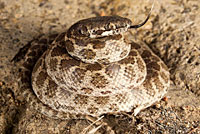 |
 |
| Adult, Santa Monica Mountains, Los Angeles County © Huck Triggs |
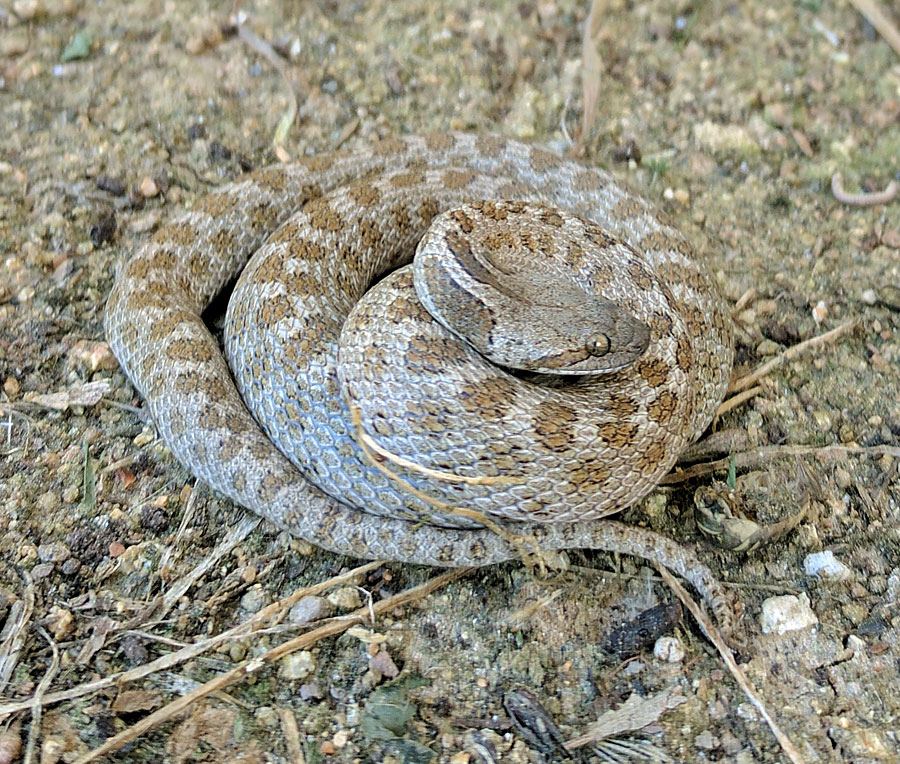
Adult coiled in defensive pose, San Diego County © Paul Maier |
Adult with unusual pattern, found in northern Los Angeles County near the border with Ventura County
© Stephen Egnatchik |
 |
 |
 |
 |
Adult, Santa Barbara County
© Ryan Sikola |
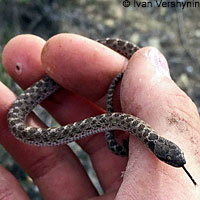
Adult, Orange County © Ivan Vershynin |
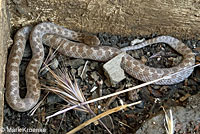
Adult, Ventura County © Mark Kroenke |
 |
 |
|
|
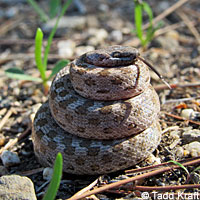
Adult coiled defensively,
Orange County, © Tadd Kraft |
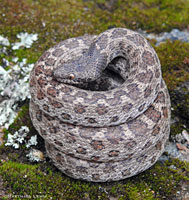
Adult coiled defensively, San Diego County © Matthias Lemm |
|
|
| |
|
|
|
| Juveniles |
 |
 |
 |
|
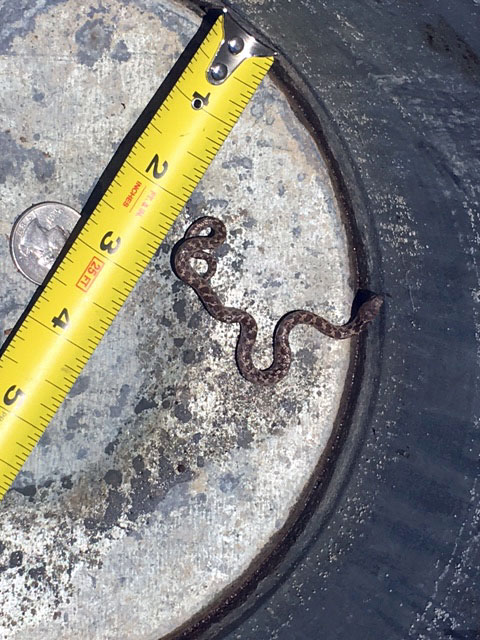
Tiny hatchling in early June,
San Diego County |
This hatchling found in mid October in the eastern San Diego County mountains was estimated to be about 5 inches in length. (The coin is .75 inches in diameter, or 19.05 mm). © Michael G. |
|
| |
|
|
|
| Habitat |
 |
 |
 |
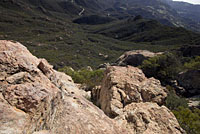 |
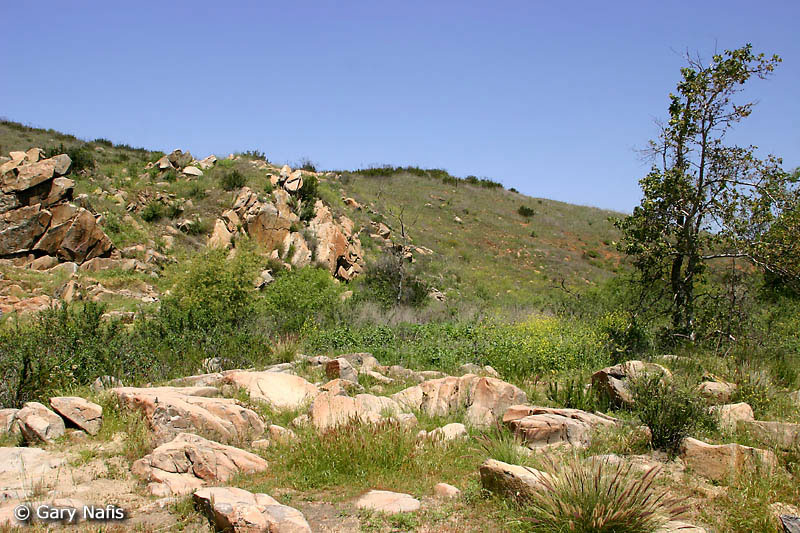
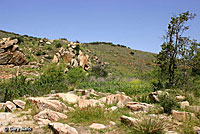
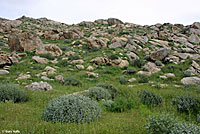
Coastal San Diego County grassland habitat that is rapidly disappearing due to development. © Brian Hinds
|
Habitat, San Diego County |
Habitat, Riverside County |
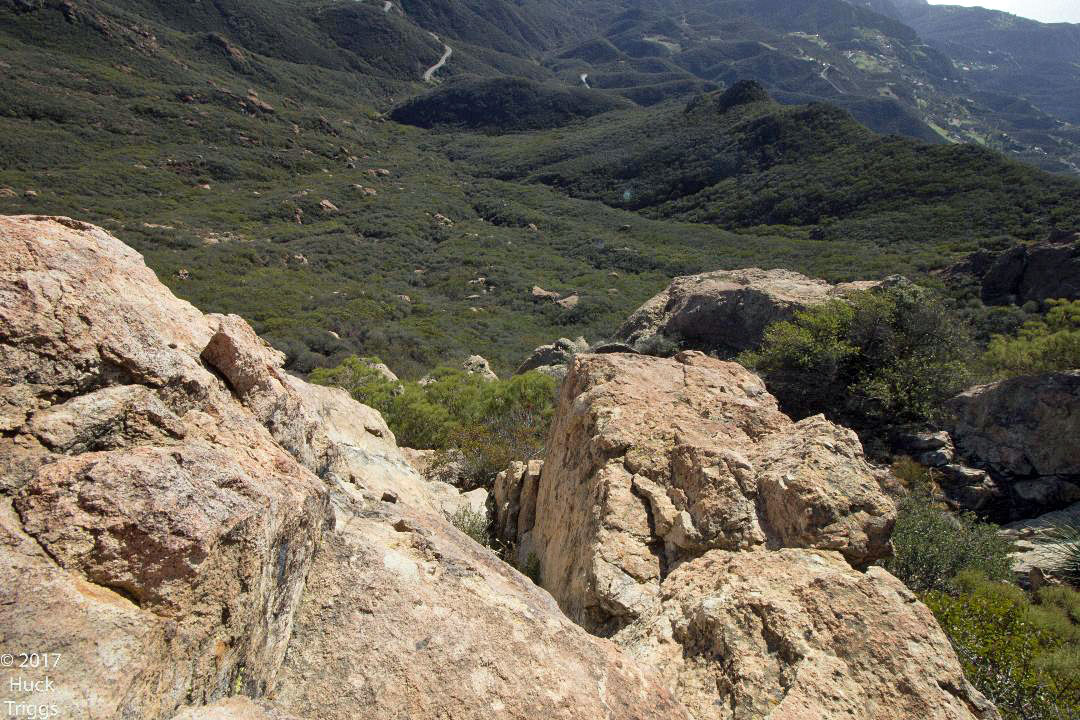
Habitat, Santa Monica Mountains, Los Angeles County © Huck Triggs |
 |
|
|
|
| Habitat, Santa Monica Mountains, Los Angeles County © Huck Triggs |
|
|
|
| |
|
|
|
| Short Video of Similar Subspecies |
 |
|
|
|
| An uncooperative California Nightsnake found on a road at night refuses to do anything worth putting on video, but it's all I could get. |
|
|
|
|
|
|
|
| Description |
Not Dangerous - This snake may produce a mild venom that does not typically cause death or serious illness or injury in most humans, but its bite should be avoided.
Commonly described as "harmless" or "not poisonous" to indicate that its bite is not dangerous, but "not venomous" is more accurate since the venom is not dangerous. (A poisonous snake can hurt you if you eat it. A venomous snake can hurt you if it bites you.)
Rear teeth on the upper jaw are enlarged and grooved to aid in injecting a mild saliva/venom mixture into prey.
|
| Size |
Adults can be 12 - 26 inches long (30-66 cm.) Most seen are 8 - 12 inches long, rarely over 16 inches.
Bartlett & Bartlett (2009) shows the size of Hypsiglena hatchlings to be about 7 inches in length (18 cm) but some have been estimated to be as small as 5 inches long (12.7 cm).
|
| Appearance |
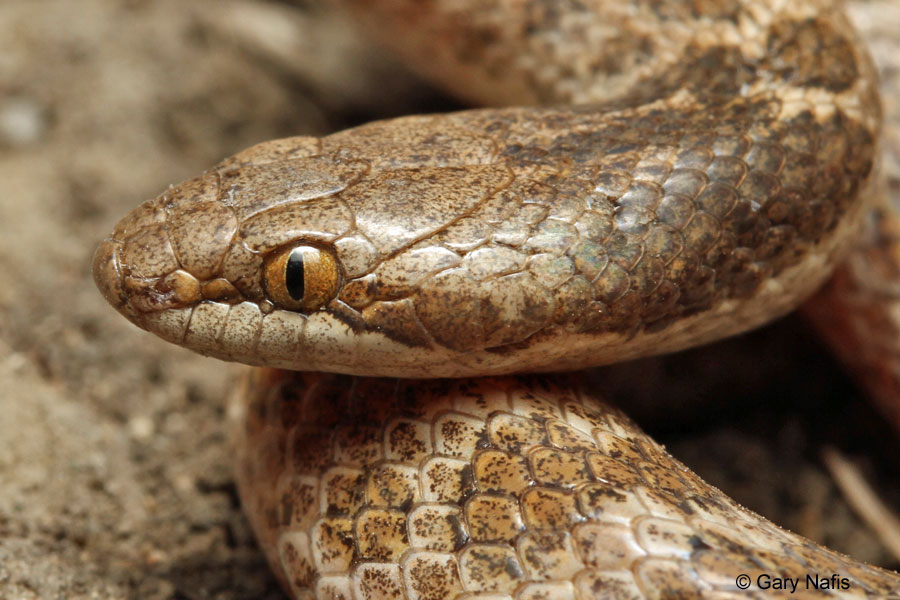
A small slender snake with a narrow flat head, smooth scales in 19 rows, and vertical pupils.
|
| Color and Pattern |
Color varies, often matching the substrate, from light gray, light brown, beige, to tan or cream, with dark brown or gray blotches on the back and sides.
Usually a pair of large dark blotches on the neck and a dark bar through or behind the eyes.
Whitish or yellowish and unmarked underneath. |
| Subspecies Variation |
H. o. klauberi "is characterized by a three-part nuchal collar formed by two lateral blotches, not in contact with the eye stripe, and an elongate, irregular median nape spot."
H. o. nuchalata is "…characterized by large nuchal blotches on the sides that often come together to form a collar, and one row of large dorsal body blotches; the eye stripe comes to a point, just contacting the lateral blotches or collar." 1
|

|
Click this image to see an example of the eye stripe differences.
This difference may not be always consistent, but it seems to be the best way to differentiate the subspecies.
|
 |
The vertical pupils on a night snake can help you tell them apart from
gophersnakes and other similar species which have circular pupils.
|
Identifying Nightsnakes in California
|
| Life History and Behavior |
Activity |
Nocturnal, and also active at dusk and dawn.
Can be found under rocks, boards, logs, and other surface objects.
Sometimes seen crossing roads on warm nights. |
| Diet and Feeding |
| Eats a wide range of terrestrial vertebrates, mostly lizards and their eggs, sometimes small snakes, frogs, and salamanders. |
| Venom |
| Nightsnakes, genus Hypsiglena, have mildly venomous saliva that is introduced into prey by the repeated chewing action of two enlarged teeth found at the rear of the mouth. The venom is not injected by fangs, it is introduced into the prey through small puncture wounds made by the enlarged teeth. The venom helps to incapacitate the small prey, but it is not considered harmful to humans. The small size of the snake's head, the location of the fangs, and the chewing action necessary to administer the venom, make it difficult for a nightsnake to envenomate anything but small animals. (Werler & Dixon, 2000) |
| Reproduction |
Oviparous. After mating, females lay a clutch of 2-9 eggs from April to September. (Stebbins, 2003)
Incubation is probably similar to that of the Desert Nightsnake species, H. clorophaea, the eggs of which hatch in 50-65 days with hatchlings about 7 inches in length. (Bartlett & Tennant, 2000)
|
| Habitat |
Found in a variety of habitats, often arid areas, from chaparral, Sagebrush flats, deserts, suburban lots and gardens, mountain meadows, grassland. Most commonly found in areas with abundant surface cover.
|
| Geographical Range |
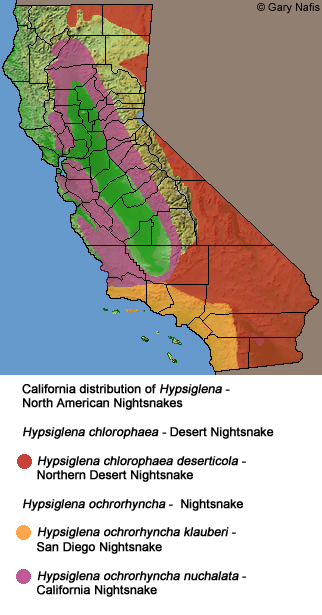
This subspecies, Hypsiglena ochrorhyncha klauberi - San Diego Nightsnake, is found from the coast to the coastal slopes of the Peninsular, Transverse, and South Coast Ranges from near Santa Barbara County south to mid Baja California. An old record for Hypsiglena torquata from Santa Cruz Island should be this species..
The species, Hypsiglena ochrorhyncha - Nightsnake, is found in a ring around the San Joaquin and Sacramento valleys, including the south coast ranges, and the inner north coast ranges and the foothills of the Sierra Nevada, and south into coastal Southern California to the southern tip of Baja California. |
 |
Approximate range of Hypsiglena ochrorhyncha - Coast Nightsnake
Dark Blue: Hypsiglena ochrorhyncha klauberi - San Diego Nightsnake
Yellow: Hypsiglena ochrorhyncha nuchalata - California Nightsnake
- Not found in California
Orange: Hypsiglena ochrorhyncha martinensis - Isla San Martin Nightsnake
Bight Green: Hypsiglena ochrorhyncha baueri - Isla Cedros Nightsnake
Bright Blue: Hypsiglena ochrorhyncha gularis - Isla Partida Norte Nightsnake
Red: Hypsiglena ochrorhyncha ochrorhyncha - Cape Nightsnake
Pink: Hypsiglena ochrorhyncha unaocularis - Islas Revillagigedo Nightsnake
Green: Hypsiglena ochrorhyncha venusta - Magdalena Nightsnake
|
| Elevational Range |
Sea level to 8,700 ft. (2,650 meters).
|
| Notes on Taxonomy |
Mulcahy, 2008, conducted a comprehensive genetics study of Hypsiglena, recognizing 6 species, three in the USA, and an undescribed species, all from the one previous species of Hypsiglena torquata. He also maintained several subspecies designations. Within California: H. chlorophaea, and H. ochrorhyncha "…were each recovered as groups of multiple subspecies. The subspecies within these wide-ranging species were maintained pending further evaluation. These subspecies may represent incipient species that may not yet have achieved reciprocal monophyly, but possess unique morphologies, and are geographically discrete." 1
------------------------------------------------------------------------------------------------------------------------------------------------------------------------------------------------------------------------------
Grismer et al. (1994 Bulletin of the Southern California Academy of Science 93(2): 45-80) synonymized the Hypsiglena torquata subspecies deserticola and klauberi because they intergraded widely.
------------------------------------------------------------------------------------------------------------------------------------------------------------------------------------------------------------------------------
"Based on mtDNA data, Myers and Mulcahy (2020, Mitochondrial DNA Part B Re- sources. 5: 3056–3058) recognized nine named and two unnamed (presumed) species. Three or their named and one of their unnamed species occur in the U.S. The nine named species closely follow the boundaries of taxa formerly recognized as subspecies. The authors continue to recognize subspecies designations within several of the widespread, polymorphic species. See also Myers et al. (2017, Journal of Biogeography 44: 461–474) and Myers et al. (2019, Molecular Ecology 28: 4535–4548)."
(Nicholson, K. E. (ed.). 2025 SSAR Scientific and Standard English Names List)
------------------------------------------------------------------------------------------------------------------------------------------------------------------------------------------------------------------------------
Alternate and Previous Names (Synonyms)
H. ochrorhyncha - Coast Night Snake (Stebbins & McGinnis 2018)
H. ochrorhynchus - Coast Night Snake (Stebbins & McGinnis 2012, Reptile Database, 10/23)
H. torquata - NIght Snake (Stebbins 1985, 2003)
H. torquata klauberi - San Diego NIght Snake (Stebbins 1966)
H. torquata klauberi (Stebbins 1954)
H. torquata klauberi - San Diegan Spotted Night Snake (Tanner 1944)
Hypsiglena ochrorhynchus - Spotted Night Snake (Rock Snake; Xantus's Snake) (Grinnell and Camp 1917)
|
| Conservation Issues (Conservation Status) |
| None |
|
| Taxonomy |
| Family |
Colubridae |
Colubrids |
Oppel, 1811 |
| Genus |
Hypsiglena |
North American Nightsnakes |
Cope, 1860 |
| Species |
ochrorhyncha |
Coast Nightsnake |
Cope, 1860 |
Subspecies
|
klauberi |
San Diego Nightsnake |
Tanner, 1944 |
| Original Description |
Hypsiglena ochrorhyncha - Cope, 1860
klauberi - Tanner, 1944
|
| Meaning of the Scientific Name |
Hypsiglena - Greek - hypsi = on high + glenes = eyeball - probably refers to the vertical pupil
ochrorhyncha = yellow-ochre snout: ochro - Greek - ochra = yellow-ochre + rhynchos = a beak, snout
klauberi - honors the herpetologist Laurence M. Klauber
Taken partly from Scientific and Common Names of the Reptiles and Amphibians of North America - Explained © Ellin Beltz
and from Jaeger, Edmund C. A Source-book of Biological Names and Terms Third Edition. Charles C. Thomas Publisher, 1962.
|
| Related or Similar California Herps |
H. o. nuchalata - California Nightsnake
H. clorophaea deserticola - Northern Desert Nightsnake
Tantilla planiceps - Western Black-headed Snake
|
| More Information and References |
California Department of Fish and Wildlife
1 Daniel G. Mulcahy. Phylogeography and species boundaries of the western North American Night snake (Hypsiglena torquata): Revisiting the subspecies concept. ScienceDirect - Molecular Phylogenetics and Evolution 46 (2008) 1095-1115.
Hansen, Robert W. and Shedd, Jackson D. California Amphibians and Reptiles. (Princeton Field Guides.) Princeton University Press, 2025.
Stebbins, Robert C., and McGinnis, Samuel M. Field Guide to Amphibians and Reptiles of California: Revised Edition (California Natural History Guides) University of California Press, 2012.
Stebbins, Robert C. California Amphibians and Reptiles. The University of California Press, 1972.
Flaxington, William C. Amphibians and Reptiles of California: Field Observations, Distribution, and Natural History. Fieldnotes Press, Anaheim, California, 2021.
Nicholson, K. E. (ed.). 2025. Scientific and Standard English Names of Amphibians and Reptiles of North America North of Mexico, with Comments Regarding Confidence in Our Understanding. Ninth Edition. Society for the Study of Amphibians and Reptiles. [SSAR] 87pp.
Samuel M. McGinnis and Robert C. Stebbins. Peterson Field Guide to Western Reptiles & Amphibians. 4th Edition. Houghton Mifflin Harcourt Publishing Company, 2018.
Stebbins, Robert C. A Field Guide to Western Reptiles and Amphibians. 3rd Edition. Houghton Mifflin Company, 2003.
Behler, John L., and F. Wayne King. The Audubon Society Field Guide to North American Reptiles and Amphibians. Alfred A. Knopf, 1992.
Robert Powell, Roger Conant, and Joseph T. Collins. Peterson Field Guide to Reptiles and Amphibians of Eastern and Central North America. Fourth Edition. Houghton Mifflin Harcourt, 2016.
Powell, Robert., Joseph T. Collins, and Errol D. Hooper Jr. A Key to Amphibians and Reptiles of the Continental United States and Canada. The University Press of Kansas, 1998.
Lemm, Jeffrey. Field Guide to Amphibians and Reptiles of the San Diego Region (California Natural History Guides). University of California Press, 2006.
Bartlett, R. D. & Patricia P. Bartlett. Guide and Reference to the Snakes of Western North America (North of Mexico) and Hawaii. University Press of Florida, 2009.
Bartlett, R. D. & Alan Tennant. Snakes of North America - Western Region. Gulf Publishing Co., 2000.
Brown, Philip R. A Field Guide to Snakes of California. Gulf Publishing Co., 1997.
Ernst, Carl H., Evelyn M. Ernst, & Robert M. Corker. Snakes of the United States and Canada. Smithsonian Institution Press, 2003.
Taylor, Emily. California Snakes and How to Find Them. Heyday, Berkeley, California. 2024.
Wright, Albert Hazen & Anna Allen Wright. Handbook of Snakes of the United States and Canada. Cornell University Press, 1957.
John E. Werler and James R. Dixon. Texas Snakes: Identification, Distribution, and Natural History. University of Texas Press, Austin. 2000.
Joseph Grinnell and Charles Lewis Camp. A Distributional List of the Amphibians and Reptiles of California. University of California Publications in Zoology Vol. 17, No. 10, pp. 127-208. July 11, 1917.
|
|
|
The following conservation status listings for this animal are taken from the July 2025 State of California Special Animals List and the July 2025 Federally Listed Endangered and Threatened Animals of California list (unless indicated otherwise below.) Both lists are produced by multiple agencies every year, and sometimes more than once per year, so the conservation status listing information found below might not be from the most recent lists, but they don't change a great deal from year to year.. To make sure you are seeing the most recent listings, go to this California Department of Fish and Wildlife web page where you can search for and download both lists:
https://www.wildlife.ca.gov/Data/CNDDB/Plants-and-Animals.
A detailed explanation of the meaning of the status listing symbols can be found at the beginning of the two lists. For quick reference, I have included them on my Special Status Information page.
If no status is listed here, the animal is not included on either list. This most likely indicates that there are no serious conservation concerns for the animal. To find out more about an animal's status you can also go to the NatureServe and IUCN websites to check their rankings.
Check the current California Department of Fish and Wildlife sport fishing regulations to find out if this animal can be legally pursued and handled or collected with possession of a current fishing license. You can also look at the summary of the sport fishing regulations as they apply only to reptiles and amphibians that has been made for this website.
This snake is not included on the Special Animals List, which indicates that there are no significant conservation concerns for it in California.
|
| Organization |
Status Listing |
Notes |
| NatureServe Global Ranking |
|
|
| NatureServe State Ranking |
|
|
| U.S. Endangered Species Act (ESA) |
None |
|
| California Endangered Species Act (CESA) |
None |
|
| California Department of Fish and Wildlife |
None |
|
| Bureau of Land Management |
None |
|
| USDA Forest Service |
None |
|
| IUCN |
|
|
|
|

 Orange: Range of this subspecies in California