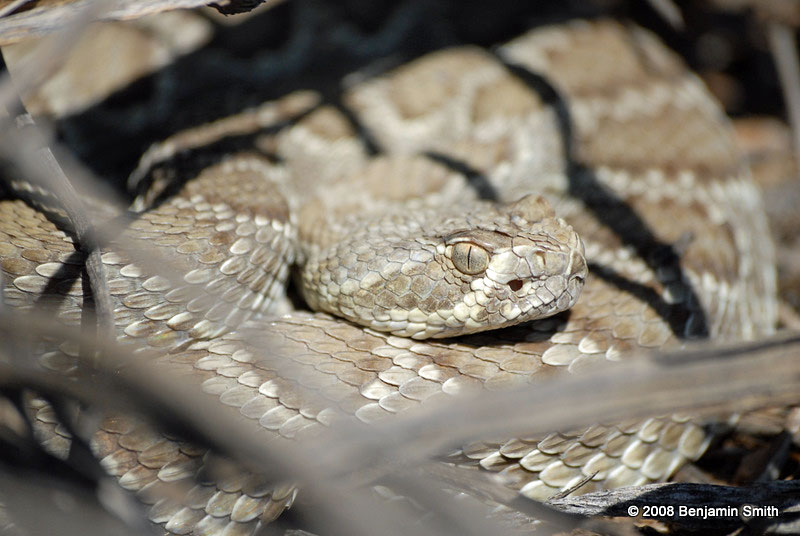
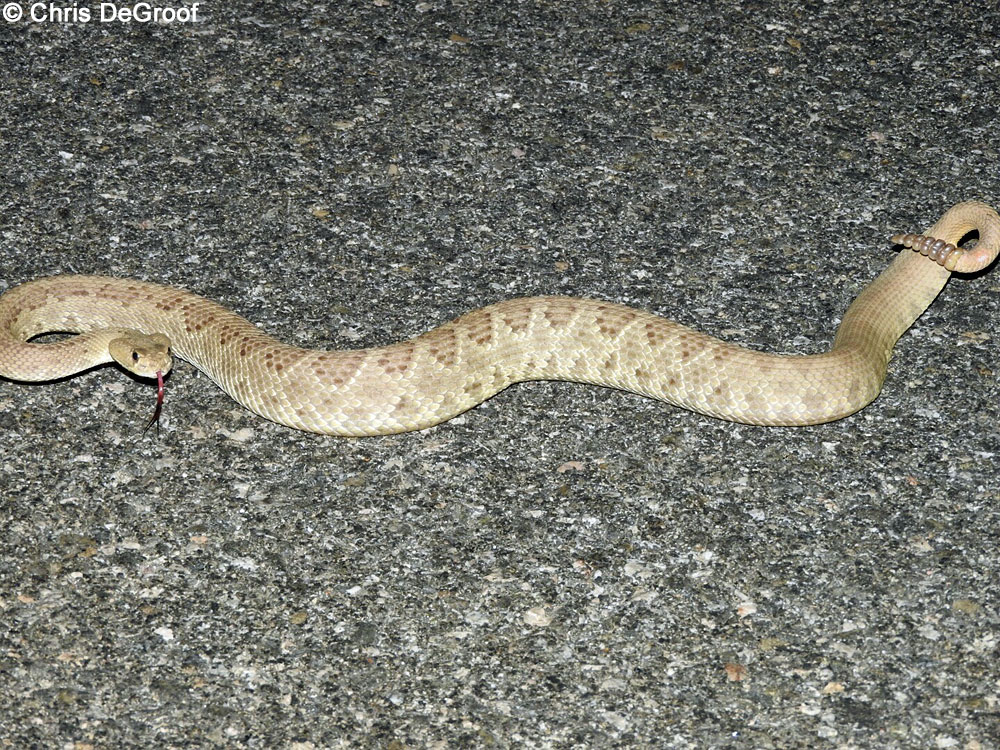
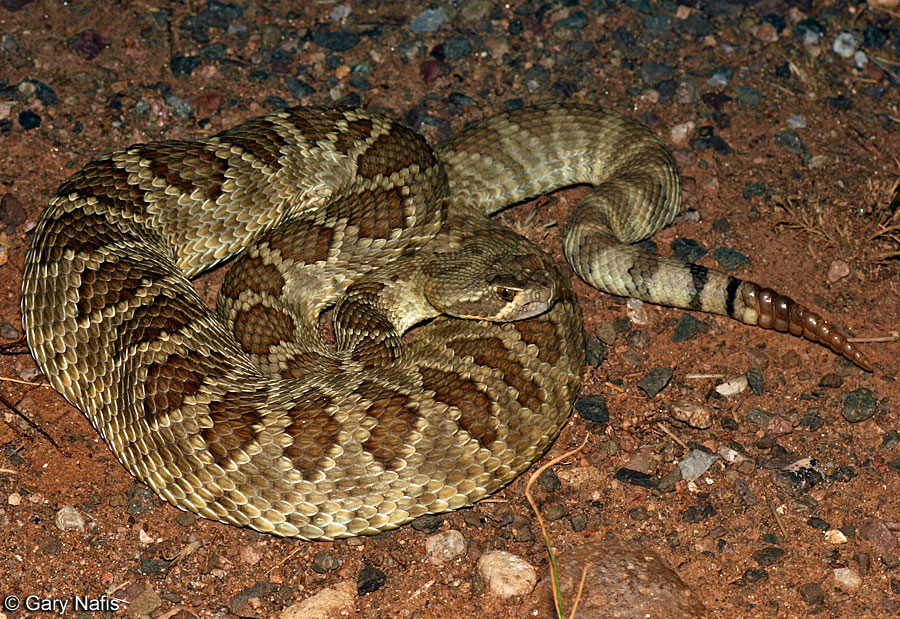
Top of the head close-up showing two
large scales between the supraoculars. Compare with the several small scales between the supraoculars of the Western Diamond-backed Rattlesnake.
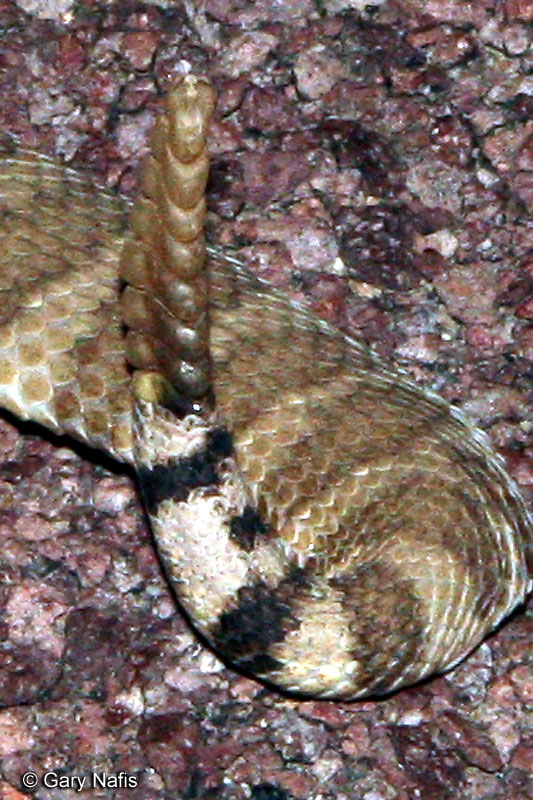
Tail and Rattle
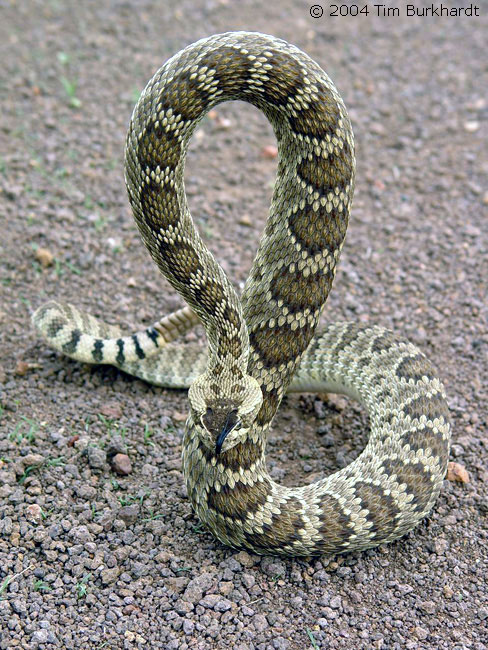
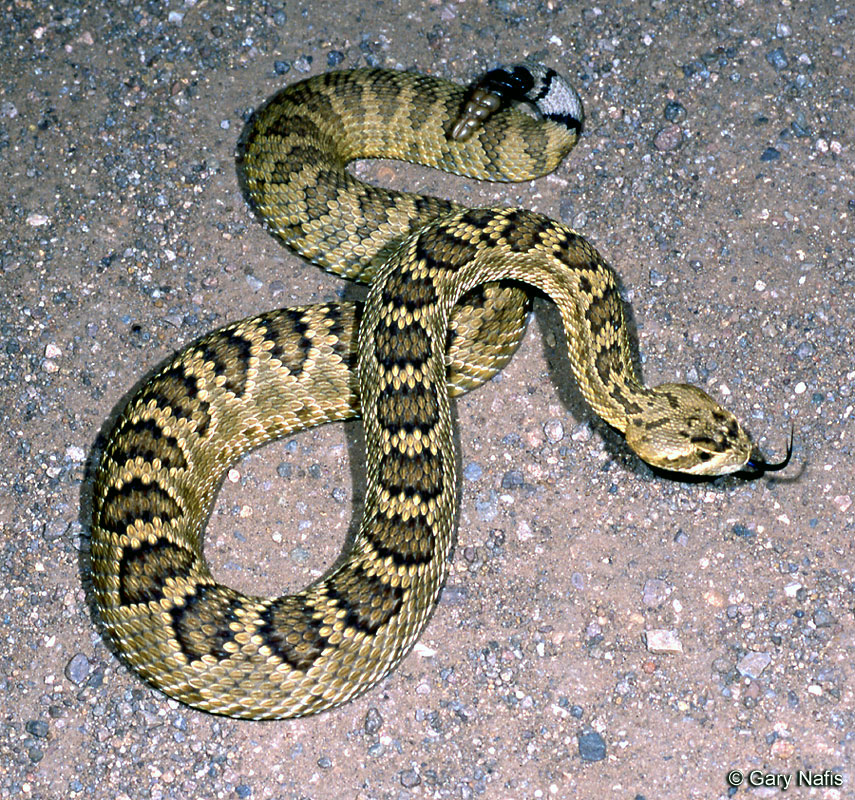
Black rings and wider white rings, circle the tail just before the rattle.
The ring adjacent to the rattle is usually white. Compare with the tail of the Western Diamond-backed Rattlesnake.
Juveniles
Juvenile resting during daytime inside a small burrow, Kern County
How to Tell the Difference Between Rattlesnakes and Gophersnakes
Harmless and beneficial gophersnakes are sometimes mistaken for dangerous rattlesnakes. Gophersnakes are often killed unnecessarily because of this confusion.
(It's also not necessary to kill every rattlesnake.)
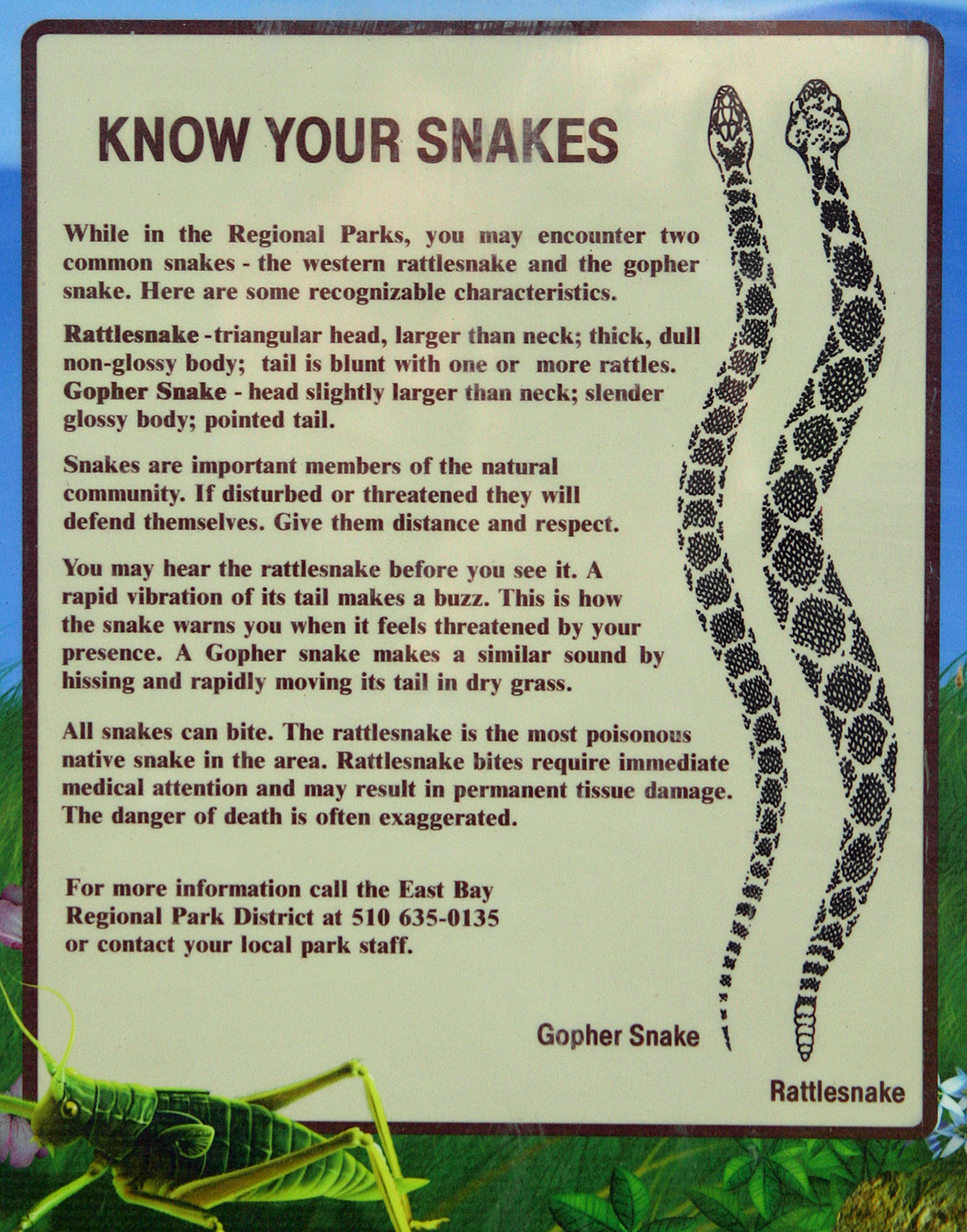
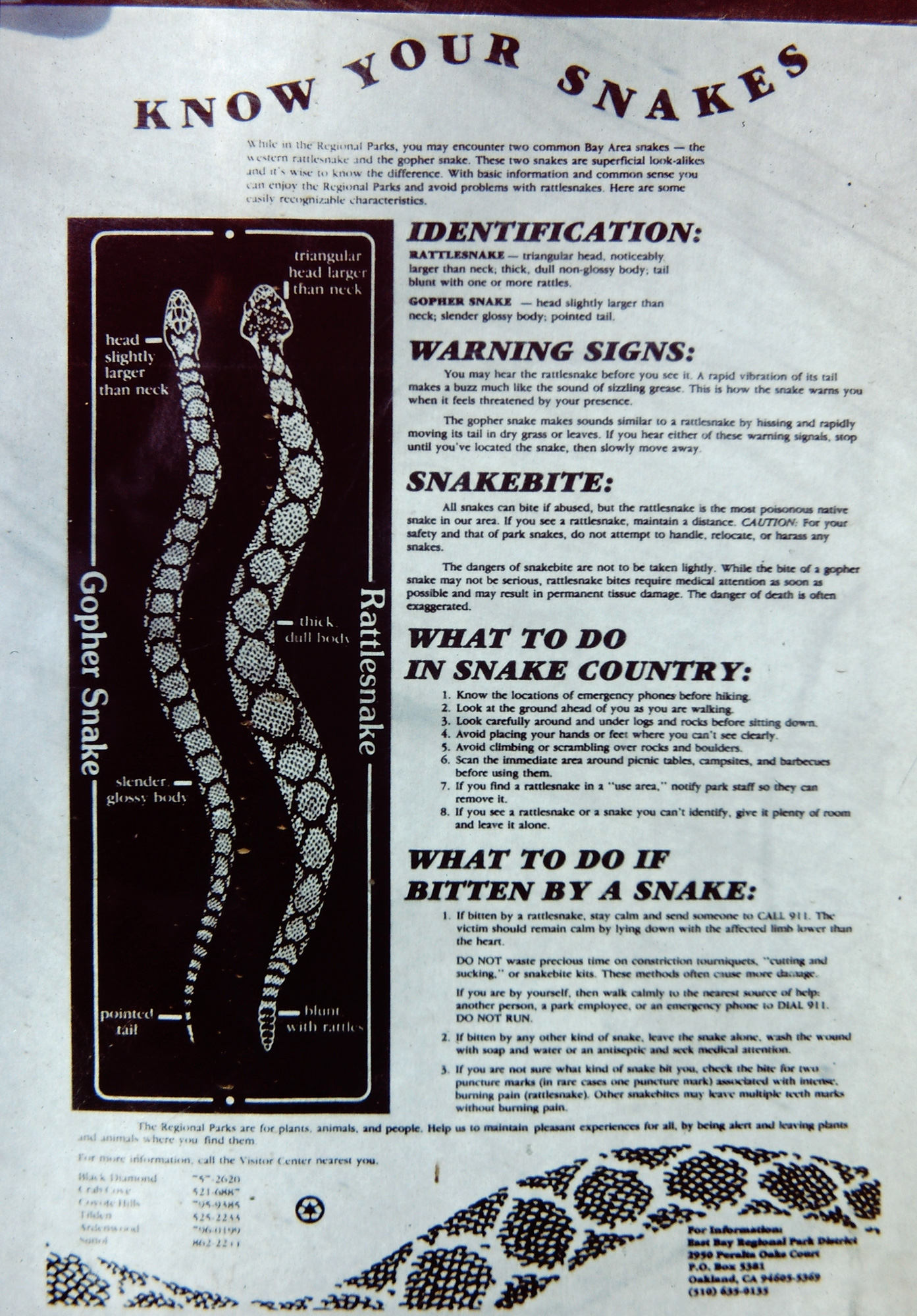
It is easy to avoid this mistake by learning to tell the difference between the two families of snakes. The informational signs shown above can help to educate you about these differences. (Click to enlarge).
If you can't see enough detail on a snake to be sure it is not a rattlesnake or if you have any doubt that it is harmless, leave it alone.
You should never handle a snake unless you are absolutely sure that it is not dangerous.
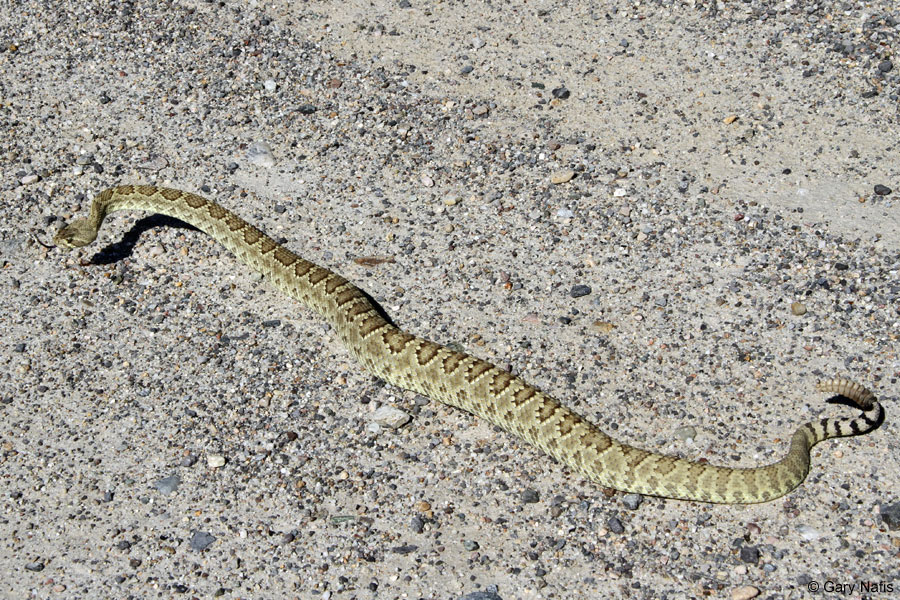
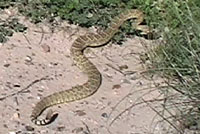
Adult warming up in the sun on a spring morning, Kern County desert
Short Videos and Sound
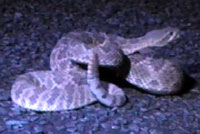
Several views of a Northern Mojave Rattlesnake rattling and taking a defensive posture.
Rattlesnakes are often portrayed as aggressive, but this camera shy Northern Mojave rattlesnake assumed a defensive posture then crawled off the road to get away from me.
Click on the play button or the speaker to hear a Mojave Rattlesnake rattling
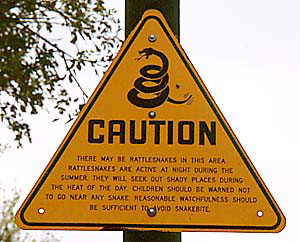
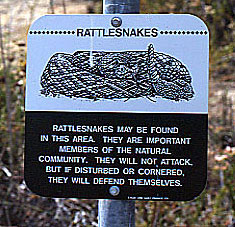
California Park sign.
Click the picture to see more rattlesnake signs.
Rattlesnakes are important members of the natural community. They will not attack, but if disturbed or cornered, they will defend themselves. Reasonable watchfulness should be sufficient to avoid snakebite. Give them distance and respect.
"Rattlesnakes are also among the most reasonable forms of dangerous wildlife: their first line of defense is to remain motionless; if you surprise them or cut off their retreat, they offer an audio warning; if you get too close, they head for cover. Venom is intended for prey so they're reluctant to bite, and 25 to 50 percent of all bites are dry - no venom is injected." Leslie Anthony. Snakebit: Confessions of a Herpetologist. Greystone Books, 2008.
Rattlesnakes are typically described as poisonous, but they are actually venomous.
A poisonous snake is one that is harmful to touch or eat.
A venomous snake injects dangerous venom into its victim.
A bite from a rattlesnake can be extremely dangerous, but rattlesnakes should not be characterized as aggressive and vicious, striking and biting without provocation, as they are often shown. If rattlesnakes are given some space and enough time to escape to a safe place, they will usually just crawl away as fast as possible to avoid confrontation. Rattlesnakes will not strike without a reason: they will strike at a potential meal and they will defend themselves from anything they perceive as dangerous. They avoid striking and biting because it uses up their valuable supply of venom which they need to kill and digest their food.
Rattlesnakes are often portrayed with the body partly coiled, the tail rattling loudly, and the head raised up and ready to strike, but they do not need to coil up this way to strike and bite. This display is a warning not to come any closer. It's a defensive behavior that some rattlesnakes use when they sense that crawling away would put them in danger of attack.
Rattlesnakes do not always rattle a warning. Sometimes they rattle loudly to warn potential enemies of their presence, but other times they remain silent when they sense a threat, choosing to remain still to rely on their cryptic color and pattern to let them blend into their surroundings to hide from the threat. Making a noise in this situation risks advertising their presence. They also use their natural camouflage to hunt by sitting still, without rattling, trying to remain invisible as they wait for a warm-blooded prey animal to pass close enough to strike.
Description
Dangerously Venomous
A bite from this snake can cause death or serious illness or injury in humans that may require immediate medical care.
(Commonly called a "poisonous" snake to indicate that its bite is dangerous, but that is not correct. It should be called a "venomous" snake. A poisonous snake can harm you if you eat it. A venomous snake can harm you if it bites you.)
Size
Adults 24 - 51 inches long (61 - 129 cm) Most snakes encountered are from 18 - 40 inches in length. Newborns are about 10.5 inches.
Appearance
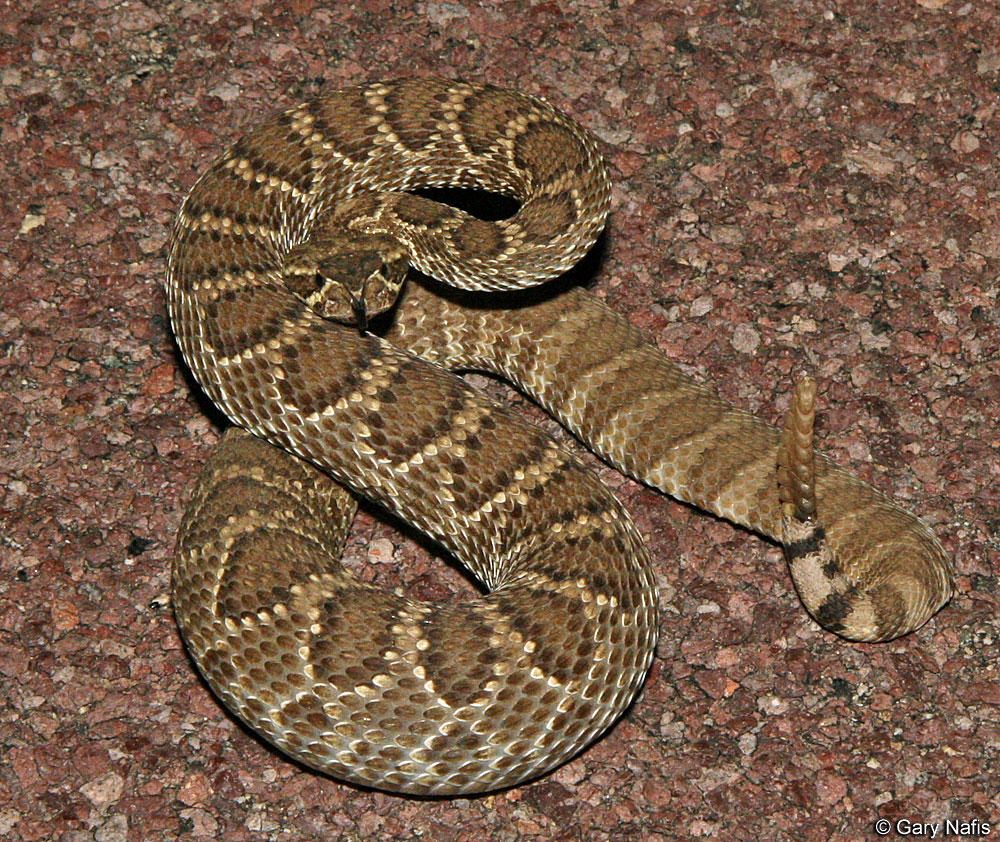
A heavy-bodied, dangerously venomous pit viper, with a thin neck and a large triangular head.
Pupils are elliptical.
Scales are keeled.
Usually there are 2 or 3 large scales on the top of the head between the supraoculars.
Rattlesnakes are "pit vipers" which means they have two pits that are used to sense heat when hunting warm-blooded prey - with one pit on each side of the front of the head above the mouth.
Color and Pattern
A light stripe runs from behind the eye diagonally to the upper lip beyond the end of the jaw, but does not cross over the lip.
(The posterior light stripe of the Western Diamond-backed Rattlesnake extends to the upper lip in front of the end of the jaw, crossing over the lip.)
Ground color varies from greenish gray, yellow, tan, olive green, to brown. Irregular, dark, well-defined, diamond or near diamond-shaped dorsal markings.
Black and white rings surround a thick tail. The black rings are narrower than the light rings, and often offset. A rattle on the end of the tail, consisting of loose interlocking segments. A new rattle segment is added each time the skin is shed.
Young
Newborn snakes do not have a rattle - just a single button which does not make a sound.
Compare the Western Diamond-backed Rattlesnake to the Northern Mojave Rattlesnake
Life History and Behavior
Activity
Primarily nocturnal and crepuscular during periods of excessive daytime heat, but also active during daylight when the temperature is more moderate. Not active during cooler periods in Winter.
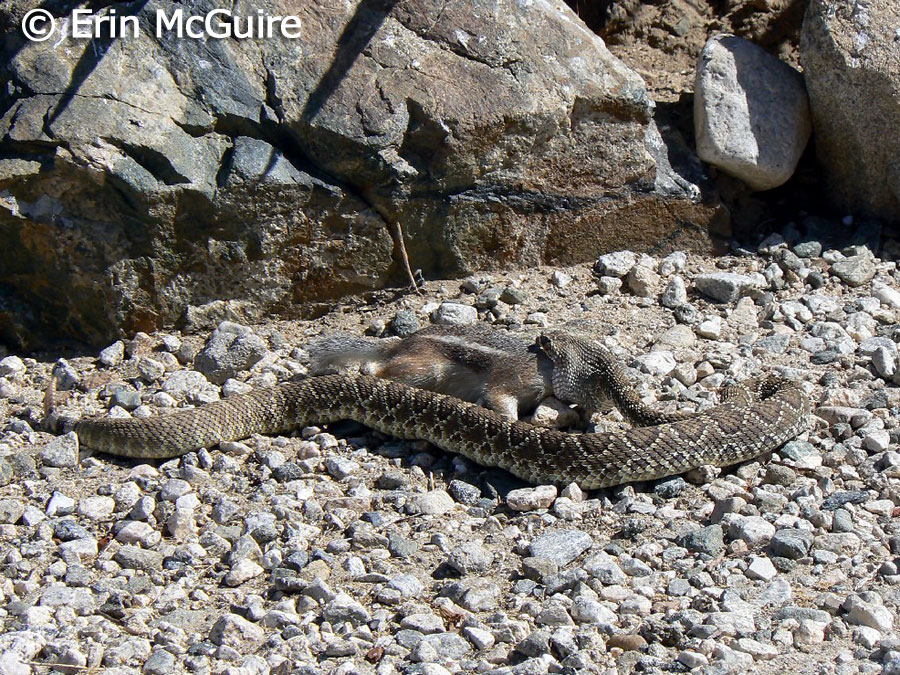
Prey is found while the snake is actively moving, or by ambush, where the snake waits near lizard or rodent trails, striking at and releasing passing prey. The snake then follows the trail of the envenomated animal and swallows it whole.
Fangs and Venom
Two large hollow movable fangs are located at the front of the upper jaw are folded backwards when not used. The fangs are connected to venom glands so that when the snake bites, the fangs swing forward rapidly to stab the prey and inject a toxic venom that quickly immobilizes the prey. A rattlesnake can control the amount of venom injected. The fangs can be replaced if broken.
Bites that inject venom into humans are potentially dangerous without immediate medical treatment.
Sometimes a rattlesnake bites but does not inject venom. These are called "dry bites." A dry bite may still require medical attention.
Even a dead snake can bite and inject venom if the jaws open and close reflexively when they are touched.
A bite from any kind of rattlesnake of any age or any size should be treated as a serious medical emergency, but the bite of a juvenile rattlesnake is not more dangerous than the bite of an adult.
Experts disagree whether or not juvenile rattlesnake venom is more potent than adult rattlesnake venom, but this does not really make much difference in the severity of a bite.
While adult rattlesnakes can control the amount of venom they inject depending on their needs (small animals need less venom, a defensive or warning bite may need no venom, etc.), it is often assumed that juvenile rattlesnakes do not have the same ability and that they always inject the full amount of venom they have available. Some studies show this is not true.
There is also no proof that adult rattlesnakes are more likely than juveniles to bite without injecting venom when they are biting as a warning. Regardless of these things, adults have far more venom to inject than juveniles so the potential danger from the bite of an adult is significantly higher than the danger from the bite of a juvenile. Even when an adult does not inject the full amount of venom it has available, it most likely injects more venom than a juvenile would inject.
Venomous snakes are immune to the venom of their own species, so if a snake is bitten during interactions with other snakes of its species during territorial fights or during mating or if it accidentally bites itself, it will not suffer from the venom. However, they are not typically immune to the venom of other species of snakes.
Sound - The Rattle
When alarmed, a rattlesnake shakes its tail back and forth. The movement rubs the rattle segments together producing a buzzing sound which serves as a warning. Juveniles are born with only a silent button at the end of the tail.
A new rattle segment is added each time the skin is shed, which can be more than one time per year.
Diet and Feeding
Eats small mammals, including ground squirrels, mice, rats, rabbits and hares, and occasionally birds, lizards, snakes, toads and spadefoots.
Pits on the sides of the head sense heat. These heat sensors help the snake to locate prey by their warmth.
Long, hollow, movable fangs connected to venom glands inject a very toxic venom which quickly immobilize the prey.
The snake can control the amount of venom injected and the fangs are replaced if broken.
Rattlesnakes are ovoviviparous. The mother keeps her fertilized eggs inside her body and gives birth to living young.
Mating typically occurs in the spring. Males search extensively for females during the mating season.
Famales probably start bearing young at three years of age and breed annually. (Klauber, 1982)
Two to 17 young are born between July and September. (Stebbins & McGinnis, 2013)
Male "Combat Dance"
Adult males engage in a ritual "Combat Dance" during the spring breeding season and at other times. Throughout much of history this activity was presumed to be a mating male and female instead of two competing males. Despite the common name, it is not combat as neither male is injured. And it's not a dance, it's essentially a wrestling match in which the necks and front parts of the bodies are intertwined, with the stronger snake slamming the smaller one to the ground until the weaker snake leaves the area. Most bouts end in a draw.
"Certainly the presence of a female is not necessary to stimulate males to dance."
"Dancing is not restricted to a single season of the year."
(Klauber, 1982)
You can see two male Northern Mojave Rattlesnakes wrestling in this YouTube movie.
Habitat
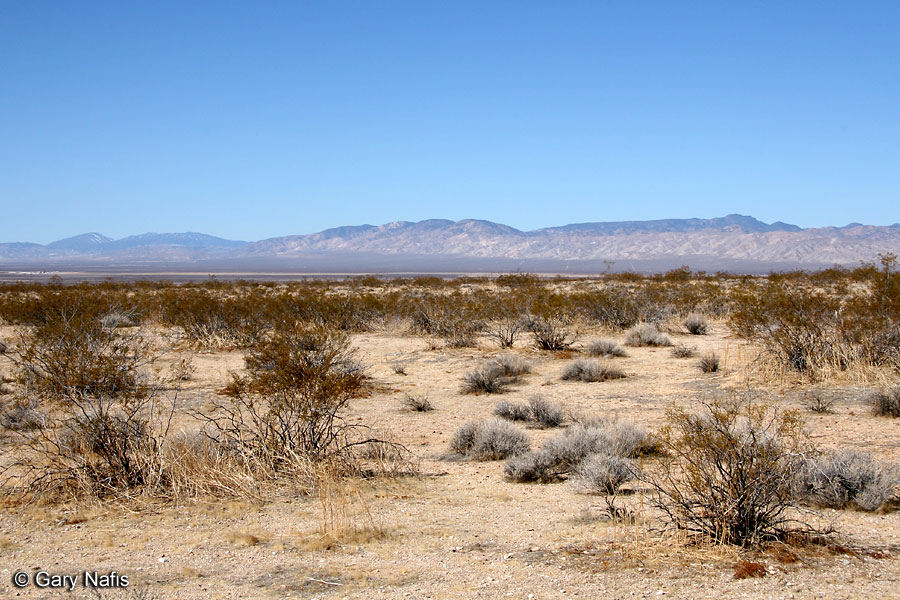
Inhabits grassland, desert scrub, rocky slopes, creosote bush flats, open juniper woodland, and light chaparral.
Geographical Range
Found in southeastern California from the Colorado river north of the San Bernardino County line, west through the Mojave desert to the Antelope Valley, to Walker Pass in the Sierra Nevada, and east of the Sierra Nevada into Inyo County.
Probably also occurs in Riverside County. There is only one museum record I can find from Joshua Tree National Park in the county, and the exact location is not given, and there are a few museum records from "within 2 miles of Palo Verde" in Riverside County, which is almost in Imperial County, so the range could be a lot farther south than is typically recognized.
Old maps (including mine) have shown this species present in the southern part of Inyo County, but the first documented record from the county was in 2020. (Herp Review 51(3), 2020.)
Outside of California, the species ranges north into Nevada and extreme soutwest Utah, east into west Texas, and far south into Mexico.
Hybrids with the Southern Pacific Rattlesnake have been reported where their ranges overlap in western Antelope Valley, (Stebbins, 2003), etc. but "...there is no genetic confirmation that these species interbreed." (Hansen & Shedd, 2025)
- Not found in California
Blue: Crotalus scutulatus salvini - Huamantlan Rattlesnake
Notes on Taxonomy
Two subspecies are recognized:
C. s. scutulatus - Northern Mojave Rattlesnake
C. s. salvini - Huamantlan Rattlesnake
------------------------------------------------------------------------------------------------------------------------------------------------------------------------------------------------------------------------------
"Schield et al. (2018, Molecular Phylogenetics and Evolution 127: 669–681), using thousands of ddRAD loci and mtDNA found four lineages within C. scutulatus, with the deepest node differentiating Mexican Plateau populations + C. s. salvini from those to the north. The northern populations formed two lineages on either side of the Continental Divide; the authors state that current taxonomy does not capture the diversity within C. scutulatus but they do not specifically recommend taxonomic changes. See also Myers et al. (2017, Journal of Biogeography 44: 461–474) and Myers et al. (2019, Molecular Ecology 28: 4535–4548). Note, Myers et al. (2019, op. cit.) did not find structure at the continental divide. Watson et al. (2019, Zootaxa 4683: 129–143) evaluated morphology throughout the geographic range and found that variation was clinal without discrete character change at genetic boundaries. They recommended retention of the two classic subspecies."
(Nicholson, K. E. (ed.). 2025 SSAR Scientific and Standard English Names List)
------------------------------------------------------------------------------------------------------------------------------------------------------------------------------------------------------------------------------
Why was it formerly spelled here "Mohave" and not "Mojave"?
I followed the taxonomy used by the 2017 SSAR North American Species Names List which includes these Taxon Notes about the spelling:
' The spelling of the word “Mojave” or “Mohave” has been a subject of debate. Lowe in the preface to his “Venomous Reptiles of Arizona” (1986) argued for “Mohave” as did Campbell and Lamar (2004, The Venomous Reptiles of the Western Hemisphere, Comstock Publishing). According to linguistic experts on Native American languages, either spelling is correct, but using either the “j” or “h” is based on whether the word is used in a Spanish or English context. Given that this is an English names list, we use the “h” spelling (P. Munro, Linguistics, UCLA, pers. comm.). Jones (2016, Sonoran Herpetol. 29: 64–71) argued that the spelling should be with “j” but the committee was not convinced and voted to continue to spell it as Mohave. '
------------------------------------------------------------------------------------------------------------------------------------------------------------------------------------------------------------------------------
Crotalus - Greek - krotalon = a rattle - refers to the rattle on the tail
scutulatus - Latin = having a shield shaped patch - refers to the dorsal pattern
Hansen, Robert W. and Shedd, Jackson D. California Amphibians and Reptiles. (Princeton Field Guides.) Princeton University Press, 2025.
Stebbins, Robert C., and McGinnis, Samuel M. Field Guide to Amphibians and Reptiles of California: Revised Edition (California Natural History Guides) University of California Press, 2012.
Stebbins, Robert C. California Amphibians and Reptiles. The University of California Press, 1972.
Flaxington, William C. Amphibians and Reptiles of California: Field Observations, Distribution, and Natural History. Fieldnotes Press, Anaheim, California, 2021.
Samuel M. McGinnis and Robert C. Stebbins. Peterson Field Guide to Western Reptiles & Amphibians. 4th Edition. Houghton Mifflin Harcourt Publishing Company, 2018.
Stebbins, Robert C. A Field Guide to Western Reptiles and Amphibians. 3rd Edition. Houghton Mifflin Company, 2003.
Behler, John L., and F. Wayne King. The Audubon Society Field Guide to North American Reptiles and Amphibians. Alfred A. Knopf, 1992.
Robert Powell, Roger Conant, and Joseph T. Collins. Peterson Field Guide to Reptiles and Amphibians of Eastern and Central North America. Fourth Edition. Houghton Mifflin Harcourt, 2016.
Powell, Robert., Joseph T. Collins, and Errol D. Hooper Jr. A Key to Amphibians and Reptiles of the Continental United States and Canada. The University Press of Kansas, 1998.
Bartlett, R. D. & Patricia P. Bartlett. Guide and Reference to the Snakes of Western North America (North of Mexico) and Hawaii. University Press of Florida, 2009.
Bartlett, R. D. & Alan Tennant. Snakes of North America - Western Region. Gulf Publishing Co., 2000.
Brown, Philip R. A Field Guide to Snakes of California. Gulf Publishing Co., 1997.
Ernst, Carl H., Evelyn M. Ernst, & Robert M. Corker. Snakes of the United States and Canada. Smithsonian Institution Press, 2003.
Taylor, Emily. California Snakes and How to Find Them. Heyday, Berkeley, California. 2024.
Wright, Albert Hazen & Anna Allen Wright. Handbook of Snakes of the United States and Canada. Cornell University Press, 1957.
Ernst, Carl. H. Venomous Reptiles of North America. Smithsonian Institution Press, 1999.
Hayes, William K., Kent R. Beaman, Michael D. Cardwell, and Sean P. Bush, editors. The Biology of Rattlesnakes. Loma Linda University Press, 2009.
Hubbs, Brian R., & Brendan O'Connor. A Guide to the Rattlesnakes and other Venomous Serpents of the United States. Tricolor Books, 2011.
Klauber, Laurence M. Rattlesnakes. University of California Press. (Abridged from the 1956 two volume Rattlesnakes:
Their Habits, Life Histories, and Influence on Mankind.) University of California Press, 1982.
Rubio, Manny. Rattlesnake - Portrait of a Predator. Smithsonian Institution Press, 1998.
Walls, Jerry G. Rattlesnakes: Their Natural History and Care. T. F. H. Publications, Inc., 1996.
The following conservation status listings for this animal are taken from the July 2025 State of California Special Animals List and the July 2025 Federally Listed Endangered and Threatened Animals of California list (unless indicated otherwise below.) Both lists are produced by multiple agencies every year, and sometimes more than once per year, so the conservation status listing information found below might not be from the most recent lists, but they don't change a great deal from year to year.. To make sure you are seeing the most recent listings, go to this California Department of Fish and Wildlife web page where you can search for and download both lists: https://www.wildlife.ca.gov/Data/CNDDB/Plants-and-Animals.
A detailed explanation of the meaning of the status listing symbols can be found at the beginning of the two lists. For quick reference, I have included them on my Special Status Information page.
If no status is listed here, the animal is not included on either list. This most likely indicates that there are no serious conservation concerns for the animal. To find out more about an animal's status you can also go to the NatureServe and IUCN websites to check their rankings.

 Red: Range in California