|
 |
 |
| Adult, Del Norte County |
Adult, Del Norte County |
 |
 |
 |
 |
| Adult, Del Norte County |
Adult, Del Norte County |
Adult, Del Norte County |
 |
 |
 |
 |
| Adult, South Fork Smith River, Del Norte County |
Adult, Del Norte County |
|
 |
 |
 |
| |
Red-backed adult, Humboldt County |
|
Adult, Del Norte County |
 |
 |
 |
 |
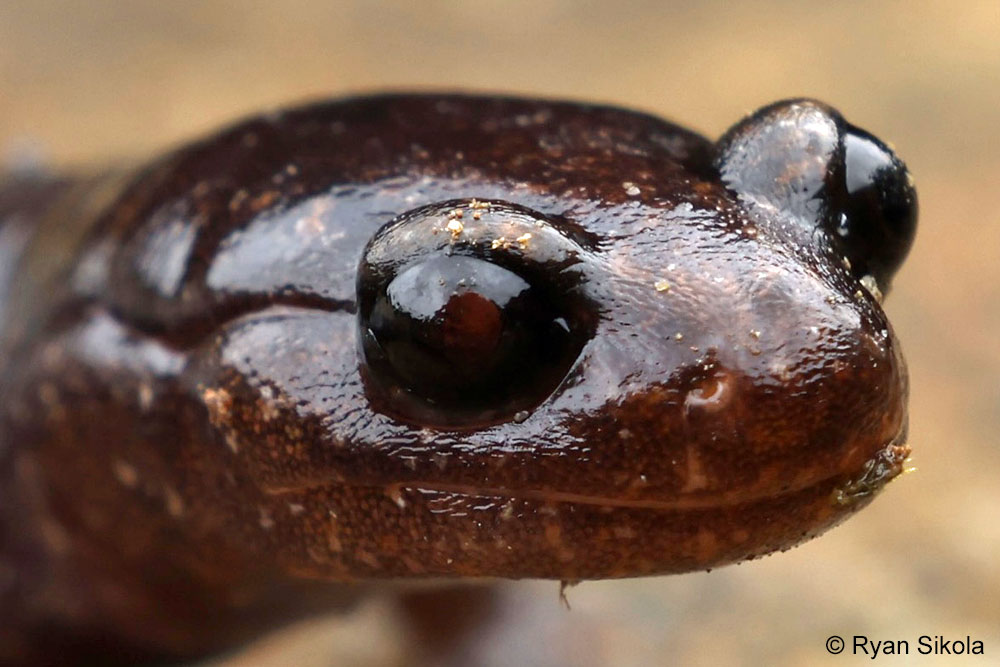
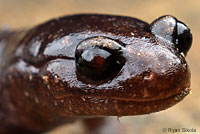
| Adult, Del Norte County © Ryan Sikola |
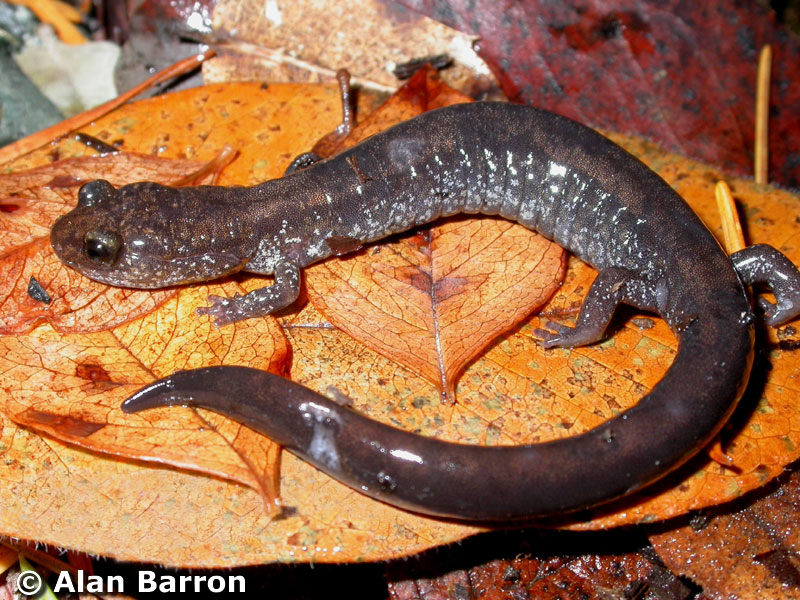
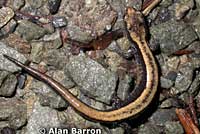
Adult from coastal redwood forest, Del Norte County © Alan Barron |
 |
 |
 |
 |
Adult, Patrick's Creek, Del Norte County
© Alan Barron |
Adult, Crescent City, Del Norte County
© Alan Barron |
Adult, Klamath River, Del Norte County © Alan Barron |
 |
 |
 |
 |
Adult, Patrick's Creek, Del Norte County
© Alan Barron |
Adult, Del Norte County
© Alan Barron |
Three growth stages of Del Norte Salamanders, Humboldt County,
© Spencer Riffle
Adult, left
Juvenile, middle
Sub-adult, right
|
Adult, Del Norte County
© Benjamin Genter |
 |
|
|
|
| Adult Del Norte Salamander (left) with juvenile Painted Ensatina (right) for comparison as they were found together underneath a rock. |
|
|
|
| |
|
|
|
| Juveniles |
 |
 |
 |
 |
| Adult with juvenile, Del Norte County |
Juvenile, Del Norte County |
Juvenile, Del Norte County |
Juvenile, Smith River, Del Norte County |
 |
 |
 |
 |
| Juvenile, 2,500 ft., Del Norte County © Alan Barron |
Juveniles, Klamath River, Del Norte County © Alan Barron |
Juvenile, Del Norte County
© Alan Barron |
| |
|
|
|
| Habitat |
 |
 |
 |
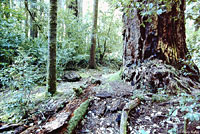 |
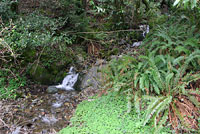
Habitat, small forest creek,
Del Norte County |
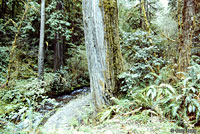
Habitat, redwood forest,
Del Norte County |
Habitat, creek in redwood forest,
Del Norte County |
Habitat, redwood forest,
Del Norte County |
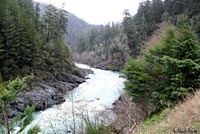 |
 |
 |
 |
| Habitat, Smith River, Del Norte County |
Habitat, rocky talus, Del Norte County
|
Habitat, Del Norte County
|
Habitat, Humboldt County
|
| |
|
|
|
| Short Videos |
 |
 |
|
|
Watch this salamander walk and get an overview of its habitat.
|
Several Del Norte Salamanders run away and hide in typical salamander style. |
|
|
|
|
|
|
| Description |
| |
| Size |
Adults are 2 3/8 - 3 inches long (6 - 7.6 cm) from snout to vent, and 4 1/3 - 6 inches (11 - 15 cm) in total length.
|
| Appearance |
A slender, elongated salamander with short limbs, nasolabial grooves, and usually 18 costal grooves with 5-6 intercostal folds between adpressed limbs.
Toes are short and slightly webbed. |
| Color and Pattern |
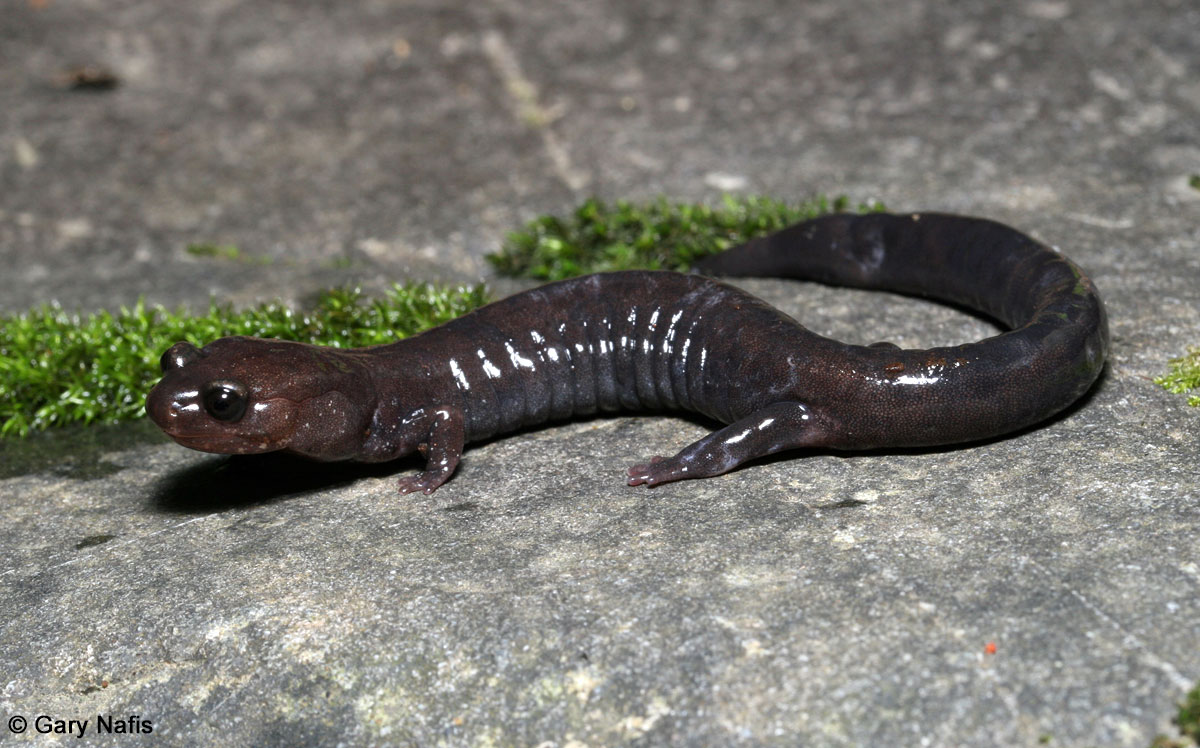
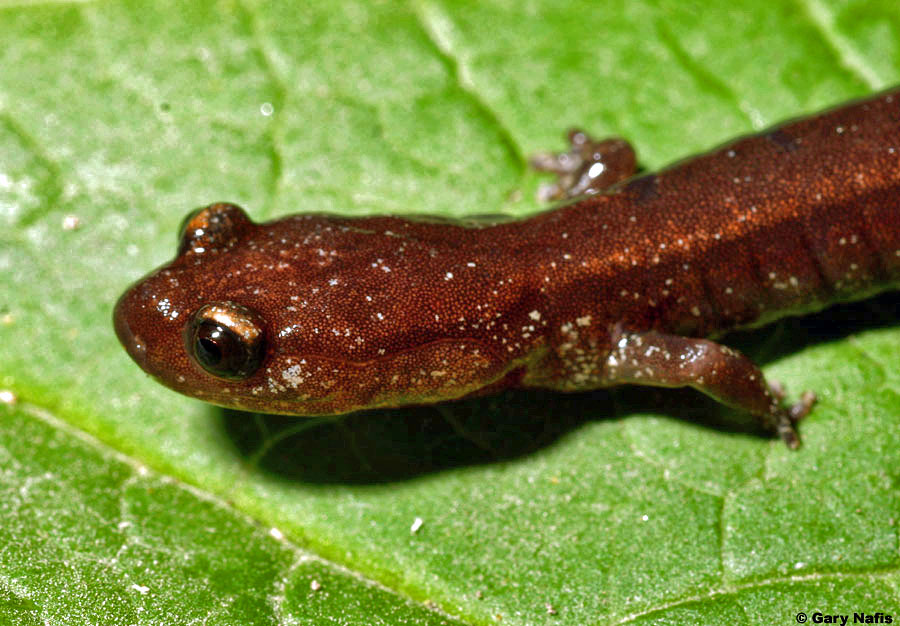
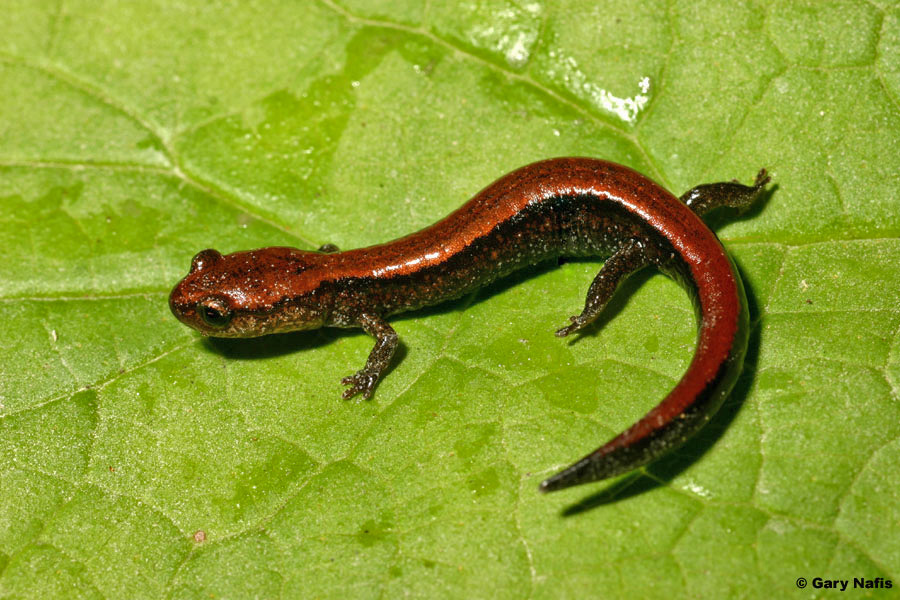
Color is solid dark brown or black with an even-edged reddish brown dorsal stripe extending from the head to the tail tip. Often, especially with older animals, this stripe is missing and the body is solid brown or black.
The belly is dark gray with light gray flecks. |
| Juveniles |
Juveniles resemble adults, but have more conspicuous dorsal stripes.
|
| Life History and Behavior |
A member of family Plethodontidae, the Plethodontid or Lungless Salamanders.
Plethodontid salamanders do not breathe through lungs. They conduct respiration through their skin and the tissues lining their mouth. This requires them to live in damp environments on land and to move about on the ground only during times of high humidity. (Plethodontid salamanders native to California do not inhabit streams or bodies of water but they are capable of surviving for a short time if they fall into water.)
Plethodontid salamanders are also distinguished by their nasolabial grooves, which are vertical slits between the nostrils and upper lip that are lined with glands associated with chemoreception.
All Plethodontid Salamanders native to California lay eggs in moist places on land.
The young develop in the egg and hatch directly into a tiny terrestrial salamander with the same body form as an adult.
(They do not hatch in the water and begin their lives as tiny swimming larvae breathing through gills like some other types of salamanders.) |
| Activity |
Terrestrial.
Active on rainy or wet nights, fall through spring.
Inactive in very cold and very hot weather.
Reported to be inactive in summer, retreating far underground, but I have found them in shaded areas under wet streamside rocks in the dry summer months in coastal redwood forest.
Recapture studies have shown that P. elongatus moves very little in a single year - staying within a 7.5 square meter area. |
| Diet and Feeding |
Eats small invertebrates, including termites, mites, beetles, and springtails.
Del Norte Salamanders are sit-and-wait predators, quickly jumping from a hiding spot to grab their prey. |
| Reproduction |
Not much is known about the breeding behavior of this species.
Reproduction is terrestrial. Mating probably occurs in fall and spring.
|
| Eggs |
Females lay eggs most likely in underground nests, probably under rocky talus, in spring or early summer and it is presumed that they brood them until they hatch in the fall.
Eggs have been found at the base of a redwood fence post. There were 10 eggs in a grape-like cluster.
Two adult females were found with 10 to 11 eggs. (Stebbins.) |
| Young |
Young develop completely in the egg and hatch fully formed, probably in fall, and most likely remain underground until the following spring.
|
| Habitat |
Terrestrial, strongly associated with moist talus in humid shaded and closed-canopy coastal forests of mixed hardwoods and conifers, but also found in rock rubble of old riverbeds, and under bark and logs on forest floor, usually in rocky areas. Especially attracted to older forests.
|
| Geographical Range |
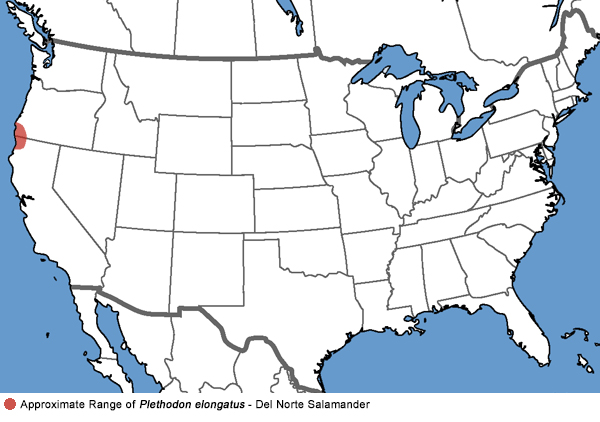
Found along the coast in far northwest California from near Orick, Humboldt County, east to near the Seiad Valley, Sisiyou county and Salyer, Trinity County, and north into southwestern Oregon where they have been found inland along West Cow Creek in Douglas County. (Photo.)
|
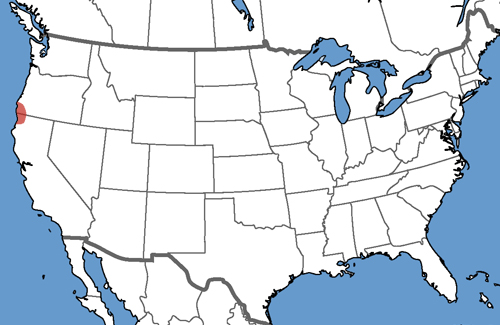 |
Red: Approximate range of Plethodon elongatus - Del Norte Salamander
|
| Notes on Taxonomy |
Some herpetologists name this salamander P. e. elongatus, a subspecies of P. elongatus, making the interior form, the Siskiyou Mountains Salamander, P. e. stormi. Others recognize P. stormi as a separate species as we do here.
Genetic diversity has been found to be highest in inland and southern populations. Recent genetics studies have determined that the Del Norte Salamander consists of two lineages at the southern end of its range which are different from populations north of Humboldt County. These lineages might be described as new species in the near future. (Hartwell, et. al, 2005.)
Alternate and Previous Names (Synonyms)
Plethodon elongatus - Del Norte Salamander (Stebbins & McGinnis 2012)
Plethodon elongatus elongatus - Striped Del Norte Salamander (Stebbins 1985, 2003)
Plethodon elongatus - Del Norte Salamander (Storer 1925, Bishop 1943, Stebbins 1954, 1966)
Plethodon elongatus - Del Norte Salamander (Grinnell and Camp 1917)
Plethodon elongatus (Van Denburgh 1916)
|
| Conservation Issues (Conservation Status) |
A California Species of Special Concern.
May be in decline in areas which have been logged, especially at locations inland from the coast and at the southern edge of their range, where populations are more fragmented, making them more vulnerable to extirpation. |
|
| Taxonomy |
| Family |
Plethodontidae |
Lungless Salamanders |
Gray, 1850 |
| Genus |
Plethodon |
Woodland Salamanders |
Tschudi, 1838 |
Species
|
elongatus |
Del Norte Salamander |
Van Denburgh, 1916 |
|
Original Description |
Van Denburgh, 1916 - Proc. California Acad. Sci., Ser. 4, Vol. 6, No. 7, p. 216
from Original Description Citations for the Reptiles and Amphibians of North America © Ellin Beltz
|
|
Meaning of the Scientific Name |
Plethodon - Greek- plethore = fullness or full of + odon = teeth - refers to the number of vomerine & pre-vomerine teeth
elongatus - Latin - slender, attenuated, referring to the elongated body
from Scientific and Common Names of the Reptiles and Amphibians of North America - Explained © Ellin Beltz
|
|
Similar Neighboring Salamanders |
Plethodon stormi - Siskiyou Mountains Salamander
Plethodon dunni - Dunn's Salamander
Plethodon asupak - Scott Bar Salamander
|
|
More Information and References |
California Department of Fish and Wildlife
AmphibiaWeb
Hartwell H. Welsh, Jr. - Jones, Lawrence L. C. , William P. Leonard, Deanna H. Olson, editors. Amphibians of the Pacific Northwest. Seattle Audubon Society, 2005.
Hansen, Robert W. and Shedd, Jackson D. California Amphibians and Reptiles. (Princeton Field Guides.) Princeton University Press, 2025.
Stebbins, Robert C., and McGinnis, Samuel M. Field Guide to Amphibians and Reptiles of California: Revised Edition (California Natural History Guides) University of California Press, 2012.
Stebbins, Robert C. California Amphibians and Reptiles. The University of California Press, 1972.
Flaxington, William C. Amphibians and Reptiles of California: Field Observations, Distribution, and Natural History. Fieldnotes Press, Anaheim, California, 2021.
Nicholson, K. E. (ed.). 2025. Scientific and Standard English Names of Amphibians and Reptiles of North America North of Mexico, with Comments Regarding Confidence in Our Understanding. Ninth Edition. Society for the Study of Amphibians and Reptiles. [SSAR] 87pp.
Samuel M. McGinnis and Robert C. Stebbins. Peterson Field Guide to Western Reptiles & Amphibians. 4th Edition. Houghton Mifflin Harcourt Publishing Company, 2018.
Stebbins, Robert C. A Field Guide to Western Reptiles and Amphibians. 3rd Edition. Houghton Mifflin Company, 2003.
Behler, John L., and F. Wayne King. The Audubon Society Field Guide to North American Reptiles and Amphibians. Alfred A. Knopf, 1992.
Robert Powell, Roger Conant, and Joseph T. Collins. Peterson Field Guide to Reptiles and Amphibians of Eastern and Central North America. Fourth Edition. Houghton Mifflin Harcourt, 2016.
Powell, Robert., Joseph T. Collins, and Errol D. Hooper Jr. A Key to Amphibians and Reptiles of the Continental United States and Canada. The University Press of Kansas, 1998.
American Museum of Natural History - Amphibian Species of the World 6.2
Bartlett, R. D. & Patricia P. Bartlett. Guide and Reference to the Amphibians of Western North America (North of Mexico) and Hawaii. University Press of Florida, 2009.
Bishop, Sherman C. Handbook of Salamanders. Cornell University Press, 1943.
Lannoo, Michael (Editor). Amphibian Declines: The Conservation Status of United States Species. University of California Press, June 2005.
Petranka, James W. Salamanders of the United States and Canada. Smithsonian Institution, 1998.
Corkran, Charlotte & Chris Thoms. Amphibians of Oregon, Washington, and British Columbia. Lone Pine Publishing, 1996.
Jones, Lawrence L. C. , William P. Leonard, Deanna H. Olson, editors. Amphibians of the Pacific Northwest. Seattle Audubon Society, 2005.
Leonard et. al. Amphibians of Washington and Oregon. Seattle Audubon Society, 1993.
Nussbaum, R. A., E. D. Brodie Jr., and R. M. Storm. Amphibians and Reptiles of the Pacific Northwest. Moscow, Idaho: University Press of Idaho, 1983.
Joseph Grinnell and Charles Lewis Camp. A Distributional List of the Amphibians and Reptiles of California. University of California Publications in Zoology Vol. 17, No. 10, pp. 127-208. July 11, 1917.
|
|
|
The following conservation status listings for this animal are taken from the July 2025 State of California Special Animals List and the July 2025 Federally Listed Endangered and Threatened Animals of California list (unless indicated otherwise below.) Both lists are produced by multiple agencies every year, and sometimes more than once per year, so the conservation status listing information found below might not be from the most recent lists, but they don't change a great deal from year to year.. To make sure you are seeing the most recent listings, go to this California Department of Fish and Wildlife web page where you can search for and download both lists:
https://www.wildlife.ca.gov/Data/CNDDB/Plants-and-Animals.
A detailed explanation of the meaning of the status listing symbols can be found at the beginning of the two lists. For quick reference, I have included them on my Special Status Information page.
If no status is listed here, the animal is not included on either list. This most likely indicates that there are no serious conservation concerns for the animal. To find out more about an animal's status you can also go to the NatureServe and IUCN websites to check their rankings.
Check the current California Department of Fish and Wildlife sport fishing regulations to find out if this animal can be legally pursued and handled or collected with possession of a current fishing license. You can also look at the summary of the sport fishing regulations as they apply only to reptiles and amphibians that has been made for this website.
|
| Organization |
Status Listing |
Notes |
| NatureServe Global Ranking |
G4 |
Apparently Secure |
| NatureServe State Ranking |
S3 |
Vulnerable
|
| U.S. Endangered Species Act (ESA) |
None |
|
| California Endangered Species Act (CESA) |
None |
|
| California Department of Fish and Wildlife |
WL |
Watch List |
| Bureau of Land Management |
None |
|
| USDA Forest Service |
None |
|
| IUCN |
NT |
Near Threatened |
|
|
|

 Red: Range in California