|
 |
| Adult, Mariposa County |
 |
 |
 |
| |
Adult, Mariposa County |
|
 |
 |
|
| Adult, Mariposa County |
Adult, Mariposa County |
Adult, Mariposa County |
 |
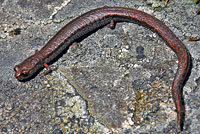 |
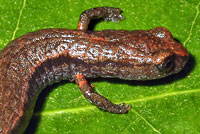 |
| Adult, Mariposa County |
Adult, Mariposa County |
Adult, Mariposa County |
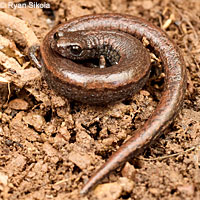 |
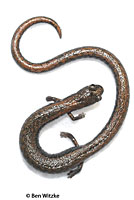 |
 |
Adult, Mariposa County
© Ryan Sikola |
This adult salamander was found near Knight's Ferry in Stanislaus County, which is the westernmost locality for the species. © Ben Witzke |
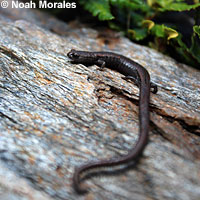
Adult, Calaveras County
© Noah Morales |
 |
 |
 |
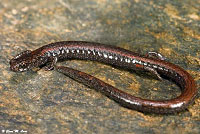
Adult, Mariposa County
© Chad M. Lane |
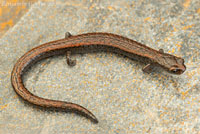
Adult, Calaveras County
© Benjamin Genter
|
Slender Salamanders
(genus Batrachoseps)
have only 4 toes on their hind feet.
All other California salamanders have
5 toes on their hind feet. |
| |
|
|
| Some similar salamander species occurring with or near B. diabolicus |
 |
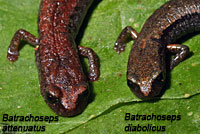 |
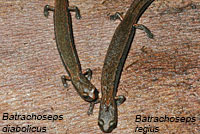 |
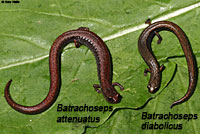
Left: B. attenuatus - California Slender Salamander
Right: B. diabolicus
In the central Sierra Nevada, the range of these species overlaps. They are very similar, but B. diabolicus has proportionally larger legs and toes. (The salamanders shown here are not of equal size. If they were, the difference would be more obvious.) |
Left: B. diabolicus
Right: B. regius - Kings River Slender Salamander
There are no noticeable size differences in body, head, feet, or toes.
|
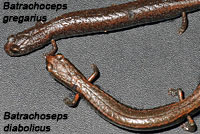 |
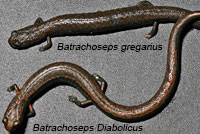 |
|
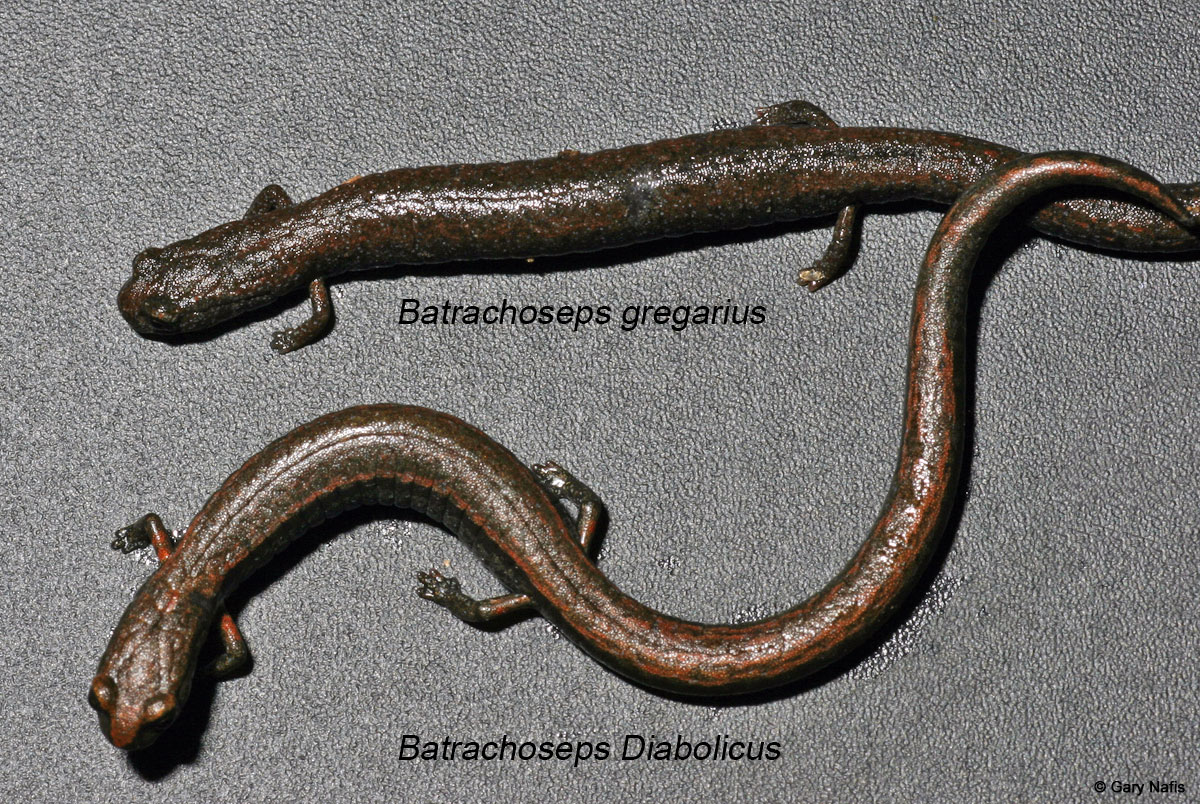
Top: B. gregarius - Gregarious Slender Salamander
Bottom: B. diabolicus
Note the somewhat larger, more robust body and limbs on B. diabolicus
|
|
| |
|
|
Habitat
|
 |
 |
 |
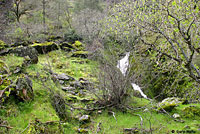
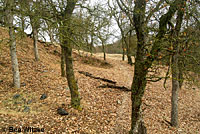
Creekside Habitat, 1,500 ft.,
Mariposa County |
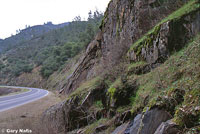
Habitat, Merced River,
Mariposa County |
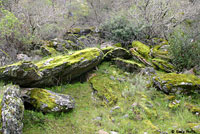
Habitat, Hell Hollow, 1,500 ft.,
Mariposa County
|
 |
 |
|
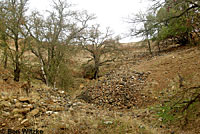
| Knight's Ferry habitat, Stanislaus County © Ben Witzke |
|
| |
|
|
| Short Video |
| |
 |
|
| |
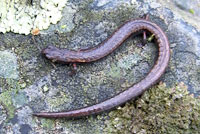
Hell Hollow Slender Salamanders in Mariposa County. |
|
| |
|
|
| Description |
| |
| Size |
Adults are 1 - 1/4 to 1-7/8 inches long (3.2 - 4.7 cm) from snout to vent.
|
| Appearance |
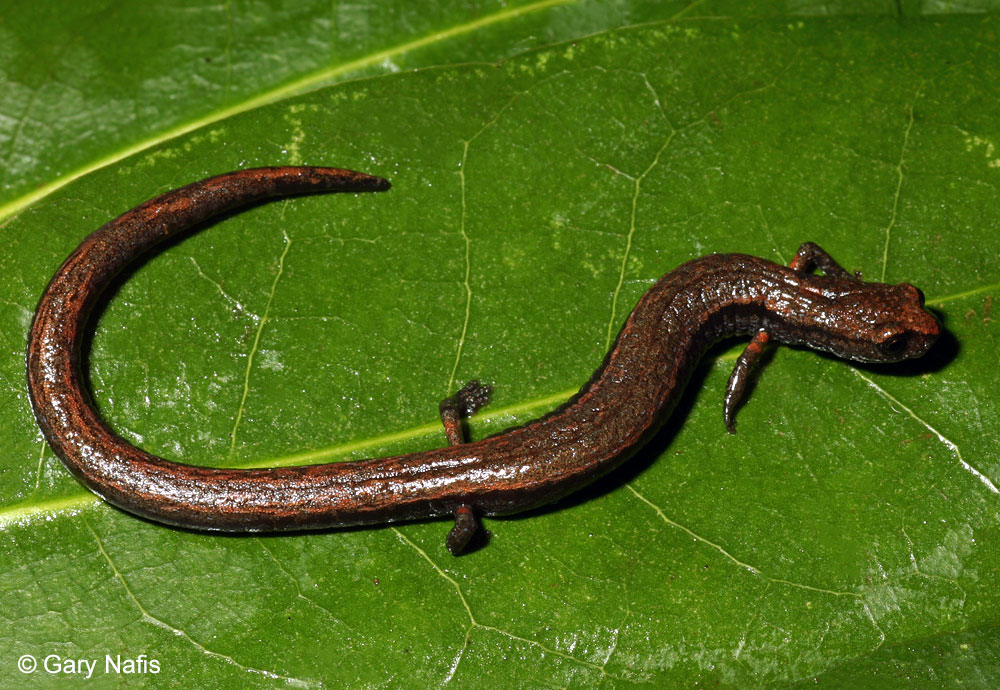
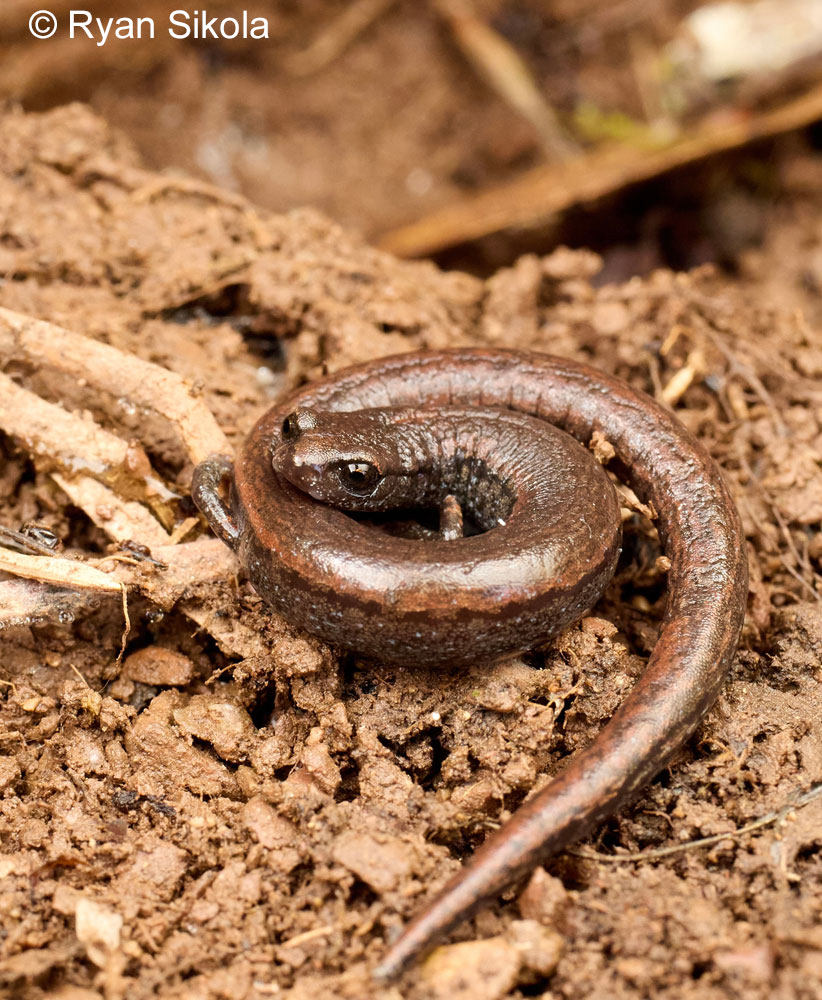
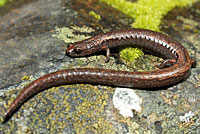
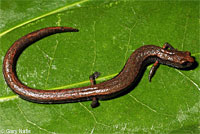
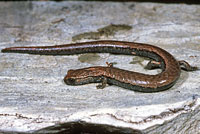
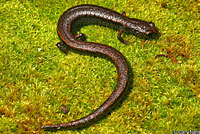
A small slim salamander with a relatively broad head and slightly defined neck.
Short limbs, a long slender body with a narrow head and a long tail, and conspicuous costal and caudal grooves give this species the worm-like appearance typical of most Slender Salamanders.
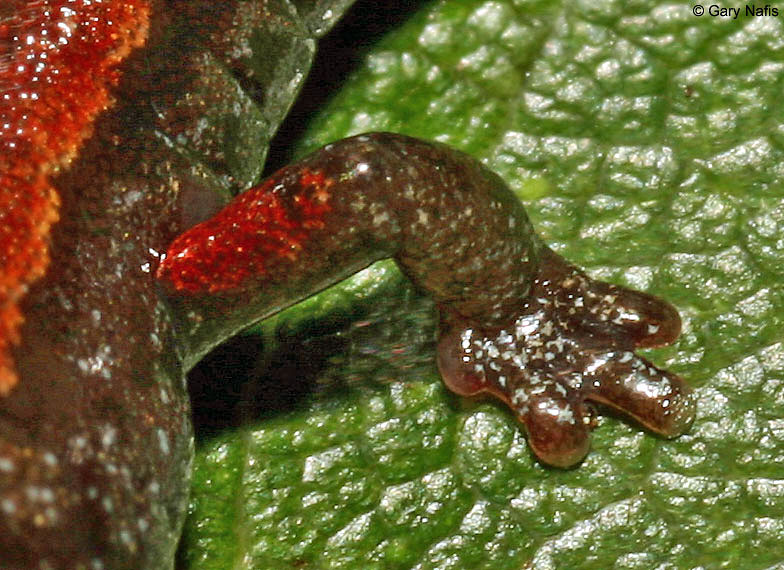
Limbs are fairly long, and hands and feet are large compared to most Slender Salamanders.
Fingers/toes are long and distinct, with expanded tips.
There are four toes on the front and hind feet, which is also typical of Slender Salamanders.
(Other California salamanders have five toes on the hind feet.) |
| Color and Pattern |
Coloration is dark dorsally with a brownish stripe that is usually brighter at it's edges and continues onto head.
There is extensive pale speckling on both the dorsal surface and the grey ventral surface.
|
| Life History and Behavior |
A member of family Plethodontidae, the Plethodontid or Lungless Salamanders.
Plethodontid salamanders do not breathe through lungs. They conduct respiration through their skin and the tissues lining their mouth. This requires them to live in damp environments on land and to move about on the ground only during times of high humidity. (Plethodontid salamanders native to California do not inhabit streams or bodies of water but they are capable of surviving for a short time if they fall into water.)
Plethodontid salamanders are also distinguished by their nasolabial grooves, which are vertical slits between the nostrils and upper lip that are lined with glands associated with chemoreception.
All Plethodontid Salamanders native to California lay eggs in moist places on land.
The young develop in the egg and hatch directly into a tiny terrestrial salamander with the same body form as an adult.
(They do not hatch in the water and begin their lives as tiny swimming larvae breathing through gills like some other types of salamanders.) |
| Activity |
Active on rainy or wet nights when temperatures are moderate, generally from November to March or April.
Retreats underground when the soil dries or when air temperature gets below freezing.
|
| Defense |
Dark coloring helps to disguise them from predators.
Slender salamanders use several defense tactics, including:
- Coiling and remaining still, relying on cryptic coloring to avoid detection.
- Uncoiling quickly and springing away repeatedly bouncing over the ground, then remaining still again to avoid detection.
- Detaching the tail, which wriggles on the ground to distract a predator from the salamander long enough for it to escape.
(After its tail is detached or severed, the salamander will grow a new tail.) |
| Diet and Feeding |
Eats small invertebrates.
A sit-and-wait predator, using a projectile tongue to capture prey. |
| Reproduction |
| Reproduction is terrestrial. |
| Eggs |
Lays eggs on land, probably in the rainy season from November to January.
Nest sites are not known. |
| Young |
Young hatch fully formed.
|
| Habitat |
Populations tend to occur along riparian zones in close proximity to large rivers and streams in pine-oak woodland and chaparral communities. North-facing slopes are preferred, and individuals are usually found beneath rock talus and large stones and other surface cover shaded by oak trees that dominate the region. Summer temperatures are extreme with no rainfall.
|
| Geographical Range |
Endemic to the foothills of the western slopes of the Sierra Nevada in California, from the lower American River drainages in El Dorado County to Sweetwater Creek, Mariposa County. (Stebbins & MicGinnis, 2012) |
| Elevational Range |
From 650 feet (200 m) to approximately 2100 feet (650 m) in elevation.
|
| Notes on Taxonomy |
The common name of this species reflects the type-locality: Hell Hollow, Mariposa County. B. diabolicus was very recently described in 1998 by Jockusch, Wake, and Yanev, who partitioned B. relictus into four species - B. diabolicus, B. regius, B. kawia and B. relictus. It is the northernmost representative of the relictus group of salamanders. Two clades have been identified, one throughout the range and one only in Calaveras County, indicating that B.diabolicus may actually represent two distinct species.
Here's a Diagram of the Batrachoseps Complex showing the relationships between species.
Alternate and Previous Names (Synonyms)
Batrachoseps diabolicus - Hell Hollow Slender Salamander (Stebbins 2003)
Batrachoseps diabolicus - Hell Hollow Slender Salamander (Jockusch, Wake, Yanov 1998)
Batrachoseps nigriventris - Black-bellied Slender Salamander (Stebbins 1985)
Batrachoseps attenuatus - California Slender Salamander (Stebbins 1954, 1966)
Batrachoseps attenuatus attenuatus - Worm-salamander (Bishop 1943)
Batrachoseps attenuatus - Slender Salamander (Storer 1925)
Batrachoseps nigriventris (Cope 1869)
Batrachoseps attenuatus (Cooper 1868)
Batrachoseps attenuata (Baird 1850)
Salamandrina attenuata (Eschscholtz 1833)
|
| Conservation Issues (Conservation Status) |
| Uncertain. Absent from large areas where the habitat would apparently support them, and not abundant where they do occur. |
|
| Taxonomy |
| Family |
Plethodontidae |
Lungless Salamanders |
Gray, 1850 |
| Genus |
Batrachoseps |
Slender Salamanders |
Bonaparte, 1841 |
Species
|
diabolicus |
Hell Hollow Slender Salamander |
Jockusch, Wake & Yanev, 1998 |
|
Original Description |
Jockusch, E. L., D. B. Wake, and K. P. Yanev. "New species of slender salamanders, Batrachoseps
(Amphibia: Plethodontidae), from the Sierra Nevada of California." Contributions in Science, Natural History
Museum of Los Angeles County, #472 1998.
|
|
Meaning of the Scientific Name |
Batrachoseps - Greek - batrachos = amphibian, frog + seps = lizard — describes lizard-like appearance
diabolicus - Greek = devilish. Referring to the name of the type locality, Hell Hollow.
from Scientific and Common Names of the Reptiles and Amphibians of North America - Explained © Ellin Beltz
|
|
Similar Neighboring Salamanders |
B. attenuatus - California Slender Salamander
B. gregarius - Gregarious Slender Salamander
|
|
More Information and References |
California Department of Fish and Wildlife
AmphibiaWeb
Hansen, Robert W. and Shedd, Jackson D. California Amphibians and Reptiles. (Princeton Field Guides.) Princeton University Press, 2025.
Stebbins, Robert C., and McGinnis, Samuel M. Field Guide to Amphibians and Reptiles of California: Revised Edition (California Natural History Guides) University of California Press, 2012.
Stebbins, Robert C. California Amphibians and Reptiles. The University of California Press, 1972.
Flaxington, William C. Amphibians and Reptiles of California: Field Observations, Distribution, and Natural History. Fieldnotes Press, Anaheim, California, 2021.
Nicholson, K. E. (ed.). 2025. Scientific and Standard English Names of Amphibians and Reptiles of North America North of Mexico, with Comments Regarding Confidence in Our Understanding. Ninth Edition. Society for the Study of Amphibians and Reptiles. [SSAR] 87pp.
Samuel M. McGinnis and Robert C. Stebbins. Peterson Field Guide to Western Reptiles & Amphibians. 4th Edition. Houghton Mifflin Harcourt Publishing Company, 2018.
Stebbins, Robert C. A Field Guide to Western Reptiles and Amphibians. 3rd Edition. Houghton Mifflin Company, 2003.
Behler, John L., and F. Wayne King. The Audubon Society Field Guide to North American Reptiles and Amphibians. Alfred A. Knopf, 1992.
Robert Powell, Roger Conant, and Joseph T. Collins. Peterson Field Guide to Reptiles and Amphibians of Eastern and Central North America. Fourth Edition. Houghton Mifflin Harcourt, 2016.
Powell, Robert., Joseph T. Collins, and Errol D. Hooper Jr. A Key to Amphibians and Reptiles of the Continental United States and Canada. The University Press of Kansas, 1998.
American Museum of Natural History - Amphibian Species of the World 6.2
Bartlett, R. D. & Patricia P. Bartlett. Guide and Reference to the Amphibians of Western North America (North of Mexico) and Hawaii. University Press of Florida, 2009.
Bishop, Sherman C. Handbook of Salamanders. Cornell University Press, 1943.
Lannoo, Michael (Editor). Amphibian Declines: The Conservation Status of United States Species. University of California Press, June 2005.
Petranka, James W. Salamanders of the United States and Canada. Smithsonian Institution, 1998.
|
|
|
The following conservation status listings for this animal are taken from the July 2025 State of California Special Animals List and the July 2025 Federally Listed Endangered and Threatened Animals of California list (unless indicated otherwise below.) Both lists are produced by multiple agencies every year, and sometimes more than once per year, so the conservation status listing information found below might not be from the most recent lists, but they don't change a great deal from year to year.. To make sure you are seeing the most recent listings, go to this California Department of Fish and Wildlife web page where you can search for and download both lists:
https://www.wildlife.ca.gov/Data/CNDDB/Plants-and-Animals.
A detailed explanation of the meaning of the status listing symbols can be found at the beginning of the two lists. For quick reference, I have included them on my Special Status Information page.
If no status is listed here, the animal is not included on either list. This most likely indicates that there are no serious conservation concerns for the animal. To find out more about an animal's status you can also go to the NatureServe and IUCN websites to check their rankings.
Check the current California Department of Fish and Wildlife sport fishing regulations to find out if this animal can be legally pursued and handled or collected with possession of a current fishing license. You can also look at the summary of the sport fishing regulations as they apply only to reptiles and amphibians that has been made for this website.
|
| Organization |
Status Listing |
Notes |
| NatureServe Global Ranking |
G3 |
Vulnerable |
| NatureServe State Ranking |
S3 |
Vulnerable
|
| U.S. Endangered Species Act (ESA) |
None |
|
| California Endangered Species Act (CESA) |
None |
|
| California Department of Fish and Wildlife |
None |
|
| Bureau of Land Management |
None |
|
| USDA Forest Service |
None |
|
| IUCN |
DD |
Data Deficient |
|
|
|

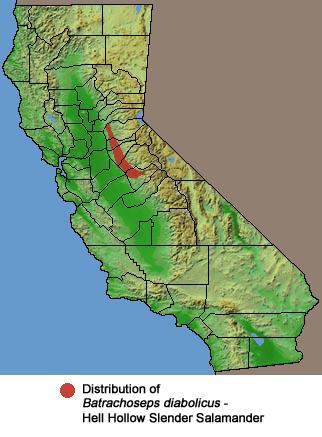 Red: Range in California