|
 |
 |
Adult, Modoc County
© William Flaxington |
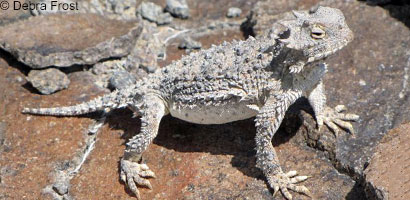
Adult, Lassen County north of Honey Lake.
© Debra Frost |
 |
 |
 |
 |
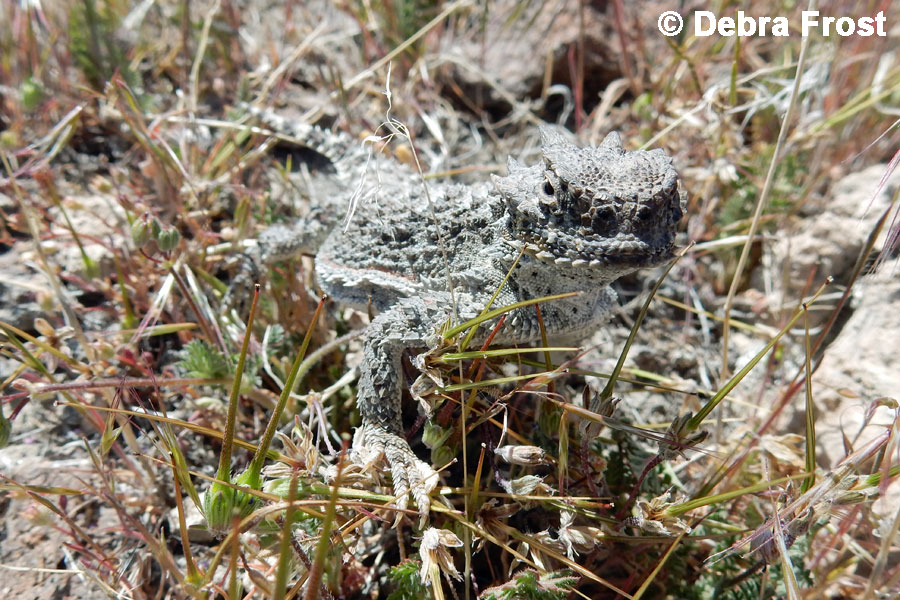
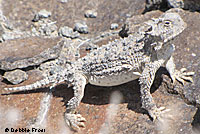
Adult, Lassen County north of Honey Lake. © Debra Frost
(This lizard let the photographer get very close and ran towards her to catch a fly.)
|
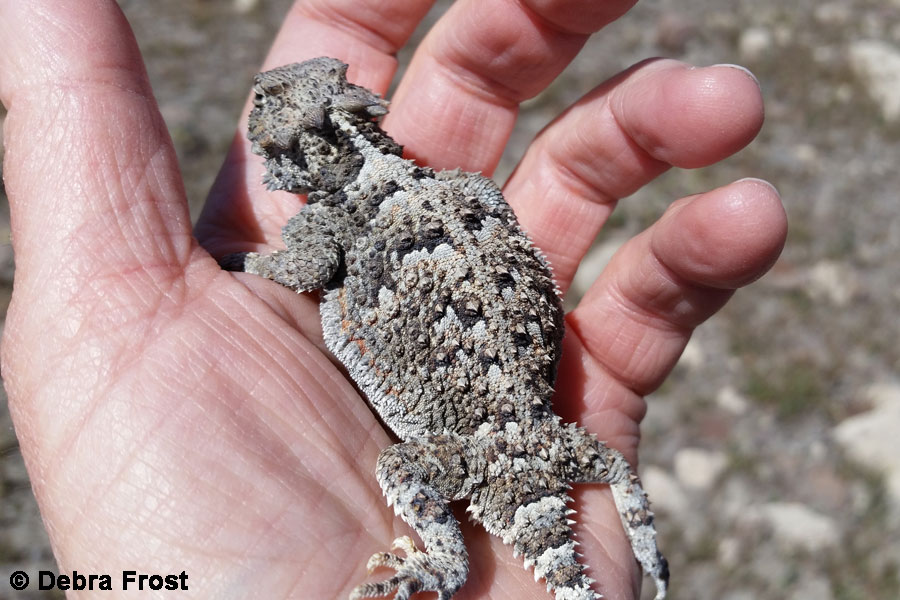
Adult, Lassen County © Debra Frost |
 |
 |
 |
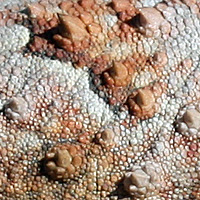 |
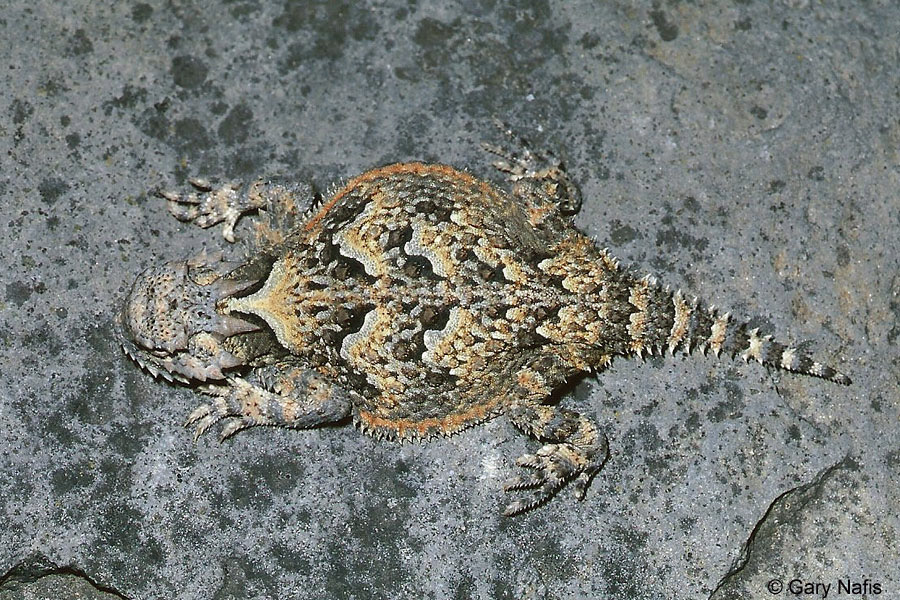
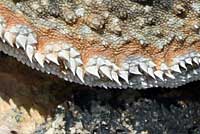
| Adult, Lassen County © Debra Frost |
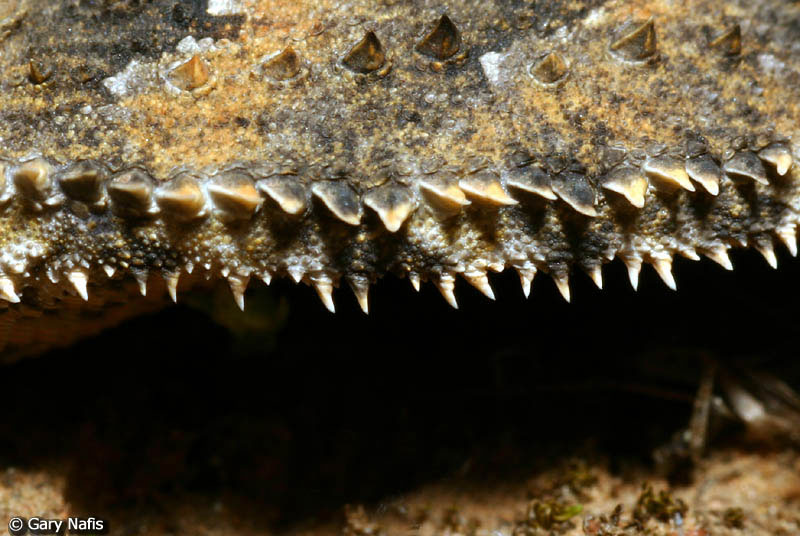
Desert Horned Lizards have one row of fringe scales on each side. Compare with the Coast Horned Lizard which has two rows of fringe scales on each side. |
Desert Horned lizards are covered with small granular scales interspersed with larger pointed scales on the dorsal surfaces. |
| |
|
|
|
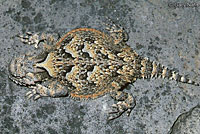
| Northern Desert Horned Lizards From Outside California |
 |
 |
 |
 |
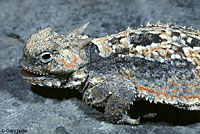
| Adult, 4,000 ft., Washoe County, Nevada |
Adult, Washoe County, Nevada |
Adult, Washoe County, Nevada |
 |
 |
 |
 |
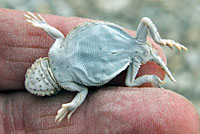
| Juvenile, White Pine County, Nevada |
 |
 |
 |
 |
| Juvenile, Washoe County, Nevada |
Adult, Humboldt County, Nevada © Spencer Riffle |
 |
 |
 |
 |
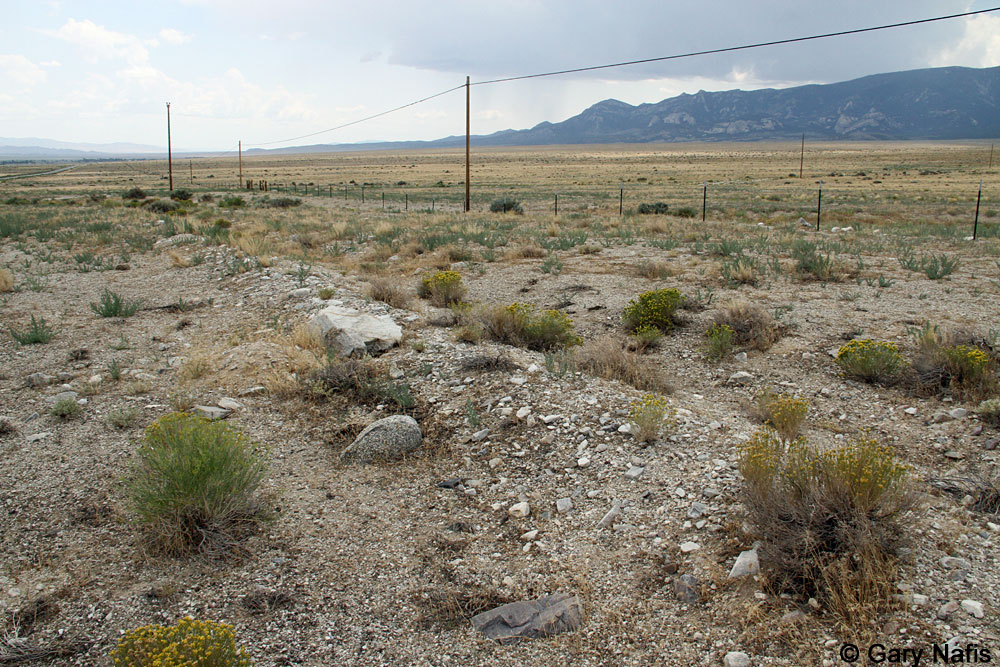
Adult and habitat,
Washoe County, Nevada |
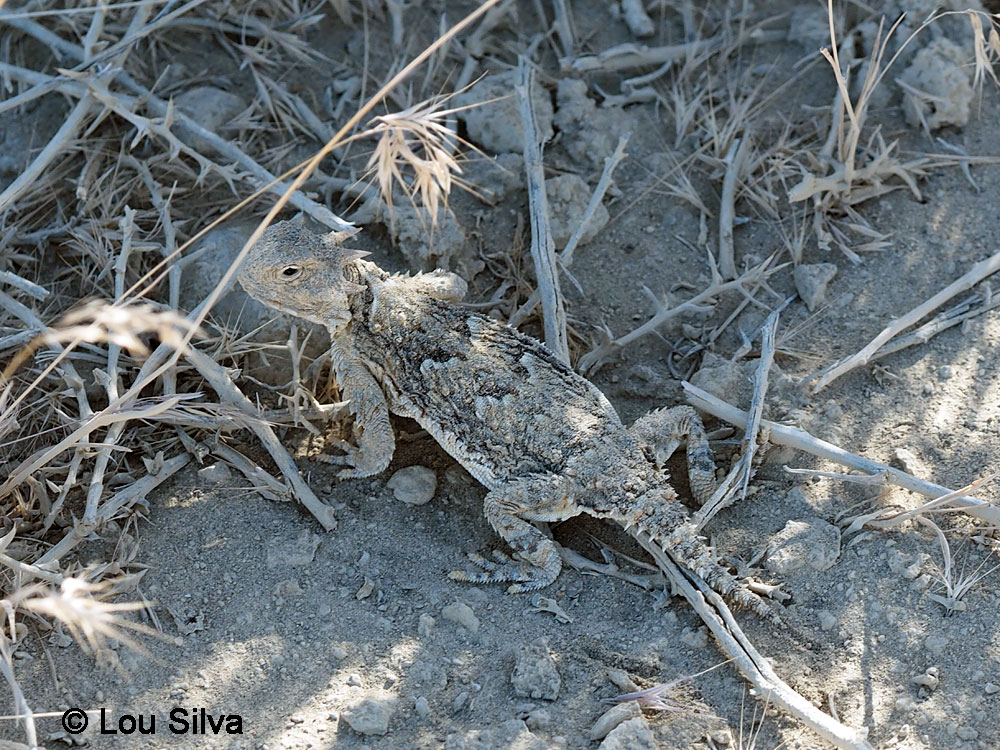
Adult, Washoe County, Nevada
© Lou Silva |
Adult, Nye County, Nevada © Stacy Holt and the Ely District Office of the Bureau of Land Management |
Adult, Washoe County, Nevada |
| |
|
|
|
| Short Videos of the Same Species, but a Different Subspecies: Southern Desert Horned Lizard - Phrynosoma platyrhinos calidiarum |
 |
 |
|
|
| I found this horned lizard basking on a rock on a cool morning in the Mohave Desert. It only had two speeds - sit still and hide, and run away as fast as you can. |
Walking around the Mohave Desert in Kern County one spring day I spotted several Desert Horned Lizards so I slowly followed them with my video camera hoping for some action. They did what they're designed to do - they ran in quick bursts a short distance, often under a bush, then they sat still hoping that their camouflage would make them invisible until I got bored waiting for them to move. That strategy worked. |
|
|
| |
|
|
|
| California Habitat |
 |
 |
|
|
Habitat, Great Basin desert,
4,000 ft.,
Lassen County |
Habitat, Surprise Valley, Modoc County |
|
|
| |
|
|
|
| Habitat Outside California |
 |
 |
 |
|
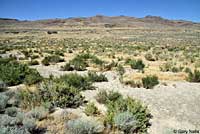
| Habitat, Washoe County, Nevada |
Habitat, Nye County, Nevada |
Habitat, White Pine County, Nevada |
|
|
|
|
|
| Description |
| |
| Size |
2.5 - 3.75 inches long from snout to vent (6.4 - 9.5 cm). (Stebbins 2003)
Up to 5.5 inches including tail.
|
| Appearance |
A medium-sized flat-bodied lizard with a wide oval-shaped body and scattered enlarged pointed scales on the upper body and tail.
The back skin is smooth with small spines.
The snout is blunt.
Horns extend from the back of the head, with the two central horns longest.
Each side of the body has one row of well-developed fringe scales. (Stebbins, 2003)
Each side of the throat has one row of
slightly enlarged scales. (Stebbins, 2003) |
| Color and Pattern |
Color can be reddish, tan, dark gay, beige, brown and even black in areas with dark lava.
Background coloring usually matches the local soil and rocks.
A pair of large dark blotches mark the neck.
Wavy dark blotches mark the back.
The belly is white with scattered small dark spots, smooth scales and black spotting at the vent opening. |
| Male / Female Differences |
Males are smaller than females, and have post-anal scales, femoral pores, and a wider tail base.
|
| Life History and Behavior |
Activity |
Diurnal. Adapted to hot and barren habitats.
Remains underground during hot or cold weather.
Hibernates in loose soil, usually emerging in April.
Most active from April to July.
Can be seen basking on rocks and road berms in the morning and late afternoon - early evening.
Horned lizards roam a home range, which may overlap with others and change seasonally, but male horned lizards do not defend their territory aggressively like other kinds of lizards. They don't have patches of brightly-colored scales to display to other males. Because they don't combat other males during the breeding season, their bodies are smaller than the bodies of female horned lizards, which lets them use their energy in searching for females instead of maintaining a large body size.
(Sherbrooke, 2003)
|
| Defense |
Flattens the body to make itself appear larger when seen from above.
When threatened, runs away quickly for a short distance then hides, relying on its camouflage to protect it.
It will often run under a low bush or into a rodent burrow to escape, or shuffle sideways to bury itself partly in the sand.
Its main defense is remaining motionless using its cryptic coloring to blend into the background and make it difficult to see. I
t will crouch down low to prevent shadows that could make it easier to see, and sit still to avoid detection.
When grabbed, it will inflate with air, hiss, threaten to bite, and move the head from side to side to jab with its horns.
Sometimes, but rarely, defends itself by squirting blood from the corner of the eyes. |
| Diet and Feeding |
90 percent of the diet consists of ants. The remainder consists of other small invertebrates, including flies, and some plant material such as berries.
Although horned lizards may be desirable pets, captive animals normally do not live very long due to the difficulties of feeding them a proper diet of ants. |
| Reproduction |
Mates April to May
Females lay
1 - 2 clutches of 2 - 16 eggs from June - July.
Hatchlings appear usually in August to mid September.
|
| Habitat |
Inhabits sandy gravelly desert flats, dune systems with low brush, dry washes, and open hillsides with loose soil.
Most often seen where desert shrubs are separated by wide sunny clear areas and near desert washes.
Patches of sand or loose soil are generally present.
Associated plants include sagebrush, big greasewood, saltbush, and other small shrubs.
|
| Geographical Range |
This subspecies is found in Great Basin Desert habitat at the far northeastern edge of the state.
Found outside of California north and east into eastern Oregon, southwest Idaho, most of Nevada, western Utah and in an isolated location at the edge of the Utah Colorado border.
Intergrades with P. p. calidiarum in the White-Inyo mountains region. (Macey & Papenfuss 1991)
The species Phrynosoma platyrhinos occurs in southern California and northeastern Baja California, throughout most of Nevada, along the extreme northeastern edge of California, in southeast Oregon and southern Idaho, in western Utah and a couple of isolated spots in northeastern Utah, and western Arizona.
|
 |
Approximate distribution of Phrynosoma platyrhinos - Desert Horned Lizard
Purple: Phrynosoma platyrhinos platyrhinos - Northern Desert Horned Lizard
Red: Phrynosoma platyrhinos calidiarum - Southern Desert Horned Lizard
- Not found in California
Yellow: Approximate distribution of Phrynosoma goodei - Goode's Desert Horned Lizard
|
| Elevational Range |
From below sea level to 6,500 ft. (1,980 m). (Stebbins 2003)
|
| Notes on Taxonomy |
Three subspecies of P. platyrhinos have been recognized:
P. p. calidiarum
P. p. platyrhinos
P. p. goodei
Mulcahy et al. (2006, Mol. Ecol. 15:1807-1826) demonstrated that P. p. goodei is a full species, P. goodei, and showed that it occurs in the United States.
Leache and McGuire (2006, Molecular Phylog. Evolution 39:628-644) named four subclades of Phrynosoma - 3 in our area: Anota, Doliosaurus, and Tapaja.
Hansen and Shedd (2025) do not recognize any subspecies of P. platyrhinos: "Results of phylogenetic analysis suggested that taxonomic revision of this polytipic species is warranted. (Farleigh et al. 2021)"
Alternate and Previous Names (Synonyms)
Horned lizards are sometimes called horned toads or horny toads.
Phrynosoma platyrhinos platyrhinos - Northern Desert Horned Lizard (Stebbins & McGinnis 2012)
Phrynosoma platyrhinos - Desert Horned Lizard (Stebbins 2003, 2018)
Phrynosoma platyrhinos platyrhinos - Northern Desert Horned Lizard (Stebbins 1954, 1966, 1985)
Phrynosoma platyrhinos platyrhinos - Desert Horned Lizard (Smith 1946)
Phrynosoma platyrhinos - Desert Horned-toad (Anota calidiarum; Phrynosoma calidiarum; Doliosaurus platyrhinos; Anota plathrhina; Phrynosoma coronatum, part. Desert Horned Lizard; Ashy Horned Toad; Smooth Horned Lizard; Smooth Horned Toad; Broad-nosed Barrel Lizard; Broad-nosed HOrned Toad. (Grinnell and Camp 1917)
|
| Conservation Issues (Conservation Status) |
| None |
|
|
Taxonomy |
| Family |
Phrynosomatidae |
Zebra-tailed, Earless, Fringe-toed, Spiny, Tree, Side-blotched, and Horned Lizards |
Fitzinger, 1843 |
| Genus |
Phrynosoma |
Horned Lizards |
Wiegmann, 1828 |
| Species |
platyrhinos |
Desert Horned Lizard |
Girard, 1852 |
Subspecies
|
platyrhinos |
Northern Desert Horned Lizard |
Girard, 1852 |
|
Original Description |
Phrynosoma platyrhinos - Girard, 1852 - Proc. Acad. Nat. Sci. Philadelphia, Vol. 6, p. 69
from Original Description Citations for the Reptiles and Amphibians of North America © Ellin Beltz
|
|
Meaning of the Scientific Name |
Phrynosoma - Greek - phrynos = toad + soma = body - refers to the squat, toad-like appearance
platyrhinos - Greek - platys = flat + rhinos = nose - referring to the flat nose
from Scientific and Common Names of the Reptiles and Amphibians of North America - Explained © Ellin Beltz
|
|
Related or Similar California Lizards |
Phrynosoma platyrhinos calidiarum - Southern Desert Horned Lizard
Phrynosoma mcallii - Flat-tail Horned Lizard
Phrynosoma blainvillii - Coast Horned Lizard
Phrynosoma douglasii - Pygmy Short-horned Lizard
|
|
More Information and References |
California Department of Fish and Wildlife
Hansen, Robert W. and Shedd, Jackson D. California Amphibians and Reptiles. (Princeton Field Guides.) Princeton University Press, 2025.
Stebbins, Robert C., and McGinnis, Samuel M. Field Guide to Amphibians and Reptiles of California: Revised Edition (California Natural History Guides) University of California Press, 2012.
Stebbins, Robert C. California Amphibians and Reptiles. The University of California Press, 1972.
Flaxington, William C. Amphibians and Reptiles of California: Field Observations, Distribution, and Natural History. Fieldnotes Press, Anaheim, California, 2021.
Nicholson, K. E. (ed.). 2025. Scientific and Standard English Names of Amphibians and Reptiles of North America North of Mexico, with Comments Regarding Confidence in Our Understanding. Ninth Edition. Society for the Study of Amphibians and Reptiles. [SSAR] 87pp.
Samuel M. McGinnis and Robert C. Stebbins. Peterson Field Guide to Western Reptiles & Amphibians. 4th Edition. Houghton Mifflin Harcourt Publishing Company, 2018.
Stebbins, Robert C. A Field Guide to Western Reptiles and Amphibians. 3rd Edition. Houghton Mifflin Company, 2003.
Behler, John L., and F. Wayne King. The Audubon Society Field Guide to North American Reptiles and Amphibians. Alfred A. Knopf, 1992.
Robert Powell, Roger Conant, and Joseph T. Collins. Peterson Field Guide to Reptiles and Amphibians of Eastern and Central North America. Fourth Edition. Houghton Mifflin Harcourt, 2016.
Powell, Robert., Joseph T. Collins, and Errol D. Hooper Jr. A Key to Amphibians and Reptiles of the Continental United States and Canada. The University Press of Kansas, 1998.
Bartlett, R. D. & Patricia P. Bartlett. Guide and Reference to the Turtles and Lizards of Western North America (North of Mexico) and Hawaii. University Press of Florida, 2009.
Jones, Lawrence, Rob Lovich, editors. Lizards of the American Southwest: A Photographic Field Guide. Rio Nuevo Publishers, 2009.
Smith, Hobart M. Handbook of Lizards, Lizards of the United States and of Canada. Cornell University Press, 1946.
Taylor, Emily. California Lizards and How to Find Them. Heyday, Berkeley, California. 2025.
Sherbrooke, Wade C. Horned Lizards, Unique Reptiles of Western North America. Southwest Parks and Monuments Association, 1981.
Sherbrooke, Wade C. Introduction to Horned Lizards of North America. University of California Press, 2003.
Brown et. al. Reptiles of Washington and Oregon. Seattle Audubon Society,1995.
St. John, Alan D. Reptiles of the Northwest: Alaska to California; Rockies to the Coast. Lone Pine Publishing, 2002.
Macey, J. Robert and Theodore Papenfuss."Herpetology." The Natural History of the White-Inyo Range Eastern California.
Ed. Clarence Hall. University of California Press, 1991.
Joseph Grinnell and Charles Lewis Camp. A Distributional List of the Amphibians and Reptiles of California. University of California Publications in Zoology Vol. 17, No. 10, pp. 127-208. July 11, 1917.
|
|
|
The following conservation status listings for this animal are taken from the July 2025 State of California Special Animals List and the July 2025 Federally Listed Endangered and Threatened Animals of California list (unless indicated otherwise below.) Both lists are produced by multiple agencies every year, and sometimes more than once per year, so the conservation status listing information found below might not be from the most recent lists, but they don't change a great deal from year to year.. To make sure you are seeing the most recent listings, go to this California Department of Fish and Wildlife web page where you can search for and download both lists:
https://www.wildlife.ca.gov/Data/CNDDB/Plants-and-Animals.
A detailed explanation of the meaning of the status listing symbols can be found at the beginning of the two lists. For quick reference, I have included them on my Special Status Information page.
If no status is listed here, the animal is not included on either list. This most likely indicates that there are no serious conservation concerns for the animal. To find out more about an animal's status you can also go to the NatureServe and IUCN websites to check their rankings.
Check the current California Department of Fish and Wildlife sport fishing regulations to find out if this animal can be legally pursued and handled or collected with possession of a current fishing license. You can also look at the summary of the sport fishing regulations as they apply only to reptiles and amphibians that has been made for this website.
This animal is not included on the Special Animals List, which indicates that there are no significant conservation concerns for it in California.
|
| Organization |
Status Listing |
Notes |
| NatureServe Global Ranking |
|
|
| NatureServe State Ranking |
|
|
| U.S. Endangered Species Act (ESA) |
None |
|
| California Endangered Species Act (CESA) |
None |
|
| California Department of Fish and Wildlife |
None |
|
| Bureau of Land Management |
None |
|
| USDA Forest Service |
None |
|
| IUCN |
|
|
|
|