
A Guide to the Amphibians
and Reptiles of California
Click on a picture for a larger view

California Whiptails - genus Aspidoscelis
(formerly genus Cnemidophorus)
| Whiptails are medium-sized, long, slim-bodied, diurnal, fast-moving, l lizards with long thin tails. They are typically found in hot, dry, flat open spaces in deserts or semi-arid areas. Whiptails can be striped, or spotted, or both. Typically, they are seen on the ground running in open spots from bush to bush, and more rarely, climbing on rocks or vegetation. Normally, you will see one walking slowly with a jerky motion from bush to bush, occasionally digging or scratching the ground looking for insects. When you get too close, they will run quickly away from you for a short distance, then continue walking from bush to bush. Rarely do they stop completely, unless they run into a hole. Two whiptail species occur naturally in California - * Belding's Orange-throated Whiptail, Aspidoscelis hyperythra * Western Whiptail, Aspidosceleis tigris (Three subspeces are found in the state.) Where they overlap in coastal Southern California, these two species are easy to tell apart, because the Orange-throated whiptail has distinct, solid lengthwise stripes, orange on the throat, and a bluish tail, while the Western Whiptail has a more checkered or spotted appearance with these spots sometimes forming broken stripes. A third introduced species has become established in southern California - * Sonoran Spotted Whiptail - Aspidoscelis sonorae The Sonoran Spotted Whiptail is similar in appearance to Belding's Orange-throated Whiptail, but they can be differentiated by examining the paravertebral stripes. |
||
Western Whiptail - Aspidoscelis tigris |
||
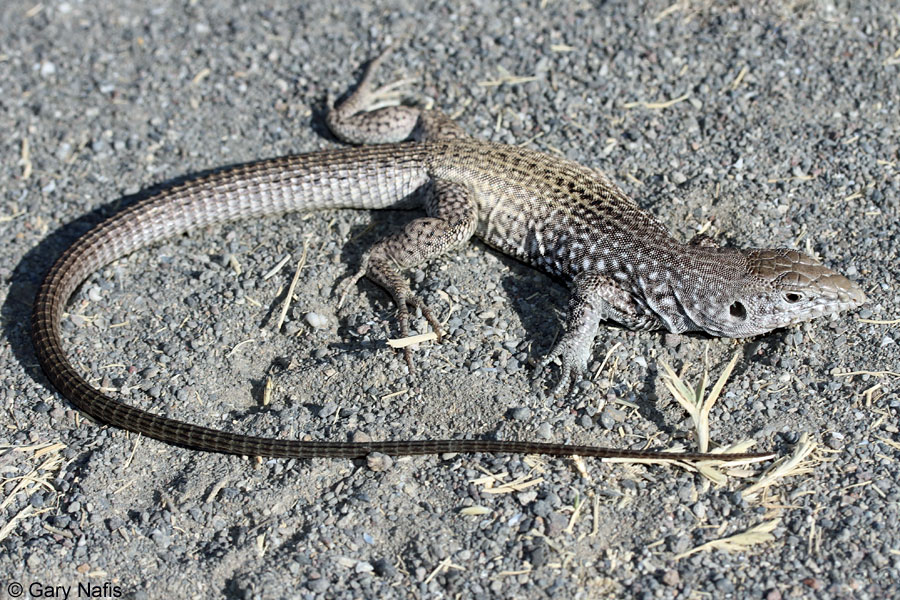
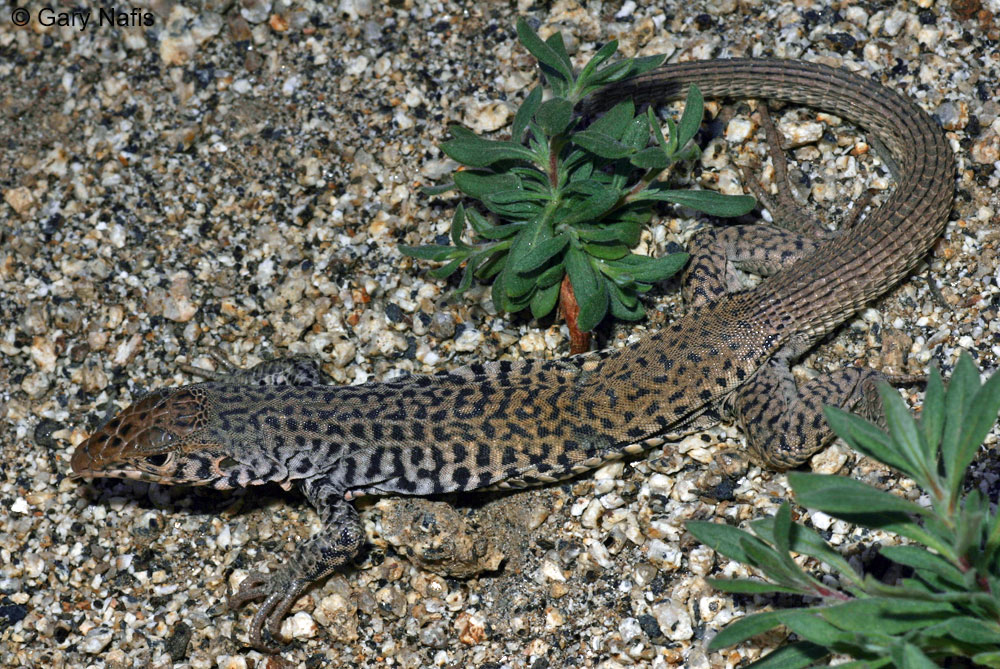
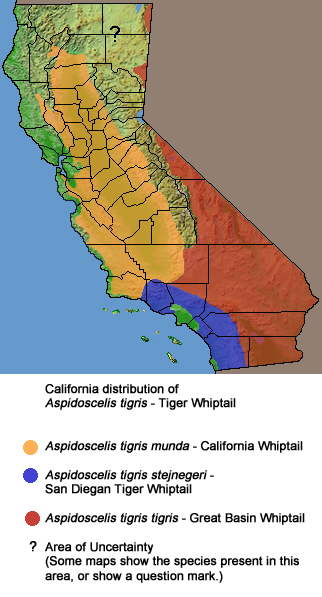
| Three subspecies of this species are found in California, all about the same maximum size - 5 inches long (12.7 cm) not including the tail, or about 13 inches (33 cm) including the tail, and all fairly similar in appearance. Check the range map to determine which subspecies is in your area. |
||
| California Whiptail Aspidoscelis tigris munda |
Coastal Whiptail Aspidoscelis tigris stejnegeri |
Great Basin Whiptail Aspidoscelis tigris tigris |
 |
 |
 |
 |
 |
 |
 © George Chrisman © George Chrisman |
 |
 © Adam Clause © Adam Clause |
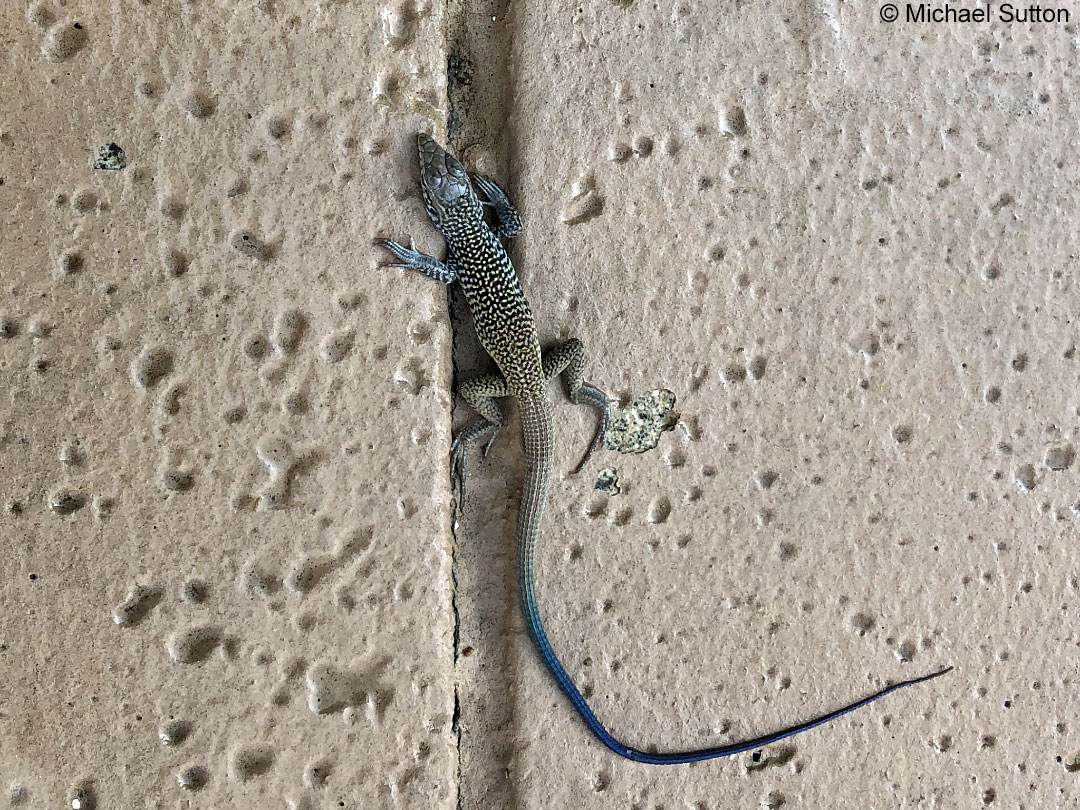
| Tiny juvenile Western Whiptails sometimes have more distinct stripes and usually have a blue tail. The blue coloring fades as they grow larger. |
||
 © Karyn Sieglitz © Karyn Sieglitz |
 © Michael Sutton |
 |
 |
||
| Orange: California Whiptail Blue: Coastal Whiptail Red: Great Basin Whiptail |
||
Belding's Orange-throated Whiptail - Aspidoscelis hyperythra beldingi |
||
 |
 |
 |
 |
 |
 |
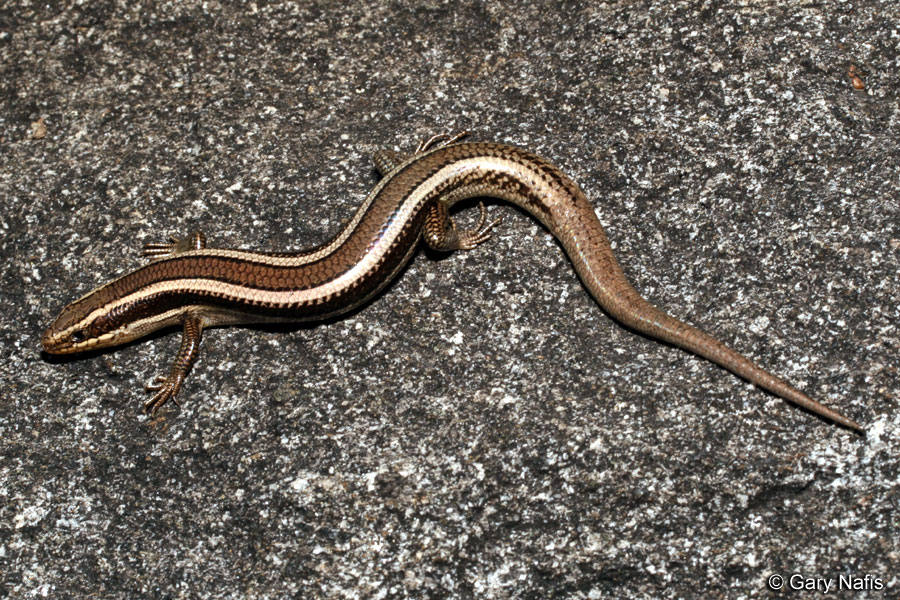
| Juveniles have a bright blue tail, which might cause you to confuse them with a juvenile skink. | ||
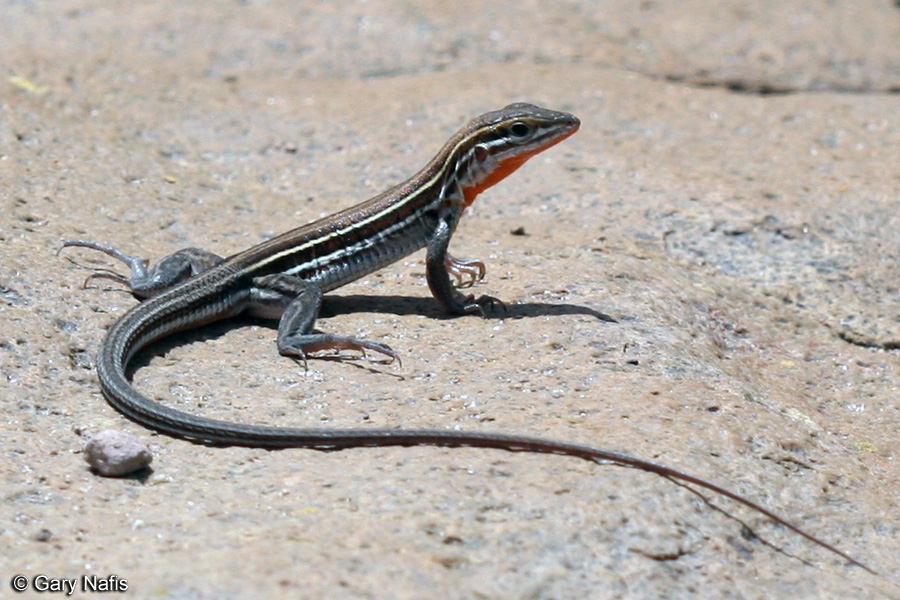
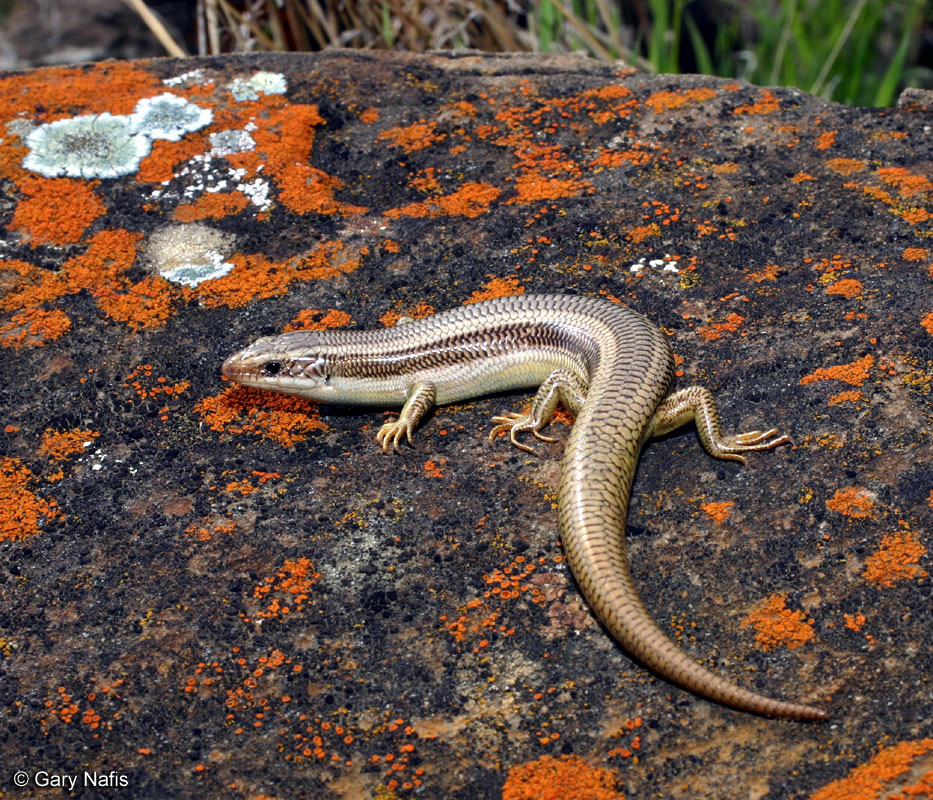
| The smaller size, a dark back with distinct light stripes, a blueish tail and orange on the throat will differentiate this species from the Coastal Whiptail which sometimes shares its habitat in coastal Southern California. The paravertebral stripes (the two stripes on either side of the middle of the back) merge together to form a single mid-dorsal stripe that continues onto the tail. These stripes can help to differentiate this species from the non-native Sonoran Spotted Whiptail. This whiptail is also sometimes mistaken for a Western Skink, and vice versa. The skink will be more rounded, with more stripes that are thinner, and with a shorter, fatter snout, and a fatter tail. Breeding skinks will also have orange coloring under the throat, so do not let that confuse you. Also, juvenile Orange-throated whiptails may not have orange on the throat. |
||
 |
|
|
| The orange-throated whiptail might be confused with a Coronado Skink, which occurs in the same areas, but the whiptail has more light stripes and they are thinner, along with other differences. Click the picture above to see a closer comparison. |
Juvenile Western Whiptails, like the one shown above, with their distinct stripes and blue tail, can also be confused with orange-throated whiptails, but they have fewer stripes on the back and males do not have an orange throat. | |
 |
||
| |
||
| Belding's Orange-throated Whiptail can be confused with a non-native species that is spreading around Orange County, The Sonoran Spotted Whiptail (show below.) These pictures can help to tell them apart. (click to enlarge) |
||
 |
||
Sonoran Spotted Whiptail - Aspidoscelis sonorae |
||
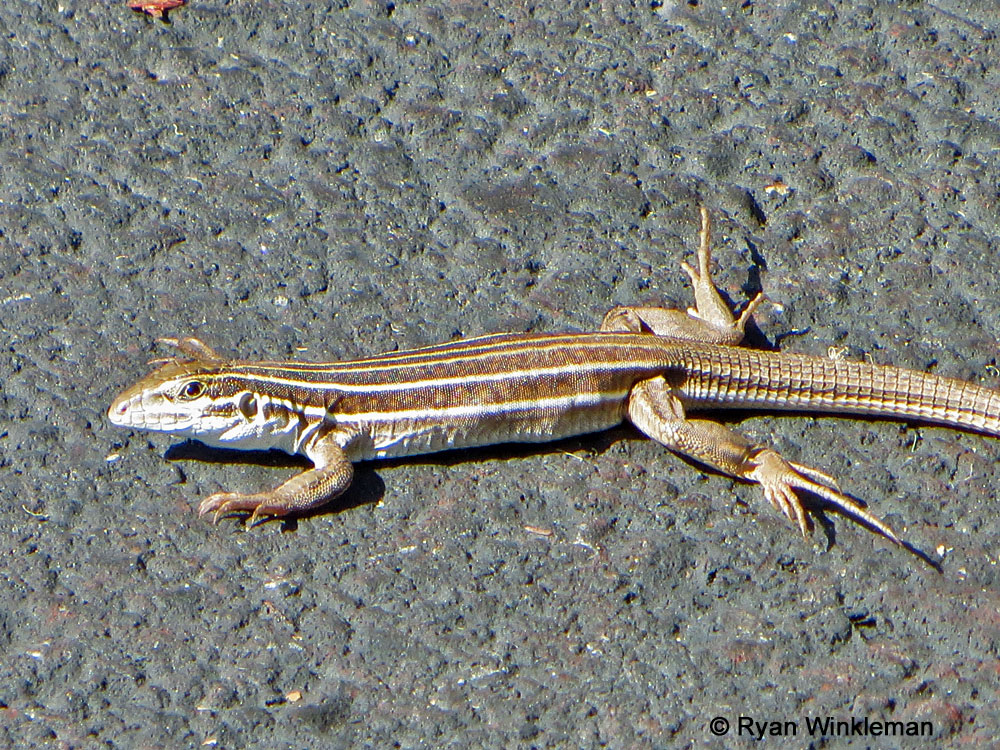
Sonoran Spotted Whiptails are not native to California. They have become established in Orange County, and may spread to other nearby counties in the future. Adults have 6 distinct light stripes on the back with light spots in the dark fields between the stripes. The paravertebral stripes (the two stripes on either side of the middle of the back) remain parallel and fade out on the tail. Smaller than the native Western Whiptail, adults average 3.5 inches (9 cm) in length, not including the tail, but slightly larger than the native Belding's Orange-throated Whiptail, which this species is sometimes confused with. |
||
 |
 |
 |
| Adult, Orange County © William Flaxington |
Juvenile, Orange County © William Flaxington |
Adult, Orange County © Ryan Winkleman |
 |
 |
 |
| Adult, Orange County © Ryan Winkleman |
Adult, Orange County © Nathan Taxel |
Adult, Orange County © Ryan Winkleman |
 |
||
Common Checkered Whiptail - Aspidoscelis tesselatus |
||
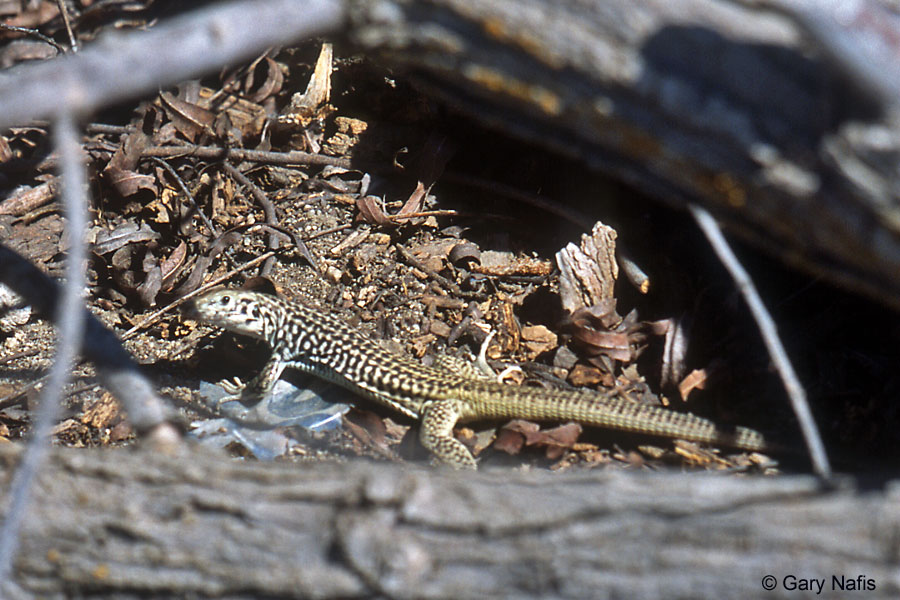
| Established in Long Beach, Los Angeles County. A large whiptail, to about 4.2 inches long from snout to vent (106 mm.) The body is long and tubular, with large plate-like scales on the head, small granular scales on the body, and large square scales on the tail and underside. The head is narrow with a pointed snout, the forelimbs are small, and the hind limbs are long. The tail is very long and thin, sometimes twice the length of the body. The back is marked with 6 to 8 longitudinal stripes with spots and bars that connect to form a checkered appearance. Stripes are more prominent in juveniles. As adults age, their stripes become broken or disappear. |
||
 |
 |
 |
| Adult, Presidio County, Texas |
||
|
||






Return to the Top
© 2000 -