|
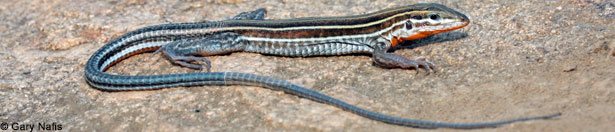 |
| Adult male, San Diego County |
 |
 |
 |
| |
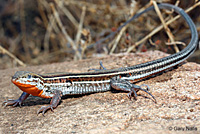
Adult male, San Diego County |
|
 |
 |
 |
Adult male, San Diego County
© Dick Bartlett |
Adult female, San Diego County |
 |
 |
 |
| |
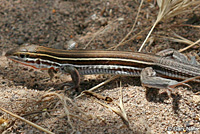
Adult male, San Diego County |
|
 |
 |
 |
| |
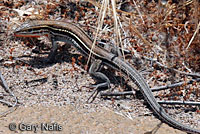
Sub-adult, San Diego County |
|
 |
 |
 |
| Adult, Orange County © Tadd Kraft |
Adult male head © Patrick Briggs |
 |
 |
 |
| Dorsal view © Patrick Briggs |
Lateral view © Patrick Briggs |
Underside © Patrick Briggs |
 |
|
|
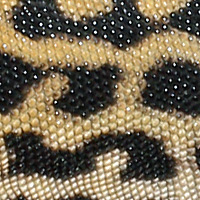
| Whiptails, genus Aspidoscelis, have small granular dorsal scales. |
|
|
| |
|
|
| Juveniles |
 |
 |
|
| Juvenile, San Diego County |
Small juvenile, Riverside County
© Darren Ramsey |
|
| |
|
|
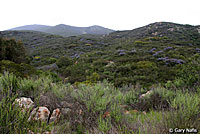
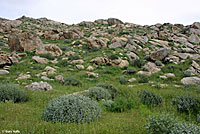
| Habitat |
 |
 |
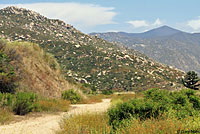 |
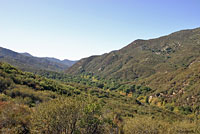
| Habitat, San Diego County |
Habitat, San Diego County |
Habitat, San Diego County |
 |
 |
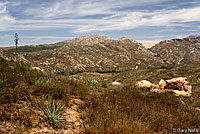 |
| Habitat, San Diego County |
Habitat, Riverside County |
Coastal habitat, San Diego County |
| |
 |
|
| |
Habitat, Santa Ana Mountains,
Riverside County |
|
| |
|
|
| Short Video |
| |
 |
|
| |
On a cold morning in early Spring, several woozy Orange-throated Whiptails, recently removed from overnight traps during a study in San Diego County coastal sage habitat awkwardly crawl across the ground to freedom. |
|
|
|
|
| Description |
| |
| Size |
2 - 2 3/4 inches snout to vent (5.1 - 7 cm).
|
| Appearance |
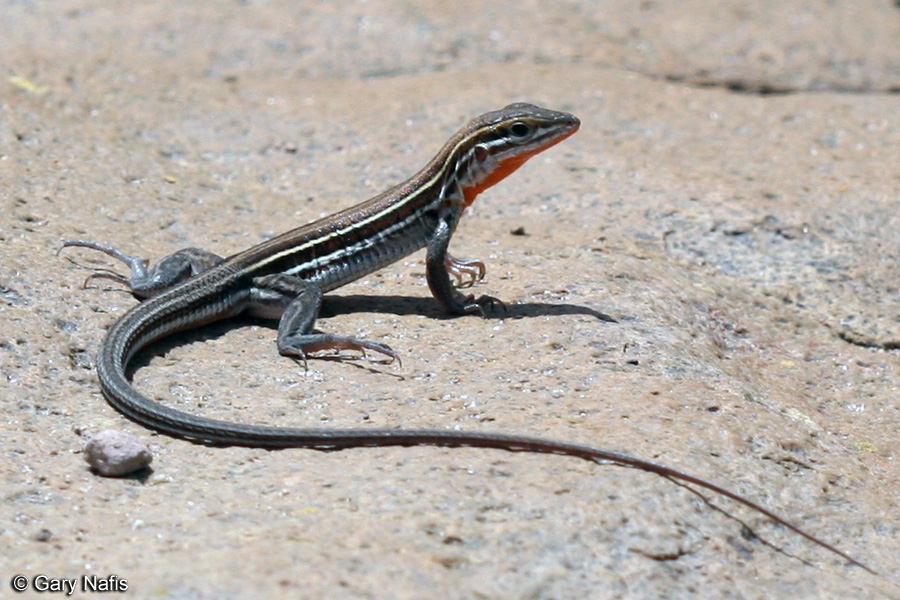
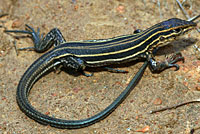
A slim-bodied lizard with a long slender tail, a pointed snout, and large symmetrical head plates.
Scales on the back are small and granular, and scales on the tail are keeled.
|
| Color and Pattern |
The back is unspotted and black, dark brown, or grayish with 6 or fewer pale yellow or whitish stripes.
The throat and often the chest are orange, turning brighter orange during breeding season.
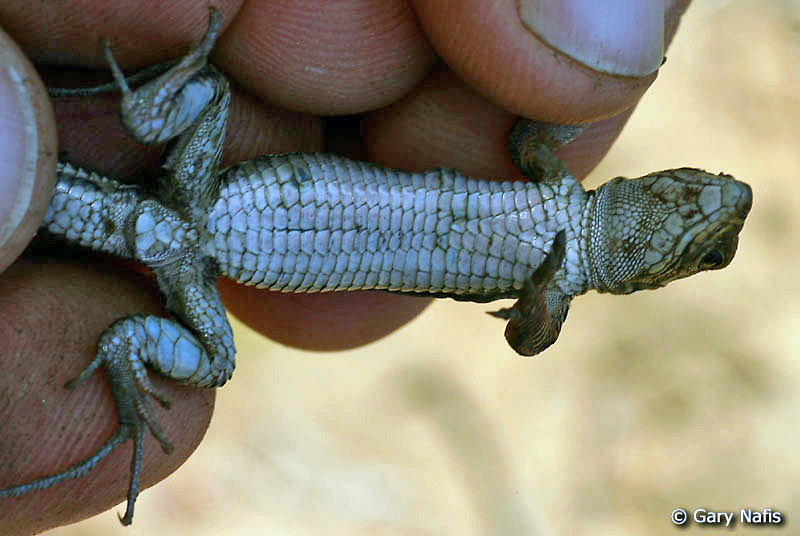
The belly is pale blue-gray or whitish with large, smooth, rectangular scales in 8 lengthwise rows.
The tail color fades to gray in adults.
The tail
can reach up to two times the length of the body. |
| Young |
The tail is blue in juveniles.
|
| Comparison With Similar Species |
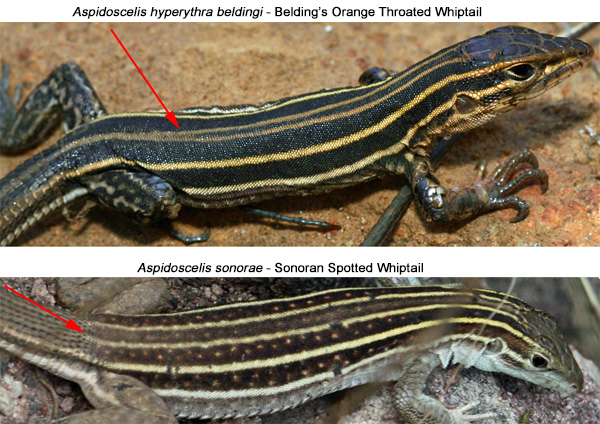
Similar in appearance to the introduced species Aspidoscelis sonorae - Sonoran Spotted Whiptail.
To differentiate them note the paravertebral stripes (the two stripes on either side of the middle of the back) as illustrated below.
The paravertebral stripes on A. sonarae remain parallel and fade out on the tail.
The paravertebral stripes on A. h. beldingi merge together and become a single mid-dorsal stripe that extends onto the tail.
|
|
| Life History and Behavior |
Activity |
Diurnal.
Wary and very active, moving with abrupt stops and starts, side-to-side head movement, and tongue flicking.
Often seen digging rapidly when foraging.
Difficult to approach - typically foraging near cover, and capable of quick bursts of speed into heavy brush or holes.
|
| Territoriality |
| Males defend territory against other males with a threat display - arching the back, twitching the tail tip, and pointing the snout at the ground. |
| Diet and Feeding |
Small invertebrates, especially spiders, scorpions, centipedes, and termites, and small lizards.
|
| Reproduction |
Eggs are laid June - July, hatching in about 2 months.
|
| Habitat |
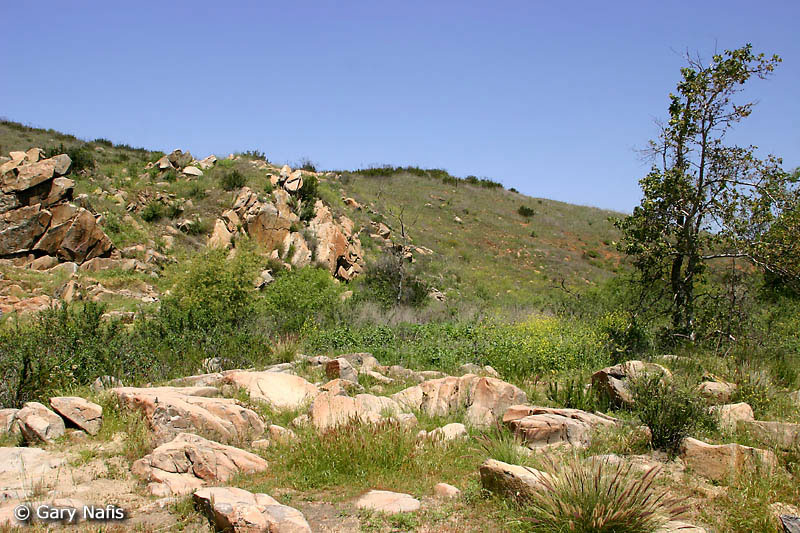
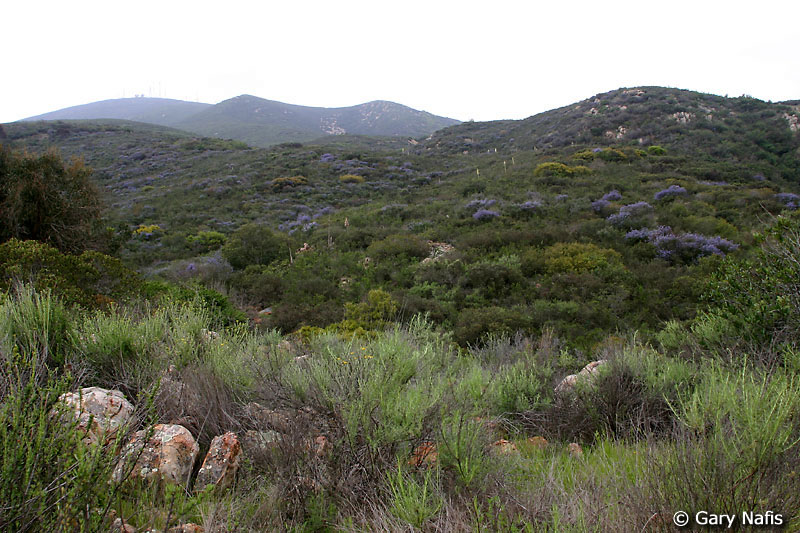
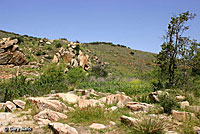
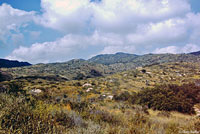
Semi-arid brushy areas typically with loose soil and rocks, including washes, stream sides, rocky hillsides, and coastal chaparral.
|
| Geographical Range |
In California, this subspecies ranges from the Santa Ana River in Orange County, and near Colton in San Bernardino County, west of the Peninsular ranges, south almost to the cape region of the Baja Peninsula. A second subspecies occurs from there to the southernmost edge of Baja California.
|
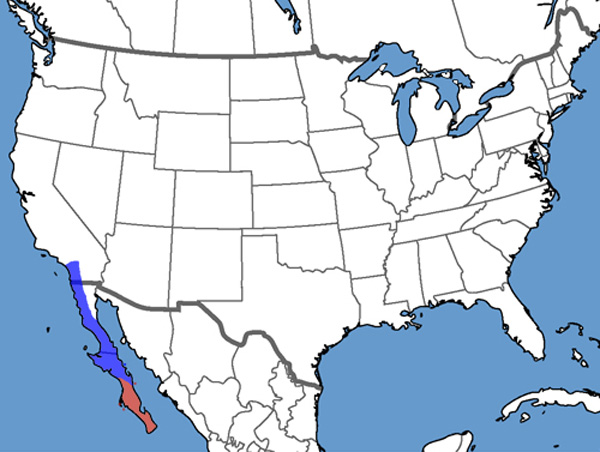 |
Approximate distribution of Aspidoscelis hyperythra - Orange-throated Whiptail
Dark Blue: Aspidoscelis hyperythra beldingi - Belding's Orange-throated Whiptail
- Not found in California
Red: Aspidoscelis hyperythra hyperythra - Cape Orange-throated Whiptail
|
| Elevational Range |
From sea level to approximately 2,000 ft. (610 m).
|
| Notes on Taxonomy |
Formerly placed in the genus Cnemidophorus.
---------------------------------------------------------------------------------------------------------------------------------------------------------------------
The recognition of subspecies of A. hyperythra is in flux.
On its 2012 list (SSAR Herpetological Circular No. 39) the SSAR recognizes two subspecies - A. h. hyperythra and A. h. beldingi, with the formerly-recognized subspecies A. h. schmidti (found in central Baja California) synonymized with A. h. beldingi. The 2017 Herpetological Circular No. 43 cites a 2014 study by Taylor and Walker that did not support the recognition of A. h. schmidti.
---------------------------------------------------------------------------------------------------------------------------------------------------------------------
"Tucker et al. (2016, Molecular Phylogenetics and Evolution 103: 75–84) interpreted the gender of the name Aspidoscelis as masculine rather than feminine, and we have therefore changed the endings of several of the names of Aspidoscelis species to their masculine forms..." A. hyperythra becomes A. hyperythrus.
(Nicholson, K. E. (ed.). 2025 SSAR Scientific and Standard English Names List)
---------------------------------------------------------------------------------------------------------------------------------------------------------------------
Alternate and Previous Names (Synonyms)
Aspidoscelis Hyperythrus - Orange-throated Whiptail (Nicholson, K. E. (ed.). 2025 SSAR Scientific and Standard English Names List)
Cneidophorus hyperythrus - Orange-throated Whiptail (Stebbins 2003)
Cnemidophorus hypythrus beldingi - Belding Orange-throated Whiptail (Stebbins 1985)
Cneidophorus hyperythrus beldingi - Orange-throated Racerunner (Smith 1946)
|
| Conservation Issues (Conservation Status) |
| Populations of this lizard are fragmented. It inhabits only about 25 percent of its former range. Much of the habitat it needs for survival has been destroyed by development. |
|
|
Taxonomy |
| Family |
Teiidae |
Whiptails and Racerunners |
Gray, 1827 |
| Genus |
Aspidoscelis (formerly Cnemidophorus) |
Whiptails |
Fitzinger, 1843 |
| Species |
hyperythra |
Orange-throated Whiptail |
(Cope, 1863) |
Subspecies
|
beldingi |
Belding's Orange-throated Whiptail |
(Stejneger, 1894) |
|
Original Description |
Cnemidophorus hyperythrus Cope, 1863 - Proc. Acad. Nat. Sci. Philadelphia, Vol. 15, p. 103
Cnemidophorus hyperythrus beldingi - Stejneger, 1894 - Proc. U.S. Natl. Mus., Vol. 17, p. 17
from Original Description Citations for the Reptiles and Amphibians of North America © Ellin Beltz
Eponyms
This subspecies of Aspidoscelis hyperythrus was first described by Leohnard Stejneger in 1894. The subspecies name "Aspidoscelis hyperythra beldingi" and the common name "Belding's Orange-throated Whiptail" honor Lyman Belding (1829-1917) an American ornithologist who did extensive work in California and Baja California.
See: Biographies of Persons Honored in the Herpetological Nomenclature © Ellin Beltz
|
|
Meaning of the Scientific Name |
Aspidoscelis - Greek - aspido = shield + skelos = leg
tigris - Latin = of a tiger - refers to the dorsal pattern
hyperythrus - Greek - hyper = above, beyond, over + erythros = red - referring to the throat color
beldingi - honors Belding, Lyman
Taken in part from Scientific and Common Names of the Reptiles and Amphibians of North America - Explained © Ellin Beltz
|
|
Related or Similar California Lizards |
A. t. stejnegeri - Coastal Whiptail
A. t. munda - California Whiptail
A. t. tigris - Great Basin Whiptail
E. s. interparietalis - Coronado Skink
|
|
More Information and References |
California Department of Fish and Wildlife
Hansen, Robert W. and Shedd, Jackson D. California Amphibians and Reptiles. (Princeton Field Guides.) Princeton University Press, 2025.
Stebbins, Robert C., and McGinnis, Samuel M. Field Guide to Amphibians and Reptiles of California: Revised Edition (California Natural History Guides) University of California Press, 2012.
Stebbins, Robert C. California Amphibians and Reptiles. The University of California Press, 1972.
Flaxington, William C. Amphibians and Reptiles of California: Field Observations, Distribution, and Natural History. Fieldnotes Press, Anaheim, California, 2021.
Nicholson, K. E. (ed.). 2025. Scientific and Standard English Names of Amphibians and Reptiles of North America North of Mexico, with Comments Regarding Confidence in Our Understanding. Ninth Edition. Society for the Study of Amphibians and Reptiles. [SSAR] 87pp.
Samuel M. McGinnis and Robert C. Stebbins. Peterson Field Guide to Western Reptiles & Amphibians. 4th Edition. Houghton Mifflin Harcourt Publishing Company, 2018.
Stebbins, Robert C. A Field Guide to Western Reptiles and Amphibians. 3rd Edition. Houghton Mifflin Company, 2003.
Behler, John L., and F. Wayne King. The Audubon Society Field Guide to North American Reptiles and Amphibians. Alfred A. Knopf, 1992.
Robert Powell, Roger Conant, and Joseph T. Collins. Peterson Field Guide to Reptiles and Amphibians of Eastern and Central North America. Fourth Edition. Houghton Mifflin Harcourt, 2016.
Powell, Robert., Joseph T. Collins, and Errol D. Hooper Jr. A Key to Amphibians and Reptiles of the Continental United States and Canada. The University Press of Kansas, 1998.
Bartlett, R. D. & Patricia P. Bartlett. Guide and Reference to the Turtles and Lizards of Western North America (North of Mexico) and Hawaii. University Press of Florida, 2009.
Jones, Lawrence, Rob Lovich, editors. Lizards of the American Southwest: A Photographic Field Guide. Rio Nuevo Publishers, 2009.
Smith, Hobart M. Handbook of Lizards, Lizards of the United States and of Canada. Cornell University Press, 1946.
Taylor, Emily. California Lizards and How to Find Them. Heyday, Berkeley, California. 2025.
Grismer, L. Lee. Amphibians and Reptiles of Baja California, Including Its Pacific Islands and the Islands in the Sea of Cortés. The University of California Press, 2002.
McPeak, Ron H. Amphibians and Reptiles of Baja California. Sea Challengers, 2000.
Samuel M. McGinnis and Robert C. Stebbins. Peterson Field Guide to Western Reptiles & Amphibians. 4th Edition. Houghton Mifflin Harcourt Publishing Company, 2018.
Stebbins, Robert C. A Field Guide to Western Reptiles and Amphibians. 3rd Edition. Houghton Mifflin Company, 2003.
The Reptile Database
|
|
|
The following conservation status listings for this animal are taken from the July 2025 State of California Special Animals List and the July 2025 Federally Listed Endangered and Threatened Animals of California list (unless indicated otherwise below.) Both lists are produced by multiple agencies every year, and sometimes more than once per year, so the conservation status listing information found below might not be from the most recent lists, but they don't change a great deal from year to year.. To make sure you are seeing the most recent listings, go to this California Department of Fish and Wildlife web page where you can search for and download both lists:
https://www.wildlife.ca.gov/Data/CNDDB/Plants-and-Animals.
A detailed explanation of the meaning of the status listing symbols can be found at the beginning of the two lists. For quick reference, I have included them on my Special Status Information page.
If no status is listed here, the animal is not included on either list. This most likely indicates that there are no serious conservation concerns for the animal. To find out more about an animal's status you can also go to the NatureServe and IUCN websites to check their rankings.
Check the current California Department of Fish and Wildlife sport fishing regulations to find out if this animal can be legally pursued and handled or collected with possession of a current fishing license. You can also look at the summary of the sport fishing regulations as they apply only to reptiles and amphibians that has been made for this website.
The Special Animals list shows this lizard as Aspidoscelis hyperythra - Orange-throated Whiptail.
|
| Organization |
Status Listing |
Notes |
| NatureServe Global Ranking |
G5 |
Secure |
| NatureServe State Ranking |
S2S3 |
Imperiled - Vulnerable |
| U.S. Endangered Species Act (ESA) |
None |
|
| California Endangered Species Act (CESA) |
None |
|
| California Department of Fish and Wildlife |
WL |
Watch List
|
| Bureau of Land Management |
None |
|
| USDA Forest Service |
S |
Sensitive |
| IUCN |
LC |
Least Concern |
|
|