|
 |
 |
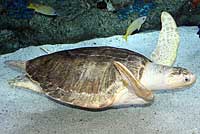 |
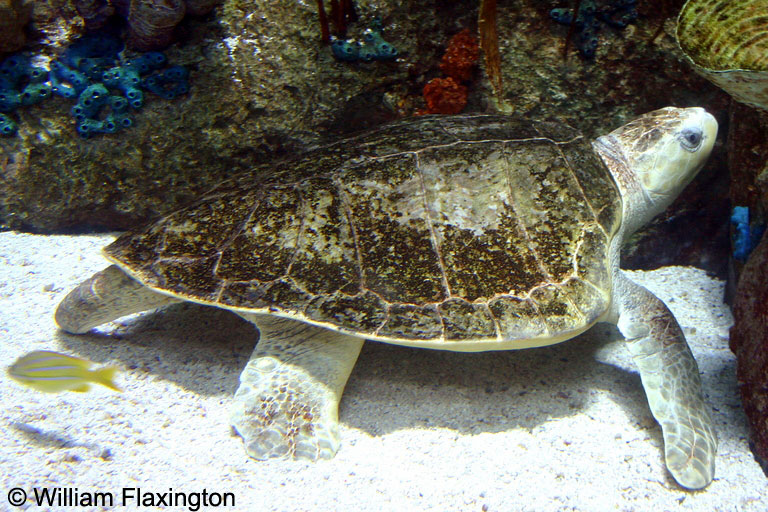
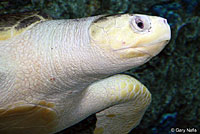
| Aquarium captive adult from the Pacific Ocean |
 |
 |
 |
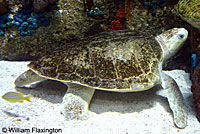
| Aquarium captive from the Pacific Ocean |
Aquarium captive adult from the Pacific Ocean © William Flaxington
|
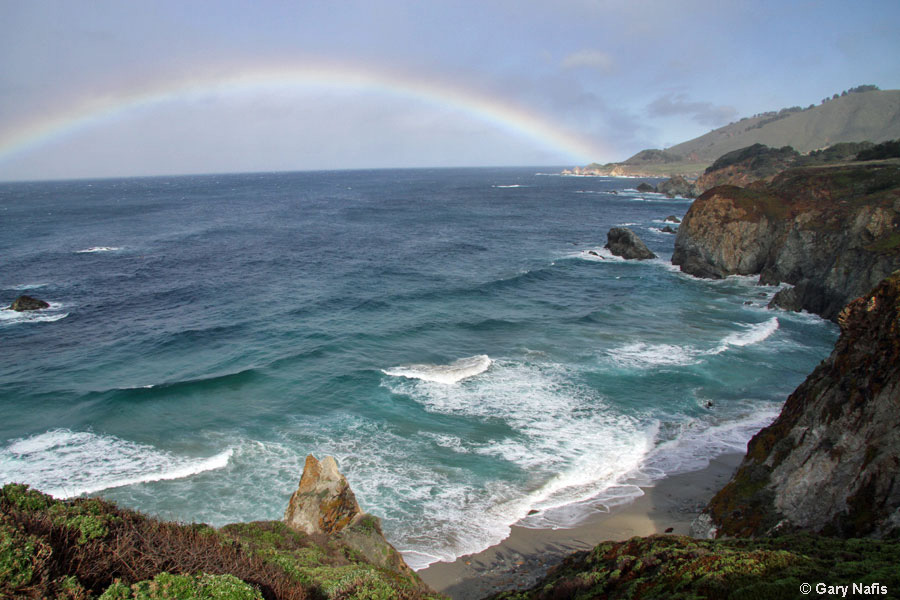
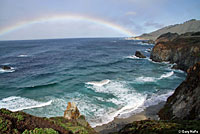
Habitat in California - the Pacific Ocean
|
| |
|
|
| Marin County Sighting 2002 |
 |
 |
| Adult Olive Ridley on Shell Beach, Marin County 2002. © Reuven Walder |
Shell Beach, Marin County |
Olive Ridleys show up rarely along the California coast, but one appeared on Shell beach in Tamales Bay, Marin County, in November of 2002. Reuven Walder, a biologist with the sea turtle protection organization Turtle Island Restoration Network, just happened to be vacationing there with his family when the turtle appeared. They watched as it swam in the water than hauled out onto the beach, something Olive Ridleys almost never do except to nest. It probably needed to warm up since it was farther north than usual in colder waters. Walder was able to identify the turtle and take some pictures, including the one above.
(Talk about being in the right place at the right time!)
You can read more about this sighting here, along with an account of another turtle that was pulled up entangled in the fishing line of a sport fishing boat a half mile off the Marin County coast in October 2001. Unlike many Olive Ridleys found north of their optimal range, which are typically dead stranded turtles, both of these were alive and healthy. |
| |
| Short Video |
| |
|
|
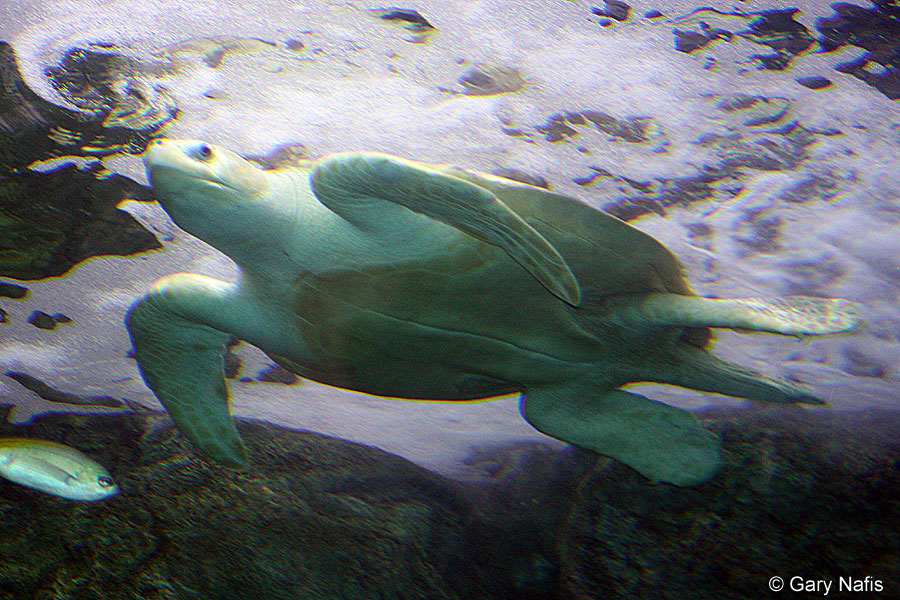
| An Olive Ridley swims around in a large aquarium. |
| |
| Description |
| |
| Size |
The smallest (and most numerous) sea turtle in the world. Adults are 20 - 29 inches in shell length (51 - 74 cm) 0 - 100+ lbs. (Stebbins 2003)
|
| Appearance |
| A small sea turtle with a round, flat carapace and a large, triangular head. |
| Color and Pattern |
The carapace is olive to grayish green.
The skin is gray, and the plastron is light greenish yellow or whitish.
There are two pairs of prefrontals, and usually 5 - 9 costal shields on the sides, the first pair coming into contact with the nuchal. |
| Male / Female Differences |
Males have longer thicker tails than females and well-developed curved claws on the forelimbs.
|
| Life History and Behavior |
Activity |
Little is known about Olive Ridley behavior other than nesting behavior.
They undertake long migrations to and from nesting beaches.
Large numbers are sometimes seen basking at the surface. |
| Diet and Feeding |
| Mostly carnivorous. Eats mollusks, crustaceans, jellyfish, sea urchins, crab, fish, sea urchins, snails, jellyfish, and occasional plant material - algae, seagrass, and seaweed. |
| Reproduction |
Olive Ridleys found in our area derive from eggs laid from May through January from Costa Rica to Baja California. Nesting occurs in some part of its range in almost every month of the year.
Olive Ridleys nest together in synchronized mass nesting called "arribadas" which may consist of thousands of females nesting at the same time. From 20,000 to 200,000 females may visit a nesting beach in one season.
Tropical beaches and barrier islands, often near river mouths, are preferred.
Many females reproduce every year, but some nest every 2 - 3 years, usually from 1 - 2 times per season, every 14 - 30 days.
Nesting occurs mostly at night, but diurnal nesting also occurs. A female crawls onto the nesting beach, scoops a body pit, then digs a nest and lays a clutch of 30 - 170 eggs, which she covers with sand before crawling back into the ocean. The whole procedure takes less than an hour. Nests are robbed by a variety of predators including humans, pigs, opossums, racoons, coyotes, coatimundi, caimans, and snakes. The eggs hatch in 45 - 70 days depending on the weather and temperature. Hatchlings emerge and begin a frantic race to the sea, chased by predators such as crabs, vultures, and seabirds. Once they reach the water they are still in danger from predators such as sharks, fish, and crocodiles.
Sea Turtle Navigation
A study published in 2018 * shows that Loggerhead Sea Turtles use the earth's magnetic fields to navigate back to within about 50 miles of where they were born. They learn the magnetic signature of their natal beach through geomagnetic imprinting.
* J. Roger Brothers, Kenneth J. Lohmann. Evidence that Magnetic Navigation and Geomagnetic Imprinting Shape Spatial Genetic Variation in Sea Turtles. Current Biology Volume 28, Issue 8, 23 April 2018.
|
| Habitat |
Marine. Found well out to sea and in protected, relatively shallow bays and lagoons and the shallow water between reefs and the shore.
|
| Geographical Range |
Found in tropical waters of the Pacific and Indian Oceans, including Arabia, Japan, Micronesia, off the west coast of Africa, the north and east coasts of South America, occasionally in the Caribbean, from Chile north to the Gulf of California, occasionally straying as far north as British Colombia, Canada during warm-water years.
One was found on the Oregon coast in 2015.
On September 30th, 2019, a hypothermic Olive Ridley Sea Turtle was found off the coast of Port Alberni, British Colombia, Canada, only the fourth of its species to be recorded in B.C. waters in about 20 years. (CBS News 10/03/2019.)
Olive Ridleys in California Waters
Sea turtles can show up almost anywhere on the coast of California, but most sightings are not documented. The locations mentioned here only represent a small percentage of sightings. Locations where Olive Ridleys have been seen in California waters include Point Loma, La Jolla, and Encinitas in San Diego County, near Noyo in Mendocino County, near Table Bluff in Humboldt County, Stinson Beach, 2009, Tamales Bay, 2002, 1/2 mile off the Marin County Coast, 2001, near Las Animas Canyon in Santa Barbara Count, Point Piedras Blancas in San Luis Obispo County, and San Gregorio State Beach in San Mateo County.
|

Click Map to Enlarge
|
| Notes on Taxonomy |
No subspecies are recognized.
Alternate and Previous Names (Synonyms)
Lepidochelys olivacea - Olive Ridley Sea Turtle (Stebbins & McGinnis 2012)
Lepidochelys olivacea - Pacific Ridley (Stebbins 1966, 2003)
|
| Conservation Issues (Conservation Status) |
Endangered.
Although it is the most numerous species of sea turtles, Olive Ridley populations are declining. Nesting no longer occurs on some formerly heavily-used beaches. Eggs and turtle flesh are eaten by humans and the hide is used for leather, with turtles often slaughtered on or offshore of the nesting beaches during the nesting season, contributing to a decline in reproduction.
Other causes for the decline of sea turtles include the development and degradation of nesting beaches, degradation of feeding habitats, entanglement of turtles in fishing nets, including discarded nets, and ingestion of plastic garbage, especially plastic grocery bags (which look like jellyfish floating on the surface) and offshore boats moving so quickly that turtles are not able to move out of the way fast enough to avoid being killed or injured. Some authorities also question whether humans handling nesting females and doing research on nesting beaches is stressing the turtles and lowering reproduction and survivorship.
Increased warming due to global climate change might be creating too many female sea turtles.
The sex of a sea turtle is determined by the temperature of the egg when it is incubating buried in the sand. Warmer temperatures produce a higher number of females. Jensen et al * found that the increase in temperature caused by global climate change is making the sex of most of the Green Sea Turtles they studied female, including over 99% of all juveniles and subadults. It is not known how few males are required to sustain sea turtle populations. A lack of a sufficient number of males to perpetuate a population could eventually be catastrophic.
* Michael P. Jensen, Camryn D. Allen, Tomoharu Eguchi, Ian P. Bell, Erin L. LaCasella, William A. Hilton, Christine A.M. Hof, Peter H. Dutton. Environmental Warming and Feminization of One of the Largest Sea Turtle Populations in the World. Current Biology Volume 28, Issue 1, 8 January 2018.
National Geographic article, 8 January 2018. |
|
|
Taxonomy |
| Family |
Cheloniidae |
Sea Turtles |
Oppel, 1811 |
| Genus |
Lepidochelys |
Ridley Sea Turtles |
Fitzinger, 1843 |
Species
|
olivacea |
Olive Ridley Sea Turtle |
(Eschscholtz, 1829) |
|
Original Description |
Lepidochelys olivacea - (Eschscholtz, 1829) - Zool. Atlas, Pt. 1, p. 2, pl. 3
from Original Description Citations for the Reptiles and Amphibians of North America © Ellin Beltz
|
|
Meaning of the Scientific Name |
Lepidochelys - Greek - lepido = scaled + chelys = turtle
olivacea - Latin - olive = olive green + -acea = having the nature or color of - refers to the olive green color
from Scientific and Common Names of the Reptiles and Amphibians of North America - Explained © Ellin Beltz
|
|
Alternate Names |
Olive Ridley
Pacific Ridley
|
|
Related or Similar California Turtles |
C. caretta - Loggerhead Sea Turtle
C. mydas - Green Sea Turtle
E. i. bissa - Pacific Hawksbill Sea Turtle
D. coriacea - Leatherback Sea Turtle
|
|
More Information and References |
National Oceanic and Atmospheric Administration - Olive Ridley Sea Turtle
California Department of Fish and Wildlife
NMFS
Hansen, Robert W. and Shedd, Jackson D. California Amphibians and Reptiles. (Princeton Field Guides.) Princeton University Press, 2025.
Stebbins, Robert C., and McGinnis, Samuel M. Field Guide to Amphibians and Reptiles of California: Revised Edition (California Natural History Guides) University of California Press, 2012.
Stebbins, Robert C. California Amphibians and Reptiles. The University of California Press, 1972.
Flaxington, William C. Amphibians and Reptiles of California: Field Observations, Distribution, and Natural History. Fieldnotes Press, Anaheim, California, 2021.
Nicholson, K. E. (ed.). 2025. Scientific and Standard English Names of Amphibians and Reptiles of North America North of Mexico, with Comments Regarding Confidence in Our Understanding. Ninth Edition. Society for the Study of Amphibians and Reptiles. [SSAR] 87pp.
Samuel M. McGinnis and Robert C. Stebbins. Peterson Field Guide to Western Reptiles & Amphibians. 4th Edition. Houghton Mifflin Harcourt Publishing Company, 2018.
Stebbins, Robert C. A Field Guide to Western Reptiles and Amphibians. 3rd Edition. Houghton Mifflin Company, 2003.
Behler, John L., and F. Wayne King. The Audubon Society Field Guide to North American Reptiles and Amphibians. Alfred A. Knopf, 1992.
Robert Powell, Roger Conant, and Joseph T. Collins. Peterson Field Guide to Reptiles and Amphibians of Eastern and Central North America. Fourth Edition. Houghton Mifflin Harcourt, 2016.
Powell, Robert., Joseph T. Collins, and Errol D. Hooper Jr. A Key to Amphibians and Reptiles of the Continental United States and Canada. The University Press of Kansas, 1998.Bartlett, R. D. & Patricia P. Bartlett. Guide and Reference to the Turtles and Lizards of Western North America (North of Mexico) and Hawaii. University Press of Florida, 2009.
Carr, Archie. Handbook of Turtles: The Turtles of the United States, Canada, and Baja California. Cornell University Press, 1969.
Ernst, Carl H., Roger W. Barbour, & Jeffrey E. Lovich. Turtles of the United States and Canada. Smithsonian Institution 1994.
(2nd Edition published 2009)
Lemm, Jeffrey. Field Guide to Amphibians and Reptiles of the San Diego Region (California Natural History Guides). University of California Press, 2006.
Range and Nesting Information has been adapted from a number of sources, including:
Sea Turtle Conservancy
National Oceanic and Atmospheric Administration
Wikipedia
Witherington, Blair E. Sea Turtles: An Extraordinary Natural History of Some Uncommon Turtles. Voyageur Press, 2006.
Spotila, James R. Sea Turtles: A Complete Guide to Their Biology, Behavior, and Conservation. The Johns Hopkins University Press and Oakwood Arts, 2004.
Perrine, Doug. Sea Turtles of the World. Voyageur Press, Inc., 2003.
Arnold, E. Nicholas, and Denys W. Ovenden. Reptiles and Amphibians of Europe. Princeton University Press and Oxford, 2002.
|
|
|
The following conservation status listings for this animal are taken from the July 2025 State of California Special Animals List and the July 2025 Federally Listed Endangered and Threatened Animals of California list (unless indicated otherwise below.) Both lists are produced by multiple agencies every year, and sometimes more than once per year, so the conservation status listing information found below might not be from the most recent lists, but they don't change a great deal from year to year.. To make sure you are seeing the most recent listings, go to this California Department of Fish and Wildlife web page where you can search for and download both lists:
https://www.wildlife.ca.gov/Data/CNDDB/Plants-and-Animals.
A detailed explanation of the meaning of the status listing symbols can be found at the beginning of the two lists. For quick reference, I have included them on my Special Status Information page.
If no status is listed here, the animal is not included on either list. This most likely indicates that there are no serious conservation concerns for the animal. To find out more about an animal's status you can also go to the NatureServe and IUCN websites to check their rankings.
Check the current California Department of Fish and Wildlife sport fishing regulations to find out if this animal can be legally pursued and handled or collected with possession of a current fishing license. You can also look at the summary of the sport fishing regulations as they apply only to reptiles and amphibians that has been made for this website.
This turtle is not included on the Special Animals List, which indicates that there are no significant conservation concerns for it in California (probably because of its rarity in California waters) however it is endangered worldwide and it is Federally listed as threatened.
|
| Organization |
Status Listing |
Notes |
| NatureServe Global Ranking |
|
|
| NatureServe State Ranking |
|
|
| U.S. Endangered Species Act (ESA) |
FT |
Listed as Threatened 7/28/1978 |
| California Endangered Species Act (CESA) |
None |
|
| California Department of Fish and Wildlife |
None |
|
| Bureau of Land Management |
None |
|
| USDA Forest Service |
None |
|
| IUCN |
|
|
|
|