basic logo

A Guide to the Amphibians
and Reptiles of California


Chionactis occipitalis annulata - Colorado Desert Shovel-nosed Snake


Click on a picture for a larger view


Range in California: Green

Click the map for a guide
to the other subspecies.


observation link


Adult, Imperial County
  Adult, Imperial County  
 
Juvenile, San Diego County
 
Juvenile, San Diego County
Adult, Imperial County
© Jeremiah Easter
Adult, Riverside County Adult, San Diego County, found by David Young. Photo © Stuart Young Juvenile, Imperial County
   
  Snake tracks in the sand  
Habitat
Habitat, San Diego County Habitat, San Diego County Habitat, San Diego County
Habitat, Imperial County Habitat, Imperial County Habitat, Imperial County
Short Video
   
  A nocturnal Colorado Desert Shovel-nosed snake crawls across the desert floor.  
Description

Nonvenomous
Considered harmless to humans.
Size
Adults are 11 - 17 inches long (25 - 43 cm)
Appearance
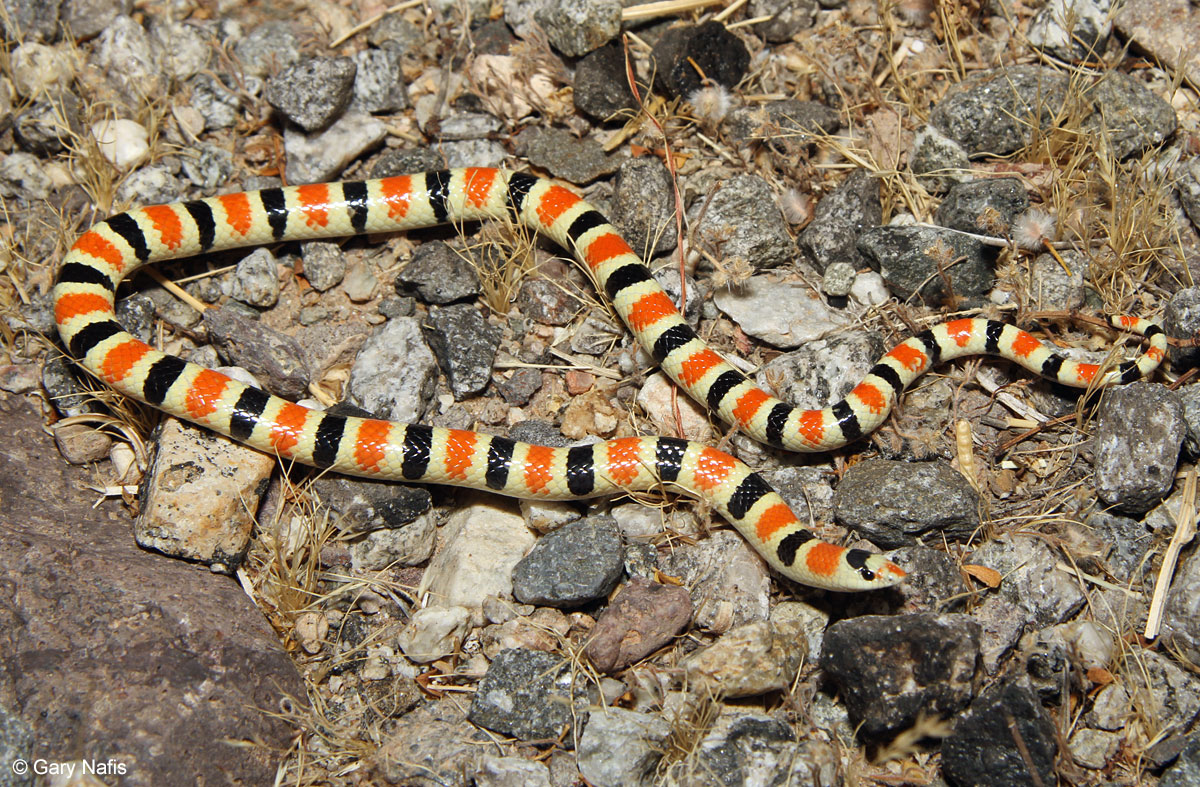
Smooth, shiny scales, not keeled. The ground color is cream or yellowish and the body is circled with black bands, usually fewer than 25, and most often with narrow red crossbands between them. Usually less than 45 bands. Many black bands completely encircle the body. The head is narrow with a large spade-like scale on the tip of a flat shovel-like snout, acountersunk lower jaw, and nasal valves.
Behavior
Nocturnal. Burrows underground in daytime, but occasionally found by day in shaded areas. Smooth scales, flat shout, concave abdomen, and nasal valves are adaptations that allow for a quick swimming movement through loose sand, with an s-shaped, side-to-side movement. Often seen crossing desert roads at night.
Diet
Eats invertebrates: insects, scorpions, spiders, centipedes, larval insects and moths, often while the snake is burrowing.
Reproduction
Lays eggs late spring through summer.
Range
Found in extreme southeastern California, east of the desert slope of the peninsular range to the Colorado River. Ranges south into Baja California, and east into southwestern Arizona.
Habitat
Inhabits dry desert habitats with loose sand and often with little vegetation - washes, dunes, sandy flats, rocky hillsides.
Conservation Issues  (Conservation Status)
None.

Taxonomy
Family Colubridae Colubrids
Genus Chionactis Shovel-nosed Snakes
Species occipitalis Western Shovel-nosed Snake
Subspecies


annulata Colorado Desert Shovel-nosed Snake
Original Description
Chionactis occipitalis - (Hallowell, 1854) - Proc. Acad. Nat. Sci. Philadelphia, Vol. 7, p. 95
Chionactis occipitalis annulata - (Baird, 1859) - U.S. Mex. Bound. Surv., Vol. 2, Rept., Pt. 2, p. 22, pl. 21

from Original Description Citations for the Reptiles and Amphibians of North America © Ellin Beltz

Meaning of the Scientific Name
Chionactis - Greek - chion - snow and aktis - ray or beam
occipitalis
- Latin - pertaining to the back of the head
annulata - Latin - ringed - referring to the banded body

from Scientific and Common Names of the Reptiles and Amphibians of North America - Explained © Ellin Beltz
Alternate Names
None

Related or Similar California Snakes
C. o. occipitalis - Mohave Shovel-nosed Snake
C. o. talpina - Nevada Shovel-nosed Snake
C. stramineus - Variable Sandsnake 
S. s. semiannulata - Variable Groundsnake
R. l. lecontei - Western Long-nosed Snake

More Information and References
Natureserve Explorer

California Dept. of Fish and Game


Stebbins, Robert C. A Field Guide to Western Reptiles and Amphibians. 3rd Edition. Houghton Mifflin Company, 2003.

Behler, John L., and F. Wayne King. The Audubon Society Field Guide to North American Reptiles and Amphibians. Alfred A. Knopf, 1992.

Powell, Robert., Joseph T. Collins, and Errol D. Hooper Jr. A Key to Amphibians and Reptiles of the Continental United States and Canada. The University Press of Kansas, 1998.

Bartlett, R. D. & Patricia P. Bartlett. Guide and Reference to the Snakes of Western North America (North of Mexico) and Hawaii. University Press of Florida, 2009.

Bartlett, R.D. , & Alan Tennant. Snakes of North America - Western Region. Gulf Publishing Co., 2000.

Brown, Philip R. A Field Guide to Snakes of California. Gulf Publishing Co., 1997.

Ernst, Carl H., Evelyn M. Ernst, & Robert M. Corker. Snakes of the United States and Canada. Smithsonian Institution Press, 2003.

Wright, Albert Hazen & Anna Allen Wright. Handbook of Snakes of the United States and Canada. Cornell University Press.

Conservation Status

The following status listings come from the Special Animals List which is published several times each year by the California Department of Fish and Game.

This snake is not included on the Special Animals List, which indicates that there are no significant conservation concerns for it in California.


Organization
Status Listing
U.S. Endangered Species Act (ESA) None
California Endangered Species Act (CESA) None
California Department of Fish and Game None
Bureau of Land Management None
USDA Forest Service None
Natureserve Global Conservation Status Ranks
World Conservation Union - IUCN Red List


Home Site Map About Us Identification Lists Maps Photos More Lists CA Snakes CA Lizards CA Turtles CA Salamanders CA Frogs
Contact Us Usage Resources Rattlesnakes Sounds Videos FieldHerping Yard Herps Behavior Herp Fun CA Regulations
Beyond CA All Herps


Return to the Top

© 2000 - 2012