|
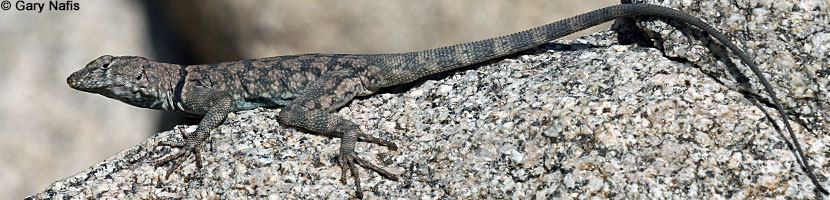 |
| Adult male, San Diego County |
 |
 |
 |
 |
| Adult male, San Diego County |
Adult male, San Diego County |
Adult, San Diego County |
 |
 |
 |
 |
| Adult female, San Diego County |
Gravid adult female, San Diego County |
Adult male, San Diego County |
Adult male, San Diego County |
 |
 |
 |
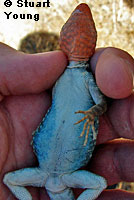 |
| Adult male, San Diego County |
Adult, basking in and out of the sun on a Winter day in San Diego County
|
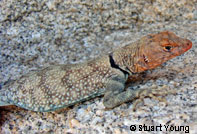
Adult female with breeding colors, Imperial County. © Stuart Young |
 |
 |
 |
 |
| |
Adult, San Diego County |
|
Adult, San Diego County |
 |
 |
 |
 |
| Adult, San Diego County |
Adult, Imperial Diego County |
Hatchling, late September,
San Diego County |
Adult, San Diego County |
 |
 |
 |
 |
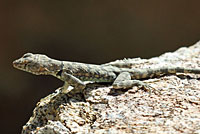
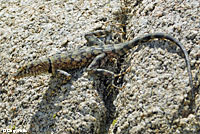
Adult, San Diego County,
blending in with the granite background. |
Adult, San Diego County |
Gravid adult female, showing orange coloring on head, San Diego County |
 |
 |
 |
 |
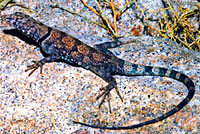
Adult, San Diego County
© Patrick Briggs |
Adult, San Diego County
© Patrick Briggs |
A very colorful adult male from the northernmost edge of their range in Riverside County just south of Cajon Pass. © Lou Hamby |
 |
 |
 |
 |
| Adult, Imperial County |
Adult, Imperial County |
Adult, Imperial County |
 |
 |
 |
 |
| Adult, San Diego County © Bruce Edley |
Adult, San Diego County |
Courting adult male and female
© Dan K. |
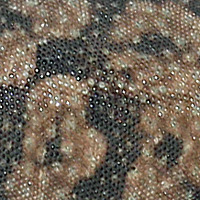
The Banded Rock Lizard has small granular scales on the dorsal surfaces, and pointed keeled scales on the tails and limbs. |
| |
|
|
|
| Habitat |
 |
 |
 |
 |
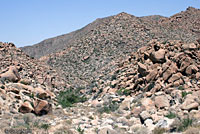
Habitat, Imperial County. Banded Rock Lizards tend
to
prefer massive rock outcrops such as these. |
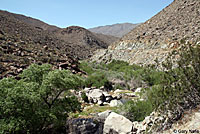
Habitat, San Diego County |
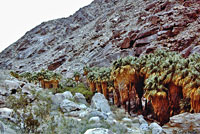
Habitat, Imperial County |
 |
 |
 |
 |
| Habitat, San Diego County |
Habitat, San Diego County |
Habitat, San Diego County |
Habitat, Imperial County |
| |
|
|
|
| Short Videos |
 |
 |
 |
 |
| An adult Banded Rock Lizard shows its rock climbing and jumping acrobatics, finally doing a defensive push-up display, then a juvenile lizard crawls around the face of a massive rock. |
Banded Rock Lizards in the San Diego county desert. |
Banded Rock Lizards on their rocks including one spotted at night. |
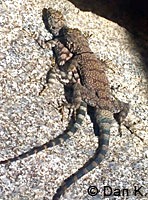
As part of their courtship, which I presume precedes their mating, a male bites the tail of a female, then follows her closely, positioning himself on top of her.
© Dan K. |
|
|
|
|
| Description |
| |
| Size |
2.75 - 4.5 inches long from snout to vent (6.6 - 10.6 cm). (Stebbins 2003)
|
| Appearance |
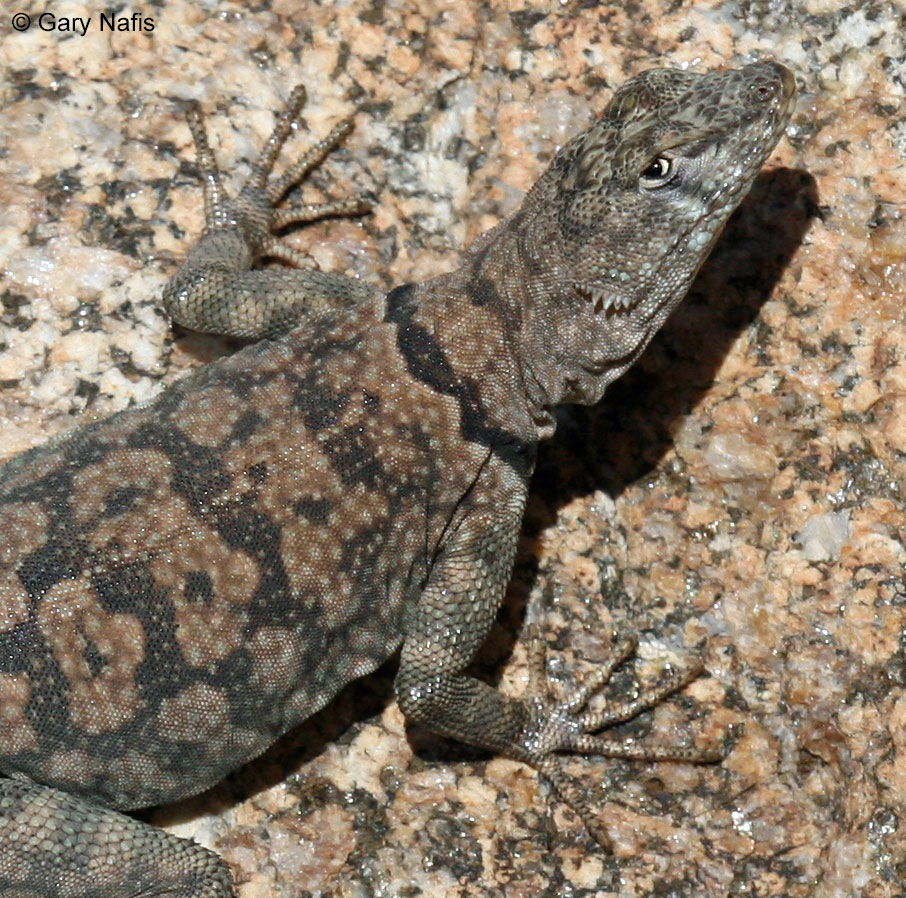
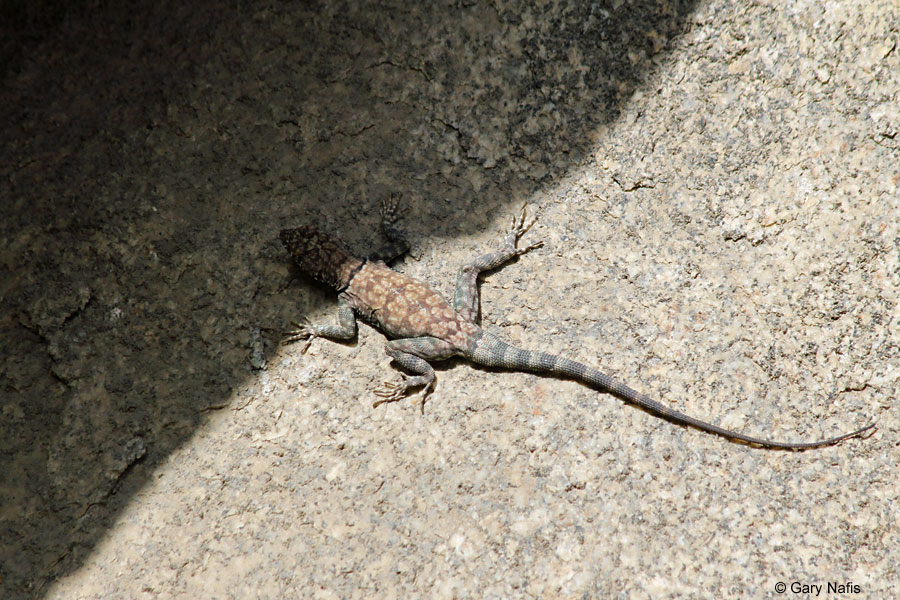
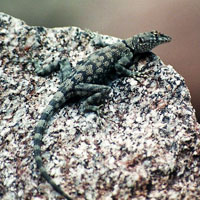
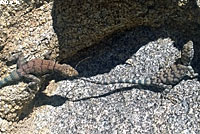
A medium-sized flat bodied lizard with a conspicuous narrow black collar around the neck (not bordered in white), and a long thin tail which can grow back if detached.
Wavy dark cross scales are granular except on the legs and the tail where they are strongly keeled.
|
| Color and Pattern |
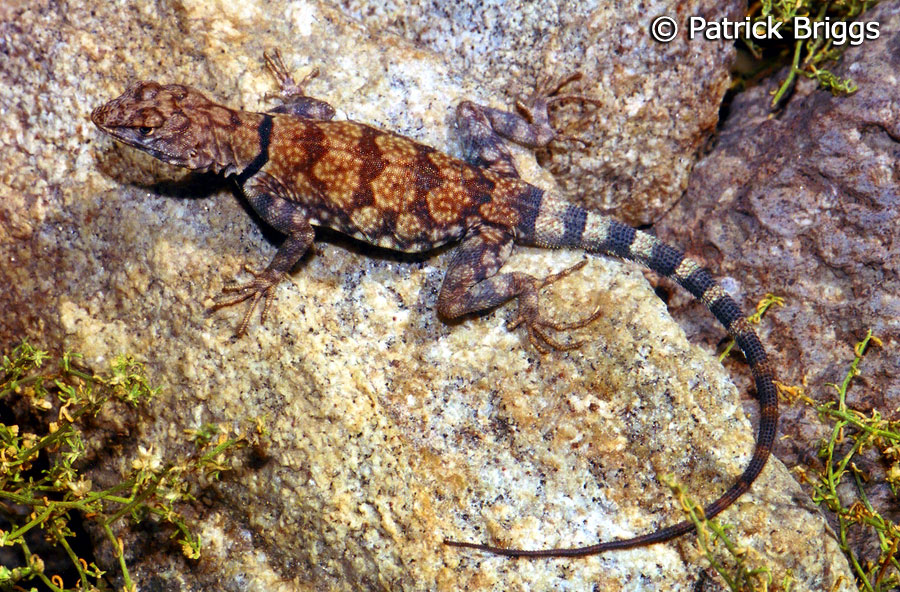
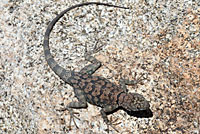
Color is olive, brown, or grayish with many small white or bluish spots.
Bars mark the back, but sometimes these are very faint.
The tail is prominently banded.
The underside is pale with some bluish color on the sides.
The throat is dark and marked with whitish spots.
Melanistic lizards have been observed in the Mountain Springs area. (Lemm, 2006) |
| Male / Female Differences |
Males have a more pronounced pattern and more blue coloring on the throat than females, and they have enlarged post-anal scales.
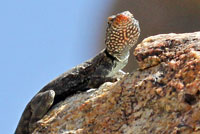
Females develop orange coloring on the throat and on the head above the eyes when they are gravid.
|
| Life History and Behavior |
Activity |
Diurnal, and sometimes crepuscular.
Most activity is probably from March into early Fall, but lizards may come out during warm periods at any time of year.
Remains dormant in rock crevices during cold temperatures.
Most active in the early morning during hot periods.
An excellent climber, able to scale nearly vertical rocks and even run upside down among the rocks.
|
| Territoriality |
| Males are territorial and defend their territories by bobbing their head up and down. |
| Defense |
Escapes from a pursuer by running to the opposite side of a rock.
Will bite when handled. |
| Diet and Feeding |
| Eats a variety of small invertebrates, ants, beetles, flies, caterpillars, spiders, etc. along with flower buds and blossoms, and occasionally small lizards. |
| Reproduction |
Breeding takes place in the spring.
Females lay
2 - 6 eggs from June to August.
Eggs
hatch in two months.
|
| Habitat |
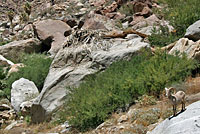
Associated with large rocks in shady, narrower parts of canyons, on the desert slopes of mountains. Most common among massive rocks and high rocky cliffs and washes, palm oases, and desert flats where there are large rock outcrops.
|
| Geographical Range |
Ranges from San Gorgonio Pass south along the east side of the Peninsular Range mountains south into the northern third of Baja California and several islands, including Angel de la Guarda.
|
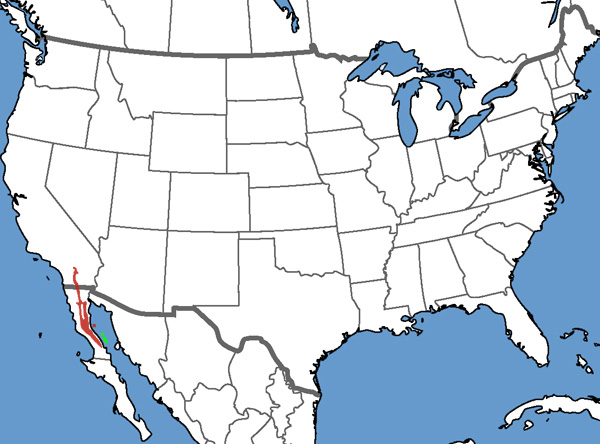 |
Approximate distribution of Petrosaurus mearnsi - Banded Rock Lizard
Red: Petrosaurus mearnsi mearnsi - Banded Rock Lizard
-Not found in California
Bright Green: Petrosaurus mearnsi sleveni - Slevin's Banded Rock Lizard
|
| Elevational Range |
From near sea level to around 3,600 ft. (1,100 m.) (Stebbins 2003)
|
| Notes on Taxonomy |
Two subspecies have been recognized by the S.S.A.R. - P. m. mearnsi and P. m. slevini, (which occurs on two islands in the Gulf of California) however Grismer elevated P. m. slevini to full species status in 1999. (Grismer, L. Lee. 1999. An evolutionary classification of reptiles on islands in the Gulf of California, México. Herpetologica 55 (4): 446-469)
-----------------------------------------------------------------------------------------------------------------------------------------------------------------------------------------------------------------------------
"Gottscho (2015, Ph.D. dissertation, University of California at Riverside and San Diego State University), based on RADseq data, found that P. mearnsi samples were divided into northern and southern clades and populations, with P. slevini included within the southern population and sister to the remaining members of that population."
(Nicholson, K. E. (ed.). 2025 SSAR Scientific and Standard English Names List)
-----------------------------------------------------------------------------------------------------------------------------------------------------------------------------------------------------------------------------
Alternate and Previous Names (Synonyms)
Petrosaurus mearnsi - Banded Rock Lizard (no subspecies recognized) (Stebbins 1985)
Streptosaurus mearnsi - Banded Rock Lizard (Stebbins 1966)
Uta mearnsi - California Rock Lizard (Stebbins 1954)
Streptosaurus mearnsi - Californian Collared Lizard (Smith 1946)
Uta mearnsi - Mearns Lizard (Mearns Swift) (Grinnell and Camp 1917)
|
| Conservation Issues (Conservation Status) |
| None |
|
|
Taxonomy |
| Family |
Phrynosomatidae |
Zebra-tailed, Earless, Fringe-toed, Spiny, Tree, Side-blotched, and Horned Lizards |
Fitzinger, 1843 |
| Genus |
Petrosaurus |
Banded Rock Lizards |
Boulenger, 1885 |
| Species |
mearnsi |
Banded Rock Lizard |
(Stejneger, 1894) |
Subspecies
|
mearnsi |
Banded Rock Lizard |
(Stejneger, 1894) |
|
Original Description |
Petrosaurus mearnsi - (Stejneger, 1894) - Proc. U.S. Natl. Mus., Vol. 17, p. 589
from Original Description Citations for the Reptiles and Amphibians of North America © Ellin Beltz
Eponyms
Described by Leonhard Stejneger in 1894, the specific name "Petrosaurus mearnsi" and the common name "Mearns' Rock Lizard" honor Edgar Alexander Mearns (1856-1916), an American surgeon, naturalist, and ornithologist - founder of the American Ornithologists' Union - who collected the first specimens of the lizard.
See: Biographies of Persons Honored in the Herpetological Nomenclature © Ellin Beltz
|
|
Meaning of the Scientific Name |
Petrosaurus - Greek - petra = rock + sauros = lizard - refers to this lizard's rocky habitat
mearnsi - honors Mearns, Edgar A.
from Scientific and Common Names of the Reptiles and Amphibians of North America - Explained © Ellin Beltz
|
|
Related or Similar California Lizards |
Baja California Collared Lizard
|
|
More Information and References |
California Department of Fish and Wildlife
Hansen, Robert W. and Shedd, Jackson D. California Amphibians and Reptiles. (Princeton Field Guides.) Princeton University Press, 2025.
Stebbins, Robert C., and McGinnis, Samuel M. Field Guide to Amphibians and Reptiles of California: Revised Edition (California Natural History Guides) University of California Press, 2012.
Stebbins, Robert C. California Amphibians and Reptiles. The University of California Press, 1972.
Flaxington, William C. Amphibians and Reptiles of California: Field Observations, Distribution, and Natural History. Fieldnotes Press, Anaheim, California, 2021.
Nicholson, K. E. (ed.). 2025. Scientific and Standard English Names of Amphibians and Reptiles of North America North of Mexico, with Comments Regarding Confidence in Our Understanding. Ninth Edition. Society for the Study of Amphibians and Reptiles. [SSAR] 87pp.
Samuel M. McGinnis and Robert C. Stebbins. Peterson Field Guide to Western Reptiles & Amphibians. 4th Edition. Houghton Mifflin Harcourt Publishing Company, 2018.
Stebbins, Robert C. A Field Guide to Western Reptiles and Amphibians. 3rd Edition. Houghton Mifflin Company, 2003.
Behler, John L., and F. Wayne King. The Audubon Society Field Guide to North American Reptiles and Amphibians. Alfred A. Knopf, 1992.
Robert Powell, Roger Conant, and Joseph T. Collins. Peterson Field Guide to Reptiles and Amphibians of Eastern and Central North America. Fourth Edition. Houghton Mifflin Harcourt, 2016.
Powell, Robert., Joseph T. Collins, and Errol D. Hooper Jr. A Key to Amphibians and Reptiles of the Continental United States and Canada. The University Press of Kansas, 1998.
Bartlett, R. D. & Patricia P. Bartlett. Guide and Reference to the Turtles and Lizards of Western North America (North of Mexico) and Hawaii. University Press of Florida, 2009.
Jones, Lawrence, Rob Lovich, editors. Lizards of the American Southwest: A Photographic Field Guide. Rio Nuevo Publishers, 2009.
Smith, Hobart M. Handbook of Lizards, Lizards of the United States and of Canada. Cornell University Press, 1946.
Taylor, Emily. California Lizards and How to Find Them. Heyday, Berkeley, California. 2025.
Grismer, L. Lee. Amphibians and Reptiles of Baja California, Including Its Pacific Islands and the Islands in the Sea of Cortés. The University of California Press, 2002.
McPeak, Ron H. Amphibians and Reptiles of Baja California. Sea Challengers, 2000.
Samuel M. McGinnis and Robert C. Stebbins. Peterson Field Guide to Western Reptiles & Amphibians. 4th Edition. Houghton Mifflin Harcourt Publishing Company, 2018.
Stebbins, Robert C. A Field Guide to Western Reptiles and Amphibians. 3rd Edition. Houghton Mifflin Company, 2003.
The Reptile Database
Lemm, Jeffrey. Field Guide to Amphibians and Reptiles of the San Diego Region (California Natural History Guides). University of California Press, 2006.
Joseph Grinnell and Charles Lewis Camp. A Distributional List of the Amphibians and Reptiles of California. University of California Publications in Zoology Vol. 17, No. 10, pp. 127-208. July 11, 1917.
|
|
|
The following conservation status listings for this animal are taken from the July 2025 State of California Special Animals List and the July 2025 Federally Listed Endangered and Threatened Animals of California list (unless indicated otherwise below.) Both lists are produced by multiple agencies every year, and sometimes more than once per year, so the conservation status listing information found below might not be from the most recent lists, but they don't change a great deal from year to year.. To make sure you are seeing the most recent listings, go to this California Department of Fish and Wildlife web page where you can search for and download both lists:
https://www.wildlife.ca.gov/Data/CNDDB/Plants-and-Animals.
A detailed explanation of the meaning of the status listing symbols can be found at the beginning of the two lists. For quick reference, I have included them on my Special Status Information page.
If no status is listed here, the animal is not included on either list. This most likely indicates that there are no serious conservation concerns for the animal. To find out more about an animal's status you can also go to the NatureServe and IUCN websites to check their rankings.
Check the current California Department of Fish and Wildlife sport fishing regulations to find out if this animal can be legally pursued and handled or collected with possession of a current fishing license. You can also look at the summary of the sport fishing regulations as they apply only to reptiles and amphibians that has been made for this website.
This animal is not included on the Special Animals List, which indicates that there are no significant conservation concerns for it in California.
|
| Organization |
Status Listing |
Notes |
| NatureServe Global Ranking |
|
|
| NatureServe State Ranking |
|
|
| U.S. Endangered Species Act (ESA) |
None |
|
| California Endangered Species Act (CESA) |
None |
|
| California Department of Fish and Wildlife |
None |
|
| Bureau of Land Management |
None |
|
| USDA Forest Service |
None |
|
| IUCN |
|
|
|
|