|
 |
| Adult female, light phase, showing breeding coloring, San Luis Obispo County |
 |
 |
 |
 |
Adult male in dark phase,
San Luis Obispo County |
Adult, San Luis Obispo County |
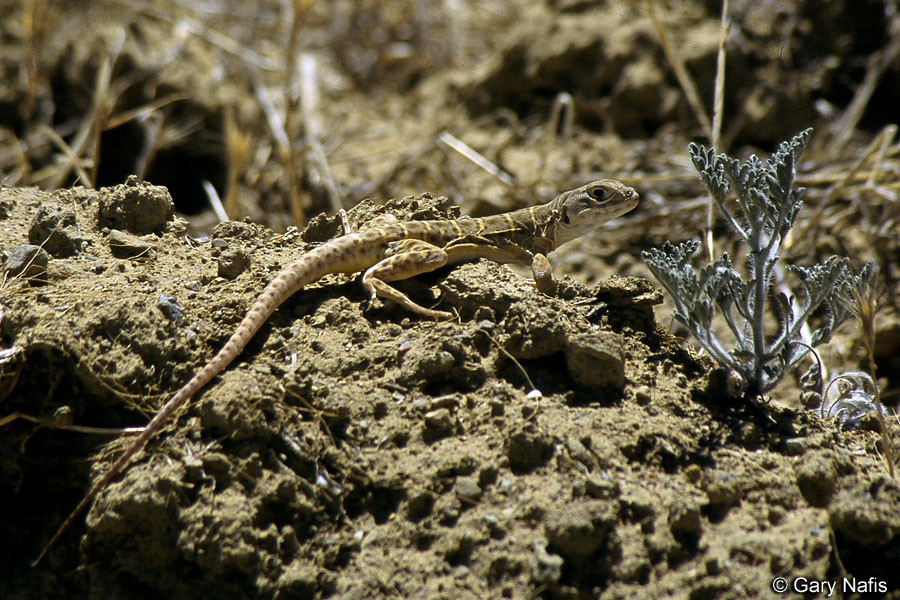
Adult, San Luis Obispo County
|
Adult female, light phase, showing breeding coloring, San Luis Obispo County |
 |
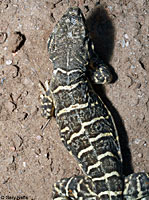 |
 |
 |
| Adult male in dark phase, San Luis Obispo County |
 |
 |
 |
 |
Adult, San Luis Obispo County
|
Adult at the mouth of its burrow,
San Luis Obispo County. |
Adult, Fresno County |
 |
 |
 |
 |
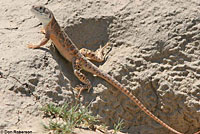
Male during the breeding season, Tulare County. © Don Roberson
(Don's web page has more pictures of Blunt-nosed Leopard lizards and their Tulare County habitat.) |
Adult male (left) and adult female (right) showing the striking salmon lateral and ventral region of a male in very hot temperatures during breeding season. Kings County © Patrick Briggs
|
Adult male, Kings County
© Patrick Briggs |
Adult, Tulare County © Patrick Briggs |
 |
 |
 |
 |
Adult male, Kings County
© Patrick Briggs |
Adult female, Kings County
© Patrick Briggs |
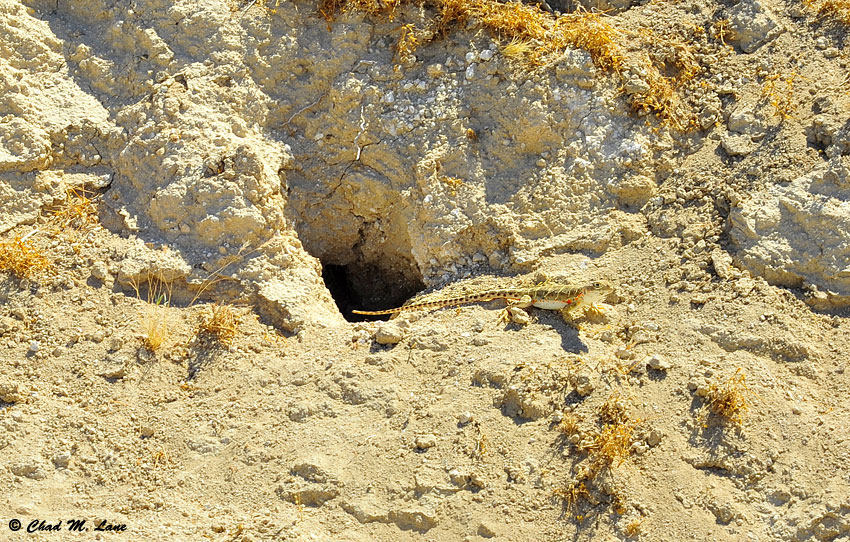
Adult at burrow, Fresno County.
© Chad Lane |
Adult, Fresno County. © Chad Lane |
 |
 |
 |
 |
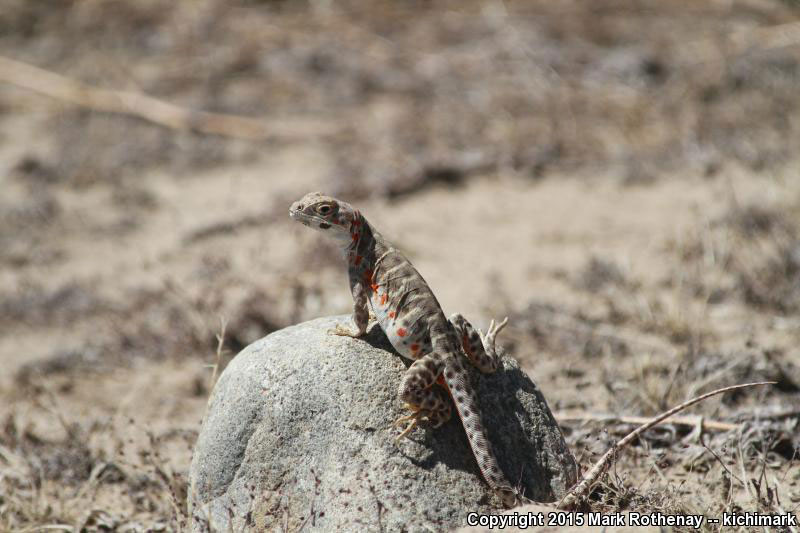
| These adults, photographed in early July in San Luis Obispo County, appear to be gravid females that are showing red breeding colors. They are probably just about ready to lay their eggs. © Mark Rothenay |
Adult head close-up, Kings County
© Patrick Briggs |
 |
 |
 |
 |
Adult, San Luis Obispo County
© Ryan Sikola |
Adult, San Luis Obispo County
© Ryan Sikola |
Adult, San Luis Obispo County
© Ryan Sikola |
Adult in burrow, Kern County
© Zachary Cava |
 |
 |
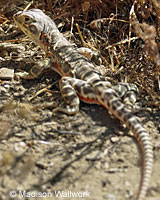 |
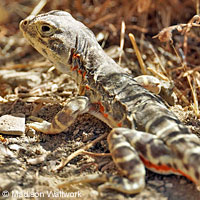 |
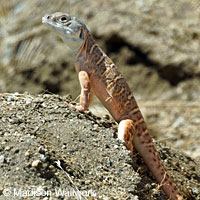
| Breeding adult male, Kern County © Madison Wallwork |
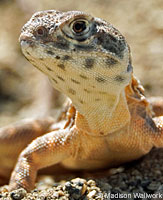
Breeding adult female, Kern County © Madison Wallwork |
 |
 |
|
|
Adult surveying its surroundings from the top of a bush, Kern County
© Zachary Cava |
Adult, Kern County © Matthias Lemm |
|
|
 |
 |
 |
 |
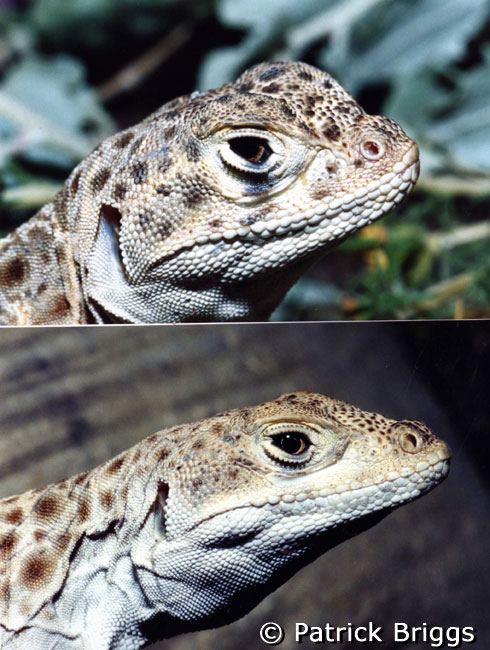
Gambelia Nose Comparisons
Top - Blunt-nosed Leopard Lizard -
Gambelia sila (Adult, Kings County)
Bottom - Long-nosed Leopard Lizard -
Gambelia wislizenii (Adult, Inyo County)
© Patrick Briggs
As you would expect from their common names, the Long-nosed Leopard Lizard has a longer nose than the Blunt-nosed Leopard Lizard.
|
Cloacal views of Gambelia sila
Top - Female
Bottom - Male
© Patrick Briggs
Notice the hemipenis pocket and the enlarged femoral pores on the male, and the orange breeding coloring on the female. |
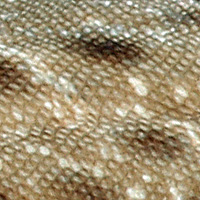
Backs and Skin of Gambelia sila
Left - Male
Right - Female
Both are adults from Kings County.
© Patrick Briggs |
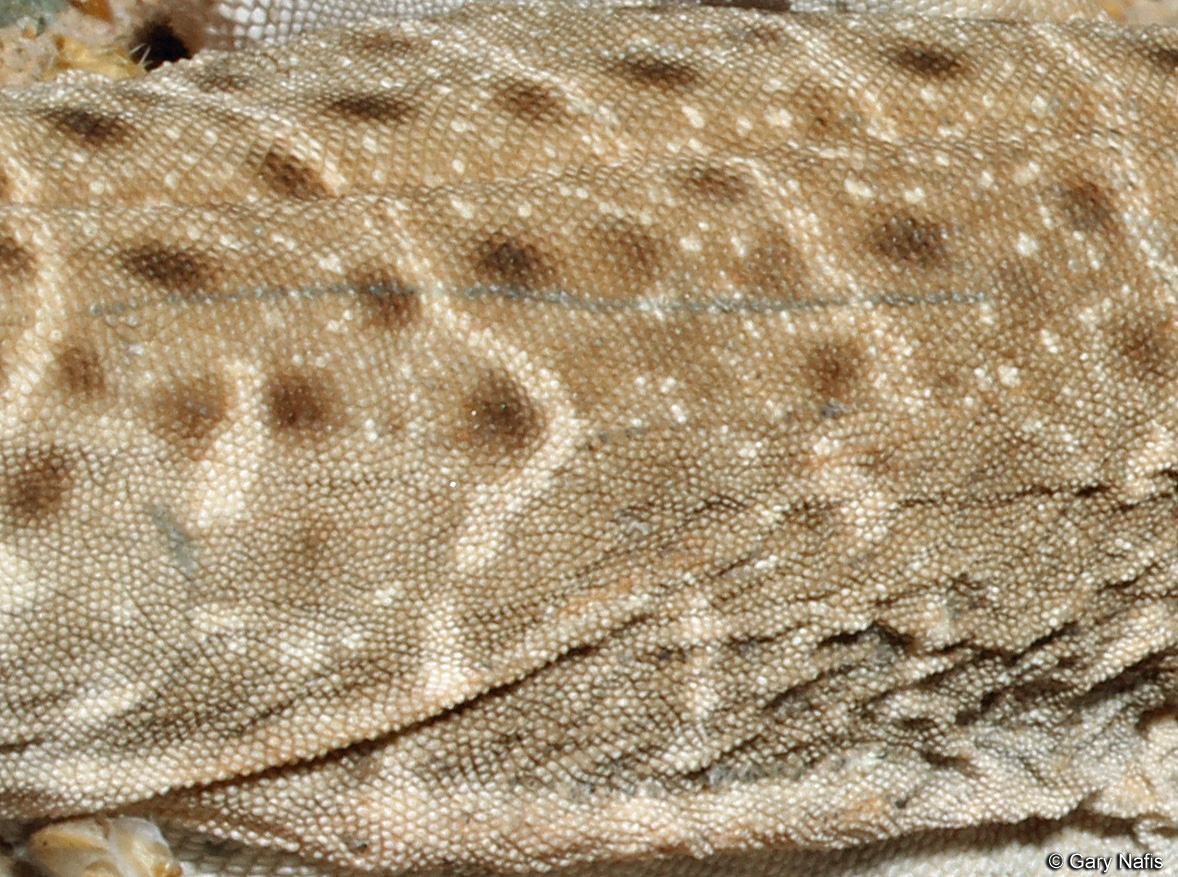
Leopard Lizards, genus Gambelia, have small granular scales on the body. |
| |
|
|
|
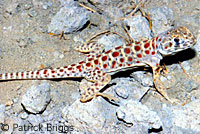
| Juveniles |
 |
| Juvenile, San Luis Obispo County © Ryan Sikola |
 |
 |
 |
 |
Juvenile, Kings County
© Patrick Briggs |
Hatchling, San Benito County © Jon Hirt |
Juvenile, San Luis Obispo County |
 |
 |
 |
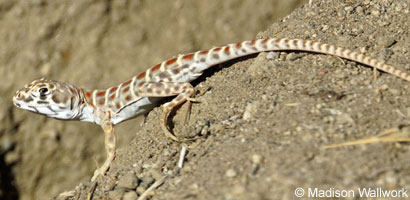
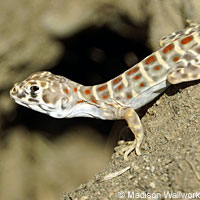
| Juvenile, Kern County © Madison Wallwork |
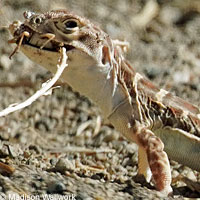
Juvenile eating a grasshopper,
Kern County © Madison Wallwork |
| |
|
|
|
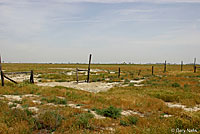
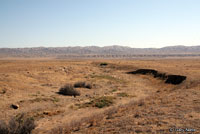
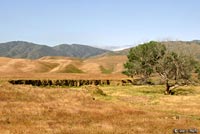
| Habitat |
 |
 |
 |
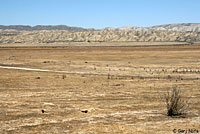 |
| Habitat, Kings County |
Habitat, San Luis Obispo County |
Habitat, Tulare County |
Habitat, San Luis Obispo County |
 |
 |
 |
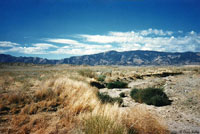 |
Habitat, San Luis Obispo County
|
Habitat, Fresno County |
Habitat, San Luis Obispo County |
Habitat, San Luis Obispo County |
 |
 |
 |
|
| Habitat, San Luis Obispo County |
Habitat, San Luis Obispo County |
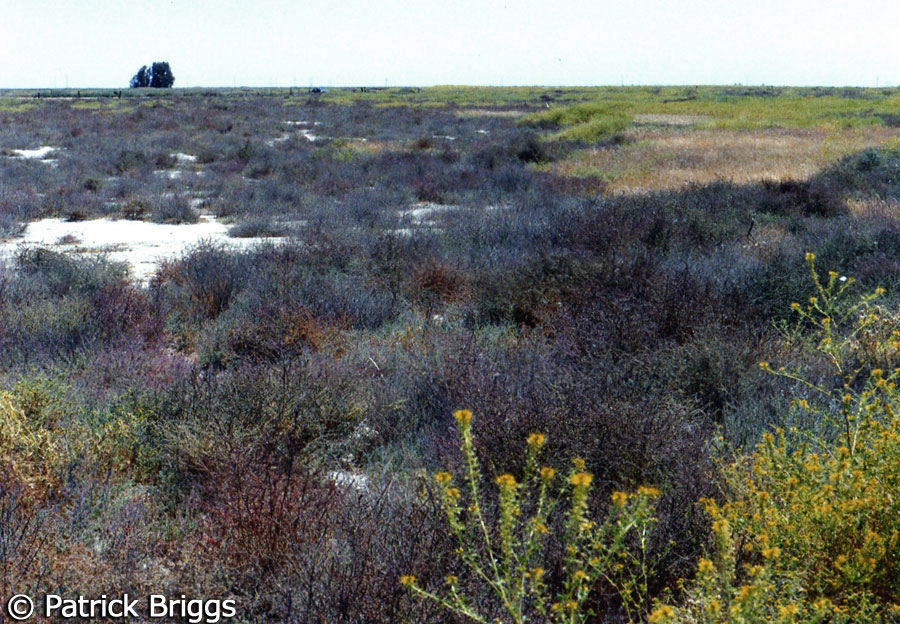
Habitat, Kings County © Patrick Briggs
|
|
| |
|
|
|
| Short Video |
| |
 |
|
|
| |
A large adult lizard rests at the mouth of its burrow then runs off into its sparsely-vegetated habitat. |
|
|
|
|
|
|
| Description |
| |
| Size |
3 - 5 inches long (7.5 - 12.5 cm.) from snout to vent.
|
| Appearance |
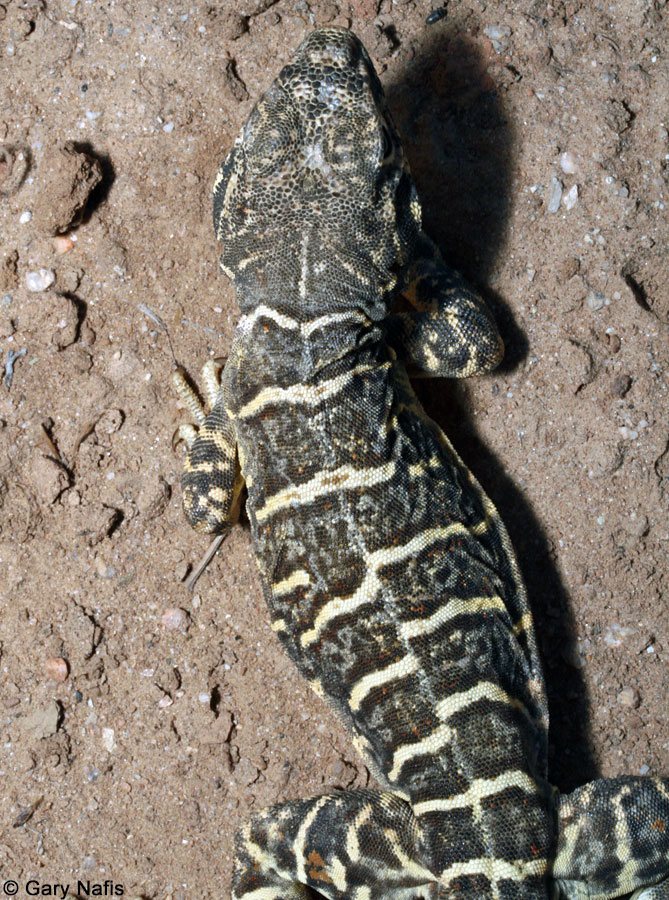
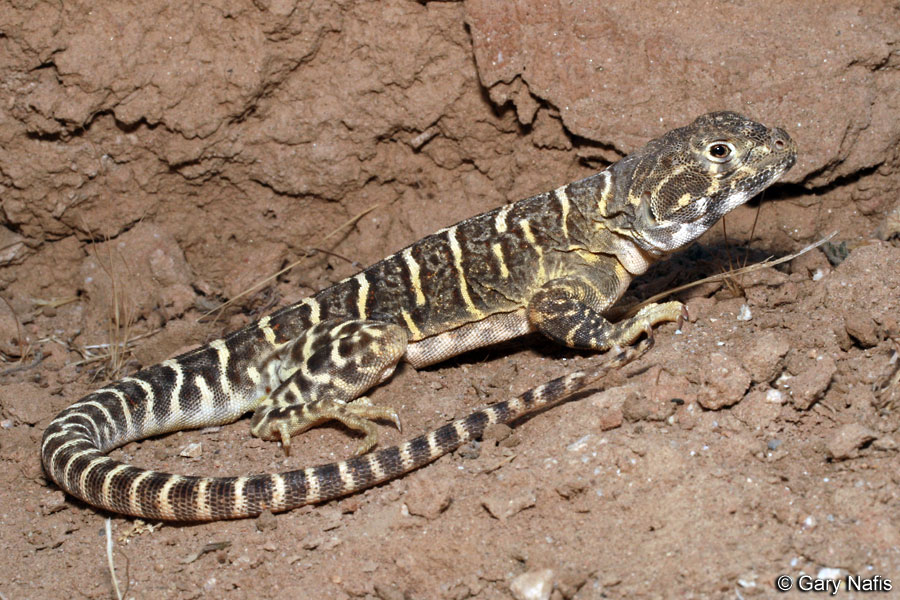
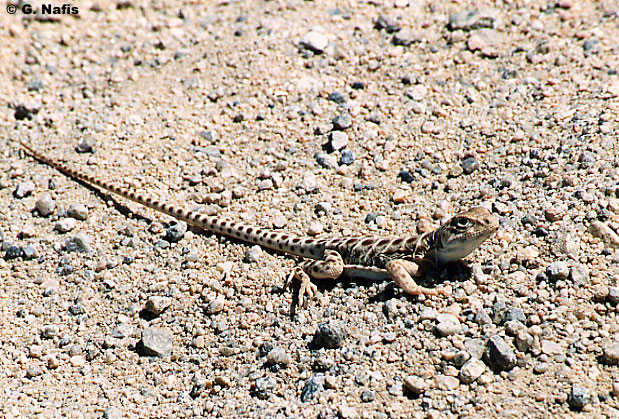
A large lizard with a broad triangular-shaped head, a truncated snout (compared to the Long-Nosed Leopard Lizard) a rounded body, well-developed limbs, granular scales, and a long rounded tail that is longer than the body.
Females develop reddish orange spots and bars on the sides and underneath the tail when gravid.
Males develop pink or rusty wash on the throat, chest, and sometimes the body, during the breeding season. |
| Color and Pattern |
Color is grayish to brown, with cream-colored cross-bands and large dark spots.
The ground color lightens considerably as the lizard's body temperature increases.
The underside is pale, with gray markings on the throat. |
| Young |
Juveniles have more highly contrasted markings than adults, often with rusty coloring on the back or bright red spots, and yellow on the thighs and under the tail.
|
| Life History and Behavior |
Activity |
Diurnal, emerging to bask in the morning.
|
| Diet and Feeding |
| Eats insects and other arthropods, and lizards. |
| Reproduction |
Breeds from May to June.
Eggs are laid in June and July, and hatch in July and August.
|
| Habitat |
Semiarid grasslands, alkali flats, and washes.
Prefers flat areas with open space for running, avoiding densely vegetated areas.
Uses large shrubs with dense canopy cover for refuge and thermoregulation.
Uses mammal dens and burrows for cover and shelter.
The number of available burrows will determine the size of this lizard's population in an area.
|
| Geographical Range |
Endemic to California.
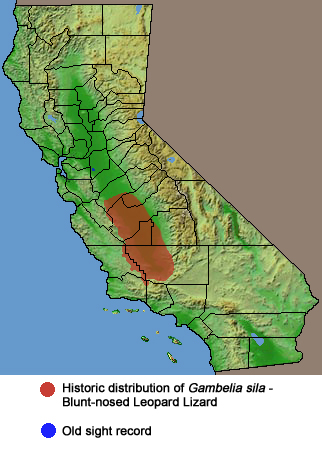
Inhabits the San Joaquin Valley and nearby valleys and foothills, from extreme northwest Santa Barbara County and western Kern County north to southern Merced County.
There is also a sight record from the eastern end of Corral Hollow in San Joaquin County from the late 1950s.
(Eric R. Pianka and Laurie J. Vitt. Lizards - Windows to the Evolution of Diversity. University of California Press, 2003. (Laurie Vitt, Page 6.)
|
 |
Approximate distribution of Gambelia - Leopard Lizards
Green: Gambelia sila - Blunt-nosed Leopard Lizard
Red: Gambelia wislizenii - Long-nosed Leopard Lizard
Dark Blue: Gambelia copei - Baja California Leopard Lizard
|
| Elevational Range |
From 100 - 2,400 ft. (30 - 730 m).
|
| Notes on Taxonomy |
There is evidence that at one time G. sila hybridized with G. wislizenii in the upper Cuyama drainage in Ventura Co, but there is no evidence that there is any current contact between the two species, or if they can hybridize now. Much of the hybrid zone habitat has been degraded, and it appears that these hybrids have been eliminated. (Stebbins 2003.)
------------------------------------------------------------------------------------------------------------------------------------------------------------------------------------------------------------------------------
"Richmond et al. (2017, Molecular Ecology 26: 3618–3635) corroborated the existence of two groups within this species found by Grimes et al. (2014, Southwestern Naturalist 59: 38–46) but did not infer restricted nuclear gene flow between those groups. They also presented genetic evidence corroborating previous hypotheses of hybridization with G. wislizenii (Montanucci, 1970, Copeia 1970: 104–123; 1978, Journal of Herpetology 12: 299–307). "
(Nicholson, K. E. (ed.). 2025 SSAR Scientific and Standard English Names List)
------------------------------------------------------------------------------------------------------------------------------------------------------------------------------------------------------------------------------
Alternate and Previous Names (Synonyms)
Gambelia silus - Blunt-nosed Leopard Lizard (Stebbins 1985)
Crotaphytus wislizenii silus - Blunt-nosed Leopard Lizard (Stebbins 1966)
Gambelia wislizenii silus - San Joaquin Leopard Lizard (Smith 1946)
Crotaphytus silus - San Joaquin Leopard Lizard (Crotaphytus wislizenii, part; Crotaphytus fasciatus, part; Short-nosed Leopard Lizard; Wislizenius' Lizard, part; Banded Lizard) (Grinnell and Camp 1917)
|
| Conservation Issues (Conservation Status) |
Endangered. No longer present throughout most of its former range as the habitat has been significantly altered by farming, urban development, overgrazing, oil wells, mining, reservoirs, and off-road vehicle use. This habitat alteration continues.
“Clearly this lizard’s ‘double-endangered’ status has been a direct result of essentially uncontrolled and unregulated land conversion.”
(Stebbins & McGinnis, 2012)
At the Pixley National Wildlife Refuge, managed cattle grazing has been used to reduce dense growths of non-native grasses, which improves the habitat for the Blunt-nosed Leopard Lizard and other threatened species.
------------------------------------------------------------------------------------------------------------------------------------------------------------------------------------------------------------------------------
In 2013 & 2014, Researchers from York University in Toronto used scat sniffing dogs to study the behavior of Blunt-nosed Leopard Lizards. The dogs located the scat which indicated where the lizards were hiding leading to the discovery that the lizards were using shrubs with dense canopy cover to hide under and to thermoregulate in the shade of the shrubs. The lizards also utilized rodent burrows which are most often found under the shrubs.
The researchers also discovered that invasive grasses hinder the lizards’ ability to move around easily, limit the variety of rodent species which also limits the number of burrows that can be used as refuges by the lizards, and cause diminished shrub growth due to competition with the grasses.
These findings show the importance of managing invasive plant species and maintaining the presence of shrubs in order to protect desert and semi-arid species such as the Blunt-nosed Leopard Lizard, and they point out the dangers of removing shrubs to develop land for uses such as the installation of solar panels.
UPI Science
|
|
|
Taxonomy |
| Family |
Crotaphytidae |
Collared and Leopard Lizards |
Smith & Brodie, 1982 |
| Genus |
Gambelia |
Leopard Lizards |
Baird 1859 “1858” |
Species
|
sila |
Blunt-nosed Leopard Lizard |
(Stejneger, 1890) |
|
Original Description |
Gambelia sila - (Stejneger, 1890) - N. Amer. Fauna, No. 3, p. 105
from Original Description Citations for the Reptiles and Amphibians of North America © Ellin Beltz
|
|
Meaning of the Scientific Name |
Gambelia - honors Gambel, William
sila - Latin - silus = snub nosed - refers to the blunt nose of species compared to Gambelia wislizenii
from Scientific and Common Names of the Reptiles and Amphibians of North America - Explained © Ellin Beltz
|
|
Related or Similar California Lizards |
Long-nosed Leopard Lizard - Gambelia wislizenii
Baja California (Cope's) Leopard Lizard - Gambelia copeii
|
|
More Information and References |
California Department of Fish and Wildlife
Hansen, Robert W. and Shedd, Jackson D. California Amphibians and Reptiles. (Princeton Field Guides.) Princeton University Press, 2025.
Stebbins, Robert C., and McGinnis, Samuel M. Field Guide to Amphibians and Reptiles of California: Revised Edition (California Natural History Guides) University of California Press, 2012.
Stebbins, Robert C. California Amphibians and Reptiles. The University of California Press, 1972.
Flaxington, William C. Amphibians and Reptiles of California: Field Observations, Distribution, and Natural History. Fieldnotes Press, Anaheim, California, 2021.
Nicholson, K. E. (ed.). 2025. Scientific and Standard English Names of Amphibians and Reptiles of North America North of Mexico, with Comments Regarding Confidence in Our Understanding. Ninth Edition. Society for the Study of Amphibians and Reptiles. [SSAR] 87pp.
Samuel M. McGinnis and Robert C. Stebbins. Peterson Field Guide to Western Reptiles & Amphibians. 4th Edition. Houghton Mifflin Harcourt Publishing Company, 2018.
Stebbins, Robert C. A Field Guide to Western Reptiles and Amphibians. 3rd Edition. Houghton Mifflin Company, 2003.
Behler, John L., and F. Wayne King. The Audubon Society Field Guide to North American Reptiles and Amphibians. Alfred A. Knopf, 1992.
Robert Powell, Roger Conant, and Joseph T. Collins. Peterson Field Guide to Reptiles and Amphibians of Eastern and Central North America. Fourth Edition. Houghton Mifflin Harcourt, 2016.
Powell, Robert., Joseph T. Collins, and Errol D. Hooper Jr. A Key to Amphibians and Reptiles of the Continental United States and Canada. The University Press of Kansas, 1998.
Bartlett, R. D. & Patricia P. Bartlett. Guide and Reference to the Turtles and Lizards of Western North America (North of Mexico) and Hawaii. University Press of Florida, 2009.
Jones, Lawrence, Rob Lovich, editors. Lizards of the American Southwest: A Photographic Field Guide. Rio Nuevo Publishers, 2009.
Smith, Hobart M. Handbook of Lizards, Lizards of the United States and of Canada. Cornell University Press, 1946.
Taylor, Emily. California Lizards and How to Find Them. Heyday, Berkeley, California. 2025.
Joseph Grinnell and Charles Lewis Camp. A Distributional List of the Amphibians and Reptiles of California. University of California Publications in Zoology Vol. 17, No. 10, pp. 127-208. July 11, 1917.
|
|
|
The following conservation status listings for this animal are taken from the July 2025 State of California Special Animals List and the July 2025 Federally Listed Endangered and Threatened Animals of California list (unless indicated otherwise below.) Both lists are produced by multiple agencies every year, and sometimes more than once per year, so the conservation status listing information found below might not be from the most recent lists, but they don't change a great deal from year to year.. To make sure you are seeing the most recent listings, go to this California Department of Fish and Wildlife web page where you can search for and download both lists:
https://www.wildlife.ca.gov/Data/CNDDB/Plants-and-Animals.
A detailed explanation of the meaning of the status listing symbols can be found at the beginning of the two lists. For quick reference, I have included them on my Special Status Information page.
If no status is listed here, the animal is not included on either list. This most likely indicates that there are no serious conservation concerns for the animal. To find out more about an animal's status you can also go to the NatureServe and IUCN websites to check their rankings.
Check the current California Department of Fish and Wildlife sport fishing regulations to find out if this animal can be legally pursued and handled or collected with possession of a current fishing license. You can also look at the summary of the sport fishing regulations as they apply only to reptiles and amphibians that has been made for this website.
July 2023 Federally Listed Endangered and Threatened Animals list note:
Synonymous with Gambelia silus. Originally listed under the ESA as Crotaphytus wislizenii silus.
|
| Organization |
Status Listing |
Notes |
| NatureServe Global Ranking |
G1 |
Critically Imperiled |
| NatureServe State Ranking |
S2 |
Imperiled
|
| U.S. Endangered Species Act (ESA) |
FE |
Listed as Endangered 3/11/67 |
| California Endangered Species Act (CESA) |
SE |
Listed as Endangered 6/27/71 |
| California Department of Fish and Wildlife |
FP |
Fully Protected |
| Bureau of Land Management |
None |
|
| USDA Forest Service |
None |
|
| IUCN |
EN |
Endangered |
|
|