Range in California: Green
Red: Desert Rosy Boa
|
 |
 |
 |
Adult, San Diego County |
 |
|
|
|
Adult, San Diego County. © Gary Nafis Specimen courtesy of Tim Burkhardt |
|
|
|
Unstriped "unicolor" Adult, San Diego County. © Gary Nafis Specimen courtesy of Tim Burkhardt |
Unstriped "unicolor" Adult, San Diego County. © Gary Nafis Specimen courtesy of Jim Melli |
 |
 |
 |
Juvenile, San Gabriel Mountains, Los Angeles County © Ross Padilla |
Intergrade with L. t. gracia from San Gorgonio Pass, Riverside County |
|
|
|
|
|
|
|
 |
|
|
|
Habitat, Riverside County |
|
|
 |
Habitat, San Diego County
|
Habitat, San Diego County
|
Habitat, Riverside County |
 |
|
|
| Habitat, San Gabriel Mountains, Los Angeles County © Ross P. |
|
|
|
Description |
Nonvenomous |
| Considered harmless to humans. |
| Size |
| Adults 17 - 44 inches long (43 - 112 cm) but generally under 36 inches. The largest Rosy Boa subspecies. Hatchlings are 10 - 14 inches long. |
| Appearance |
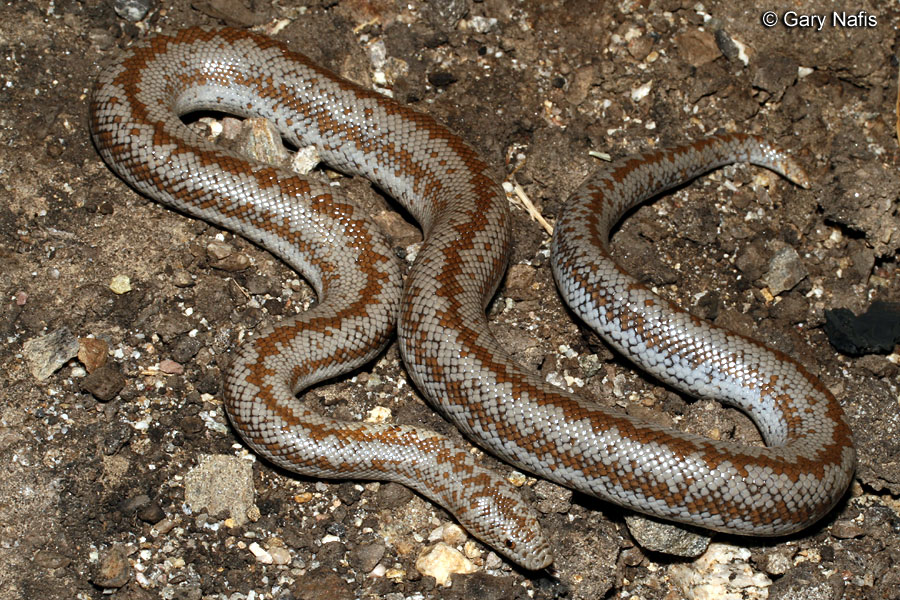
A heavy-bodied snake with smooth shiny scales and a blunt, but tapered tail. The head is only a little wider than the neck. Pupils are vertical.
There are three poorly-defined irregular dark stripes, brown, reddish-brown, orange or rust in color, running lengthwise on the back and sides with a gray, olive-gray, bluish-gray or brownish ground color inbetween. Flecks of the stripe color are usually present in the ground color (unlike the Coastal Rosy Boa, where the stripes are more well-defined. Snakes with more contrasting even-edged stripes are associated with drier habitats.) The belly is predominantly dark - often bluish to bluish-gray with dark flecks. A "unicolor" phase without dark stripes is found in southern San Diego County and Baja California.
Males have small spurs on each side of the vent which are vestigial hind limbs.
Rosy boas of all subspecies have been common pet snakes for many years. Breeders have produced new color morphs and, in order to promote regional variations in appearance, they have also designated sometimes confusing locality-specific names such as Verbenia, Corn Springs, Whitewater, Pioneertown, Long Canyon, Mojave, San Gabriel, Lake Elsinore, Hemet, Unicolor, Anza-Borrego, Harquahala, Bagdad, Baja Cape, San Felipe, Catavina, and Bay of LA, among others. |
| Behavior |
Primarily active at dawn, dusk, and at night, rarely in daylight, but may be active in the morning, especially in cool weather. In the hottest and coldest months of the year, remains inactive in burrows or under surface debris. A good climber.
Sometimes rolls the body into a ball and hides the head when alarmed. |
| Diet |
| Eats rodents, small birds, lizards, small snakes, and amphibians. Kills prey by constriction. |
| Reproduction |
| Live-bearing; young are born October - November. |
| Range |
| Occurs in southwestern California to the coastal slopes of the San Gabriel and San Bernardino mountains, and across the peninsular ranges into the desert in San Diego County. Snakes in the eastern San Gorgonio pass and Palm Springs area are considered integrades. |
| Habitat |
| Inhabits arid scrublands, semi-arid shrublands, rocky shrublands, rocky deserts, canyons, and other rocky areas. Appears to be common in riparian areas, but does not require permanent water. |
| Taxonomic Notes |
Rosy boa taxonomy can be confusing. The generic name Lichanura has been challenged, with some taxonomists placing the snake in the genus Charina, along with the Rubber Boas. The three traditional subspecies, gracia, roseofusca, and trivirgata, have also been challenged, with gracia and roseofusca placed into the subspecies myriolepis, and the Arizona populations into arizonense.
Since most Rosy Boas do not have the rosy ventral coloring which gives the snake its name, Robert Stebbins (Stebbins, 2003) has suggested using the common name Three Lined Boa, which was given the snake by the original describer (E. D. Cope, 1861.)
Wood, Fisher and Reeder [Novel patterns of historical isolation, dispersal, and secondary contact across Baja California in the Rosy Boa (Lichanura trivirgata). Molecular Phylogenetics and Evolution 46 (2008) 484–502. December 2007]
found discrepencies between mtDNA and currently recognized subspecies of Lichanura trivirgata
leading them to
recognize two evolutionary species - Lichanura orcutti, and Lichanura trivirgata.
L. orcutti occurs north of the US-Mexico border within San Diego County along the coastal Peninsular Ranges, northward into the Mojave Desert and eastward in the Sonoran Desert of California and Arizona north of the Gila River and in the Gila Mountains.
This species consists of L. t. roseofusca (excluding extreme southern San Diego County boas) and L. t. gracia, including the "Arizona Rosy Boa" phase.
L. trivirgata occurs in extreme southern San Diego County within the Tijuana River and Otay watersheds, southward throughout the Baja California peninsula, and northwestern Mexico in the state of Sonora and in isolated mountain ranges south of the Gila River in Maricopa, Pima, and Pinal Counties in Arizona.
This species consists of the extreme southern San Diego County Lichanura (including the "Unicolor" boas), the Mid-Baja " L. t. saslowi" boas, and the Mexican Rosy Boa - L. t. trivirgata. |
| Conservation Issues (Conservation Status) |
| Listed as a sensitive species by the USFS and the BLM. |
|
|
Taxonomy |
| Family |
Boidae |
Boas and Pythons |
| Genus |
Lichanura |
Rosy Boas |
| Species |
trivirgata |
Rosy Boa |
Subspecies
|
roseofusca |
Coastal Rosy Boa |
|
Original Description |
Charina trivirgata Cope, 1861 - Proc. Acad. Nat. Sci. Philadelphia, Vol. 13, p. 304
Charina trivirgata roseofusca - Cope, 1868 - Proc. Acad. Nat. Sci. Philadelphia, Vol. 20, p. 2
from Original Description Citations for the Reptiles and Amphibians of North America © Ellin Beltz
|
|
Meaning of the Scientific Name |
Lichanura - Greek - lichanos - forefinger, and oura tail - possibly refers to the body form or the stumpy tail
trivergata - Latin - tri - three, and virgata - striped - refers to the color pattern
roseofusca - Latin - roseus - ruddy, and fusca - dusky
from Scientific and Common Names of the Reptiles and Amphibians of North America - Explained © Ellin Beltz
|
|
Alternate Names |
Charina trivirgata roseofusca
|
|
Related or Similar California Snakes |
L. t. gracia - Desert Rosy Boa
C. bottae - Northern Rubber Boa
C. umbratica - Southern Rubber Boa
|
|
More Information and References |
Natureserve Explorer
California Dept. of Fish and Game
Wood, Dustin A., Robert N. Fisher, and Tod W. Reeder. Novel patterns of historical isolation, dispersal, and secondary contact across Baja California in the Rosy Boa (Lichanura trivirgata). Molecular Phylogenetics and Evolution 46 (2008) 484–502. December 2007. (Available online at www.sciencedirect.com).
Stebbins, Robert C. A Field Guide to Western Reptiles and Amphibians. 3rd Edition. Houghton Mifflin Company, 2003.
Behler, John L., & F. Wayne King. The Audubon Society Field Guide to North American Reptiles and Amphibians. Alfred A. Knopf, 1992.
Bartlett, R.D. , & Alan Tennant. Snakes of North America - Western Region. Gulf Publishing Co., 2000.
Ernst, Carl H., Evelyn M. Ernst, & Robert M. Corker. Snakes of the United States and Canada. Smithsonian Institution Press, 2003.
Wright, Albert Hazen & Anna Allen Wright. Handbook of Snakes of the United States and Canada. Cornell University Press.
Brown, Philip R. A Field Guide to Snakes of California. Gulf Publishing Co., 1997.
|
|
|
The following status listings come from the Special Animals List which is published several times each year by the California Department of Fish and Game.
This snakes is listed as Charina trivirgata and is not listed separatedly by subspecies.
|
Organization
|
Status Listing
|
| U.S. Endangered Species Act (ESA) |
None |
|
| California Endangered Species Act (CESA) |
None |
|
| California Department of Fish and Game |
None |
|
| Bureau of Land Management |
BLM:S |
Sensitive |
| USDA Forest Service |
USFS:S |
Sensitive |
| Natureserve Global Conservation Status Ranks |
G4 |
Apparently Secure |
World Conservation Union - IUCN Red List
|
None |
|
|
|