California Reptiles & Amphibians

Diadophis punctatus occidentalis - Northwestern Ring-necked Snake


Click on a picture for a larger view


Range in California: Orange

Click the map for a guide
to the other subspecies


Adult, Humboldt County
Adult, Napa County
Adult, Shasta county (from the intergrade zone with D. p. occidentalis.)
 
Adult, 1800 ft, Del Norte County © Alan Barron
 
Habitat, Napa County


Habitat, Humboldt County
Description

Mildly Venomous
Not considered dangerous to humans. Enlarged non-grooved teeth in the rear of the upper jaw and mild venom which may help to incapacitate small prey.
Size
8 - 34 inches long (20 - 87cm.) Snakes of this subspecies are adult at around 11 - 18 inches (28 -46 cm.)
Appearance
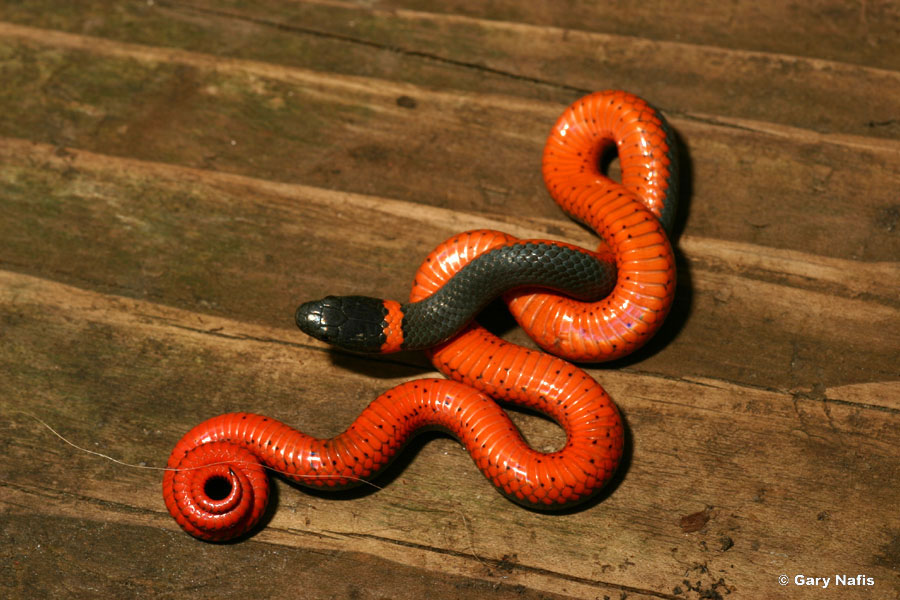
A small, thin snake with smooth scales. Gray, blue-gray, blackish, or dark olive dorsal coloring, with a bright orange to reddish underside, lightly speckled with black markings, heavily speckled under the chin. The underside of the tail is a bright reddish orange. A narrow orange band around the neck, 1.5 - 3 scale rows wide.
Behavior
Secretive - usually found under the cover of rocks, wood, bark, boards and other surface debris, but occasionally seen moving on the surface on cloudy days, at dusk, or at night.

When disturbed, coils its tail like a corkscrew, exposing the underside which is usually bright red. It may also smear musk and cloacal contents.
Diet
Eats slender salamanders and other small salamanders, tadpoles, small frogs, small snakes, lizards, worms, slugs, and insects. The mild venom may help to incapacitate prey.
Reproduction
Lays eggs in the summer, sometimes in a communal nest.
Range
Found along the northern California coast from Sonoma County to the Oregon border, and inland through the coast ranges. Ranges north through Oregon into southern Washington, with isoloated populations in Idaho.
Habitat
Prefers moist habitats, including wet meadows, rocky hillsides, gardens, farmland, grassland, chaparral, coniferous forests, mixed woodlands.
Taxonomic Notes
Many herpetologists no longer recognize the traditional morphologically-based subspecies of Diadophis punctatus, pending a thorough molecular study of the whole species. One ongoing study (Feldman and Spicer, 2006, Mol. Ecol. 15:2201-2222) has found all of the D. punctatus subspecies in California (except D. p. regalis) to be indistinguishable. It is likely that D. punctatus is composed of several distinct lineages that do not follow the geographic ranges of the subspecies.


In a phylogeographic analysis of the species, Fontanella, et. al identified fourteen lineages of Diadophis punctatus. They did not recognize these lineages as separate species, pending a full taxonomic review that will require further dna sampling and evaluation, including populations in Mexico.

In our area, they recognized four distinct lineages, which loosely follow existing subspecies boundaries, but merge the seven subspecies into 4 groups:

* A southern California lineage, which includes the San Diego and San Bernardino subspecies, D. p. similis, and D. p. modestus

* An eastern California lineage, which includes the Coral-bellied subspecies, D. p. pulchellus, and some of the northern intergrades with D. p. occidentalis.

* A Coastal California lineage, which includes the Monterey subspecies, D. p. vandenburghi, the Pacific subspcies, D. p. amabilis, the Northwestern subspecies, D. p. occidentalis, and snakes from one region of the western Sierra Nevada currently recognized as D. p. pulchellus, along with the southern intergrades in the Tehachapi mountains region.

* A Great Basin lineage which presumably includes the Regal subspecies, D. p. regalis, found in isolated locations in the eastern Mojave.

A rough interpretation of the ranges of these four lineages is illustrated in the map below.

Green: Southern lineage
Orange: Eastern lineage
Blue: Coastal lineage      
           Light Blue: Great Basin lineage


Conservation Issues  (Conservation Status)
None.

Taxonomy
Family Colubridae Colubrids
Genus Diadophis Ring-necked Snakes
Species punctatus Ring-necked Snake
Subspecies


occidentalis Northwestern Ring-necked Snake
Original Description
Diadophis punctatus - (Linnaeus, 1766) - Syst. Nat., 12th ed., Vol. 1, p. 376
Diadophis punctatus occidentalis - Blanchard, 1923 - Occ. Papers Mus. Zool. Univ. Michigan, No. 142, p. 6

from Original Description Citations for the Reptiles and Amphibians of North America © Ellin Beltz

Meaning of the Scientific Name
Diadophis - Latin - diadema - crown and Greek -ophis - snake -- "generally w/a light ring on the occipital region."
punctatus
- Latin - dotted - refers to spotted belly of species
occidentalis - Latin - western - probably refers to distribution

from Scientific and Common Names of the Reptiles and Amphibians of North America - Explained © Ellin Beltz

Alternate Names
Diadophis punctatus - Ring-necked Snake (no subspecies recognized)

Related or Similar California Snakes
D. p. amabilis - Pacific Ring-necked Snake
D. p. modestus - San Bernardino Ring-necked Snake
D. p. pulchellus - Coral-bellied Ring-necked Snake
D. p. regalis - Regal Ring-necked Snake
D. p. similis - San Diego Ring-necked Snake
D. p. vandenburgii - Monterey Ring-necked Snake
C. tenuis - Sharp-tailed Snake

More Information and References
Natureserve Explorer

California Dept. of Fish and Game

Stebbins, Robert C. A Field Guide to Western Reptiles and Amphibians. 3rd Edition. Houghton Mifflin Company, 2003.

Behler, John L., & F. Wayne King. The Audubon Society Field Guide to North American Reptiles and Amphibians. Alfred A. Knopf, 1992.

Bartlett, R.D. , & Alan Tennant. Snakes of North America - Western Region. Gulf Publishing Co., 2000.

Ernst, Carl H., Evelyn M. Ernst, & Robert M. Corker. Snakes of the United States and Canada. Smithsonian Institution Press, 2003.

Wright, Albert Hazen & Anna Allen Wright. Handbook of Snakes of the United States and Canada. Cornell University Press.

Brown, Philip R. A Field Guide to Snakes of California. Gulf Publishing Co., 1997.

Brown et. al. Reptiles of Washington and Oregon. Seattle Audubon Society,1995.

Nussbaum, R. A., E. D. Brodie Jr., and R. M. Storm. Amphibians and Reptiles of the Pacific Northwest. Moscow, Idaho: University Press of Idaho, 1983.

St. John, Alan D. Reptiles of the Northwest: Alaska to California; Rockies to the Coast. Lone Pine Publishing, 2002.

Fontanella , Frank M., Chris R. Feldman, Mark E. Siddall, & Frank T. Burbrink. Phylogeography of Diadophis punctatus: Extensive lineage diversity and repeated patterns of historical demography in a trans-continental snake. Molecular Phylogenetics and Evolution 46 (2008) 1049–1070. 2008.

Conservation Status

The following status listings come from the Special Animals List which is published several times each year by the California Department of Fish and Game.

This snake is not included on the Special Animals List, which indicates that there are no significant conservation concerns for it in California.
Organization
Status Listing
U.S. Endangered Species Act (ESA)
California Endangered Species Act (CESA)
California Department of Fish and Game
Bureau of Land Management
USDA Forest Service
Natureserve Global Conservation Status Ranks
World Conservation Union - IUCN Red List


Home | Lists | Maps | Photo Indexes | Sounds | Identification | More Info | Beyond CA | About Us | Usage | Taxonomy | New Stuff | Thanks | Disclaimers | Contact

Return to the Top                     © 2000 - 2008