|
 |
 |
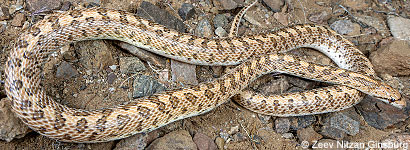
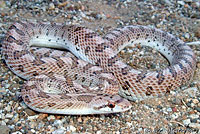
| Adult, San Bernardino/Inyo County line © Zeev Nitzan Ginsburg |
 |
 |
|
| Adult, Kern County |
Adult, Kern County
© John Stephenson |
Adult, Los Angeles County
© Jeremiah Easter |
 |
 |
 |
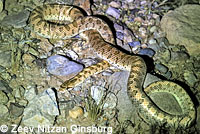
Adult, San Bernardino County
© Zeev Nitzan Ginsburg
|
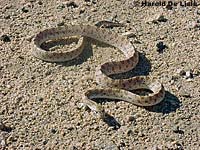
Adult, San Bernardino County © Harold De Lisle |
 |
|
|
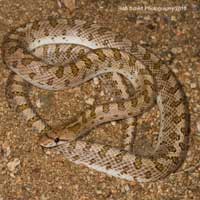
| Adult, Inyo County © Rob Schell |
|
|
| |
|
|
| Juveniles |
 |
 |
|
| Juvenile, Inyo County © Chris Morrison |
|
| |
|
|
| Habitat |
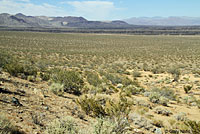 |
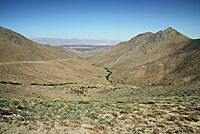 |
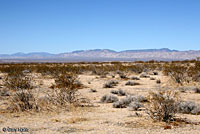 |
| Habitat, Inyo County desert |
Habitat, Inyo County desert |
Habitat, desert flats, Kern County |
|
|
|
| Description |
Not Dangerous - This snake does not have venom that can cause death or serious illness or injury in most humans.
Commonly described as "harmless" or "not poisonous" to indicate that its bite is not dangerous, but "not venomous" is more accurate. (A poisonous snake can hurt you if you eat it. A venomous snake can hurt you if it bites you.)
|
| Size |
Adults are 26-70 inches in length (66-178 cm). (Stebbins, 2003) Average length is 3 - 4 feet.
|
| Appearance |
A medium-sized muscular snake with smooth, glossy scales, a faded or bleached-out appearance, and a short tail.
Rostral scale (on the nose) is enlarged for digging (but not as much so as that of a patch-nosed snake or a leaf-nosed snake.)
Pupils are rounded. |
| Color and Pattern |
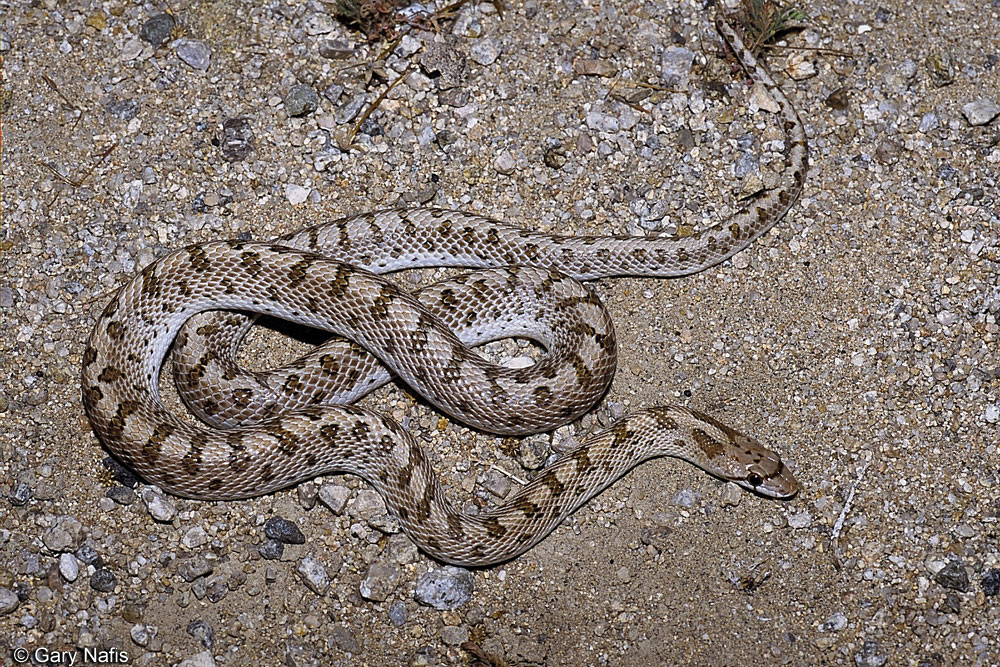
Smooth, glossy scales with a faded or bleached-out appearance - a light brown, gray, cream, or pink ground color with tan brown or gray blotches on back and sides with black edges and a pale, unmarked underside.
Dark line behind each eye and a dark line (a "unibrow") between the eyes.
An average of 63 narrow blotches on body. |
| Similar Snakes |
Comparison of the 3 subspecies of Arizona elegans in California,
along with sympatric species similar in appearance:
Pituophis catenifer - Gopher Snake,
Trimorphodon biscutatus - Lyre Snake,
Hypsiglena - Night Snakes,
Coluber constrictor mormon - Western Yellow-Bellied Racer (juvenile).
|
| Life History and Behavior |
| Activity |
Nocturnal.
Hides underground in daytime under rocks, in exsisting burrows, or uses its specialized nose to make its own burrow. |
| Diet and Feeding |
Preys mostly on sleeping diurnal lizards, but also eats small snakes, terrestrial birds, and nocturnally-active mammals.
Hunts active mammals at night by waiting in ambush.
Kills prey by direct swallowing or constriction. |
| Reproduction |
Females are oviparous - laying from 3 - 23 eggs (more often 5-12) in June and July. (Stebbins, 2003)
Eggs most likely hatch in late summer and early fall.
|
| Habitat |
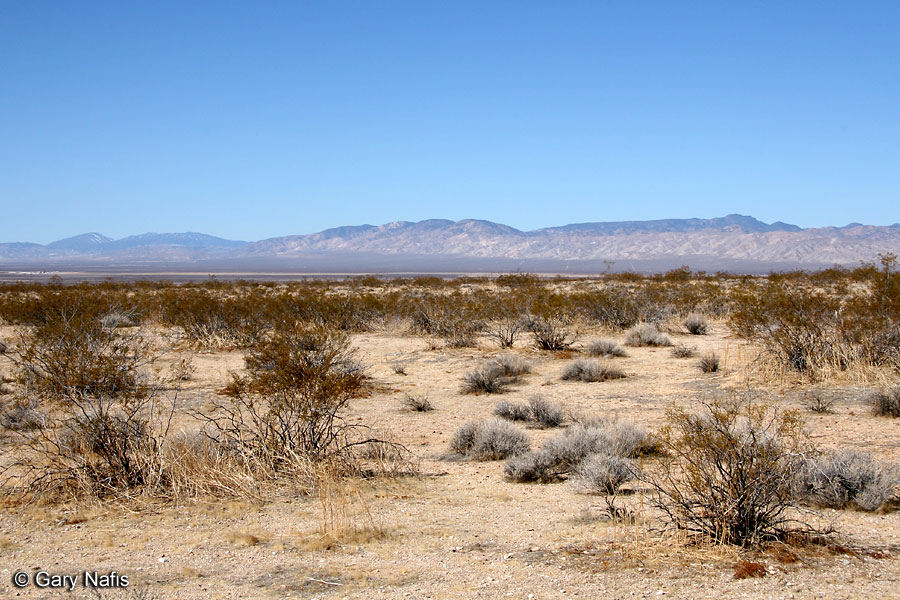
Inhabits barren open sandy desert, desert scrub, rocky washes, grasslands.
Appears to prefer microhabitats of open areas and areas with soil loose enough for easy burrowing.
|
| Geographical Range |
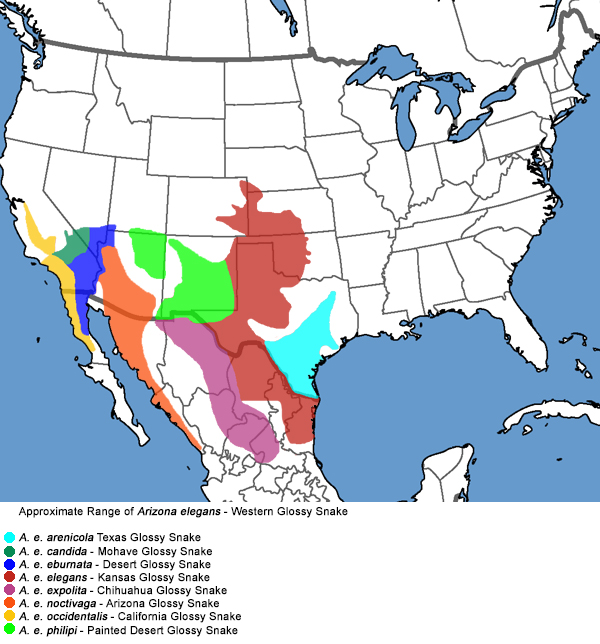
This subspecies, Arizona elegans candida - Mojave Glossy Snake, occurs from Inyo County south through much of the Owens Valley and most of the Mojave Desert, and east into southwestern Nevada.
The species Arizona elegans - Western Glossy Snake, has a very wide range, occurring through most of the southwest, and the southeastern part of the Midwest, and south into Mexico, including northern Baja California.
|
 |
| Elevational Range |
The species is found from below sea level to around 7,218 ft. (2,200 m). (Stebbins, 2003)
|
| Notes on Taxonomy |
'The spelling of the word "Mojave" or "Mohave" has been a subject of debate. Lowe in the preface to his "Venomous Reptiles of Arizona" (1986) argued for "Mohave" as did Campbell and Lamar (2004, "The Venomous Reptiles of the Western Hemisphere"). According to linguistics experts on Native American languages, either spelling is correct, but using either the "j" or "h" is based on whether the word is used in a Spanish or English context. Given that this is an English names list, we use the "h" spelling (P. Munro, Linguistics, UCLA, pers. comm.).'
(Taxon Notes to Crotalus scutulatus, SSAR Herpetological Circular no 39, published August 2012, John J. Moriarty, Editor.)
---------------------------------------------------------------------------------------------------------------------------------------------------------------------
Collins elevated the western Glossy Snakes - A. e. occidentalis, A. e. eburnata, and A. e. candida - to specific status (Arizona occidentalis) (1991, Herp. Review 22:42-43) with the eastern Glossy Snakes remaining Arizona elegans, but this change has not been widely accepted.
---------------------------------------------------------------------------------------------------------------------------------------------------------------------
"Using genetic data, Myers et al. (2017, Journal of Biogeography 44: 461–474; Myers et al., 2019, Molecular Ecology 28: 4535-4548) and Dahn et al. (2018, Molecular Phylogenetics and Evolution 129: 214–225) confirmed that the eastern and western populations were distinct as predicted by Collins (1991, Herpetological Review 22: 42–43). However, neither study recommended taxonomic changes."
(Nicholson, K. E. (ed.). 2025 SSAR Scientific and Standard English Names List)
---------------------------------------------------------------------------------------------------------------------------------------------------------------------
2025 Revision of Glossy Snake Taxonomy
All California Glossy Snakes become Arizona occidentalis.
Using DNA sequencing on the glossy snakes (genus Arizona), Dustin A. Wood, et al, 2025, concluded that the genus consists of three species instead of the formerly recognized two species - Arizona elegans and Arizona pacata. All three California subspecies, A. e. candida, A. e. eburnata, and A. e. occidentalis are synonymized into a new species, Arizona occidentalis, along with the subspecies A. e. noctivaga found in Arizona and Mexico. They did not give a common name to Arizona occidentalis, but since it uses "occidentalis" which was the California Glossy Snake subspecies, California Glossy Snake will probably become the common name for the new species.
No subspecies of Arizona occidentalis were described, but they found four evolutionary groups in California - San Joaquin, Mojave, coast-desert slope, and Sonoran, that conform to separate biomes within the state. The former subspecies A. e. occidentalis is divided into the coast-desert slope and Sonoran groups in southern California, and the San Joaquin group in central California.
The remaining eastern subspecies of Arizona elegans, A. e. arenicola, A. e. elegans, A. e. expolita, and A. e. phillipi remain in the species Arizona elegans. No subspecies have yet been described.
Arizona pacata, which occurs only in Baja California, remains unchanged.
(Desert ecosystems shape diversification in glossy snakes (genus Arizona) requiring a re-alignment of evolutionary and conservation units. Dustin A. Wood, Jonathan Q. Richmond, Michael F. Westphal, Bradford D. Hollingsworth, Robert N. Fisher, and Amy G. Vandergasta. Molecular Phylogenetics and Evolution 213 (2025) 108441)
---------------------------------------------------------------------------------------------------------------------------------------------------------------------
Alternate and Previous Names (Synonyms)
Arizona occidentalis - (D. A. Wood, et al. 2025)
Arizona elegans - Common Glossy Snake (Nicholson, K. E. (ed.). 2025 SSAR Scientific and Standard English Names List)
Arizona elegans candida - Mojave Glossy Snake (Stebbins 1966, 1985, 2003, 2012)
Arizona elegans candida - Western Mojave Glossy Snake (Wright & Wright 1957)
Arizona elegans candida (SDNHS 1946)
Arizona elegans - Faded Snake (Rhinechis elegans; Coluber arizonae. Smooth-scaled Coluber) (Grinnell and Camp 1917)
Arizona elegans (Kennicott, 1859)
|
| Conservation Issues (Conservation Status) |
| None. |
|
| Taxonomy |
| Family |
Colubridae |
Colubrids |
Oppel, 1811 |
| Genus |
Arizona |
Glossy Snakes |
Kennicott, 1859 |
| Species |
elegans |
Glossy Snake |
Kennicott, 1859 |
Subspecies
|
candida |
Mojave Glossy Snake |
Klauber, 1946 |
|
Original Description |
Arizona elegans - Kennicott, 1859 - in Baird, U.S. Mex.
Arizona elegans candida - 1946 - Trans. San Diego Soc. Nat. Hist., Vol. 10, p. 364, pl. 8, fig. 2, text fig. 1, map
from Original Description Citations for the Reptiles and Amphibians of North America © Ellin Beltz
|
|
Meaning of the Scientific Name |
Arizona - 1.) Latin - areo = to be dry + zona = belt of earth - refers to the geographical distribution
2.) Native American Indian word - arizonac = place of springs, refers to the Arizona region
elegans - Latin = fine or elegant - refers to the color pattern
candida - Latin = shining white or bright - "subspecies characterised by its light color..."
|
|
Related or Similar California Snakes |
A. e. eburnata - Desert Glossy Snake
A. e. occidentalis - California Glossy Snake
P. decurtatus - Spotted Leaf-nosed Snake
P. c. deserticola - Great Basin Gophersnake
|
|
More Information and References |
California Department of Fish and Wildlife
Hansen, Robert W. and Shedd, Jackson D. California Amphibians and Reptiles. (Princeton Field Guides.) Princeton University Press, 2025.
Stebbins, Robert C., and McGinnis, Samuel M. Field Guide to Amphibians and Reptiles of California: Revised Edition (California Natural History Guides) University of California Press, 2012.
Stebbins, Robert C. California Amphibians and Reptiles. The University of California Press, 1972.
Flaxington, William C. Amphibians and Reptiles of California: Field Observations, Distribution, and Natural History. Fieldnotes Press, Anaheim, California, 2021.
Nicholson, K. E. (ed.). 2025. Scientific and Standard English Names of Amphibians and Reptiles of North America North of Mexico, with Comments Regarding Confidence in Our Understanding. Ninth Edition. Society for the Study of Amphibians and Reptiles. [SSAR] 87pp.
Samuel M. McGinnis and Robert C. Stebbins. Peterson Field Guide to Western Reptiles & Amphibians. 4th Edition. Houghton Mifflin Harcourt Publishing Company, 2018.
Stebbins, Robert C. A Field Guide to Western Reptiles and Amphibians. 3rd Edition. Houghton Mifflin Company, 2003.
Behler, John L., and F. Wayne King. The Audubon Society Field Guide to North American Reptiles and Amphibians. Alfred A. Knopf, 1992.
Robert Powell, Roger Conant, and Joseph T. Collins. Peterson Field Guide to Reptiles and Amphibians of Eastern and Central North America. Fourth Edition. Houghton Mifflin Harcourt, 2016.
Powell, Robert., Joseph T. Collins, and Errol D. Hooper Jr. A Key to Amphibians and Reptiles of the Continental United States and Canada. The University Press of Kansas, 1998.
Bartlett, R. D. & Patricia P. Bartlett. Guide and Reference to the Snakes of Western North America (North of Mexico) and Hawaii. University Press of Florida, 2009.
Bartlett, R. D. & Alan Tennant. Snakes of North America - Western Region. Gulf Publishing Co., 2000.
Brown, Philip R. A Field Guide to Snakes of California. Gulf Publishing Co., 1997.
Ernst, Carl H., Evelyn M. Ernst, & Robert M. Corker. Snakes of the United States and Canada. Smithsonian Institution Press, 2003.
Taylor, Emily. California Snakes and How to Find Them. Heyday, Berkeley, California. 2024.
Wright, Albert Hazen & Anna Allen Wright. Handbook of Snakes of the United States and Canada. Cornell University Press, 1957.
Joseph Grinnell and Charles Lewis Camp. A Distributional List of the Amphibians and Reptiles of California. University of California Publications in Zoology Vol. 17, No. 10, pp. 127-208. July 11, 1917.
|
|
|
The following conservation status listings for this animal are taken from the July 2025 State of California Special Animals List and the July 2025 Federally Listed Endangered and Threatened Animals of California list (unless indicated otherwise below.) Both lists are produced by multiple agencies every year, and sometimes more than once per year, so the conservation status listing information found below might not be from the most recent lists, but they don't change a great deal from year to year.. To make sure you are seeing the most recent listings, go to this California Department of Fish and Wildlife web page where you can search for and download both lists:
https://www.wildlife.ca.gov/Data/CNDDB/Plants-and-Animals.
A detailed explanation of the meaning of the status listing symbols can be found at the beginning of the two lists. For quick reference, I have included them on my Special Status Information page.
If no status is listed here, the animal is not included on either list. This most likely indicates that there are no serious conservation concerns for the animal. To find out more about an animal's status you can also go to the NatureServe and IUCN websites to check their rankings.
Check the current California Department of Fish and Wildlife sport fishing regulations to find out if this animal can be legally pursued and handled or collected with possession of a current fishing license. You can also look at the summary of the sport fishing regulations as they apply only to reptiles and amphibians that has been made for this website.
This snake is not included on the Special Animals List, which indicates that there are no significant conservation concerns for it in California.
|
| Organization |
Status Listing |
Notes |
| NatureServe Global Ranking |
|
|
| NatureServe State Ranking |
|
|
| U.S. Endangered Species Act (ESA) |
None |
|
| California Endangered Species Act (CESA) |
None |
|
| California Department of Fish and Wildlife |
None |
|
| Bureau of Land Management |
None |
|
| USDA Forest Service |
None |
|
| IUCN |
|
|
|
|

 Purple: Range of this subspecies in California