|
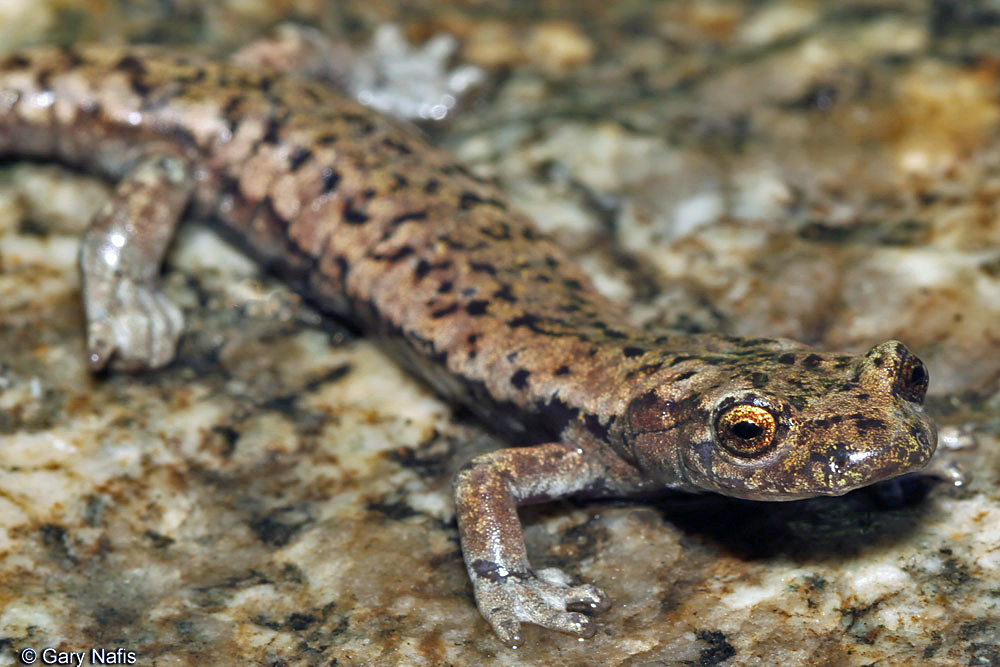
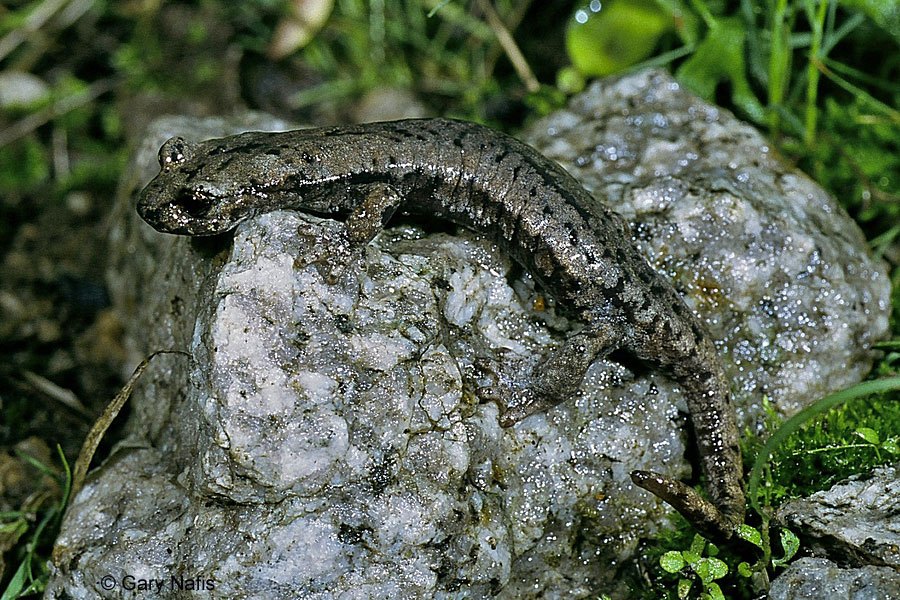
The Mount Lyell salamanders shown on this page are divided into two separate
geographically-separated populations, which are currently all recognized as the
same species:
Owens Valley population
Sierra Nevada Mountains population
|
Mount Lyell Salamander - Hydromantes platycephalus
Sierra Nevada Mountains Population
|
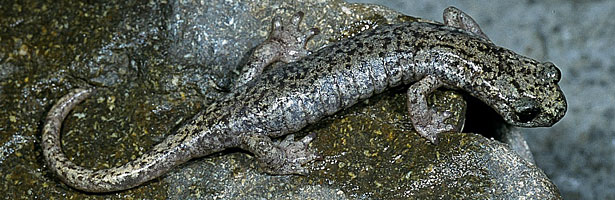 |
| Adult, Tuolumne County |
 |
 |
 |
| Adult, Tuolumne County |
Adult, Tuolumne County |
 |
 |
 |
| Adult, Tuolumne County |
Adult, Tuolumne County |
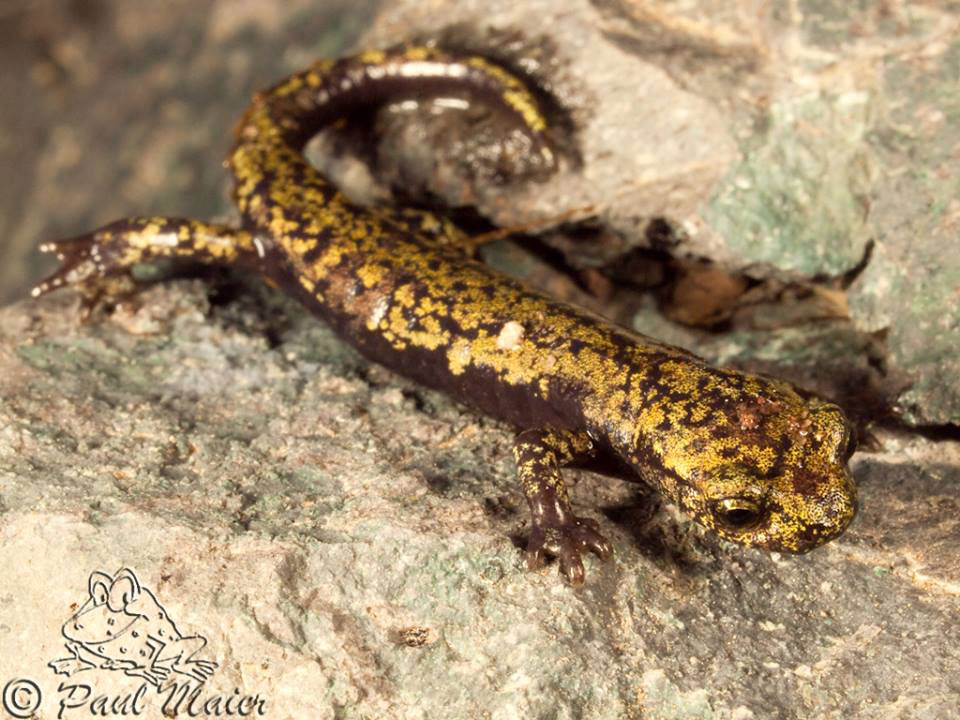
Adult, Tuolumne County
© Paul Maier |
 |
 |
 |
| Adult, El Dorado County |
Sub-adult, El Dorado County |
Underside of adult, El Dorado County |
 |
 |
 |
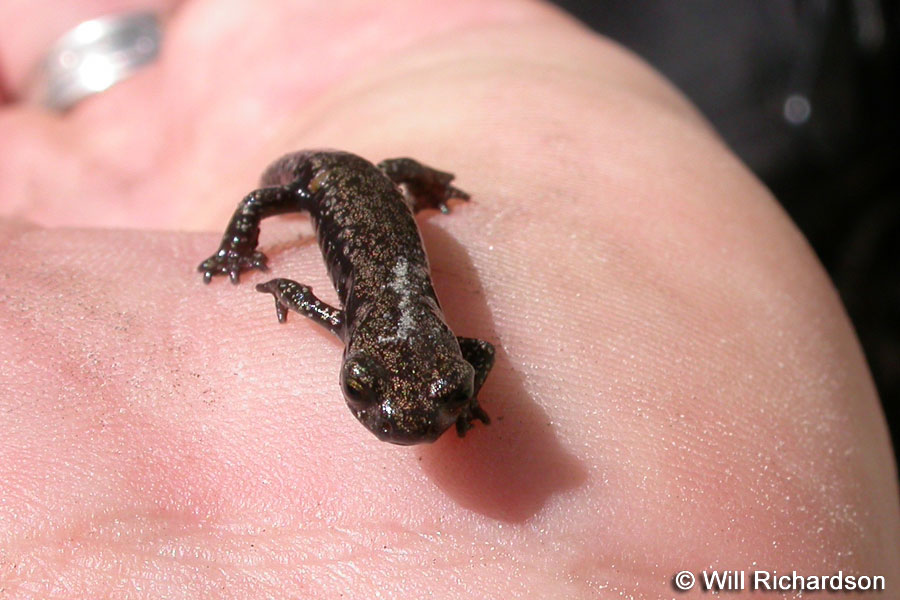
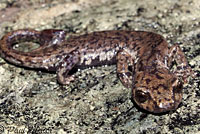
| Adult, Placer County © Will Richardson |
Adult, Fresno County © Paul Maier |
 |
 |
 |
Adult, 8,200 ft. Placer County.
© Steve Zimmerman |
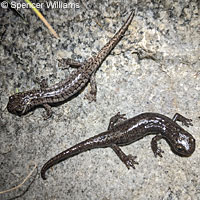
Two adults from a new Eldorado County locality, showing their phenotypic plasticity. © Spencer Williams |
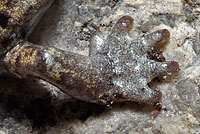
Webbed toes on hind foot |
| |
 |
|
| |
Sign at Half Dome, where Hydromantes habitat has been disturbed, Yosemite National Park, Mariposa County
© William Flaxington
|
|
| |
|
|
| Juveniles |
 |
 |
 |
| Juvenile, Tuolumne County |
 |
 |
 |
| Juvenile, Tuolumne County |
Juvenile, Tuolumne County |
Juvenile, El Dorado County |
 |
 |
 |
| Juvenile, Tuolumne County |
Juvenile, Placer County
Will Richardson
|
Juvenile, Tuolumne County © Paul Maier |
| |
|
|
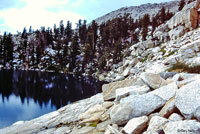
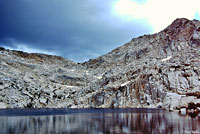
| Sierra Nevada Mountains Population Habitat |
 |
 |
 |
| Habitat, 8,700 ft., El Dorado County |
Habitat, 8,700 ft., El Dorado County |
Habitat, 9,000 ft., Tuolumne County |
 |
 |
 |
| Habitat, 9,000 ft., Tuolumne County |
Habitat, 9,000 ft., Tuolumne County |
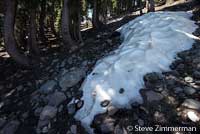
Habitat, 8,200 ft. Placer County.
© Steve Zimmerman |
 |
 |
 |
Habitat, 8,400 ft., Placer County
© Will Richardson |
Habitat, 8,400 ft., Placer County
© Will Richardson |
Habitat, Tuolumne County
© Paul Maier |
| |
|
|
| Short Videos |
 |
 |
 |
| An adult climbs up a rocky seep high in the Sierra Nevada Mountains. |
A tiny juvenile in Tuolumne County. |
This juvenile was found on a steep rock face with water flowing down it. |
|
Mount Lyell Salamander - Hydromantes platycephalus
Owens Valley population from the eastern side of the Sierra Nevada Mountains
(= Owens Valley Web-toed Salamander or Oak Creek Salamander)
|
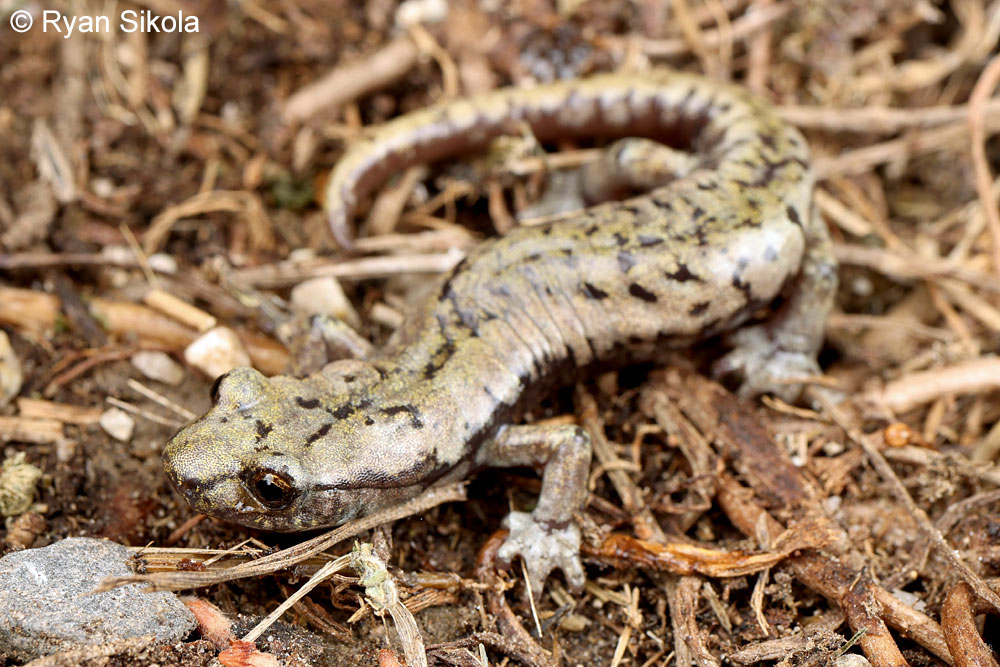
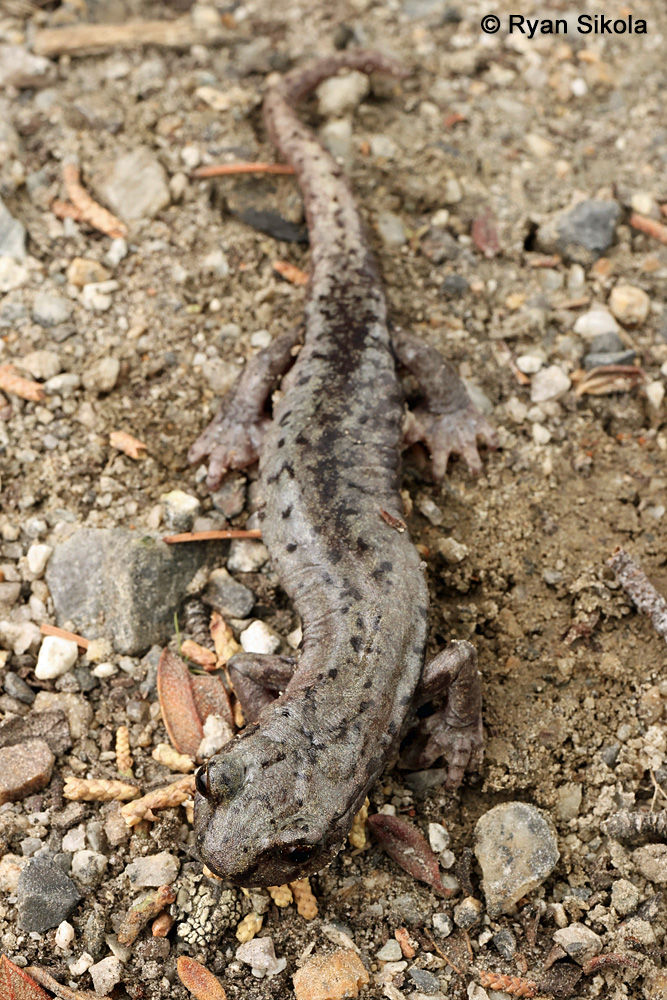
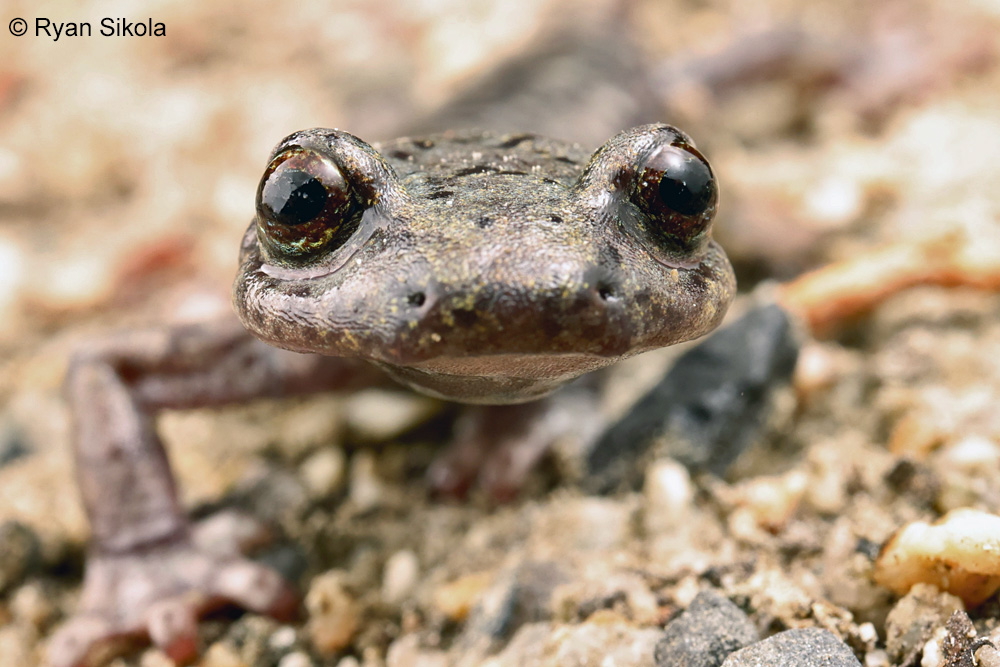
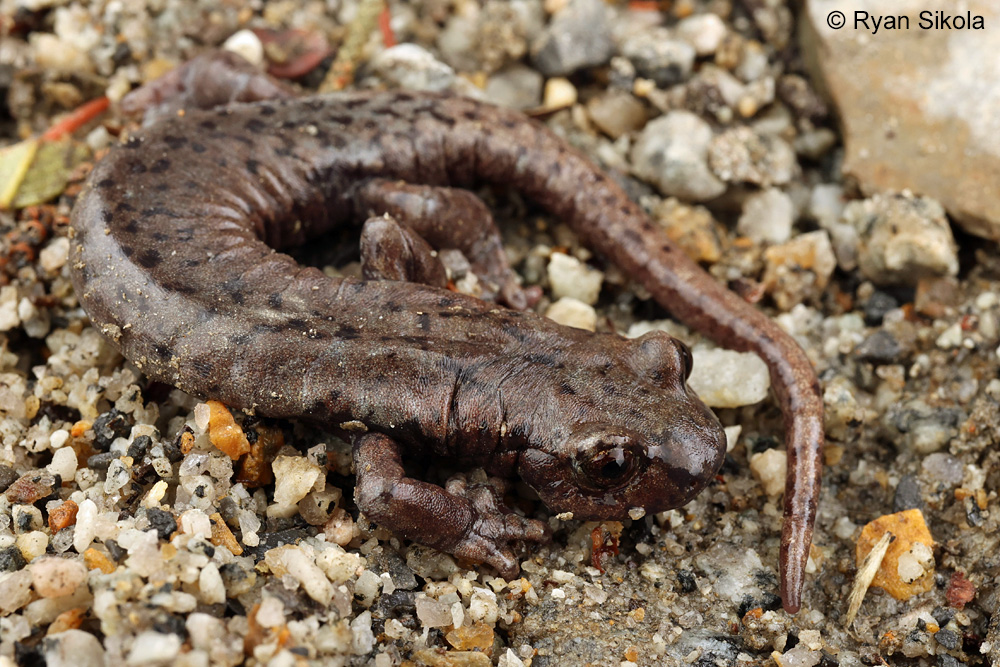
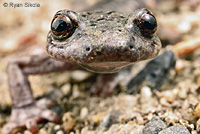
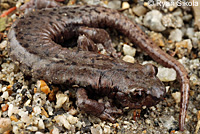
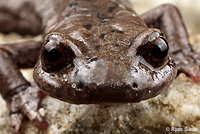
Although Hydromantes salamanders from the eastern slopes of the Sierra Nevada Mountains are currently grouped with Hydromantes platycephalus, they differ in color and habitat. In 1985, Macy and Papenfuss identified what they believed to be a new species of Hydromantes on the "Eastern slopes of the Sierra Nevada at least from the area around Owens Lake to Big Pine" which they named the Owens Valley Web-toed Salamander.
(Macey, J. Robert and Theodore Papenfuss."Herpetology." The Natural History of the White-Inyo Range Eastern California. Ed. Clarence Hall. University of California Press, 1991.)
The Owens Valley Web-toed Salamander was at one time listed separately from the Mount Lyell Salamander by the California Department of Fish and Game (now CDF & Wildlife) but is not currently.
|
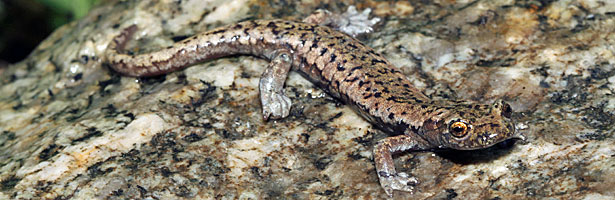 |
| Adult, Inyo County |
 |
 |
 |
| |
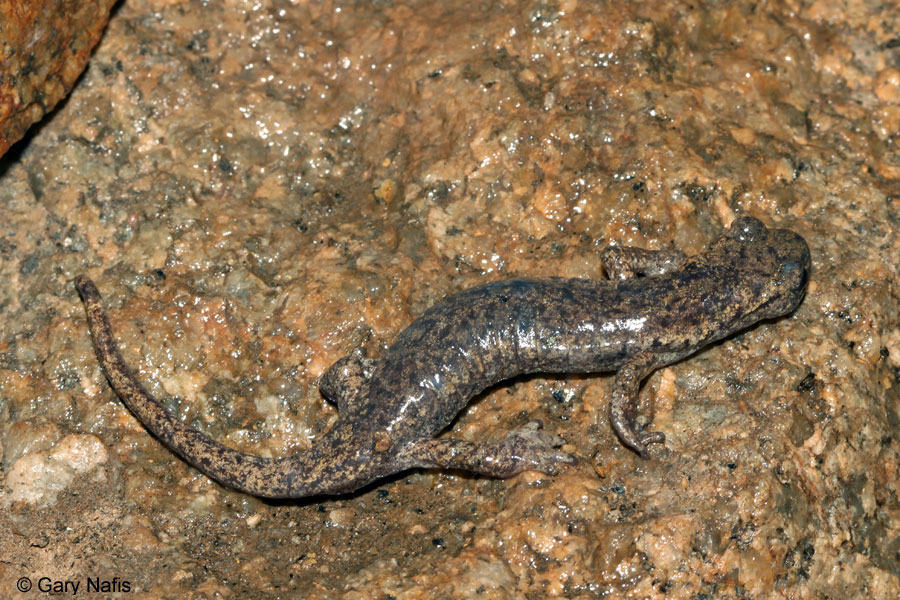
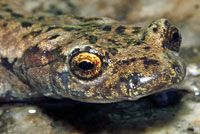
Adult, Inyo County |
|
 |
 |
 |
| Adult, Inyo County |
Adult, Inyo County |
Adult, Inyo County |
 |
 |
 |
| Adult, Inyo County |
Adult, Inyo County |
Adult, Inyo County |
 |
 |
 |
| Adult, Inyo County |
Adults, Inyo County |
Juvenile, Inyo County |
 |
 |
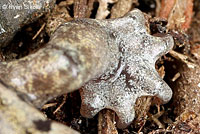 |
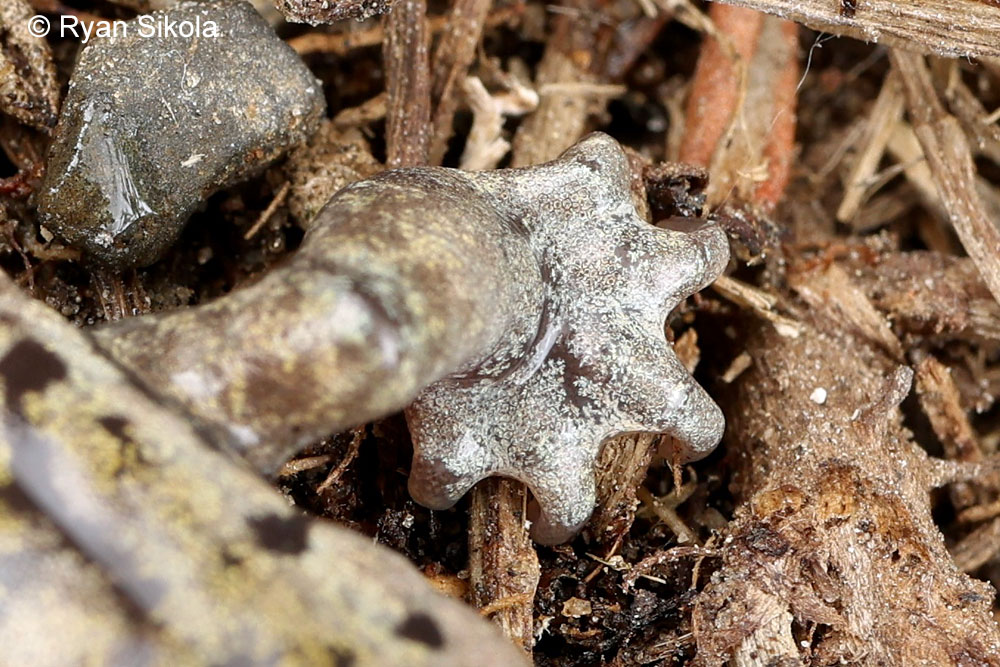
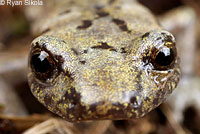
| Adult with yellow coloring, Inyo County, with close-up of webbed foot © Ryan Sikola |
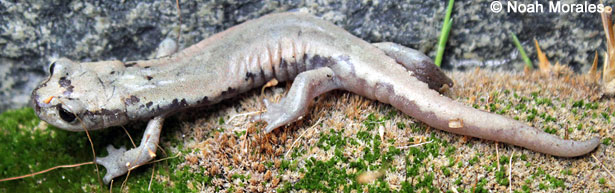 |
| Adult, Inyo County © Noah Morales |
 |
 |
 |
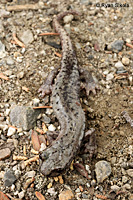
| Adult, Inyo County © Ryan Sikola |
Adult male and juvenile.
© Adam G. Clause
Animal captured and handled under state Scientific Collecting Permit and released at point of capture. |
 |
 |
|
| Dark adult, Inyo County © Ryan Sikola |
|
| |
|
|
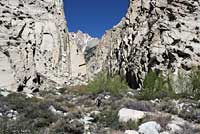
| Owens Valley Population Habitat |
 |
 |
 |
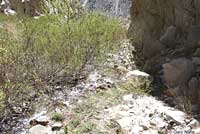
| Habitat, 7,000 ft. Inyo County |
Habitat, 7,000 ft. Inyo County |
Habitat, 7,000 ft. Inyo County |
 |
 |
|
| Habitat, 7,000 ft. Inyo County |
Habitat, 7,000 ft. Inyo County |
|
| |
|
|
| Short Videos |
 |
 |
|
| An adult salamander crawls up and over a large wet rock and under another one next to an Inyo County creek. |
An adult salamander is seen crawling down a large granite rock next to a creek in Inyo County. |
|
|
|
|
| Description |
| |
| Size |
Adults measure 1.7 - 3.5 inches long (4.4-9.0 cm) from snout to vent.
|
| Appearance |
A small stocky salamander with a short tail, webbed feet, and a flattened head and body and 12 costal grooves.
The toes are webbed and the tail is short to aid in climbing.
Nasolabial grooves are present.
|
| Color and Pattern |
The dorsal surface usually gray, or brownish, the color of the granite rocks they inhabit, marked with dark spots again to help camouflage an individual.
The ventral surface is dusky with white flecks. |
| Juveniles |
Young are dark with a greenish tinge.
|
| Life History and Behavior |
A member of family Plethodontidae, the Plethodontid or Lungless Salamanders.
Plethodontid salamanders do not breathe through lungs. They conduct respiration through their skin and the tissues lining their mouth. This requires them to live in damp environments on land and to move about on the ground only during times of high humidity. (Plethodontid salamanders native to California do not inhabit streams or bodies of water but they are capable of surviving for a short time if they fall into water.)
Plethodontid salamanders are also distinguished by their nasolabial grooves, which are vertical slits between the nostrils and upper lip that are lined with glands associated with chemoreception.
All Plethodontid Salamanders native to California lay eggs in moist places on land.
The young develop in the egg and hatch directly into a tiny terrestrial salamander with the same body form as an adult.
(They do not hatch in the water and begin their lives as tiny swimming larvae breathing through gills like some other types of salamanders.)
|
| Activity |
This species is nocturnal and cold tolerant down to 35 degrees F. (2.0 C).
Surface activity is from late April to early September.
Mt. Lyell Salamanders probably move into below-ground microhabitats and remain inactive during winter freezes and summer droughts, but they remain active underground during the summer.
Adapted to climb easily over smooth steep rock surfaces using its webbed feet and tail for stability.
Several H. platycephalus were observed by G. Nafis and T. Burkhardt on May 18, 2001 at 9000 ft.elevation in Tuolumne County. The salamanders were actively foraging on steep rock faces wet from snowmelt at 12:00 AM with an air temperature of 40 degrees F.
|
| Defense |
| Defense mechanisms include raising up the head and tail and flattening the body, producing sticky toxic skin secretions, and tightly coiling the body and tail and rolling downhill (the same escape tactic used by other Hydromantes species.) (You can watch a short video of a different species of salamander using this coiling, rolling and springing escape technique here.) |
| Diet and Feeding |
Diet consists primarily of insects and other small invertebrates.
Feeds by shooting out a very long sticky mushroom-like tongue very quickly to catch prey. |
| Reproduction |
Little is known about the breeding behavior of this species.
Reproduction is terrestrial.
|
| Eggs |
| Females presumably lay eggs in early summer. |
| Young |
Young develop completely in the egg and hatch fully formed.
Apparent hatchlings have been found in summer.
|
| Habitat |
Associated with granite talus with water seeping through it, typically downslope from snowfields that melt well into the summer. Inhabits caves, granite boulders, rock fissures. rocky stream edges, and seepages from springs and melting snow. Frequents cliff faces, vertical cavern walls, and level ground. In the Yosemite Valley, H. platycephalus is found within the spray zones of several waterfalls and under moss on wet rock faces. Most locations tend to be open, not shaded.
|
| Geographical Range |
Endemic to California, with a fairly continuous range from the Sonora Pass area south to the Franklin Pass area, Tulare County along the crest of the Sierra Nevada Mountains. Low elevation records are from the Yosemite Valley, Mariposa County. Isolated populations occur: Sierra Buttes, Sierra county; Smith Lake, El Dorado County; and Blackwood Canyon, Placer County.
The Blackwood Canyon population in the Truckee River drainage of the Lake Tahoe Basin was discovered in 2006. This is the first record from Placer County, filling in a major gap in the distribution of this salamander.
(Richardson & Gienger. Herpetological Review 38(2), 2007)
Some salamanders and their habitat from this Placer County location are shown above. |
| Elevational Range |
At elevations of 4000-12,000 ft (1220 - 3660 m).
|
| Notes on Taxonomy |
H. platycephalus is one of five species of Hydromantes, all of which are endemic to California. The others are the three Shasta complex Hydromantes and H. brunus.
---------------------------------------------------------------------------------------------------------------------------------------------------------------------
Discovered by accident in 1915 when salamanders were accidentally caught in traps intended to catch small mammals on Mt. Lyell in the Sierra Nevada Mountains.
---------------------------------------------------------------------------------------------------------------------------------------------------------------------
"Bingham et al. (2018, Bulletin of the Museum of Comparative Zoology 161: 403–427) provided range-wide geographic sampling for mitochondrial and nuclear data to revise the taxonomy of this complex, which had previously been estimated as inadequate by Rovito (2010, Molecular Ecology 19: 4554–4571). They also reported newly discovered populations of the H. shastae complex to the west and south which have not been studied and the taxonomic status of these populations requires further study."
(Nicholson, K. E. (ed.). 2025 SSAR Scientific and Standard English Names List)
---------------------------------------------------------------------------------------------------------------------------------------------------------------------
SSAR Herpetological Circular No. 43, 2017 shows the following note:
"Rovito (2010, Mol. Ecol. 19: 4554–4571) evaluated genetic variation in both mitochondrial and nuclear genes in H. brunus and H. platycephalus and those data supported the hypothesis that H. brunus was derived from H. platycephalus by peripatric speciation. Thus H. platycephalus is paraphyletic, but no changes in its taxonomy were suggested."
---------------------------------------------------------------------------------------------------------------------------------------------------------------------
H. platycephalus is currently under genetic scrutiny and may actually represent a complex of two to three species.
Macy and Pappenfuss (The Natural History of the White-Inyo Range Eastern California, 1991) have proposed that H. platycephalus occurring on the desert slope of the eastern Sierra Nevada are a distinct taxon, the Owens Valley Web-toed Salamander, but a formal description has not yet been published.
---------------------------------------------------------------------------------------------------------------------------------------------------------------------
A study by U.C. Berkeley researcher Sean M. Rovito*published in 2010 reported that "Phylogeographical analysis revealed two divergent lineages within Hydromantes platycephalus, which were estimated to have diverged in the Pliocene. By contrast, a low-elevation species, Hydromantes brunus, diverged from within the northern lineages of H. platycephalus much more recently (mid-Pleistocene), during a time of major climatic change in the Sierra Nevada."
These two deeply divergent mtDNA lineages of H. platycephalus are separated by the Middle Fork of the San Joaquin River in the Mammoth Lakes region of the central Sierra Nevada, with the northern population found from Ritter Pass north and the southern population found from Lake George south, including the Owens Valley population on the eastern slopes of the Sierra Nevada.
(Sean M. Rovito. Lineage divergence and speciation in the Web-toed Salamanders (Plethodontidae: Hydromantes) of the Sierra Nevada, California. Molecular Ecology (2010) 19,4554-4571. © 2010 Blackwell Publishing Ltd.)
---------------------------------------------------------------------------------------------------------------------------------------------------------------------
Alternate and Previous Names (Synonyms)
Eastern Sierra Nevada salamanders:
Hydromantes sp. - Owens Valley Web-toed Salamander (not yet described) (Macey and Papenfuss, 1991)
Hydromantes platycephalus - Mount Lyell Salamander (BIshop 1943, Stebbins 1954, 1966, 1985, 2003, 2012)
Hydromantes platycephala - Mount Lyell Salamander (Storer 1925)
Eurycea platycephala (Stejneger and Barbour 1917)
Speleres platycephalus (Grinnell and Camp, 1917)
|
| Conservation Issues (Conservation Status) |
| A California Species of Special Concern. There is no evidence to suggest that there have been recent changes to the population densities or range of this species. |
|
| Taxonomy |
| Family |
Plethodontidae |
Lungless Salamanders |
Gray, 1850 |
| Genus |
Hydromantes |
Web-toed Salamanders |
Gistel, 1848 |
Species
|
platycephalus |
Mount Lyell Salamander |
(Camp, 1916) |
|
Original Description |
Camp, 1916 - Univ. California Publ. Zool., Vol. 17, p. 11
from Original Description Citations for the Reptiles and Amphibians of North America © Ellin Beltz
|
|
Meaning of the Scientific Name |
Hydromantes - Greek - hydro = water + mantis = soothsayer or prophet
platycephalus - Greek = flat headed.
from Scientific and Common Names of the Reptiles and Amphibians of North America - Explained © Ellin Beltz
|
|
Related California Salamanders |
Shasta Salamander
Samwel Shasta Salamander
Wintu Shasta Salamander
Limestone Salamander
|
|
More Information and References |
California Department of Fish and Wildlife
AmphibiaWeb
Movies of Hydromantes feeding
Hansen, Robert W. and Shedd, Jackson D. California Amphibians and Reptiles. (Princeton Field Guides.) Princeton University Press, 2025.
Stebbins, Robert C., and McGinnis, Samuel M. Field Guide to Amphibians and Reptiles of California: Revised Edition (California Natural History Guides) University of California Press, 2012.
Stebbins, Robert C. California Amphibians and Reptiles. The University of California Press, 1972.
Flaxington, William C. Amphibians and Reptiles of California: Field Observations, Distribution, and Natural History. Fieldnotes Press, Anaheim, California, 2021.
Nicholson, K. E. (ed.). 2025. Scientific and Standard English Names of Amphibians and Reptiles of North America North of Mexico, with Comments Regarding Confidence in Our Understanding. Ninth Edition. Society for the Study of Amphibians and Reptiles. [SSAR] 87pp.
Samuel M. McGinnis and Robert C. Stebbins. Peterson Field Guide to Western Reptiles & Amphibians. 4th Edition. Houghton Mifflin Harcourt Publishing Company, 2018.
Stebbins, Robert C. A Field Guide to Western Reptiles and Amphibians. 3rd Edition. Houghton Mifflin Company, 2003.
Behler, John L., and F. Wayne King. The Audubon Society Field Guide to North American Reptiles and Amphibians. Alfred A. Knopf, 1992.
Robert Powell, Roger Conant, and Joseph T. Collins. Peterson Field Guide to Reptiles and Amphibians of Eastern and Central North America. Fourth Edition. Houghton Mifflin Harcourt, 2016.
Powell, Robert., Joseph T. Collins, and Errol D. Hooper Jr. A Key to Amphibians and Reptiles of the Continental United States and Canada. The University Press of Kansas, 1998.
American Museum of Natural History - Amphibian Species of the World 6.2
Bartlett, R. D. & Patricia P. Bartlett. Guide and Reference to the Amphibians of Western North America (North of Mexico) and Hawaii. University Press of Florida, 2009.
Bishop, Sherman C. Handbook of Salamanders. Cornell University Press, 1943.
Lannoo, Michael (Editor). Amphibian Declines: The Conservation Status of United States Species. University of California Press, June 2005.
Petranka, James W. Salamanders of the United States and Canada. Smithsonian Institution, 1998.
Macey, J. Robert and Theodore Papenfuss."Herpetology." The Natural History of the White-Inyo Range Eastern California. Ed. Clarence Hall. University of California Press, 1991.
Joseph Grinnell and Charles Lewis Camp. A Distributional List of the Amphibians and Reptiles of California. University of California Publications in Zoology Vol. 17, No. 10, pp. 127-208. July 11, 1917.
|
|
|
The following conservation status listings for this animal are taken from the July 2025 State of California Special Animals List and the July 2025 Federally Listed Endangered and Threatened Animals of California list (unless indicated otherwise below.) Both lists are produced by multiple agencies every year, and sometimes more than once per year, so the conservation status listing information found below might not be from the most recent lists, but they don't change a great deal from year to year.. To make sure you are seeing the most recent listings, go to this California Department of Fish and Wildlife web page where you can search for and download both lists:
https://www.wildlife.ca.gov/Data/CNDDB/Plants-and-Animals.
A detailed explanation of the meaning of the status listing symbols can be found at the beginning of the two lists. For quick reference, I have included them on my Special Status Information page.
If no status is listed here, the animal is not included on either list. This most likely indicates that there are no serious conservation concerns for the animal. To find out more about an animal's status you can also go to the NatureServe and IUCN websites to check their rankings.
Check the current California Department of Fish and Wildlife sport fishing regulations to find out if this animal can be legally pursued and handled or collected with possession of a current fishing license. You can also look at the summary of the sport fishing regulations as they apply only to reptiles and amphibians that has been made for this website.
The Special Animals List formerly (2011) listed salamanders from the eastern Sierra Nevada separately as Hydromantes sp. 1 Owens Valley web-toed salamander (AKA Oak Creek salamander) but the 2023 Special Animals List does not.
|
| Organization |
Status Listing |
Notes |
| NatureServe Global Ranking |
G4 |
Apparently Secure |
| NatureServe State Ranking |
S4 |
Apparently Secure |
| U.S. Endangered Species Act (ESA) |
None |
|
| California Endangered Species Act (CESA) |
None |
|
| California Department of Fish and Wildlife |
WL |
Watch List |
| Bureau of Land Management |
None |
|
| USDA Forest Service |
None |
|
| IUCN |
LC |
Least Concern |
|
|
|