|
 |
 |
 |
| |
Adult male, Santa Cruz Island,
Santa Barbara County |
|
 |
 |
 |
Adult, Santa Cruz Island,
Santa Barbara County
|
Adult, Santa Cruz Island,
Santa Barbara County
|
Adult, Santa Cruz Island,
Santa Barbara County
|
 |
 |
|
Adult male, Santa Cruz Island |
Juvenile, Santa Cruz Island |
|
 |
|
Adult male Western Fence Lizard with ticks on the side of the head.
A protein in the blood of the Western Fence Lizard kills the bacterium that causes Lyme disease. Bacteria carried by a tick that bites a lizard are destroyed as the tick ingests the lizard's blood.
More Info. |
This is a Short Video of two Coast Range Fence Lizards, Sceloporus occidentalis bocourtii shot during the breeding season in early May in San Benito County. The first lizard, a female, has moved from her perch on a rock to a nearby rock in order to get away from the photographer. She begins a territorial push-up display when a male comes up the side of the rock and begins to pursue her. She arches her back and hops away in order to reject him. She may have already mated and is bearing eggs, or maybe he is not her type. He finally stops and does a push-up display, possibly to continue trying to entice her, or possibly to warn the photographer that this is his territory.
|
|
 |
 |
Habitat, Santa Cruz Island
|
Habitat, Santa Cruz Island |
|
|
|
Habitat, Santa Cruz Island
|
Habitat, beach driftwood on Santa Cruz Island |
Habitat, Santa Cruz Island
|
| Description |
| Size |
| 2.25 - 3.5 inches long from snout to vent (5.7 - 8.9 cm). (Stebbins 2003) |
| Appearance |
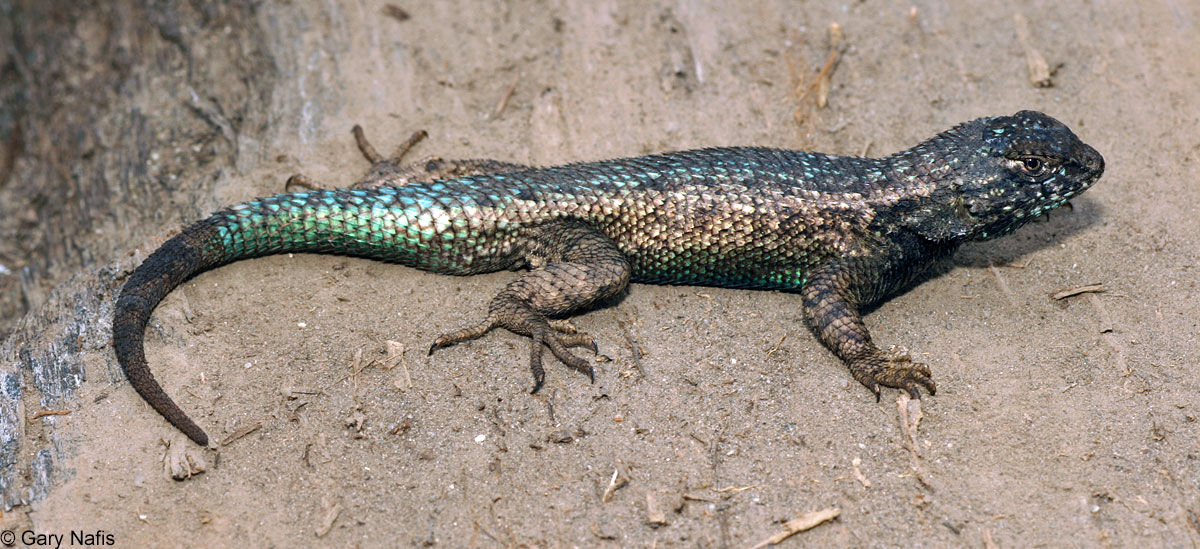
A fairly small lizard with keeled and pointed dorsal scales of equal size on the back, sides, and belly. Scales on the backs of the thighs are mostly keeled, and abruptly smaller, and the rear of the limbs is yellow or orange. The sides of the belly are blue.
Color is brown, gray, or black with blotches. Sometimes light markings on the sides of the backs form stripes or irregular lines, and sometimes dark blotching may form irregular bands. The belly is light in color.
Males have blue markings on the sides of the belly edged in black, a black patch on the throat, enlarged postanals, and a swollen tail base. Some scales on the back become blue or greenish when a lizard is in the light phase.
Females have faint or absent blue markings on the belly, no blue or green color on the upper surfaces, and dark bars or crescents on the back.
Juveniles have little or no blue on the throat and faint blue belly markings or none at all. |
| Behavior and Natural History |
Common and easily encountered in the right habitat. This is probably the species of lizard most often seen in the state, due to its abundance in and near populated areas and its conspicuous behavior.
Diurnal. Often seen basking in the sun on rocks, downed logs, trees, fences, and walls. Prefers open sunny areas. Males defend their territory and try to attract females with head-bobbing and a push-up display that exposes the blue throat and ventral colors. The tail detaches easily to distract a potential predator. Active when temperatures are warm, becomes inactive during periods of extreme heat or cold. Mile island temperatures probably allow activity all year. |
| Diet |
| Eats small invertebrates such as crickets, spiders, ticks, and scorpions, and occasionally eats small lizards including its own species. |
| Reproduction |
| Mates in the spring. Lays 1 - 3 clutches of 3 - 17 eggs from April to July. Eggs hatch in about 60 days, from July to September. |
| Range |
| This subspecies is endemic to California. Found only in the Channel Islands off the southern California coast on Santa Cruz, Santa Rosa, and San Miguel Islands.the |
| Habitat |
| Prefers open sunny areas, including stream banks, beach driftwood, grassy hillsides, human settlements. |
| Taxonomic Notes |
The taxonomy of Sceloporus occidentalis needs to be studied further. For years six subspecies have been recognized based on geographic variation in morphology, but molecular studies have identified 4 major clades and 11 different genetic groups in California (James Archie, Cal State University Long Beach). Many authorities have already accepted research that concludes that S. o. becki, the Island Fence Lizard, is a unique species - S. becki. (Wiens & Reeder, 1997) (Bell, 2001)
If it is determined that more of these genetic groups are significantly unique, S. occidentalis could be split into more species and/or the current arrangement of subspecies could be changed. Some experts no longer recognize any subspecies of S. occidentalis pending further studies. (Stebbins 2003) The February 2001 SSAR Circular No. 29, and 2003 update, on which our California State species lists are based, recognizes six subspecies. I will continue to do the same until the new list is published (some time in late 2007 or early 2008) or until I learn of changes based on accepted published work.
The range map is based on Ryan Calsbeek's distribution map. |
| Conservation Issues (Conservation Status) |
| None. |
|
|
Taxonomy |
| Family |
Phrynosomatidae |
Zebra-tailed, Earless, Fringe-toed, Spiny, Tree, Side-blotched, and Horned Lizards |
| Genus |
Sceloporus |
Spiny Lizards |
| Species |
occidentalis |
Western Fence Lizard |
Subspecies
|
becki |
Island Fence Lizard |
|
Original Description |
Sceloporus occidentalis - Baird and Girard, 1852 - Prox. Acad. Nat. Sci. Philadelphia, Vol. 6, p. 175
Sceloporus occidentalis becki - Van Denburgh, 1905 - Proc. California Acad. Sci., Ser. 3, Zool. Vol. 4, No. 1, p. 9, pl. 4
from Original Description Citations for the Reptiles and Amphibians of North America © Ellin Beltz
|
|
Meaning of the Scientific Name |
Sceloporus - Greek -skelos leg and porus - pore or opening - refers to the femoral pores on hind legs
occidentalis - Latin - western - refers to its western distribution
becki - honors Beck, Rollo Howard
from Scientific and Common Names of the Reptiles and Amphibians of North America - Explained © Ellin Beltz
|
|
Alternate Names |
Bluebelly or Blue-bellied Lizard
Fence Lizard
Swift
Sceloporus occidentalis - Western Fence Lizard (no subspecies recognized)
Sceloporus becki - Island Fence Lizard
|
|
Related or Similar California Lizards |
Western Fence Lizards:
Sceloporus occidentalis biseriatus - San Joaquin Fence Lizard
Sceloporus occidentalis bocourtii - Coast Range Fence Lizard
Sceloporus occidentalis longipes - Great Basin Fence Lizard
Sceloporus occidentalis occidentalis - Northwestern Fence Lizard
Sceloporus occidentalis taylori - Sierra Fence Lizard
Sagegrush Lizards:
S. graciosus graciosus - Northern Sagebrush Lizard
S. graciosus gracilis - Western Sagebrush Lizard
S. graciosus vandenburgianus - Southern Sagebrush Lizard
|
|
More Information and References |
Natureserve Explorer
California Dept. of Fish and Game
Stebbins, Robert C. A Field Guide to Western Reptiles and Amphibians. 3rd Edition. Houghton Mifflin Company, 2003.
Behler, John L., & F. Wayne King. The Audubon Society Field Guide to North American Reptiles and Amphibians. Alfred A. Knopf, 1992.
Smith, Hobart M. Handbook of Lizards, Lizards of the United States and of Canada. Cornell University Press, 1946.
Schoenherr, Allan A. Natural History of the Islands of California. The University of California Press. 2003.
Wiens & Reeder (1997 Herpetological Monographs 11: 1-101)
Bell (2001 Bulletin of the Maryland Herpetological Society 37(4): 137-142)
|
|
|
The following status listings come from the Special Animals List which is published several times each year by the California Department of Fish and Game.
This animal is not included on the Special Animals List, which indicates that there are no significant conservation concerns for it in California.
|
Organization
|
Status Listing
|
| U.S. Endangered Species Act (ESA) |
|
|
| California Endangered Species Act (CESA) |
|
|
| California Department of Fish and Game |
|
|
| Bureau of Land Management |
|
|
| USDA Forest Service |
|
|
| Natureserve Global Conservation Status Ranks |
|
|
World Conservation Union - IUCN Red List
|
|
|
|
|