California Reptiles & Amphibians

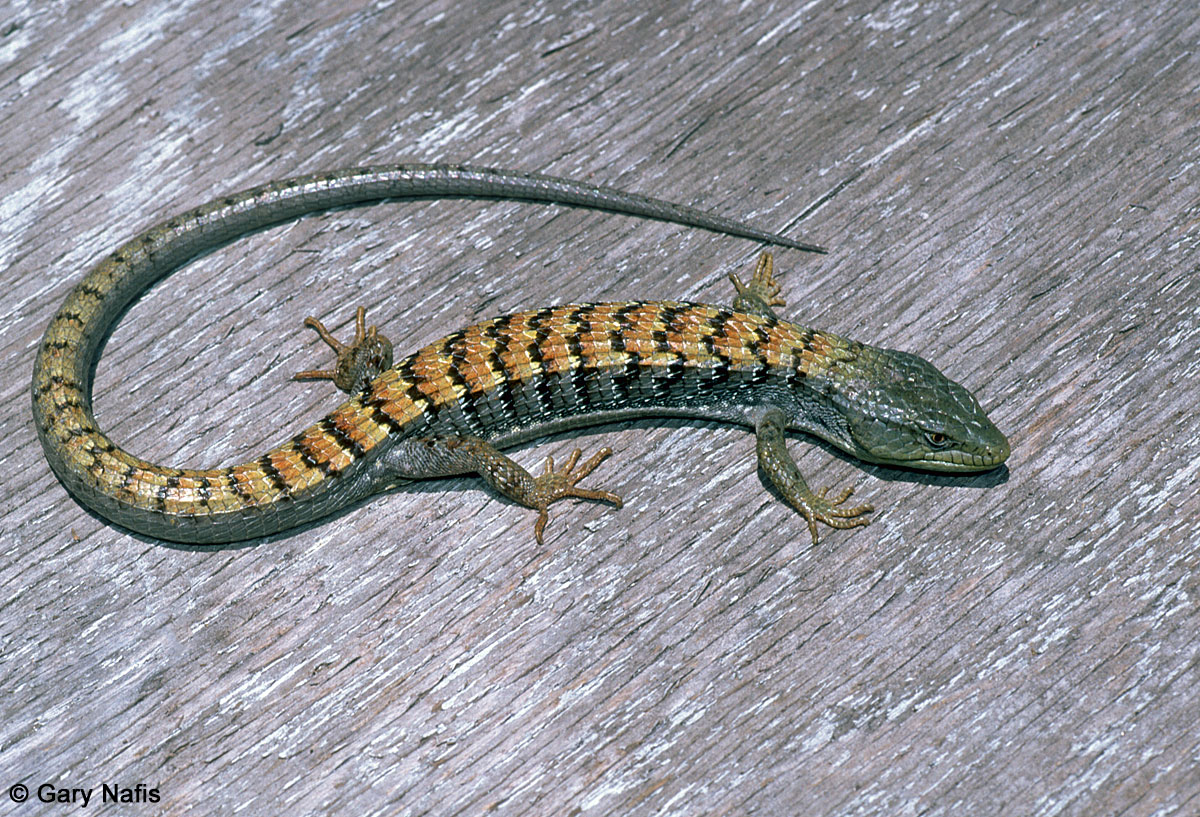
Elgaria multicarinata webbii - San Diego Alligator Lizard


Click on a picture for a larger view


Range in California: Green

Click the map for a guide
to the other subspecies


Adult, Kern County
 
Adult, San Bernardino County
Underside of Adult, Kern County
(Dark markings run through the
middle of the scales.)
Adult, Los Angeles County
Adult, Riverside County
Adult, San Diego County
Adult San Bernardino County, missing most of tail
Large triangular head of an adult male
Light eye
Young adult with high-contrast pattern, coastal Los Angeles County
© Don Huffman
Young adult with few markings, coastal Los Angeles County
© Don Huffman
Adult, Yosemite Valley, Mariposa County © Olly Burrows
Juvenile, San Diego County
© Sandra Wagner
Two males fighting in March, San Bernardino County © Joy Lutz-Mizar
Adult, Orange County © K. S. Swigart
 
Adult, San Gabriel Mountains, Los Angeles County. © Mike Ryan
This is the longest subspecies of Southern Alligator Lizard: Steve Haimwertz found this 15 inch lizard in his backyard in Los Angeles County, causing me to revise the total length size of this lizard 3 more inches.
© Steve Haimwertz.
 
Habitat, 6,200 ft.
San Bernardino County


Habitat, Riverside County
Habitat, Yosemite Valley,
Mariposa County
Description
Size
E. multicarinata ranges from 2 7/8 - 7 inches in snout to vent length (7.3 - 17.8 cm) (Stebbins) and up to aprox. 15 inches (38.1 cm) in total length, including the tail. E. m. webbii is the largest subspecies of Southern Alligator Lizard.
Appearance
Alligator lizards, genus Elgaria, are members of the family Anguidae, a family of lizards found in the Americas, Europe, Asia, and Africa. Large bony scales, a large head on an elongated body and powerful jaws probably give the lizards their common name. They are characterized by a slim body with short limbs and long tail. The tail can reach twice the length of its body if it has never been broken off and regenerated.

Color is brown, grey, or yellowish above, sometimes with reddish or orange coloring on the middle of the back.
Usually there are 9 - 13 dark bands on the back, sides, and tail, with adjacent white spots. On some lizards these dark bands are very pronounced, on others they are covered with reddish or yellowish color. Scales are keeled on the back, sides, and legs, with 14 rows of scales across the back at the middle of the body. The scales of this subspecies are more heavily keeled than with other subspecies, with the temporal scales also keeled.

A band of small granular scales separates the larger bone-reinforced scales on the back and on the belly, creating a fold along each side. These folds allow the body to expand to hold food, eggs, or live young. The fold contracts when the extra capacity is not needed.

The eyes are light yellow. (Compare with the darker eyes of Elgaria coerulea.)
The head is usually mottled with dark color. The head of a male is broader than a female's with a more triangular shape.
Usually there are dark lines running lengthwise on the underside which run through the middle of the scales. (Compare with the underside lines on Elgaria coerulea, which run between the scales, along their edges.)
Young lack the dark barring with a plain copper or brown band on the back.
Behavior
Active during the day, crepuscular and nocturnal during hot weather. Inactive during cold periods in winter.
Moves with a snake-like undulating motion. A good swimmer, sometimes diving into the water to escape by swimming away.
The slightly prehensile tail can be used to wrap around vegetation when climbing. The tail of an alligator lizard is easily broken off, as it is with many lizards. The tail will grow back, although generally not as perfectly as the original. A lizard may detach its tail deliberately as a defensive tactic. When first detached, the tail will writhe around for several minutes, long enough to distract a hungry predator from the lizard.
Other defensive tactics used by alligator lizards are smearing the contents of the cloaca on the enemy and biting. Males sometimes also extrude the hemipenes when threatened.

Alligator lizards are generally secretive, tending to hide in brush or under rocks, although they are often seen foraging out in the open or on roads in the morning and evening. They are common inhabitants of suburban yards and garages.(I have received many emails asking me to identify alligator lizards found in yards and garages, especially in Southern California.)
Diet
Eats a variety of small invertebrates. Will also eat small lizards and small mammals. Occasionally feed on bird eggs and young birds. (Stebbins)
Reproduction
Lays eggs some time from May to July. Mating probably occurs during April and May. Eggs hatch late summer and early fall.
Range
Ranges from the border in San Diego County, north, primarily west of the transverse mountain ranges, to an intergrade range in Ventura County, and north along the Tehachapi mountains and the Sierra foothills to roughly Sacramento County. Also ranges north on the east side of the Sierra Nevada Mountains through the Owens valley where it is found in some isolated populations at Grant Lake, the Alabama Hills near Independence, Walker pass, and Walker Creek near Olancha. Also found in the Mojave Desert along the Mojave River, and on Santa Catalina and San Nicolas Islands. (Stebbins)

The species Elgaria multicarinata ranges from southern Washington mostly west of the Cascades and Sierras into northwestern Baja California, including some of the Channel Islands, and has been introduced into Las Vegas. (Apparently it is common in casino gardens.) Sea level to 5,000 ft. (1,524 m).
Habitat
Grassland, open forest, chaparral. Common in foothill oak woodlands. Commonly found hiding under rocks, logs, boards, trash, other surface cover.
Taxonomic Notes
Formerly placed in the genus Gerrhonotus, with the Latin name Gerrholotus multicarinatus multicarinatus.
Conservation Issues  (Conservation Status)
None.

Taxonomy
Family Anguidae Alligator Lizards & Allies
Genus Elgaria Western Alligator Lizards
Species multicarinata Southern Alligator Lizard
Subspecies

webbii San Diego Alligator Lizard
Original Description
Elgaria multicarinata - (Blainville, 1835) - Nouv. Ann. Mus. Hist. Nat. Paris, Vol. 4, p. 298, pl. 25, fig. 2
Elgaria multicarinata webbii - (Baird, 1858) - Proc. Acad. Nat. Sci. Philadelphia, Vol. 10, p. 255

from Original Description Citations for the Reptiles and Amphibians of North America © Ellin Beltz

Meaning of the Scientific Name
Elgaria - obscure - possibly named for an "Elgar" or a pun on "alligator."
multicarinata
- Latin multi many, and carinata keeled - refers to the keeled scales
webbii - honors Webb, Thomas H.

from Scientific and Common Names of the Reptiles and Amphibians of North America - Explained © Ellin Beltz

Alternate Names
Formerly Gerrhonotus multicarinatus webbii

Related or Similar California Lizards
E. c. coerulea - San Francisco Alligator Lizard
E. c. palmeri - Sierra Alligator Lizard
E. c. shastensis - Shasta Alligator Lizard
E. c. principis - Northwestern Alligator Lizard
E. m. multicarinata - California Alligator Lizard
E. m. scincicauda - Oregon Alligator Lizard
E. panamintina - Panamint Alligator Lizard

More Information and References
Natureserve Explorer

California Dept. of Fish and Game

Stebbins, Robert C. A Field Guide to Western Reptiles and Amphibians. 3rd Edition. Houghton Mifflin Company, 2003.

Behler, John L., & F. Wayne King. The Audubon Society Field Guide to North American Reptiles and Amphibians. Alfred A. Knopf, 1992.

Smith, Hobart M. Handbook of Lizards, Lizards of the United States and of Canada. Cornell University Press, 1946.

Conservation Status

The following status listings come from the Special Animals List which is published several times each year by the California Department of Fish and Game.

This animal is not included on the Special Animals List, which indicates that there are no significant conservation concerns for it in California.


Organization
Status Listing
U.S. Endangered Species Act (ESA)
California Endangered Species Act (CESA)
California Department of Fish and Game
Bureau of Land Management
USDA Forest Service
Natureserve Global Conservation Status Ranks
World Conservation Union - IUCN Red List


Home | Lists | Maps | Photo Indexes | Sounds | Identification | More Info | Beyond CA | About Us | Usage | Taxonomy | New Stuff | Thanks | Disclaimers | Contact

Return to the Top                     © 2000 - 2008