California Reptiles & Amphibians

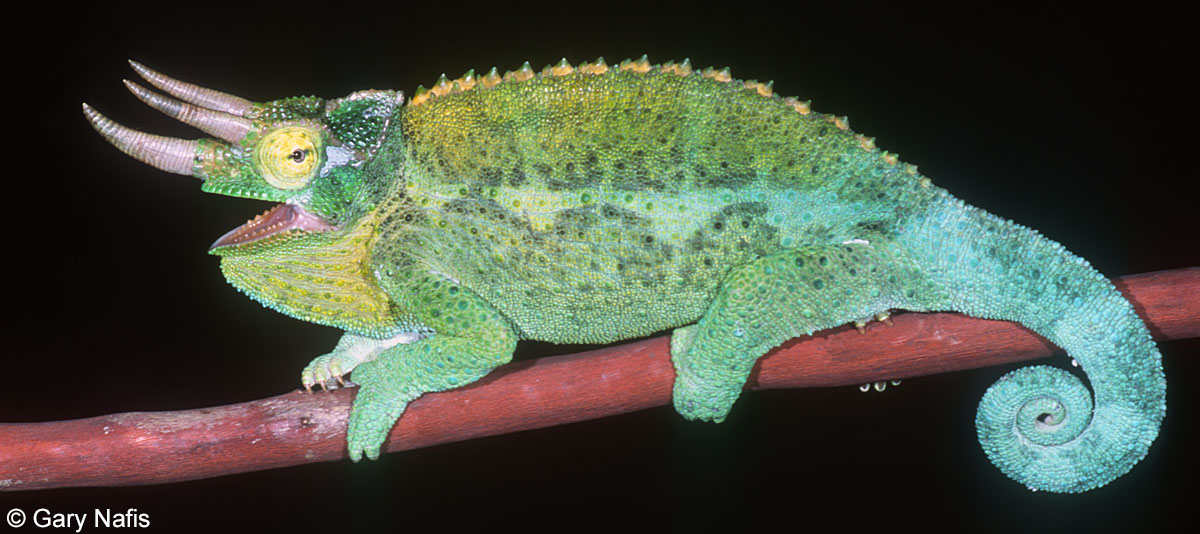
Chamaeleo jacksonii xantholophus - Yellow-crested Jackson's Chameleon


Click on a picture for a larger view


Range in California: Red


Introduced: not native to California

Adult male, Morro Bay, San Luis Obispo county,
courtesy of Steven Boone & Joe Cirone
Adult female, Morro Bay, San Luis Obispo county,
courtesy of Steven Boone & Joe Cirone
Adult female, 1,600 ft., Maui, Hawaii. Notice the color variations. These four pictures were all taken within 20 minutes.
   
A foggy summer morning in Morro Bay, San Luis Obispo County
Chameleons have been found on this property and similar residential areas around Morro Bay.
   
Description (based primarily on McKeown, 1996)
Size
Average snout-to-vent length 4 3/4 - 5 inches ( 12.1 - 12.7 cm). Average total length is 10 inches (25.4 cm).
Appearance
A large, thick-bodied lizard, able to rapidly change color. Coloring includes yellow, blue, brown, gray, charcoal, black, and many shades of green.

Males and females are different in appearance. Males have three horn-like projections at the front of the head. Females lack these horns.

Large eyes are able to move independently of each other, and are set on turrets, allowing them to move around in a circle which enables a chameleon to see in any direction. The tail is prehensile, aiding a lizard in climbing. When not in use, the tail is coiled. The tongue is hollow and extremely long - more than the length of the entire body. It is rapidly shout out of the mouth by muscular contractions to grab at prey with its sticky tip.
Behavior
Arboreal - living in trees and bushes. Opposable toes on all four feet allow sure footing, and a prehensile tail aids in climbing. Chameleons will flatten the body or make it appear thinner to hide by blending in with the foliage.

Changes color in response to interaction with other chameleons, light, temperature, response to threats, and activity. Males use horns to spar for territory or breeding rights. The losing male is pushed off a limb and forced to retreat.
Diet
Eats a variety of small invertebrates.
Reproduction
A male will approach a female, bob his head side to side, and show yellow and boue coloring. The female will indicate her readiness to mate by turning solid green. If not, she will show stress coloring, including large areas of black, and she will hiss and bite. Young are born encased in a membrane. During birth, the female sits at an elevated location and drops each newborn to the ground which stimulates it to emerge from its membrane. Anywhere from 5 - 50 young are born. Young are ready to feed within hours of birth.
Range
Native to humid cool areas of Kenya and Tanzania in East Africa, especially at altitudes of over 3,000 meters.
Jackson's Chameleons have been introduced into San Luis Obispo, Los Angeles, and San Diego Counties. (McKeown, 1997 Bull. Chicago Herpetol. Soc. 32:101.) Locations include Morro Bay, Laguna Beach, and possibly the Palos Verde Peninsula.
Habitat
In California, this lizard seems to have adapted to vegetation around human settlements along the coast where the combination of fog and sunshine provide it with the necessary temperature and moisture requirements. It appears that this lizard is in danger of dessication from dry environments.
Origin
I have received a description of the origin of this introduced population of lizards from two independant sources. Both state that the lizards were released in 1981 by
California Department of Fish and Game employees when they left the door open to a chameleon cage during a raid on a suspect in Morro Bay. It is assumed that the employees did not see the lizards in the cage and ten chameleons escaped into the wild and began breeding.
Conservation Issues  (Conservation Status)
It is not evident how competition from this introduced species impacts native species, but the spread of this or any non-native species should be discouraged.

Taxonomy
Family Chamaeleonidae Chameleons
Genus Chamaeleo Chameleons
Species jacksonii Jackson's Chameleon
Subspecies


xantholophus Yellow-crested Jackson's Chameleon
Original Description
Chamaeleo jacksonii xantholophus Eason, Ferguson & Hebrard 1988 : Yellow-crested Jackson's Chameleon

Meaning of the Scientific Name
The name "chameleon" means, "Earth lion" and is derived from the Greek words "chamai" (on the ground, on the earth) and "leon" (lion). From Wikipedia
Jacksonii - refers to someone named Jackson. If you know who, please let me know!

Alternate Names
None

Related or Similar California Lizards
None

More Information and References
Natureserve Explorer

California Dept. of Fish and Game

Stebbins, Robert C. A Field Guide to Western Reptiles and Amphibians. 3rd Edition. Houghton Mifflin, 2003.

McKeown, Sean. A Field Guide to Reptiles and Amphibians in the Hawaiian Islands. Diamond Head Publishing, Inc. 1996.


Conservation Status

The following status listings come from the Special Animals List which is published several times each year by the California Department of Fish and Game.

This animal is not included on the Special Animals List, which indicates that there are no significant conservation concerns for it in California.


Organization
Status Listing
U.S. Endangered Species Act (ESA)
California Endangered Species Act (CESA)
California Department of Fish and Game
Bureau of Land Management
USDA Forest Service
Natureserve Global Conservation Status Ranks
World Conservation Union - IUCN Red List


Home | Lists | Maps | Photo Indexes | Sounds | Identification | More Info | Beyond CA | About Us | Usage | Taxonomy | New Stuff | Thanks | Disclaimers | Contact

Return to the Top                     © 2000 - 2008