|
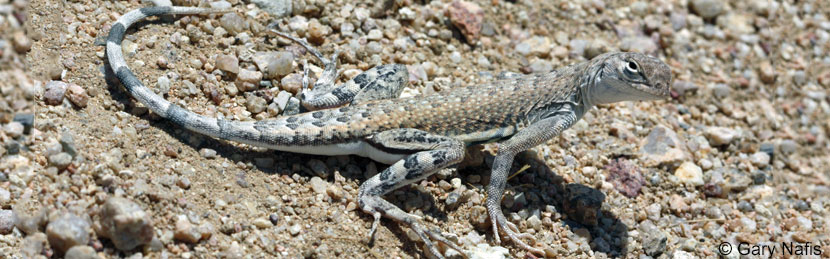 |
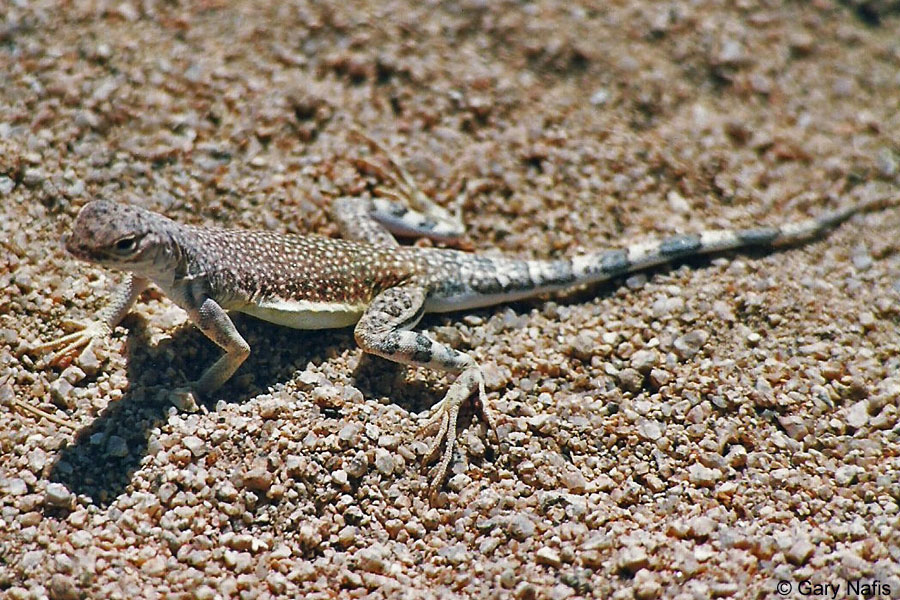
| (Non-breeding season) adult male, Kern County |
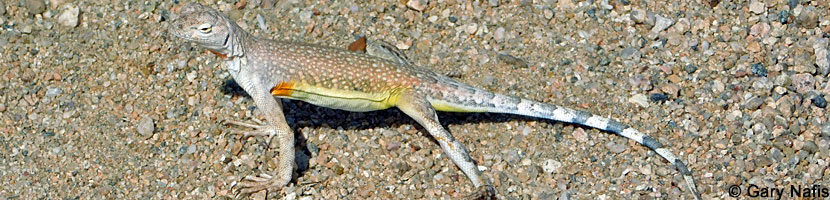 |
| Breeding adult female, Kern County |
 |
 |
 |
 |
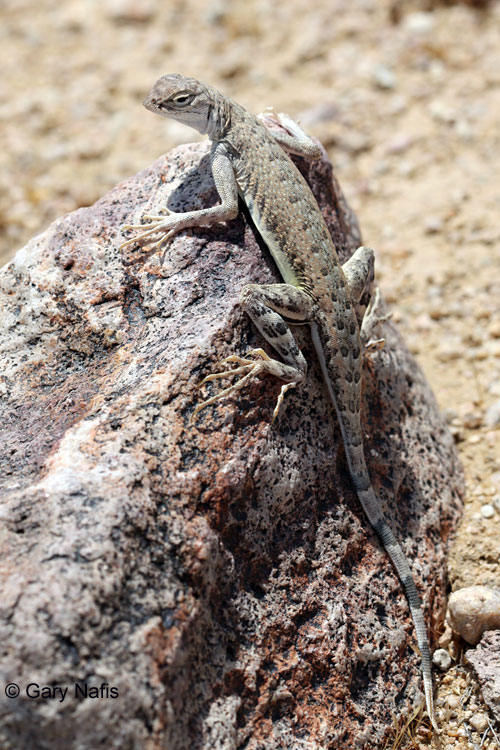
| Adult female, Kern County |
Adult female, Kern County |
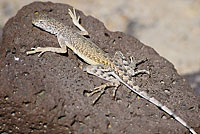
Adult female, Kern County, missing the end of her tail. |
Adult male, San Bernardino County, showing no stripes on the underside. |
 |
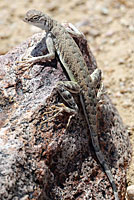 |
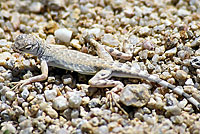 |
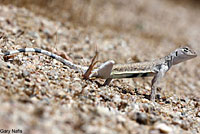 |
| Adult male, San Diego County |
Adult female, Kern County |
Juvenile, Kern County |
Adult male, Kern County |
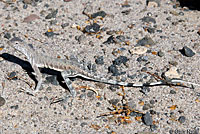 |
 |
 |
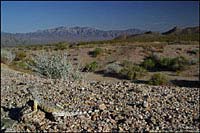 |
Adult male from dark lava flow area,
San Bernardino County |
Adult female, Kern County |
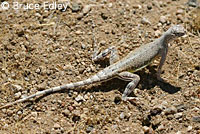
Adult male, San Diego County
© Bruce Edley |
Adult male, San Bernardino County
© Brad Alexander |
 |
 |
 |
 |
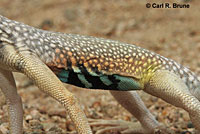
| Adult male, Inyo County. © Carl R. Brune. Males typically have two dark stripes on the sides and undersides, but this unusual male has three dark stripes. |
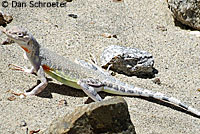
Adult female, Riverside County © Dan Schroeter |
 |
 |
 |
 |
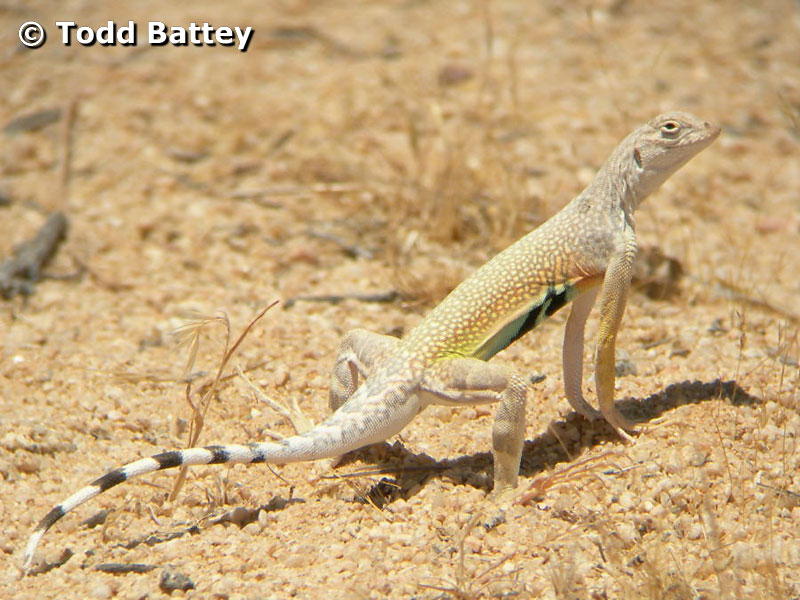
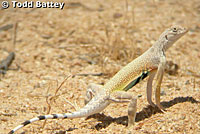
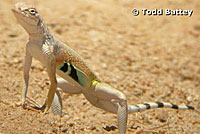
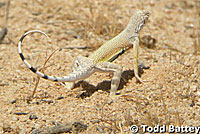
| Adult male, Kern County © Todd Battey |
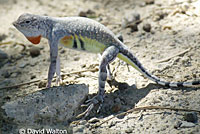
Adult male in threat display,
Clark County Nevada © David Walton |
 |
 |
 |
 |
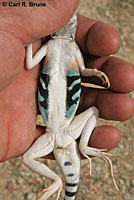
Underside of adult male,
San Diego County © Bruce Edley |
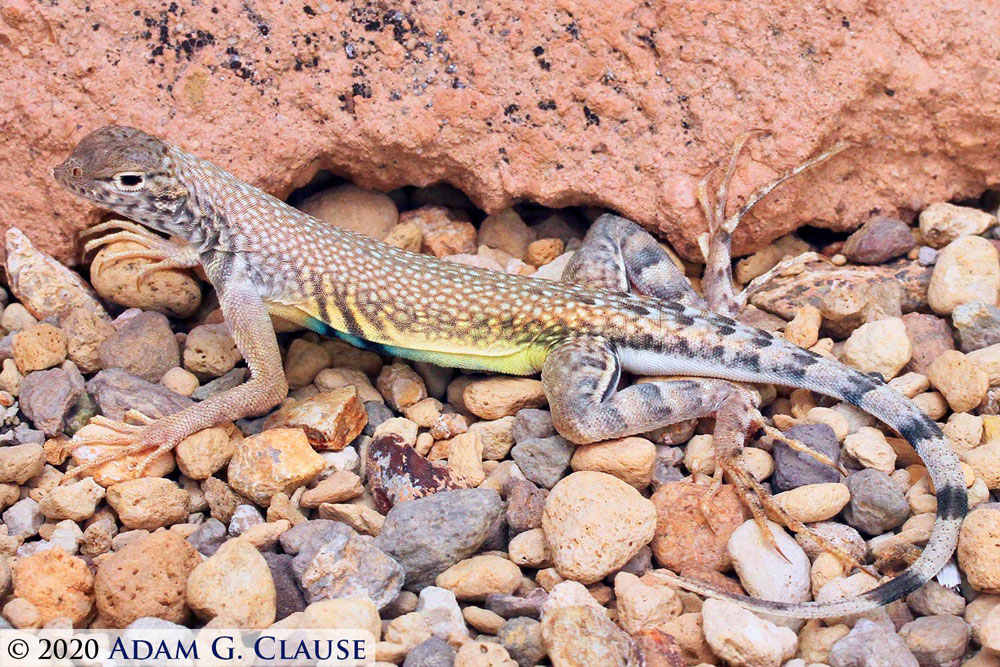
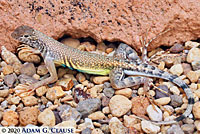
Young adult male, Mono County
© Adam G. Clause
|
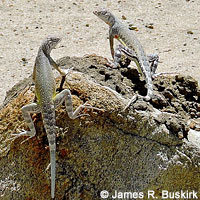
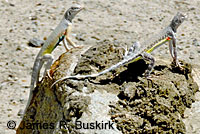
Adult male (left) and female (right) Riverside County © James R. Buskirk |
 |
 |
 |
 |
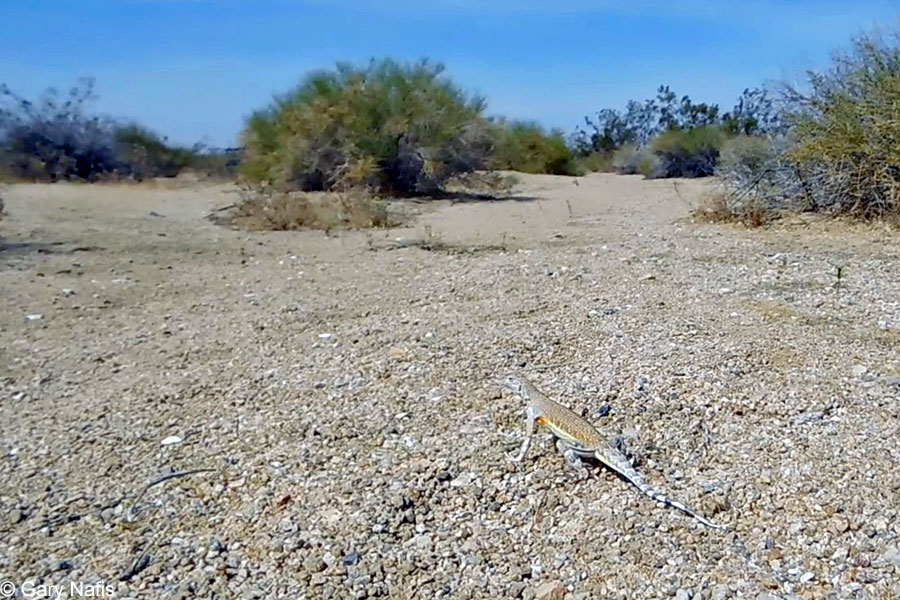
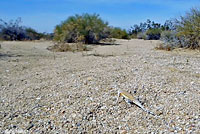
| Adult, Kern County |
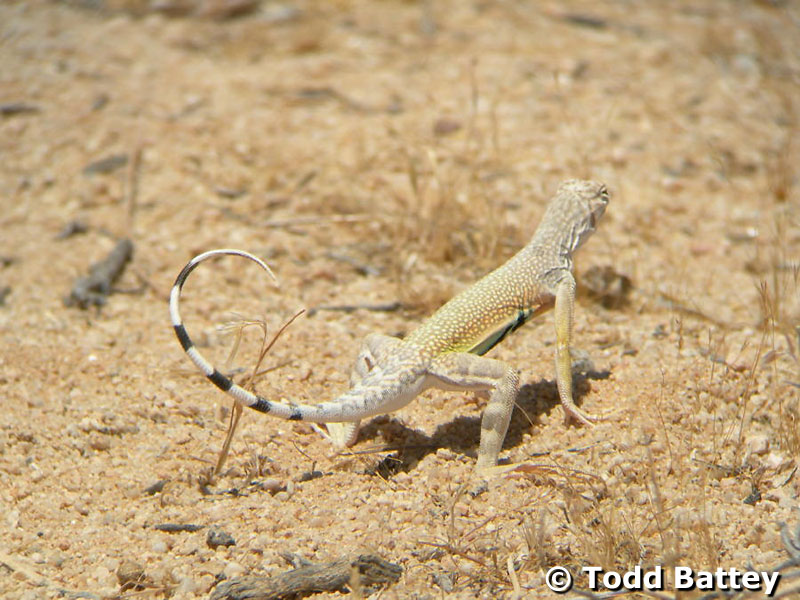
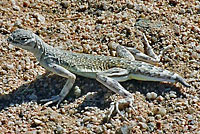
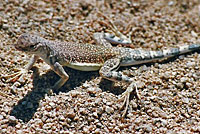
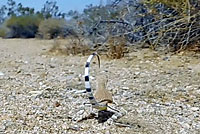
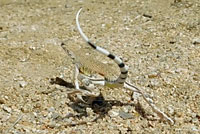
As you can see on this adult female in Kern County, when running, zebra-tailed lizards raise up and wave their tail to show the zebra-like black and white bars on the bottom of the tail. This draws the predator's attention to the more expendable tail and away from the vulnerable body. |
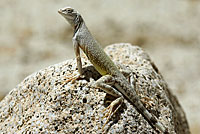
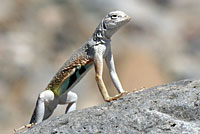
Adult male, Inyo County.
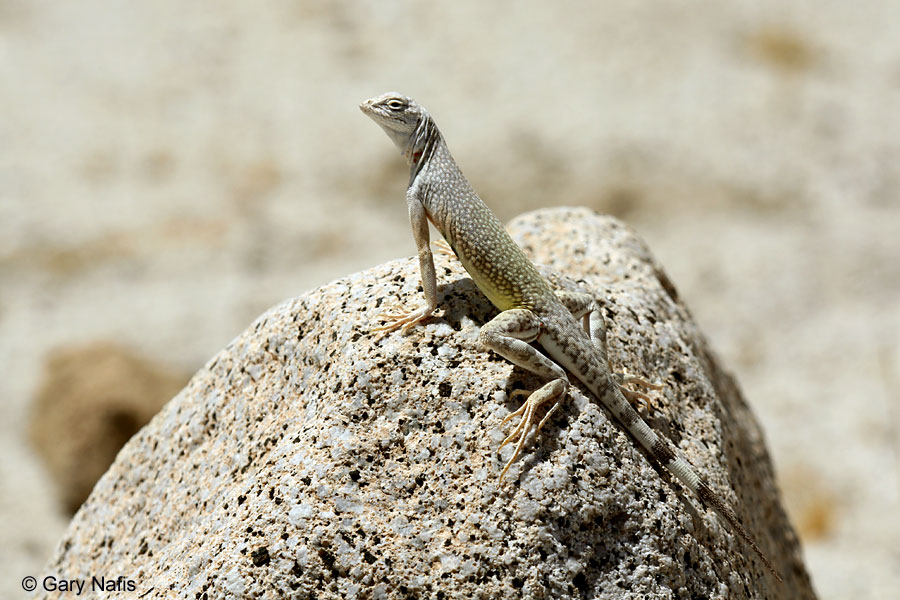
Zebra-tailed lizards are very tolerant of extreme heat. The air temperature was 100 degrees F. when this lizard was seen out in the sun on top of a rock. The temperature of the rock was 130 degrees F. ! (54.44 C.) |
 |
 |
 |
 |
Adult male, San Bernardino County
© Terry Goyan |
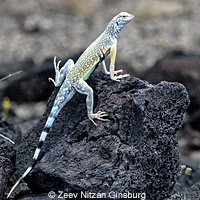
Adult male, San Bernardio County
© Zeev Nitzan Ginsburg |
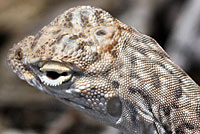
Adult female, Kern County
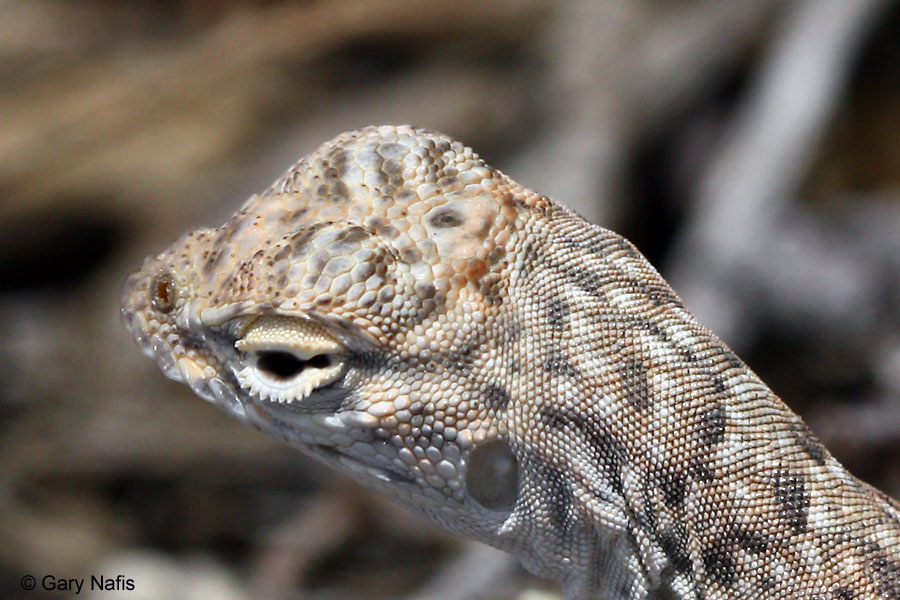
This close-up shows the fringed protective scales around the eyes, the third eye on top of the head, and the ear on side of the head behind the eye (which can help differentiate a zebra-tailed lizard from a similar earless lizard.)
|
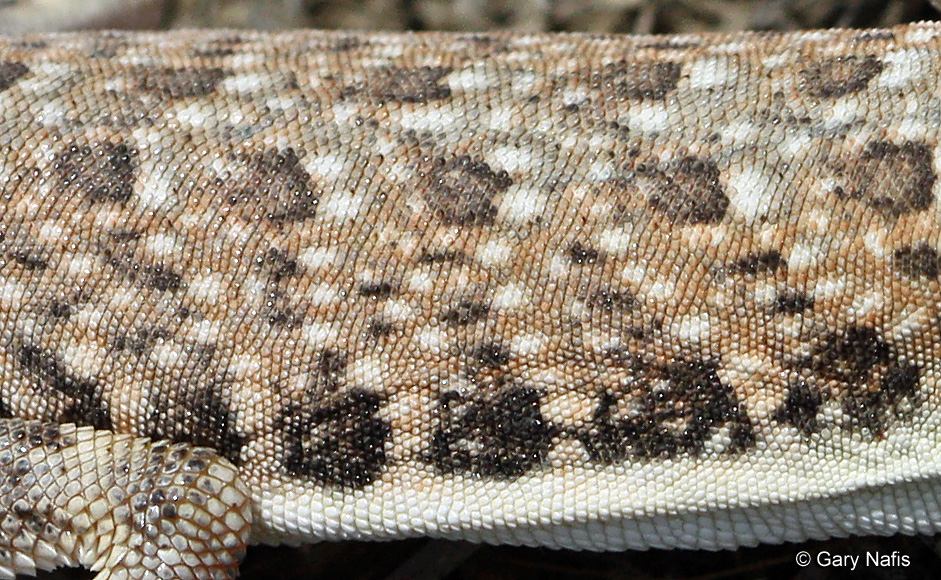
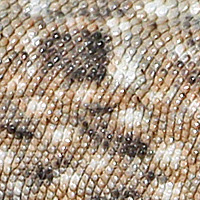
Zebra-tailed Lizards, genus Callisaurus, have smooth granular scales on their upper sides.
|
| |
|
|
|
| Habitat |
 |
 |
 |
 |
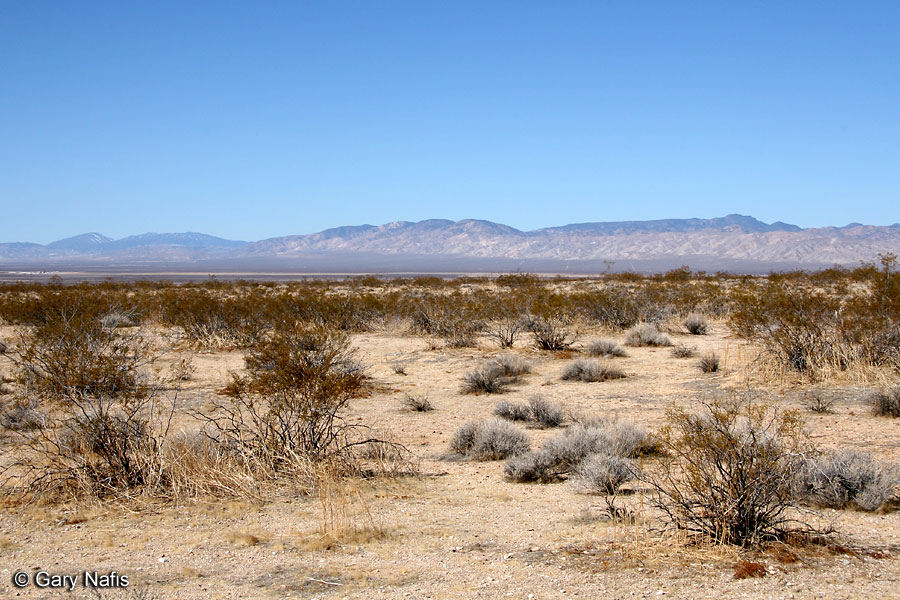
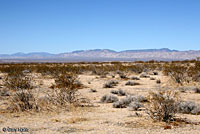
| Habitat, sandy wash, San Diego County |
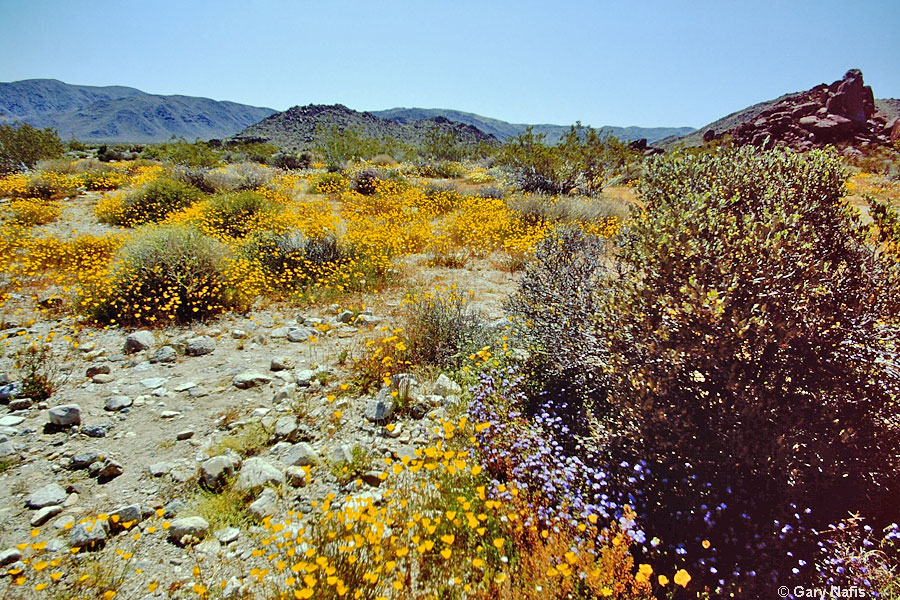
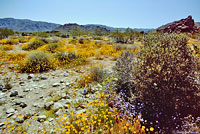
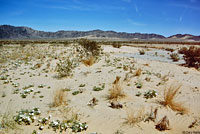
Habitat, sandy wash during a good spring wildflower bloom (1998), Riverside County
|
Habitat, Kern County |
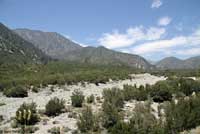
Inland habitat, creek flowing out of San Gabriel Mountains near Cajon Pass, Riverside County |
 |
 |
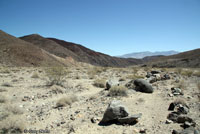 |
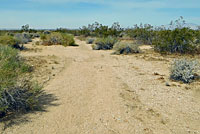 |
Habitat, windblown sand and sandy wash, San Bernardino County
|
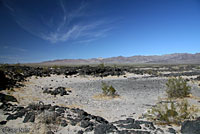
Habitat, lava flow,
San Bernardino County |
Habitat, rocky wash, Inyo County |
Habitat, Kern County |
| |
|
|
|
| Short Videos |
 |
 |
 |
|
| This video shows several views of zebra-tailed lizards from the Colorado Desert in San Diego County, waving their striped tails to divert attention away from their main body, running off quickly, and doing the territorial push-up display. |
One early afternoon during a summer cold front in the Mohave Desert in Kern County, I was able to get close to several zebra-tailed lizards and follow them around as they moved relatively slowly compared to how fast they move when it's hot. |
On a late spring day in Kern County I followed this zebra-tailed lizard around its sandy wash habitat. Most zebra-tails run away as fast as they can, but this one seemed curious of the large hairless ape with a funny hat crawling on its knees and only ran a short distance then stopped, allowing me to approach her closely again. But she still exhibits the flight behavior typical of this species - wagging her striped tail as a distraction from her body, and even doing a push-up display warning me not to come any closer. |
|
| |
|
|
|
| Description |
| |
| Size |
2.5 - 4 inches from snout to vent (6 - 10 cm), up to almost 9 inches including tail.
|
| Appearance |
A pale thin lizard with very long legs and a long flat tail with black crossbars.
Scales are small and granular.
|
| Color and Pattern |
Gray or light brown above with light spots and paired dark blotches, which are more distinct on females.
As with many lizards, the coloring is darker during lower temperatures, and lighter with very high temperatures.
Dark crossbars or bands on the tail become very distinct black and white underneath.
This black and white zebra-like pattern gives this lizard its name.
There is pale yellow and orange coloring on the sides and the center of the throat often has a pink or orange spot.
|
| Male / Female Differences |
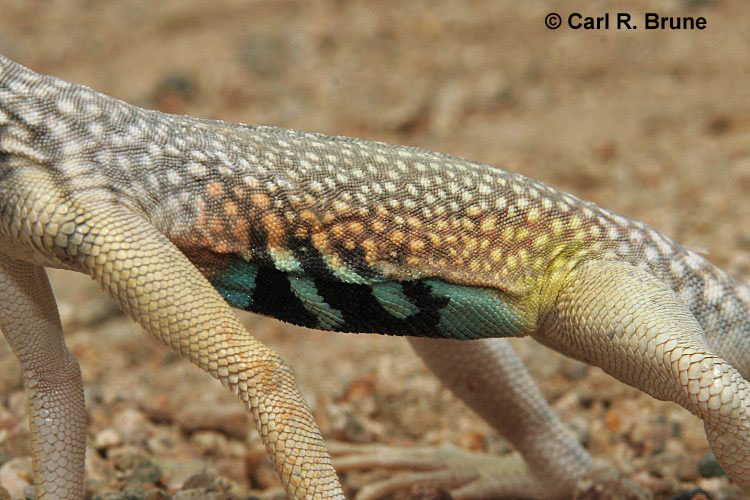
Males have two dark bars and develop a patch of blue-green coloring on the sides of the mid belly, which is visible when viewed from the side, during the breeding season.
Dark belly markings are faint or absent on females.
|
| Life History and Behavior |
Activity |
Diurnal.
Tolerant of high temperatures.
Often seen basking on rocks, even on extremely hot afternoons.
A countersunk lower jaw makes it easier for this lizard to burrow into loose or sandy soil to rest. |
| Defense |
Capable of running very fast (possibly the fastest lizard in the desert) facilitated by long legs and streamlined body.
After speeding away, this lizard sometimes stops far ahead in the open, but it will also run to the far side of a bush, out of view, or into a bush or burrow for protection.
Before running, a lizard may curl the tail up towards the back, exposing the black and white bars, and wag it nervously, then continue this behavior while running and after stopping.
This tail display tactic concentrates a predator's attention on the tail, which, if attacked and broken off, can grow back.
More information about tail loss and regeneration. |
| Diet and Feeding |
| Small invertebrates such as insects and spiders, small lizards, occasional plant material. |
| Reproduction |
Mating occurs in Spring. Eggs are laid June - August.
|
| Habitat |
Open sandy desert washes, desert pavement, and hard pan, with scant widely-spaced vegetation and open areas. Sometimes found in wind-blown sand dunes near hard-packed ground.
|
| Geographical Range |
In California, this species inhabits the Mojave and Colorado Deserts up to the desert slopes of the Peninsular and Transverse Mountains, and from the Owens Valley north along the eastern edge of the Sierra Nevada Mountains. Found on the coastal slopes of the mountains at San Jacinto Wash and Cajon Wash, where one was observed as far south as the Santa Ana River.
In 1917 Grinnell and Camp
listed the range as also occurinrg at Valle Vista, in San Jacinto Valley, Riverside County and Oak Springs, San Diego County.
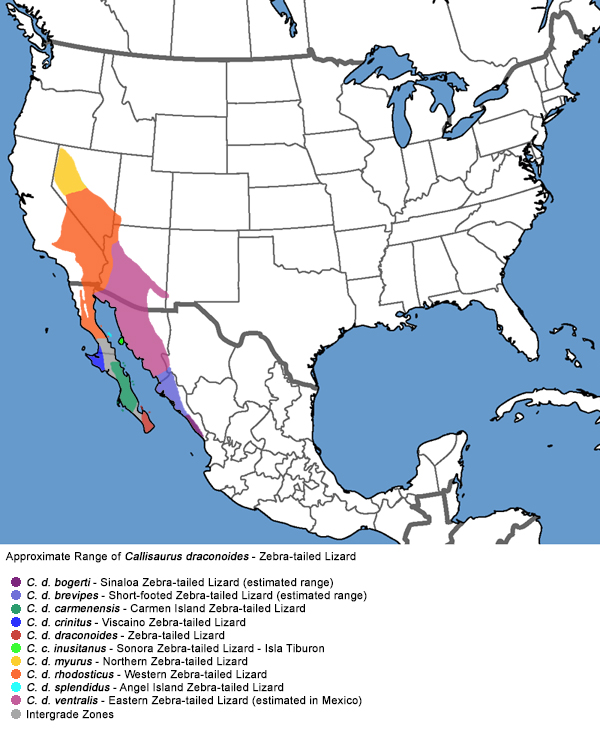
The species ranges outside California north into northern Nevada, east into extreme southwest Utah, south through Arizona and extreme southwest New Mexico, to the cape region of Baja California and across the gulf along the west coast of Mexico.
|
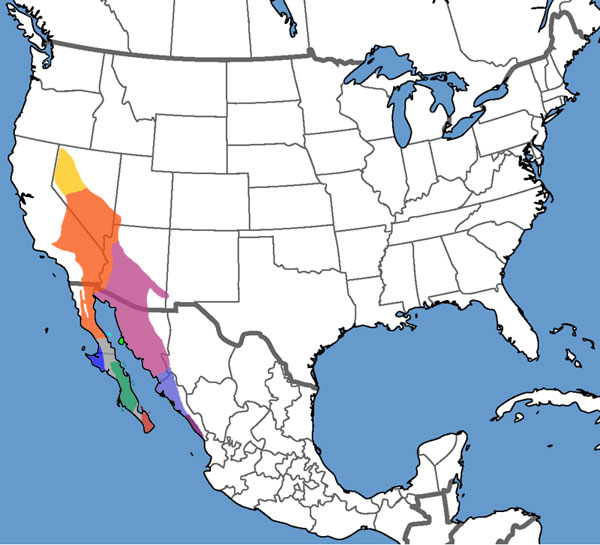 |
Approximate distribution of Callisaurus draconoides - Zebra-tailed Lizard
Red: Callisaurus draconoides rhodostictus - Western Zebra-tailed Lizard
-Not found in California
Dark Purple: Callisaurus draconoides bogerti - Sinaloa Zebra-tailed Lizard
Violet: Callisaurus draconoides brevipes - Short-footed Zebra-tailed Lizard
Green: Callisaurus draconoides carmenensis - Carmen Island Zebra-tailed Lizard
Dark Blue: Callisaurus draconoides crinitus - Viscaino Zebra-tailed Lizard
Red: Callisaurus draconoides draconoides - Zebra-tailed Lizard
Bright Green: Callisaurus draconoides inusitanus - Sonora Zebra-tailed Lizard (Isla Tiburon)
Yellow: Callisaurus draconoides myurus - Northern Zebra-tailed Lizard
Bright Blue: Callisaurus draconoides splendidus - Angel Island Zebra-tailed Lizard
Purple: Callisaurus draconoides ventralis - Eastern Zebra-tailed Lizard
|
| Notes on Taxonomy |
Callisaurus draconoides rhodostictus - Western Zebra-tailed Lizard (Hansen & Shedd, 2025)
------------------------------------------------------------------------------------------------------------------------------------------------------------------------------------------------------------------------------
Some experts do not recognize any subspecies of Callisaurus draconoides.
Others recognize three subspecies occurring in the United States:
C. d. rhodostictus, Western Zebra-tailed Lizard
C. d. myurus - Northern Zebra-tailed Lizard
C. d. ventralis - Eastern (or Arizona) Zebra-tailed Lizard
------------------------------------------------------------------------------------------------------------------------------------------------------------------------------------------------------------------------------
Some experts classify this lizard as Callisaurus draconoides draconoides - Common Zebra-tailed Lizard.
------------------------------------------------------------------------------------------------------------------------------------------------------------------------------------------------------------------------------
Alternate and Previous Names (Synonyms)
Callisaurus draconoides draconoides - Common Zebra-tailed Lizard
(Stebbins 1985, 2003)
Callisaurus draconoides - Zebra-tailed Lizard (Stebbins 1966)
Callisaurus draconoides gabbi - Common Gridiron-tailed Lizard (Smith 1946)
Callisaurus ventralis ventralis - Southern Gridiron-tailed Lizard (Callisaurus draconoides; Callisaurus draconoides ventralis; Callisaurus draconoides gabbii;
Zebra-tailed Lizard; Spotted-tail Dragon; Beautiful Lizard) (Grinnell and Camp 1917)
|
| Conservation Issues (Conservation Status) |
| None |
|
|
Taxonomy |
| Family |
Phrynosomatidae |
Zebra-tailed, Earless, Fringe-toed, Spiny, Tree, Side-blotched, and Horned Lizards |
Fitzinger, 1843 |
| Genus |
Callisaurus |
Zebra-tailed Lizards |
Blainville, 1835 |
| Species |
draconoides |
Zebra-tailed Lizard |
Blainville, 1835 |
Subspecies
|
rhodostictus |
Western Zebra-tailed Lizard |
Cope, 1896 |
|
Original Description |
Callisaurus draconoides - Blainville, 1835 - Nouv. Ann. Mus. Hist. Nat. Paris, Vol. 4, p. 286, pl. 24, fig. 2
Callisaurus draconoides rhodostictus - Cope, 1896 - Amer. Nat., Vol. 30, p. 1049
from Original Description Citations for the Reptiles and Amphibians of North America © Ellin Beltz
|
|
Meaning of the Scientific Name |
Callisaurus - Greek - kalos = beautiful + saurus = lizard - "we have given the name Callisaurus to indicate the extreme beauty of this little animal."
draconoides - Greek - draco = dragon + -eidos = similarity to a - the species of true dragons
rhodostictus - Greek - rhodon = rose, red color + Greek - stiktos = dotted or dappled
from Scientific and Common Names of the Reptiles and Amphibians of North America - Explained © Ellin Beltz
|
|
Related or Similar California Lizards |
Uma notata - Colorado Desert Fringe-toed Lizard
Uma inornata - Coachella Valley Fringe-toed Lizard
Uma scoparia - Mojave Fringe-toed Lizard
|
|
More Information and References |
California Department of Fish and Wildlife
Hansen, Robert W. and Shedd, Jackson D. California Amphibians and Reptiles. (Princeton Field Guides.) Princeton University Press, 2025.
Stebbins, Robert C., and McGinnis, Samuel M. Field Guide to Amphibians and Reptiles of California: Revised Edition (California Natural History Guides) University of California Press, 2012.
Stebbins, Robert C. California Amphibians and Reptiles. The University of California Press, 1972.
Flaxington, William C. Amphibians and Reptiles of California: Field Observations, Distribution, and Natural History. Fieldnotes Press, Anaheim, California, 2021.
Nicholson, K. E. (ed.). 2025. Scientific and Standard English Names of Amphibians and Reptiles of North America North of Mexico, with Comments Regarding Confidence in Our Understanding. Ninth Edition. Society for the Study of Amphibians and Reptiles. [SSAR] 87pp.
Samuel M. McGinnis and Robert C. Stebbins. Peterson Field Guide to Western Reptiles & Amphibians. 4th Edition. Houghton Mifflin Harcourt Publishing Company, 2018.
Stebbins, Robert C. A Field Guide to Western Reptiles and Amphibians. 3rd Edition. Houghton Mifflin Company, 2003.
Behler, John L., and F. Wayne King. The Audubon Society Field Guide to North American Reptiles and Amphibians. Alfred A. Knopf, 1992.
Robert Powell, Roger Conant, and Joseph T. Collins. Peterson Field Guide to Reptiles and Amphibians of Eastern and Central North America. Fourth Edition. Houghton Mifflin Harcourt, 2016.
Powell, Robert., Joseph T. Collins, and Errol D. Hooper Jr. A Key to Amphibians and Reptiles of the Continental United States and Canada. The University Press of Kansas, 1998.
Bartlett, R. D. & Patricia P. Bartlett. Guide and Reference to the Turtles and Lizards of Western North America (North of Mexico) and Hawaii. University Press of Florida, 2009.
Jones, Lawrence, Rob Lovich, editors. Lizards of the American Southwest: A Photographic Field Guide. Rio Nuevo Publishers, 2009.
Smith, Hobart M. Handbook of Lizards, Lizards of the United States and of Canada. Cornell University Press, 1946.
Taylor, Emily. California Lizards and How to Find Them. Heyday, Berkeley, California. 2025.
Joseph Grinnell and Charles Lewis Camp. A Distributional List of the Amphibians and Reptiles of California. University of California Publications in Zoology Vol. 17, No. 10, pp. 127-208. July 11, 1917.
|
|
|
The following conservation status listings for this animal are taken from the July 2025 State of California Special Animals List and the July 2025 Federally Listed Endangered and Threatened Animals of California list (unless indicated otherwise below.) Both lists are produced by multiple agencies every year, and sometimes more than once per year, so the conservation status listing information found below might not be from the most recent lists, but they don't change a great deal from year to year.. To make sure you are seeing the most recent listings, go to this California Department of Fish and Wildlife web page where you can search for and download both lists:
https://www.wildlife.ca.gov/Data/CNDDB/Plants-and-Animals.
A detailed explanation of the meaning of the status listing symbols can be found at the beginning of the two lists. For quick reference, I have included them on my Special Status Information page.
If no status is listed here, the animal is not included on either list. This most likely indicates that there are no serious conservation concerns for the animal. To find out more about an animal's status you can also go to the NatureServe and IUCN websites to check their rankings.
Check the current California Department of Fish and Wildlife sport fishing regulations to find out if this animal can be legally pursued and handled or collected with possession of a current fishing license. You can also look at the summary of the sport fishing regulations as they apply only to reptiles and amphibians that has been made for this website.
This animal is not included on the Special Animals List, which indicates that there are no significant conservation concerns for it in California.
|
| Organization |
Status Listing |
Notes |
| NatureServe Global Ranking |
|
|
| NatureServe State Ranking |
|
|
| U.S. Endangered Species Act (ESA) |
None |
|
| California Endangered Species Act (CESA) |
None |
|
| California Department of Fish and Wildlife |
None |
|
| Bureau of Land Management |
None |
|
| USDA Forest Service |
None |
|
| IUCN |
|
|
|
|