|
 |
 |
 |
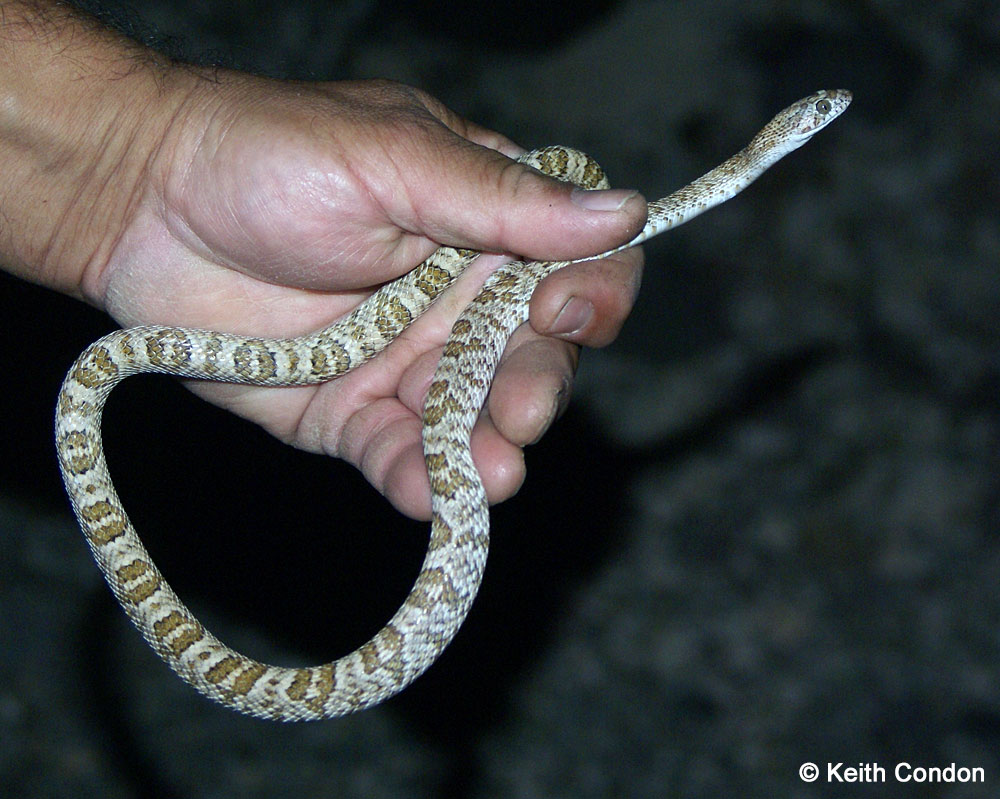
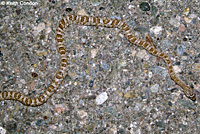
| Adult, eastern Imperial County desert © Keith Condon |
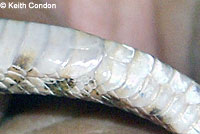
The same adult snake shown to the left, showing the divided anal plate characteristic of this species (but sometimes found on a similar species found in western California:
T. lyrophanes.) © Keith Condon |
| |
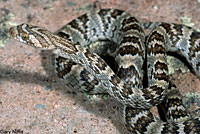
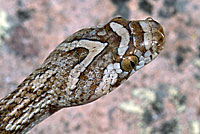
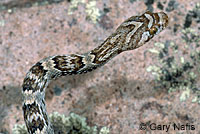
| Sonoran Lyresnakes from Outside California |
 |
 |
 |
| |
Adult, Santa Cruz County, Arizona |
|
 |
 |
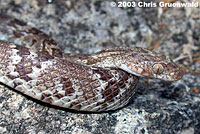 |
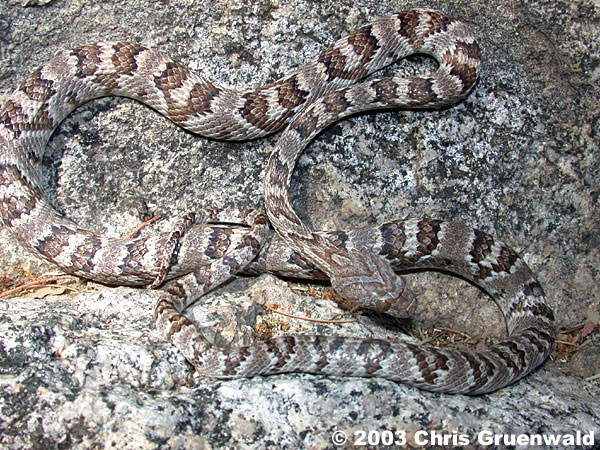
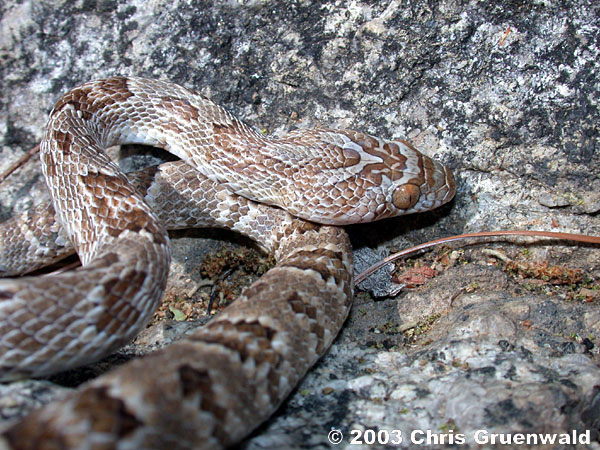
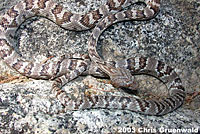
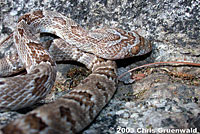
Adult, Arizona, © Chris Gruenwald
|
| |
 |
|
| |
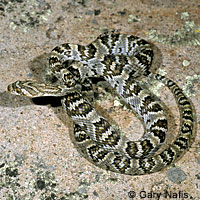
Adult, Santa Cruz County, Arizona |
|
| |
|
|
| Habitat |
 |
 |
|
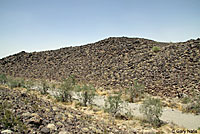
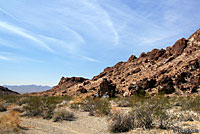
Possible habitat in Cralifornia, eastern
Imperial County
|
Possible habitat in California, Chemehuevi Mountains,
San Bernardino County |
|
|
|
|
|
Description |
Not Dangerous - This snake may produce a mild venom that does not typically cause death or serious illness or injury in most humans, but its bite should be avoided.
Commonly described as "harmless" or "not poisonous" to indicate that its bite is not dangerous, but "not venomous" is more accurate since the venom is not dangerous. (A poisonous snake can hurt you if you eat it. A venomous snake can hurt you if it bites you.)
The rear teeth on the upper jaw are enlarged and grooved to aid in injecting mild venom into prey, especially when the snake is allowed to chew, which helps to deliver more venom into the skin, so handle it with caution. Symptoms can include local swelling, redness, itching, and numbness, but the the effects are not systemic.
|
| Size |
Trimorphodon have been recorded from 18 - 47 3/4 inches in length (46 - 121 cm). Most snakes encountered are 24 - 36 inches long (61 - 91 cm).
|
| Appearance |
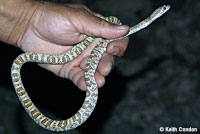
A slender snake with a broad head well-differentiated from the slim neck.
The pupils are vertical, like those of a cat.
The anal plate is divided. |
| Color and Pattern |
Coloring closely matches a snake's rocky habitat, from gray to light brown.
There are usually about 28 large dorsal blotches with light edges and a pale crossbar in the center, and smaller irregular blotches on the lower sides.
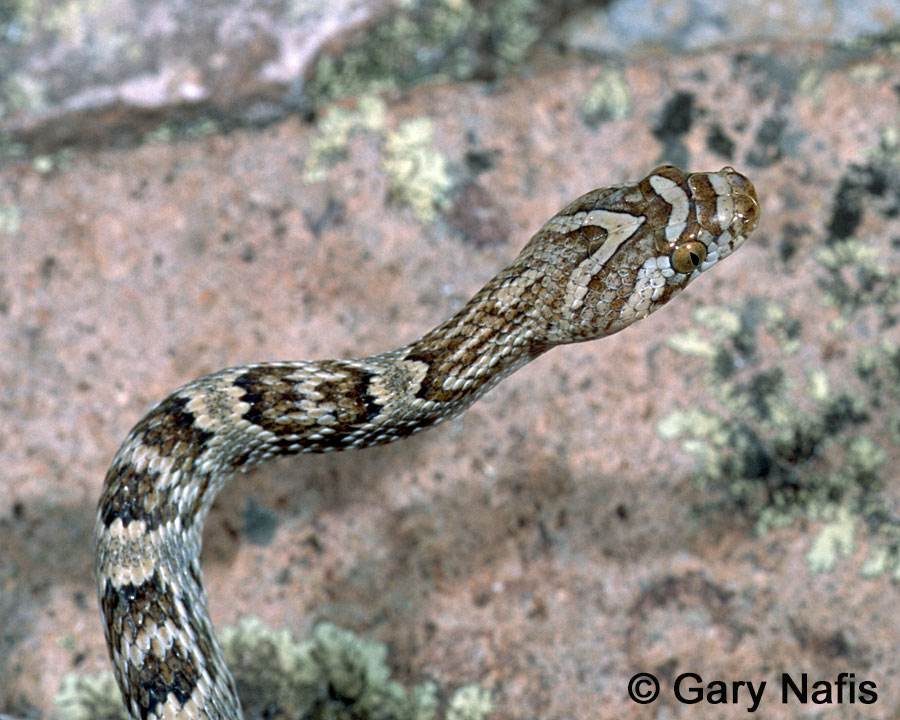
A lyre-shaped marking is present on top of the head.
The underside is off-white or yellowish with dark spots.
|
| Comparison of the Two Species of Lyresnake Found in California |
Sonoran Lyresnake - Trimorphodon lambda
Has fewer body blotches than T. lyrophanes.
(Fewer than 31 primary dark body blotches - average of 24.)
Body blotches are more widely separated than those on T. lyrophanes.
(The seventh and eighth blotches are separated by an average of four scale rows.)
The anal scale is divided.
California Lyresnake - Trimorphodon lyrophanes
Has a greater number of body blotches than T. lambda.
(Fewer than 48 primary dark body blotches - (average of 34.)
Body blotches are more narrowly separated than those on T. lambda.
(The seventh and eighth blotches are separated by an average of two scale rows.)
The anal scale is divided or undivided (entire).
(From Devitt et al, 2008 * See more detailed information here.)
|
| Life History and Behavior |
Activity |
| Nocturnal, active in very dry conditions as well as during rains. Terrestrial, and good climbers. This snake often searches rock crevices for prey. It can be found during the day inside crevices in large rock outcrops, as well as crossing desert roads at night. |
| Defense |
| When threatened, a lyresnake will sometimes vibrate its tail similar to the behavior of a rattlesnake. Sometimes it will raise up the front of its body and strike. |
| Diet and Feeding |
| Primarily lizards, but also known to eat small mammals, nestling birds, and snakes. |
| Reproduction |
Not well known.
Breeding probably takes place in Spring .
Females are oviparous, laying a clutch of 10 or more eggs in Summer which hatch in late Summer and early Fall.
|
| Habitat |
Associated primarily with rocky desert locations, but found in rockless areas, also.
|
| Geographical Range |
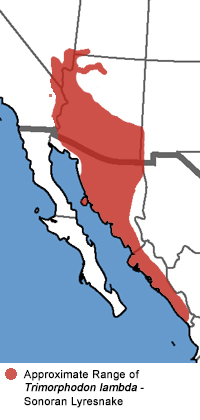
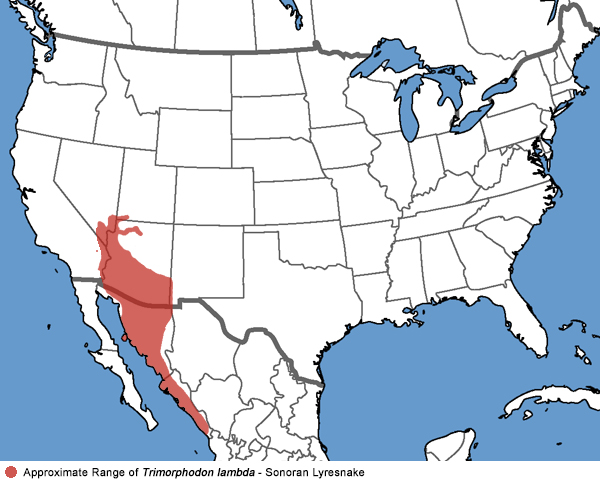
In California, found only in the southeast along the Colorado River from the Baja California border north into San Bernardino County and the Nevada border. A specimen identified as T. lambda was found in the Providence Mountains, but it is not known if the species ranges any farther west in San Bernardino County. Specimens identified as T. lyrophanes have been recorded from a few miles to the west of that location near the Granite Mountains, the Kelso Dunes, and the Bristol Mountains.
Devitt et al 2008 * described the entire range of Trimorphodon lyrophanes:
Found throughout most of the Baja California Peninsula and on Cerralvo, Danzante, San Jose´, San Marcos, and Tiburon islands; in southern California generally west of the Salton Trough region north to the vicinity of Los Angeles on the coast, and inland in the Mohave Desert north to the Argus and Amargosa mountains in Inyo County."
|
In his 2006 study ** Thomas Devitt did not sample any specimens west or east of the Salton Sea in the apparent contact area, or any specimens along the Colorado River in California. He used no specimens of T. lambda from California at all, as you can see in the map detail taken from the study to the right. This leaves me uncertain as to exactly where the contact zone exists between T. lambda and T. lyrophanes. I have found no museum records which are identified down to subspecies that help. In the range maps shown in field guides from those authors who recognize the two species (or former subspecies) the area of contact is shown in more than one place; some show T. lyrophanes ranging all the way east to the Colorado River, others show its range ending somewhere northeast of the Salton Sea in Riverside County, and another shows it ranging even farther west. I have chosen to show the two species meeting west of the river in Riverside County, following Devitt's 2006 map, but I will change this if I find more accurate information. (Please let me know if you discover any new papers published on Trimorphodon taxonomy.)
The northern range of T. lambda is also uncertain. While the maps in Devitt et al 2008 and in Devitt 2006 show the species ranging north and west of the Colorado River into Nevada somewhere above Needles, as I have done, some maps show it ranging only as far north as the Whipple Mountains/Parker Dam area, and I can find no museum or other records of Trimorphodon consistent with either interpretation, (or even any farther north than Riverside County in that area.) |
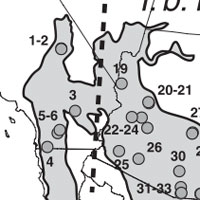
From Devitt 2006** |
|
 |
| Notes on Taxonomy |
Devitt et al 2008 * recommended that the subspecies of Trimorphodon biscutatus - lambda, lyrophanes, and vilkinsonii, be recognized as distinct species - Trimorphodon lambda, Trimorphodon lyrophanes, and Trimorphodon vilkinsonii. They recommended that the common names be Peninsular Lyresnake for T. lyrophanesand Sonoran Lyresnake for T. lambda.
This species was formerly regarded as a subspecies of Trimorphodon biscutatus: T. b. lambda - Sonoran Lyresnake.
According to The Reptile Database (4/23) there are currently seven distinct species of Trimorphodon.
Alternate and Previous Names (Synonyms)
Trimorphodon lambda - Sonoran Lyre Snake (Stebbins & McGinnis 2012)
Trimorphodon biscutatus - Western Lyre Snake (Stebbins 2003)
Trimorphodon biscutatus lambda - Sonoran Lyre Snake (Stebbins 1985)
Trimorphodon lambda - Sonora Lyre Snake (Stebbins 1966)
Trimorphodon lambda - Arizona Lyre Snake (Stebbins 1954)
Trimorphodon lambda - Sonoran Lyre Snake (Cope 1886)
|
| Conservation Issues (Conservation Status) |
| None |
|
| Taxonomy |
| Family |
Colubridae |
Colubrids |
Oppel, 1811 |
| Genus |
Trimorphodon |
Lyresnakes |
Cope, 1861 |
Species
|
lambda |
Sonoran Lyresnake |
Cope, 1886 |
|
Original Description |
Trimorphodon lambda - Cope, 1886
from Original Description Citations for the Reptiles and Amphibians of North America © Ellin Beltz
|
|
Meaning of the Scientific Name |
Trimorphodon - Greek - tri - three, and morph - shape, and odon- teeth - refers to the 3 tooth shapes in the upper jaw, recurved anterior teeth; the shorter middle teeth, and elongate grooved fangs at the rear.
lambda - Greek - letter of Greek alphabet - refers to the chevron-shaped mark on head
from Scientific and Common Names of the Reptiles and Amphibians of North America - Explained © Ellin Beltz
|
|
Related or Similar California Snakes |
T. lyrophanes - Baja California Lyresnake
Sonoran Gopher Snake
Desert Glossy Snake
|
|
More Information and References |
California Department of Fish and Wildlife
Stebbins, Robert C., and McGinnis, Samuel M. Field Guide to Amphibians and Reptiles of California: Revised Edition (California Natural History Guides) University of California Press, 2012.
Stebbins, Robert C. California Amphibians and Reptiles. The University of California Press, 1972.
Flaxington, William C. Amphibians and Reptiles of California: Field Observations, Distribution, and Natural History. Fieldnotes Press, Anaheim, California, 2021.
Samuel M. McGinnis and Robert C. Stebbins. Peterson Field Guide to Western Reptiles & Amphibians. 4th Edition. Houghton Mifflin Harcourt Publishing Company, 2018.
Stebbins, Robert C. A Field Guide to Western Reptiles and Amphibians. 3rd Edition. Houghton Mifflin Company, 2003.
Behler, John L., and F. Wayne King. The Audubon Society Field Guide to North American Reptiles and Amphibians. Alfred A. Knopf, 1992.
Powell, Robert., Joseph T. Collins, and Errol D. Hooper Jr. A Key to Amphibians and Reptiles of the Continental United States and Canada. The University Press of Kansas, 1998.
Bartlett, R. D. & Patricia P. Bartlett. Guide and Reference to the Snakes of Western North America (North of Mexico) and Hawaii. University Press of Florida, 2009.
Bartlett, R. D. & Alan Tennant. Snakes of North America - Western Region. Gulf Publishing Co., 2000.
Brown, Philip R. A Field Guide to Snakes of California. Gulf Publishing Co., 1997.
Ernst, Carl H., Evelyn M. Ernst, & Robert M. Corker. Snakes of the United States and Canada. Smithsonian Institution Press, 2003.
Wright, Albert Hazen & Anna Allen Wright. Handbook of Snakes of the United States and Canada. Cornell University Press, 1957.
* Devitt, Thomas J., Travis J. LaDuc, and Jimmy A. McGuire. The Trimorphodon biscutatus (Squamata: Colubridae) Species Complex Revisited: A Multivariate Statistical Analysis of Geographic Variation. Copeia. 2008 (2): 370-387.
** Devitt, T. J. Phylogeography of the Western Lyresnake (Trimorphodon biscutatus): testing aridland biogeographi- cal hypotheses across the Nearctic–Neotropical transition. Molecular Ecology 2006 15:4387–4407.
Clinical Toxinology Resources - The University of Adelaide, Australia, accessed 12/19.
|
|
|
The following conservation status listings for this animal are taken from the January 2024 State of California Special Animals List and the January 2024 Federally Listed Endangered and Threatened Animals of California list (unless indicated otherwise below.) Both lists are produced by multiple agencies every year, and sometimes more than once per year, so the conservation status listing information found below might not be from the most recent lists. To make sure you are seeing the most recent listings, go to this California Department of Fish and Wildlife web page where you can search for and download both lists:
https://www.wildlife.ca.gov/Data/CNDDB/Plants-and-Animals.
A detailed explanation of the meaning of the status listing symbols can be found at the beginning of the two lists. For quick reference, I have included them on my Special Status Information page.
If no status is listed here, the animal is not included on either list. This most likely indicates that there are no serious conservation concerns for the animal. To find out more about an animal's status you can also go to the NatureServe and IUCN websites to check their rankings.
This snake is not included on the Special Animals List, which indicates that there are no significant conservation concerns for it in California.
|
| Organization |
Status Listing |
Notes |
| NatureServe Global Ranking |
|
|
| NatureServe State Ranking |
|
|
| U.S. Endangered Species Act (ESA) |
None |
|
| California Endangered Species Act (CESA) |
None |
|
| California Department of Fish and Wildlife |
None |
|
| Bureau of Land Management |
None |
|
| USDA Forest Service |
None |
|
| IUCN |
|
|
|
|

 Orange: Range of this species in California