|
 |
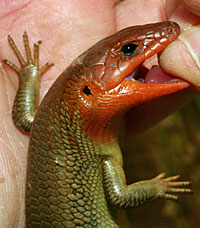 |
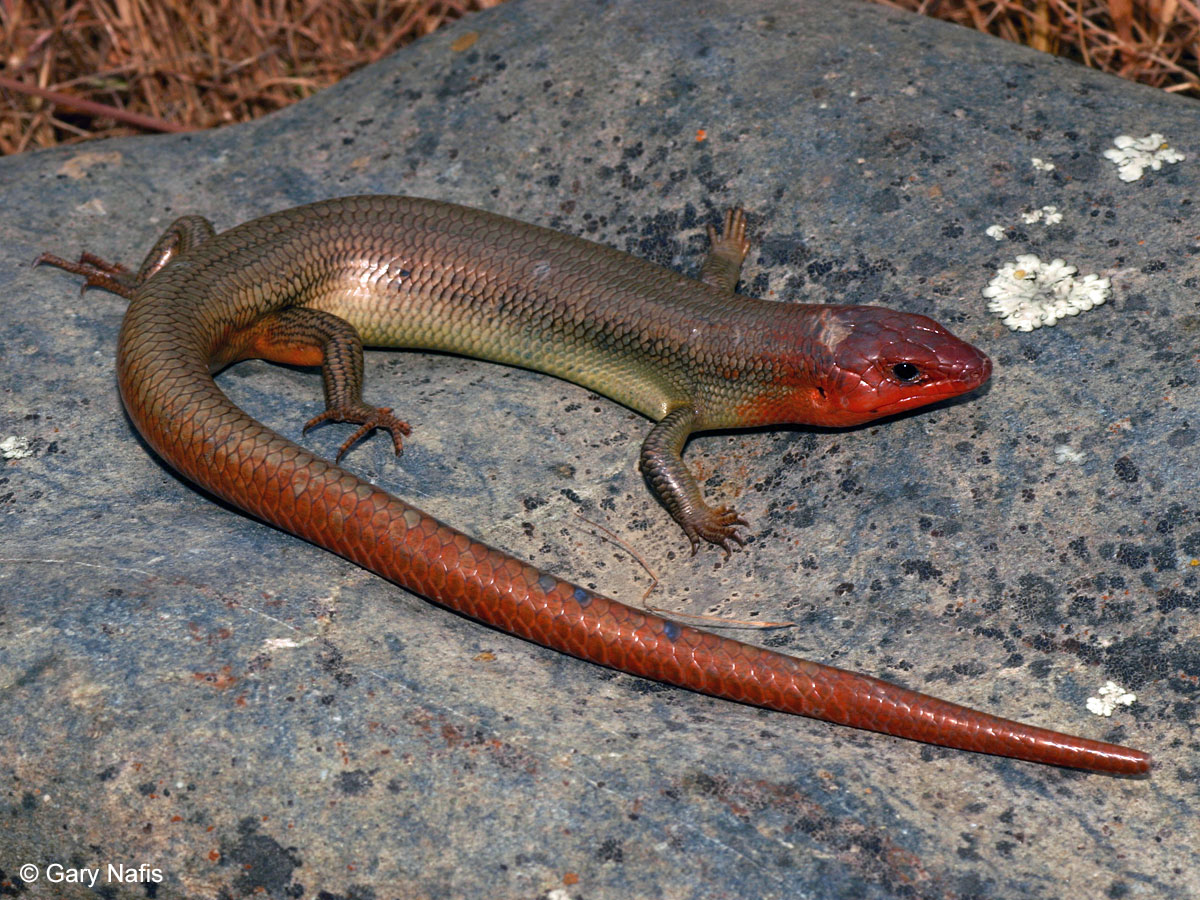
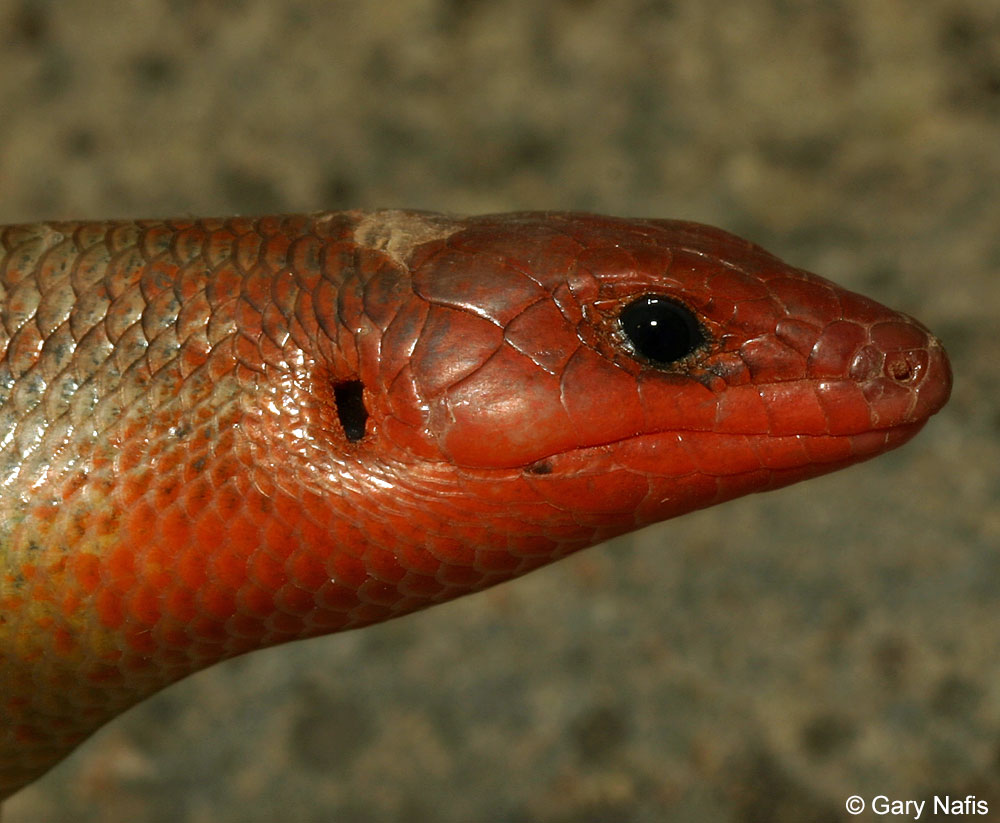
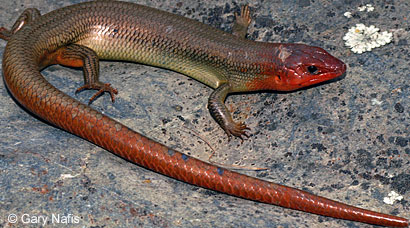
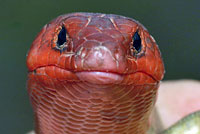
| Adult Male during breeding season, Yuba County |
 |
 |
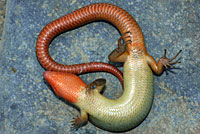 |
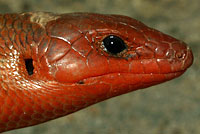
| Adult Male during breeding season, Yuba County |
 |
 |
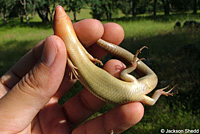 |
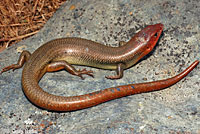
| Adult Male, Yuba County |
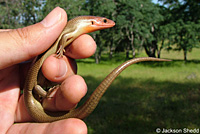
Adult, Yuba County © 2005 Jackson Shedd, courtesy of John Stephenson |
 |
 |
 |
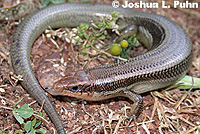
| Adult, © Joshua L. Puhn |
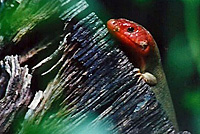
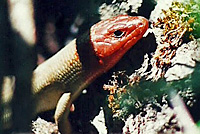
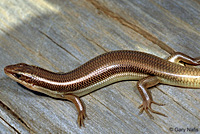
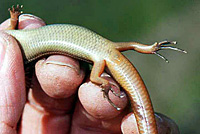
Red-headed breeding adult males, 1,300 ft. El Dorado County |
 |
 |
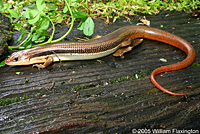 |
| Sub-adult, 1,000 ft., El Dorado County |
Adult, El Dorado County
© 2005 William Flaxington
|
 |
 |
 |
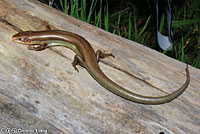
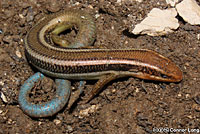
Adult, Sacramento County
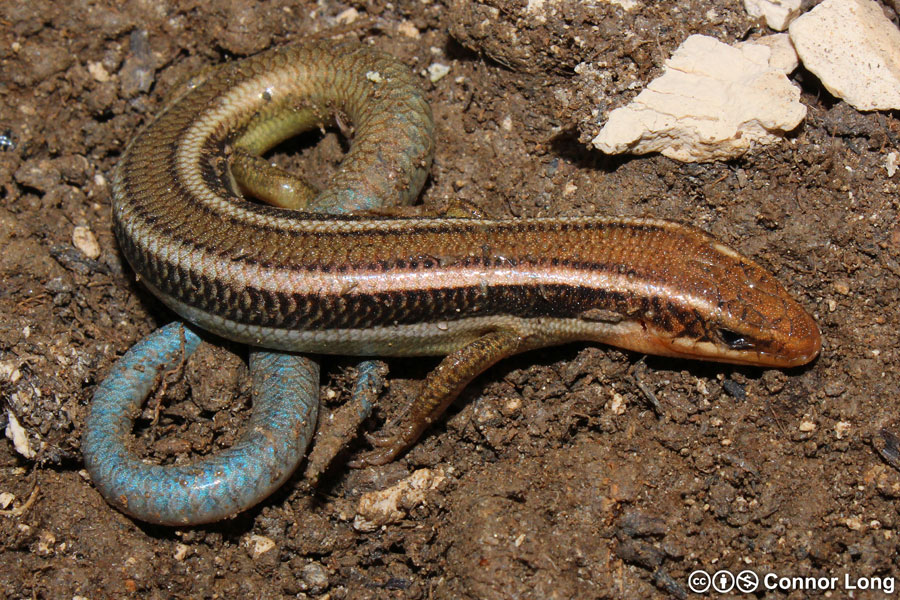
© Connor Long |
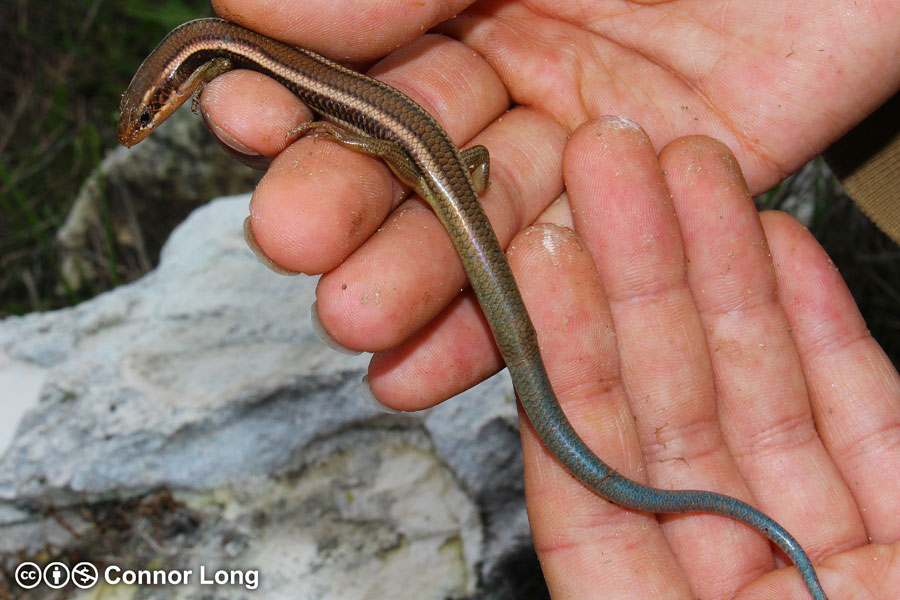
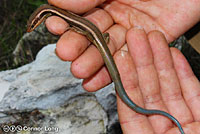
Sub-adult, Sacramento County © Connor Long |
 |
 |
 |
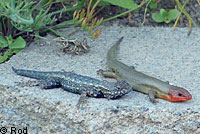
This adult male Northwestern Fence Lizard and adult male Greater Brown Skink were photographed basking together in Placer County in late April
© Rod |
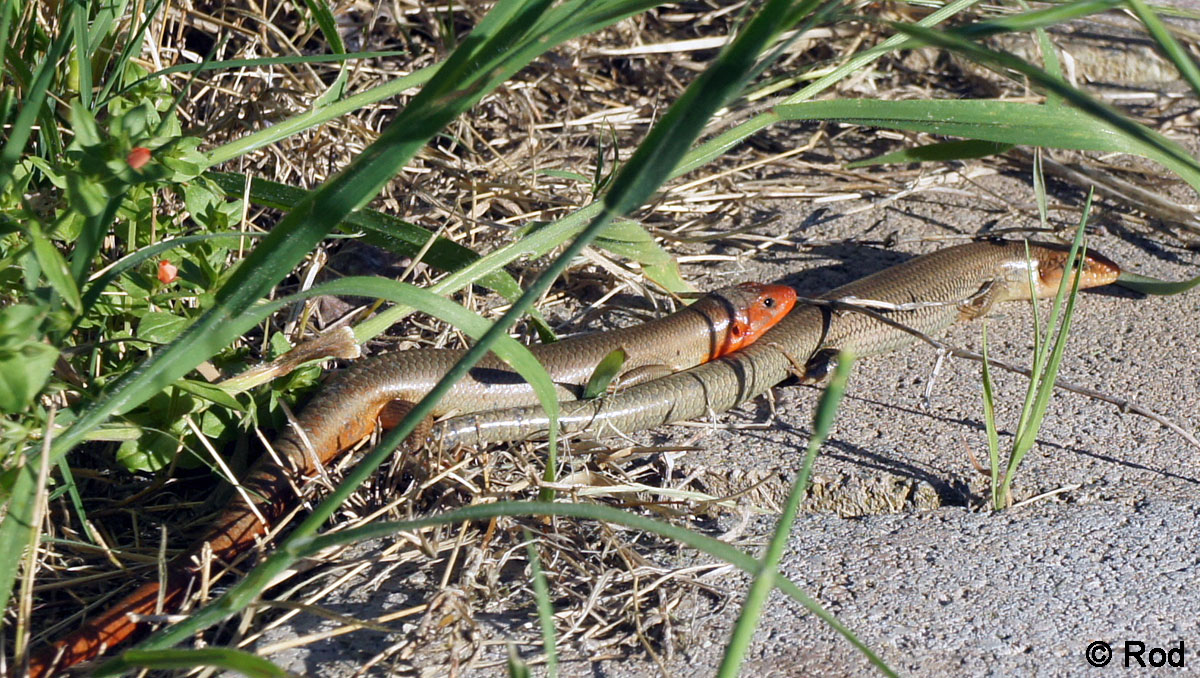
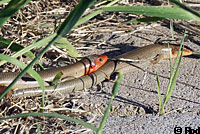
A Placer County adult male (left) appears to be courting an adult female (right) in the early May breeding season.
© Rod |
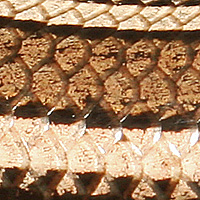
Toothy Skinks, genus Plestiodon, have smooth shiny cycloid scales that are reinforced with bone. Plestiodon skiltonianus is shown here. |
| |
|
|
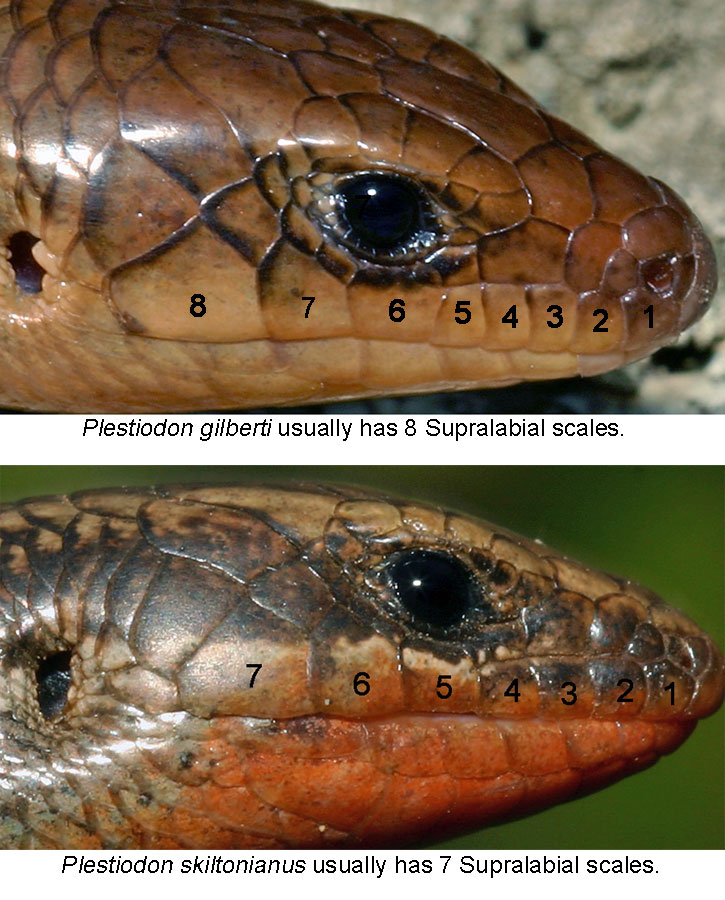
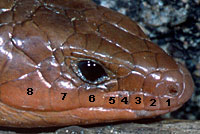
| Comparison of Gilbert's Skinks with Western Skinks (Plestiodon gilberti and Plestiodon skiltonianus) |
 |
 |
|
Gilbert's Skinks usually have 8 supralabial scales.
Compare with Western Skinks which usually have 7 supralabials. |
Note that the dark stripes on the sides of the tail on juvenile Gilbert's skinks do not extend far onto the tail past the rear leg as they do on the Western Skink.
Compare the two species
More information about the differences between Gilbert's Skinks and Western Skinks. |
|
| |
|
|
| Habitat |
 |
 |
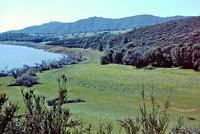 |
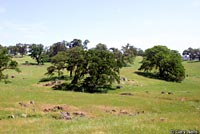
| Habitat, Yuba County |
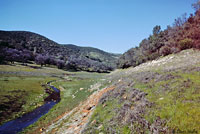
Habitat, 1,000 ft., El Dorado County |
Habitat, 1,000 ft., El Dorado County |
| |
|
|
| Short Videos |
 |
 |
|
| A sub-adult Western Red-tailed Skink shows the quick serpentine movement of a small skink. Skinks are masters at diving into grass and disappearing. This video opens with the skink wriggled into some grass roots to hide. |
Gilbert's Skinks, like this Western Red-tailed Skink, drop their tails to distract predators. The trick worked on me - I filmed the tail and its writhing distracting motion, some of which you can see here. |
|
|
|
|
| Description |
| |
| Size |
2.5 - 4.5 inches long from snout to vent (6.3 - 11.4 cm).
Tail can be up to nearly 2 times the body length.
|
| Appearance |
A large skink with a heavy body, small head, thick neck, small legs, and a smooth, shiny body with cycloid scales.
The tongue is forked, and is frequently protruded.
The long tail is easily detached. |
| Color and Pattern |
Adult coloring is olive or light brown with darker edging around the scales, and sometimes the appearance of faded light and dark stripes.
Striping fades with age but it's retained longer than on E. g. gilberti.
The tail becomes orange on older adults. |
| Male / Female Differences |
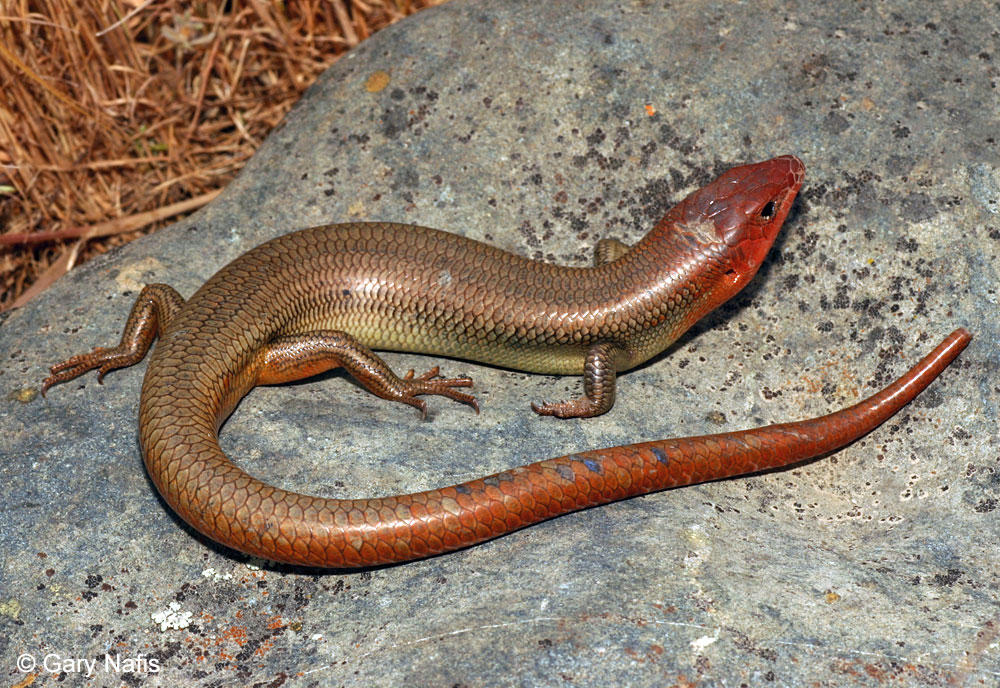
Males develop bright reddish-orange coloring on the head during the breeding season.
Females are smaller than males. |
| Young |
Young look very much like adult P. s. skiltonianus, with distinct light and dark stripes and a blue tail.
However, the dark stripe on the sides of young skinks usually extends only to near the base of the tail.
|
| Identifying Skinks in California - Differences between Western Skinks and Gilbert's Skinks (Plestiodon skiltonianus and Plestiodon gilberti) |
| |
| Life History and Behavior |
Activity |
| Found mostly under surface objects. Rarely found moving about on the ground in the open, however, they are active in the daytime and will occasionally be seen moving in grass, among rocks, or in leaf litter. Gilbert's Skinks are good burrowers, often constructing a shelter by burrowing under rocks and logs. |
| Defense |
The tail is easily broken off.
When detached, it writhes back and forth to distract a predator while the lizard escapes.
The lizard will grow a new tail.
The bright blue coloring on the tail of a juvenile skink tends to distract a predator from the main body of the lizard.
Sometimes only the blue tail can be seen as the lizard rushes through grass or leaves.
Occasionally the blue tail is mistaken for a small blue snake.
More information about tail loss and regeneration.
|
| Longevity |
| Lifespan is about 6 years or more. |
| Diet and Feeding |
| Primarily eats a variety of small ground-dwelling invertebrates, but as cannibalism has been reported, small vertebrates are probably occasionally consumed. |
| Reproduction |
Adult Gilbert Skinks become reproductive in their second year of age.
Not much is known about the timing of the breeding season. It varies based on location and elevation and local conditions.
Mating probably occurs in late spring through early summer, most likely from April to June.
Females lay a single clutch of eggs per year in summer, typically from June to August, containing from 3 to 9 eggs.
The eggs are buried in loose moist soil, often under flat stones or in rotting logs.
Females are thought to stay with the eggs to guard them as female Western Skinks do. Maternal care such as this is rare in lizards.
Eggs probably hatch in late Summer, but hatchlings have also been observed as early as May.
|
| Habitat |
Grassland, chaparral, woodlands, and pine forests. Prefers areas where moisture is present nearby.
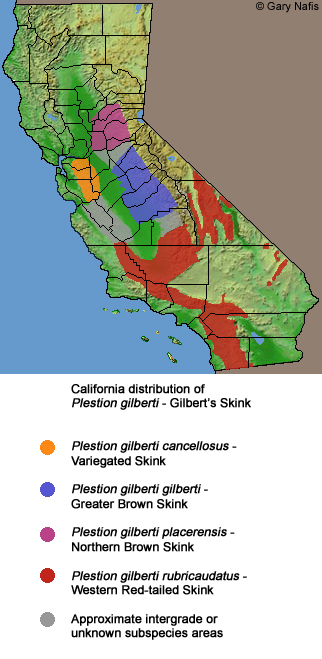
Found in the foothills and middle elevations of the northern Sierra Nevada Mountains south of the Yuba River.
|
| Geographical Range |
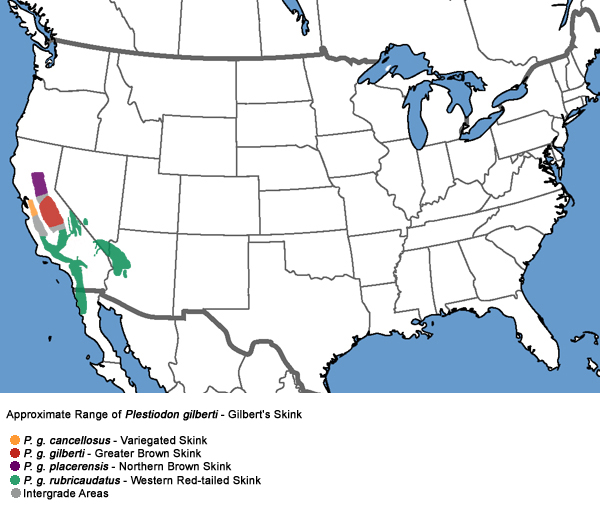
This subspecies is endemic to California in foothills and middle elevations of northern Sierra Nevada Mountains south of the Yuba River.
The species Plestiodon gilberti ranges from the northern Sierra Nevada foothills from south of the Yuba River through the southern Sierra Nevada, and south through the coast ranges, and the southern interior and mountains, into northern Baja California. Also found in isolated regions east of the Sierras along the Nevada border and into Nevada, and in the southern tip of Nevada into western Arizona.
The first Yuba country record for this species was documented in 2015: "...this report places Plestiodon gilberti west of the Sacramento River and north of the Sacramento-San Joaquin Delta, two significant hydrological impediments to dispersal in respect to known Sierra Nevada populations to the east and coastal populations to the south."
Hubbs & Hinds, Herpetological Review 46(4), 2015
|
 |
| Elevational Range |
From sea level to 7,300 ft. (2.220 m).
|
| Notes on Taxonomy |
Four subspecies of Plestiodon gilberti are currently recognized:
P. g. cancellosus - Variegated Skink
P. g. gilberti - Greater Brown Skink
P. g. placerensis - Northern Brown Skink
P. g. rubricaudatus - Western Red-tailed Skink
P. g. arizonensis - Arizona Skink - is a fifth subspecies that was formerly recognized in Yavapai County, Arizona.
Brandley et al. (2005 Syst. Biol. 54:373-390) replaced Eumeces with Plestiodon.
The Society for the Study of Amphibians and Reptiles adopted the use of Plestiodon in the sixth edition of their Scientific and Standard English Names of Amphibians and Reptiles of North America north of Mexico list.
"Richmond and Reeder (2002, Evolution 56: 1498-1513) presented evidence that populations previously referred to Eumeces gilberti represent three lineages that separately evolved large body size and the loss of stripes in late ontogenetic stages. Although they considered those three lineages to merit species recognition, they did not propose specific taxonomic changes in that paper. We have placed the name "gilberti" in quotation marks to indicate that it refers to a group composed of several species." *
* Herpetological Review 2003, 34(3), 196-203.
"Richmond and Reeder (2002, Evolution 56: 1498–1513) presented mtDNA evidence that populations previously referred to Plestiodon gilberti represent three lineages that separately evolved large body size and the loss of stripes in late ontogenetic stages. Although they considered those three lineages to merit species recognition, they did not propose speci c taxonomic changes, and subsequently Richmond and Jockusch (2007, Proc. Roy. Soc. Lond. B 274: 1701–1708) and Richmond et al. (2011, Am. Nat. 178: 320–332) have treated them as a single species based on extensive introgressive hybridization between two of the forms and the lack of prezygotic isolation between members of all pairs of them. The results of Richmond and Reeder (2002, op. cit.) contradict the recognition of P. g. arizonensis, which is not differentiated from P. g. rubricaudatus and therefore has been eliminated from this list, and indicate the existence of an unnamed and at least partially separate lineage within P. g. rubricaudatus (their Inyo clade). " **
** Comments under P. gilberti in the Society for the Study of Amphibians and Reptiles SSAR Herpetological Circular No. 43, 2017.
Alternate and Previous Names (Synonyms)
Eumeces gilberti placerensis - Northern Brown Skink (Stebbins 1966, 2003)
Eumeces gilberti placerensis - Glazed Skink (Smith 1946)
|
| Conservation Issues (Conservation Status) |
| None |
|
|
Taxonomy |
| Family |
Scincidae |
Skinks |
Gray, 1825 |
| Genus |
Plestiodon (formerly Eumeces) |
Toothy Skinks |
Duméril and Bibron, 1839 |
| Species |
gilberti |
Gilbert's Skink |
(Van Denburgh, 1896) |
Subspecies
|
placerensis |
Northern Brown Skink |
(Rodgers, 1944) |
|
Original Description |
Eumeces gilberti - Van Denburgh, 1896 - Proc. California Acad. Sci., Ser. 2, Vol. 6, p. 350
Eumeces gilberti placerensis - Rodgers, 1944 - Copeia, p. 101, figs. 1-2
from Original Description Citations for the Reptiles and Amphibians of North America © Ellin Beltz
Eponyms
First described by Van Denburgh in 1896, the specific name "Plestiodon gilberti" and the species common name "Gilbert's Skink" honor Van Denburgh's Stanford University teacher Charles Henry Gilbert (1859-1928), an American ichthyologist.
See: Biographies of Persons Honored in the Herpetological Nomenclature © Ellin Beltz
|
|
Meaning of the Scientific Name |
(Eumeces - Greek - eu- good or nice and mekos length or height)
Plestiodon = ?
gilberti - honors Gilbert, Charles H.
placerensis - belonging to Placer County, CA - refers to the area of distribution
from Scientific and Common Names of the Reptiles and Amphibians of North America - Explained © Ellin Beltz
|
|
Related or Similar California Lizards |
P. g. cancellosus - Variegated Skink
P. g. gilberti - Greater Brown Skink
P. g. rubricaudatus - Western Red-tailed Skink
P. s. interparietalis - Coronado Skink
P. s. skiltonianus - Skilton's Skink
|
|
More Information and References |
California Department of Fish and Wildlife
Stebbins, Robert C., and McGinnis, Samuel M. Field Guide to Amphibians and Reptiles of California: Revised Edition (California Natural History Guides) University of California Press, 2012.
Stebbins, Robert C. California Amphibians and Reptiles. The University of California Press, 1972.
Flaxington, William C. Amphibians and Reptiles of California: Field Observations, Distribution, and Natural History. Fieldnotes Press, Anaheim, California, 2021.
Samuel M. McGinnis and Robert C. Stebbins. Peterson Field Guide to Western Reptiles & Amphibians. 4th Edition. Houghton Mifflin Harcourt Publishing Company, 2018.
Stebbins, Robert C. A Field Guide to Western Reptiles and Amphibians. 3rd Edition. Houghton Mifflin Company, 2003.
Behler, John L., and F. Wayne King. The Audubon Society Field Guide to North American Reptiles and Amphibians. Alfred A. Knopf, 1992.
Powell, Robert., Joseph T. Collins, and Errol D. Hooper Jr. A Key to Amphibians and Reptiles of the Continental United States and Canada. The University Press of Kansas, 1998.
Bartlett, R. D. & Patricia P. Bartlett. Guide and Reference to the Turtles and Lizards of Western North America (North of Mexico) and Hawaii. University Press of Florida, 2009.
Jones, Lawrence, Rob Lovich, editors. Lizards of the American Southwest: A Photographic Field Guide. Rio Nuevo Publishers, 2009.
Smith, Hobart M. Handbook of Lizards, Lizards of the United States and of Canada. Cornell University Press, 1946.
|
|
|
The following conservation status listings for this animal are taken from the January 2024 State of California Special Animals List and the January 2024 Federally Listed Endangered and Threatened Animals of California list (unless indicated otherwise below.) Both lists are produced by multiple agencies every year, and sometimes more than once per year, so the conservation status listing information found below might not be from the most recent lists. To make sure you are seeing the most recent listings, go to this California Department of Fish and Wildlife web page where you can search for and download both lists:
https://www.wildlife.ca.gov/Data/CNDDB/Plants-and-Animals.
A detailed explanation of the meaning of the status listing symbols can be found at the beginning of the two lists. For quick reference, I have included them on my Special Status Information page.
If no status is listed here, the animal is not included on either list. This most likely indicates that there are no serious conservation concerns for the animal. To find out more about an animal's status you can also go to the NatureServe and IUCN websites to check their rankings.
This animal is not included on the Special Animals List, which indicates that there are no significant conservation concerns for it in California.
|
| Organization |
Status Listing |
Notes |
| NatureServe Global Ranking |
|
|
| NatureServe State Ranking |
|
|
| U.S. Endangered Species Act (ESA) |
None |
|
| California Endangered Species Act (CESA) |
None |
|
| California Department of Fish and Wildlife |
None |
|
| Bureau of Land Management |
None |
|
| USDA Forest Service |
None |
|
| IUCN |
|
|
|
|